
HomeBlogSeasonal & Holiday Email Campaigns4th of July Email Marketing: 5 Proven Strategies
Seasonal & Holiday Email Campaigns

4th of July Email Marketing: 5 Proven Strategies

Drive holiday sales with strategic 4th of July email marketing. Learn timing, messaging, and offers that convert during peak shopping season.

P

Priya Kapoor

April 27, 2026

13 min read
HomeBlogSeasonal & Holiday Email Campaigns4th of July Email Marketing: 5 Proven Strategies
Seasonal & Holiday Email Campaigns

4th of July Email Marketing: 5 Proven Strategies

Drive holiday sales with strategic 4th of July email marketing. Learn timing, messaging, and offers that convert during peak shopping season.

P

Priya Kapoor

April 27, 2026

13 min read
Share:
Share:
#Holiday Email Marketing#Campaign Strategy#Seasonal Promotions#Email Best Practices
Illustration for 4th of july email marketing

Stay in the loop

Get the latest posts delivered straight to your inbox. No spam, unsubscribe anytime.

The holiday spending data and campaign strategy information I need is now well in hand. Let me compose the article.

The 4th of July is one of the most purchase-ready moments on the American calendar, and most brands underuse it. Of the nearly 296 million Americans who celebrated Independence Day in 2024, 91% shopped in preparation for the holiday. Americans spent an estimated $13.3 billion on food and beverages alone for the Fourth of July 2024. That spending window is short and competitive, which means your email marketing has to work harder and smarter than a generic blast.

This guide covers five strategies that make 4th of July email marketing campaigns cut through the inbox noise, drive opens, and convert subscribers into buyers.


Key Takeaways

  • 91% of 4th of July celebrants shopped in 2024, and 95% of 2025 celebrators intend to make a purchase, making this one of the highest-intent holiday windows of the year.
  • Engagement peaks before the holiday. Data shows the Thursday preceding July 4th often sees very high email opens, while opens drop sharply on the day itself.
  • Marketers have noted a 760% increase in revenue from segmented campaigns, according to Campaign Monitor research, making list segmentation a non-negotiable for any holiday send.
  • Subject lines with emotional triggers related to urgency and excitement can increase open rates by 14% to 20%.
  • A three-email cadence (teaser, main offer, last chance) consistently outperforms single-send campaigns for time-bounded holiday promotions.

Why 4th of July Email Marketing Deserves a Real Strategy

Most brands treat Independence Day as a one-and-done send. A patriotic banner, a discount code, a broad blast to the full list. That approach leaves significant revenue on the table.

Eighty-six percent of consumers plan to celebrate the Fourth of July in 2025 and spend an average of $92.44 on food items. Beyond food, the spending extends to fireworks, apparel, home goods, travel, and services. Most consumers plan well ahead, with 74% starting their holiday shopping at least one week in advance in 2024, and an even higher 77% expected to do so in 2025.

That means your campaign window is not July 4th itself. It is the ten to fourteen days before it.

Stay in the loop

Get the latest posts delivered straight to your inbox. No spam, unsubscribe anytime.

The holiday spending data and campaign strategy information I need is now well in hand. Let me compose the article.

The 4th of July is one of the most purchase-ready moments on the American calendar, and most brands underuse it. Of the nearly 296 million Americans who celebrated Independence Day in 2024, 91% shopped in preparation for the holiday. Americans spent an estimated $13.3 billion on food and beverages alone for the Fourth of July 2024. That spending window is short and competitive, which means your email marketing has to work harder and smarter than a generic blast.

This guide covers five strategies that make 4th of July email marketing campaigns cut through the inbox noise, drive opens, and convert subscribers into buyers.


Key Takeaways

  • 91% of 4th of July celebrants shopped in 2024, and 95% of 2025 celebrators intend to make a purchase, making this one of the highest-intent holiday windows of the year.
  • Engagement peaks before the holiday. Data shows the Thursday preceding July 4th often sees very high email opens, while opens drop sharply on the day itself.
  • Marketers have noted a 760% increase in revenue from segmented campaigns, according to Campaign Monitor research, making list segmentation a non-negotiable for any holiday send.
  • Subject lines with emotional triggers related to urgency and excitement can increase open rates by 14% to 20%.
  • A three-email cadence (teaser, main offer, last chance) consistently outperforms single-send campaigns for time-bounded holiday promotions.

Why 4th of July Email Marketing Deserves a Real Strategy

Most brands treat Independence Day as a one-and-done send. A patriotic banner, a discount code, a broad blast to the full list. That approach leaves significant revenue on the table.

Eighty-six percent of consumers plan to celebrate the Fourth of July in 2025 and spend an average of $92.44 on food items. Beyond food, the spending extends to fireworks, apparel, home goods, travel, and services. Most consumers plan well ahead, with 74% starting their holiday shopping at least one week in advance in 2024, and an even higher 77% expected to do so in 2025.

That means your campaign window is not July 4th itself. It is the ten to fourteen days before it.

Email marketing generates between $36 and $40 for every dollar spent, and a focused holiday campaign with proper segmentation and timing can substantially outperform that average. The strategies below are grounded in how real consumers behave around the holiday.


Strategy 1: Build a Three-Email Cadence, Not a Single Send

A single email on July 3rd or 4th is not a campaign. It is a missed opportunity. A sequenced approach lets you build anticipation, deliver the core offer, and recover missed conversions.

Start early, 7 to 10 days before July 4th, and send at least one or two reminders. Plan a teaser email for the week before, a main offer just before the holiday, and a "last chance" email on July 4th or immediately after.

Here is a practical three-email structure:

  1. Teaser (7-10 days before): Build curiosity. Hint at the offer without revealing everything. Create a reason to watch the inbox.
  2. Main campaign (2-3 days before): Full offer reveal with your strongest creative, clearest CTA, and any urgency mechanics like countdown timers.
  3. Last chance (July 4th morning or July 5th): Many consumers are still in vacation mode or catching up on emails they missed during celebrations, making this a strategic time to reach them with final offers.

When you send a series of emails, it gradually builds excitement and anticipation. Consider the first email as a teaser, followed by specific promotions.

The July 5th send deserves special attention. The Honest Company sent a last-chance email on the morning of July 5, a smart move because customers loyal enough to subscribe might want some extra time, especially during a holiday when so many are traveling and relaxing.


Strategy 2: Nail Your Send Timing Around the Holiday

Timing is where many 4th of July email campaigns fail before the subject line even matters.

Do not send important campaigns on July 4th itself, as open rates will be very low. Instead, send holiday promotions 1-2 weeks prior, or align with the next business week.

More specifically, data indicates the Thursday preceding July 4th often has very high opens as people prepare for the holiday. On July 4th itself, opens drop off sharply. Plan major sends before the holiday and allow a brief pause on the day of.

For the sends you do schedule, general best practice points to late morning as a reliable window. A January 2025 MailerLite analysis revealed that Monday campaigns often achieve above-average open rates, while Klaviyo's 2024 ecommerce data points to mid-week as yielding the highest open and click rates.

However, your specific audience data should override any general benchmark. Run your own A/B tests on send times during the lead-up to the campaign. A/B testing different send times allows you to gather proprietary data on when your subscribers are most likely to open and click, leading to truly optimized performance.


Strategy 3: Segment Your List Before You Write a Single Word

Email marketing generates between $36 and $40 for every dollar spent, and a focused holiday campaign with proper segmentation and timing can substantially outperform that average. The strategies below are grounded in how real consumers behave around the holiday.


Strategy 1: Build a Three-Email Cadence, Not a Single Send

A single email on July 3rd or 4th is not a campaign. It is a missed opportunity. A sequenced approach lets you build anticipation, deliver the core offer, and recover missed conversions.

Start early, 7 to 10 days before July 4th, and send at least one or two reminders. Plan a teaser email for the week before, a main offer just before the holiday, and a "last chance" email on July 4th or immediately after.

Here is a practical three-email structure:

  1. Teaser (7-10 days before): Build curiosity. Hint at the offer without revealing everything. Create a reason to watch the inbox.
  2. Main campaign (2-3 days before): Full offer reveal with your strongest creative, clearest CTA, and any urgency mechanics like countdown timers.
  3. Last chance (July 4th morning or July 5th): Many consumers are still in vacation mode or catching up on emails they missed during celebrations, making this a strategic time to reach them with final offers.

When you send a series of emails, it gradually builds excitement and anticipation. Consider the first email as a teaser, followed by specific promotions.

The July 5th send deserves special attention. The Honest Company sent a last-chance email on the morning of July 5, a smart move because customers loyal enough to subscribe might want some extra time, especially during a holiday when so many are traveling and relaxing.


Strategy 2: Nail Your Send Timing Around the Holiday

Timing is where many 4th of July email campaigns fail before the subject line even matters.

Do not send important campaigns on July 4th itself, as open rates will be very low. Instead, send holiday promotions 1-2 weeks prior, or align with the next business week.

More specifically, data indicates the Thursday preceding July 4th often has very high opens as people prepare for the holiday. On July 4th itself, opens drop off sharply. Plan major sends before the holiday and allow a brief pause on the day of.

For the sends you do schedule, general best practice points to late morning as a reliable window. A January 2025 MailerLite analysis revealed that Monday campaigns often achieve above-average open rates, while Klaviyo's 2024 ecommerce data points to mid-week as yielding the highest open and click rates.

However, your specific audience data should override any general benchmark. Run your own A/B tests on send times during the lead-up to the campaign. A/B testing different send times allows you to gather proprietary data on when your subscribers are most likely to open and click, leading to truly optimized performance.


Strategy 3: Segment Your List Before You Write a Single Word

Sending the same Independence Day campaign to every subscriber on your list is one of the fastest ways to generate unsubscribes and suppress engagement. Segmentation is the foundation of effective 4th of July email marketing.

Marketers have noted a 760% increase in revenue from segmented campaigns, according to Campaign Monitor research. That number is not a function of more sophisticated writing. It reflects the compounding value of relevance.

For a July 4th campaign, the most actionable segments to build are:

  • Purchase history: Customers who bought seasonal or outdoor products from you before respond differently than first-time buyers or cold subscribers.
  • Engagement tier: Recent openers and clickers should get your best offer. Inactive subscribers may need a re-engagement angle or a softer send.
  • Geographic location: Segmenting your audience based on purchase history and engagement lets you deliver personalized VIP experiences. Geographic segmentation is equally valuable if you have physical locations or region-specific inventory.
  • Loyalty tier: The 4th of July presents a perfect opportunity to recognize and reward your most valuable customers. Creating special offers exclusively for loyal customers not only drives revenue but also strengthens emotional connections with your brand.

For a deeper framework on building these segments before a holiday push, the guide on email list segmentation strategies that boost ROI by 760% covers the mechanics in detail.

Segmented email campaigns had 100.95% more clicks compared to non-segmented emails globally, according to Mailchimp. That lift is the difference between a holiday campaign that pays for itself and one that does not.


Strategy 4: Write Subject Lines That Actually Work for This Holiday

Your subject line is the campaign. Everything else depends on it getting opened.

A study by Barilliance states that 64% of consumers decide whether or not to open an email based on the subject line. For a competitive inbox window like the days surrounding Independence Day, that percentage feels low, not high.

Three subject line principles consistently perform well for July 4th campaigns:

Lead with the holiday reference early. Marketers should introduce the holiday at the beginning of the subject line rather than in the middle or end. This structure can help brands boost open rates and better engage subscribers during the Fourth of July holiday.

Use emotional triggers and urgency language. Subject lines with emotional triggers related to urgency and excitement can increase open rates by 14% to 20%. Words that evoke emotions like "exclusive," "limited time," and "special offer" tend to perform well.

Sending the same Independence Day campaign to every subscriber on your list is one of the fastest ways to generate unsubscribes and suppress engagement. Segmentation is the foundation of effective 4th of July email marketing.

Marketers have noted a 760% increase in revenue from segmented campaigns, according to Campaign Monitor research. That number is not a function of more sophisticated writing. It reflects the compounding value of relevance.

For a July 4th campaign, the most actionable segments to build are:

  • Purchase history: Customers who bought seasonal or outdoor products from you before respond differently than first-time buyers or cold subscribers.
  • Engagement tier: Recent openers and clickers should get your best offer. Inactive subscribers may need a re-engagement angle or a softer send.
  • Geographic location: Segmenting your audience based on purchase history and engagement lets you deliver personalized VIP experiences. Geographic segmentation is equally valuable if you have physical locations or region-specific inventory.
  • Loyalty tier: The 4th of July presents a perfect opportunity to recognize and reward your most valuable customers. Creating special offers exclusively for loyal customers not only drives revenue but also strengthens emotional connections with your brand.

For a deeper framework on building these segments before a holiday push, the guide on email list segmentation strategies that boost ROI by 760% covers the mechanics in detail.

Segmented email campaigns had 100.95% more clicks compared to non-segmented emails globally, according to Mailchimp. That lift is the difference between a holiday campaign that pays for itself and one that does not.


Strategy 4: Write Subject Lines That Actually Work for This Holiday

Your subject line is the campaign. Everything else depends on it getting opened.

A study by Barilliance states that 64% of consumers decide whether or not to open an email based on the subject line. For a competitive inbox window like the days surrounding Independence Day, that percentage feels low, not high.

Three subject line principles consistently perform well for July 4th campaigns:

Lead with the holiday reference early. Marketers should introduce the holiday at the beginning of the subject line rather than in the middle or end. This structure can help brands boost open rates and better engage subscribers during the Fourth of July holiday.

Use emotional triggers and urgency language. Subject lines with emotional triggers related to urgency and excitement can increase open rates by 14% to 20%. Words that evoke emotions like "exclusive," "limited time," and "special offer" tend to perform well.

Match the subject line to the email's purpose. A send designed to wish customers well should sound warm. A promotional send should be direct about the offer. The action you want recipients to take should be clearly conveyed in your email subject lines.

A few patterns that have shown strong results across real 4th of July campaigns:

  • Urgency-based: "Last Chance: July 4th Deals Expire Tonight"
  • Offer-forward: "25% Off Sitewide: Independence Day Sale"
  • Curiosity-based: "Your July 4th Surprise Is Inside"
  • Personalized: "[First Name], Happy 4th! Here's Something for You"

Personalized emails achieve an impressive open rate of 29% and a click-through rate of 41%. Adding even a first-name merge tag to a subject line can lift opens measurably. For a full breakdown of what works at the subject line level, see the guide on email subject line best practices that boost open rates by 27%.


Strategy 5: Design for Mobile and Use Urgency Mechanics Correctly

A substantial portion, around 46%, of U.S. email opens occur on mobile devices. Over a holiday weekend when people are at cookouts, parks, and events, that figure climbs higher. An email that renders poorly on a phone is functionally invisible.

Mobile design requirements for July 4th campaigns:

  • Single-column layout that scales from desktop to mobile without horizontal scrolling
  • Large, tappable CTA buttons (minimum 44x44px touch target)
  • Short, scannable copy with clear visual hierarchy
  • Fast-loading images, ideally under 100KB each
  • Preheader text that extends the subject line message

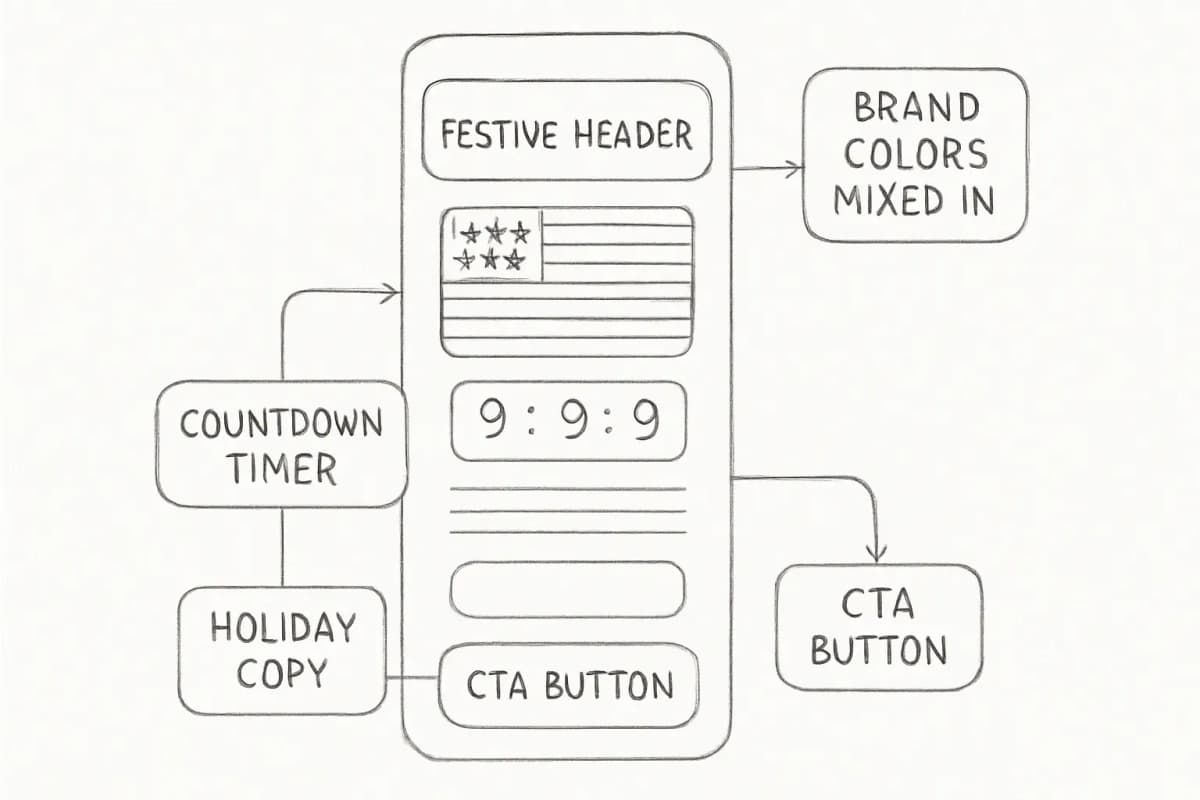
Beyond layout, countdown timers are one of the most effective urgency mechanics for time-bounded holiday offers. Adding countdown timers to promotional emails creates a sense of urgency and initiates FOMO (Fear of Missing Out). Used correctly, a real-time countdown reinforces the deadline without requiring the subscriber to remember when the sale ends.

Be precise about how you use urgency. Creating a sense of urgency is one of the most powerful motivators in marketing. When applied strategically to 4th of July campaigns, time-limited offers can drive immediate action from customers who might otherwise postpone their purchase decision. The key is making the deadline feel both real and significant.

False urgency (an "expires tonight" message that runs for three more days) trains subscribers to ignore it. Real deadlines, clearly communicated, convert.

Finally, keep brand consistency intact even as you adopt holiday visuals. Be festive but keep your brand style intact. For example, use flag colors but merge them with your brand ones. The email copy should include holiday-specific words, but your overall tone should be consistent with your previous email campaigns.

Match the subject line to the email's purpose. A send designed to wish customers well should sound warm. A promotional send should be direct about the offer. The action you want recipients to take should be clearly conveyed in your email subject lines.

A few patterns that have shown strong results across real 4th of July campaigns:

  • Urgency-based: "Last Chance: July 4th Deals Expire Tonight"
  • Offer-forward: "25% Off Sitewide: Independence Day Sale"
  • Curiosity-based: "Your July 4th Surprise Is Inside"
  • Personalized: "[First Name], Happy 4th! Here's Something for You"

Personalized emails achieve an impressive open rate of 29% and a click-through rate of 41%. Adding even a first-name merge tag to a subject line can lift opens measurably. For a full breakdown of what works at the subject line level, see the guide on email subject line best practices that boost open rates by 27%.


Strategy 5: Design for Mobile and Use Urgency Mechanics Correctly

A substantial portion, around 46%, of U.S. email opens occur on mobile devices. Over a holiday weekend when people are at cookouts, parks, and events, that figure climbs higher. An email that renders poorly on a phone is functionally invisible.

Mobile design requirements for July 4th campaigns:

  • Single-column layout that scales from desktop to mobile without horizontal scrolling
  • Large, tappable CTA buttons (minimum 44x44px touch target)
  • Short, scannable copy with clear visual hierarchy
  • Fast-loading images, ideally under 100KB each
  • Preheader text that extends the subject line message

Beyond layout, countdown timers are one of the most effective urgency mechanics for time-bounded holiday offers. Adding countdown timers to promotional emails creates a sense of urgency and initiates FOMO (Fear of Missing Out). Used correctly, a real-time countdown reinforces the deadline without requiring the subscriber to remember when the sale ends.

Be precise about how you use urgency. Creating a sense of urgency is one of the most powerful motivators in marketing. When applied strategically to 4th of July campaigns, time-limited offers can drive immediate action from customers who might otherwise postpone their purchase decision. The key is making the deadline feel both real and significant.

False urgency (an "expires tonight" message that runs for three more days) trains subscribers to ignore it. Real deadlines, clearly communicated, convert.

Finally, keep brand consistency intact even as you adopt holiday visuals. Be festive but keep your brand style intact. For example, use flag colors but merge them with your brand ones. The email copy should include holiday-specific words, but your overall tone should be consistent with your previous email campaigns.


Mobile email design mockup showing a 4th of July themed campaign with red, white, and blue color scheme blended with brand colors. The email displays a countdown timer showing days remaining until the holiday, a festive headline, and a prominent call-to-action button. The design balances holiday visual elements (flag colors, patriotic graphics) with consistent brand typography and styling to maintain brand identity while capturing holiday urgency.


Measuring Performance After the Campaign Ends

The work does not stop when July 5th passes. The data from your 4th of July email marketing campaign is your competitive advantage for next year and for every summer promotion in between.

Track these metrics by segment and by email in the sequence:

  • Open rate by send day: Did Thursday outperform Tuesday? Did the day-of send collapse as expected?
  • Click-to-open rate (CTOR): Measures whether the email body converted openers into clickers, independent of the subject line's performance.
  • Revenue per recipient: The most direct measure of campaign value per email sent.
  • Unsubscribe rate by segment: A spike in one segment signals a mismatch between the offer and that audience.

Track open and click rates for emails with time-sensitive language to refine your approach for future marketing campaigns and identify which customer segments respond best to urgency-based messaging.

For a structured approach to post-campaign analysis, the guide on email marketing analytics best practices covers the metrics framework in detail.

Store your results with notes on timing, subject line copy, and segment performance. The major holiday season comes around once a year, and tracking all the details provides invaluable insights for future holiday campaigns and your email program as a whole.


What to Avoid in Your 4th of July Campaign

A short list of common mistakes that sink otherwise solid campaigns:

  • Sending a single blast to your full list. Without segmentation, you are paying for sends that generate unsubscribes, not revenue.
  • Sending on July 4th itself. Recent U.S. data strongly advises against sending important marketing emails on major holidays like July 4th, as engagement plummets significantly.
  • Using vague patriotic copy with no offer clarity. Subscribers need to know what you are giving them and for how long.
  • Ignoring the July 5th window. Late responders and travelers catching up on their inbox represent recoverable revenue most brands ignore.
  • Overloading the email with design. Animated GIFs and complex layouts can slow load times and trigger rendering issues, especially on lower-bandwidth mobile connections at outdoor events.

Mobile email design mockup showing a 4th of July themed campaign with red, white, and blue color scheme blended with brand colors. The email displays a countdown timer showing days remaining until the holiday, a festive headline, and a prominent call-to-action button. The design balances holiday visual elements (flag colors, patriotic graphics) with consistent brand typography and styling to maintain brand identity while capturing holiday urgency.


Measuring Performance After the Campaign Ends

The work does not stop when July 5th passes. The data from your 4th of July email marketing campaign is your competitive advantage for next year and for every summer promotion in between.

Track these metrics by segment and by email in the sequence:

  • Open rate by send day: Did Thursday outperform Tuesday? Did the day-of send collapse as expected?
  • Click-to-open rate (CTOR): Measures whether the email body converted openers into clickers, independent of the subject line's performance.
  • Revenue per recipient: The most direct measure of campaign value per email sent.
  • Unsubscribe rate by segment: A spike in one segment signals a mismatch between the offer and that audience.

Track open and click rates for emails with time-sensitive language to refine your approach for future marketing campaigns and identify which customer segments respond best to urgency-based messaging.

For a structured approach to post-campaign analysis, the guide on email marketing analytics best practices covers the metrics framework in detail.

Store your results with notes on timing, subject line copy, and segment performance. The major holiday season comes around once a year, and tracking all the details provides invaluable insights for future holiday campaigns and your email program as a whole.


What to Avoid in Your 4th of July Campaign

A short list of common mistakes that sink otherwise solid campaigns:

  • Sending a single blast to your full list. Without segmentation, you are paying for sends that generate unsubscribes, not revenue.
  • Sending on July 4th itself. Recent U.S. data strongly advises against sending important marketing emails on major holidays like July 4th, as engagement plummets significantly.
  • Using vague patriotic copy with no offer clarity. Subscribers need to know what you are giving them and for how long.
  • Ignoring the July 5th window. Late responders and travelers catching up on their inbox represent recoverable revenue most brands ignore.
  • Overloading the email with design. Animated GIFs and complex layouts can slow load times and trigger rendering issues, especially on lower-bandwidth mobile connections at outdoor events.

Building your 4th of July email marketing strategy around these five principles, a sequenced cadence, precise timing, smart segmentation, subject lines written around consumer psychology, and mobile-first design with real urgency, puts you in a significantly stronger position than the majority of brands competing for the same inbox attention.

If your broader email strategy needs a foundation-up review before the holiday, the email marketing strategy template for 2025 offers a structured starting point.


Frequently Asked Questions

When should I send my 4th of July email campaign?

Data indicates the Thursday preceding July 4th often has very high opens as people prepare for the holiday. On July 4th itself, opens drop off sharply. Plan major sends before the holiday and allow a brief pause on the day of. A three-email sequence starting 7 to 10 days out is the most effective structure.

How many emails should I send for a July 4th campaign?

Three is the practical standard: a teaser 7 to 10 days before, a main campaign email 2 to 3 days before, and a last-chance email either on the morning of July 4th or July 5th. Sending more than three risks list fatigue unless your segments are tight and your offers are distinct.

Should I offer a discount in my 4th of July emails?

Discounts perform well, but they are not mandatory. Shoppers expect sales all year, not just on Black Friday. Brands that want to excel beyond the average will need to go beyond discounts to develop smarter digital relationships. If a discount fits your margins and your positioning, use it clearly. If it does not, lead with exclusivity, early access, limited-edition products, or a loyalty reward instead.

How do I improve open rates for my Independence Day campaign?

Start with subject line precision. Introduce the holiday at the beginning of the subject line rather than in the middle or end. This structure can help brands boost open rates and better engage subscribers during the Fourth of July holiday. Pair that with list segmentation so your offer reaches the subscribers most likely to act on it, and test at least two subject line variations before your main send.

What metrics matter most for a 4th of July email campaign?

Revenue per recipient, click-to-open rate, and unsubscribe rate by segment are the three metrics that tell you whether the campaign actually worked. Open rate alone does not confirm conversion, and overall unsubscribe rate masks which audiences found the send irrelevant.


No comments yet. Be the first!

Leave a comment

Comments are reviewed before publishing.

Building your 4th of July email marketing strategy around these five principles, a sequenced cadence, precise timing, smart segmentation, subject lines written around consumer psychology, and mobile-first design with real urgency, puts you in a significantly stronger position than the majority of brands competing for the same inbox attention.

If your broader email strategy needs a foundation-up review before the holiday, the email marketing strategy template for 2025 offers a structured starting point.


Frequently Asked Questions

When should I send my 4th of July email campaign?

Data indicates the Thursday preceding July 4th often has very high opens as people prepare for the holiday. On July 4th itself, opens drop off sharply. Plan major sends before the holiday and allow a brief pause on the day of. A three-email sequence starting 7 to 10 days out is the most effective structure.

How many emails should I send for a July 4th campaign?

Three is the practical standard: a teaser 7 to 10 days before, a main campaign email 2 to 3 days before, and a last-chance email either on the morning of July 4th or July 5th. Sending more than three risks list fatigue unless your segments are tight and your offers are distinct.

Should I offer a discount in my 4th of July emails?

Discounts perform well, but they are not mandatory. Shoppers expect sales all year, not just on Black Friday. Brands that want to excel beyond the average will need to go beyond discounts to develop smarter digital relationships. If a discount fits your margins and your positioning, use it clearly. If it does not, lead with exclusivity, early access, limited-edition products, or a loyalty reward instead.

How do I improve open rates for my Independence Day campaign?

Start with subject line precision. Introduce the holiday at the beginning of the subject line rather than in the middle or end. This structure can help brands boost open rates and better engage subscribers during the Fourth of July holiday. Pair that with list segmentation so your offer reaches the subscribers most likely to act on it, and test at least two subject line variations before your main send.

What metrics matter most for a 4th of July email campaign?

Revenue per recipient, click-to-open rate, and unsubscribe rate by segment are the three metrics that tell you whether the campaign actually worked. Open rate alone does not confirm conversion, and overall unsubscribe rate masks which audiences found the send irrelevant.

No comments yet. Be the first!

Leave a comment

Comments are reviewed before publishing.

More from

Related posts

Illustration for thanksgiving email marketing ideas
Seasonal & Holiday Email CampaignsMay 10, 2026 11 min

Thanksgiving Email Marketing Ideas for 2024

Boost holiday sales with 8 proven Thanksgiving email strategies. From subject lines to timing, learn what works for ecommerce and B2B.

More from

Related posts

Illustration for thanksgiving email marketing ideas
Seasonal & Holiday Email CampaignsMay 10, 2026 11 min

Thanksgiving Email Marketing Ideas for 2024

Boost holiday sales with 8 proven Thanksgiving email strategies. From subject lines to timing, learn what works for ecommerce and B2B.

P
Priya Kapoor
P
Priya Kapoor
Illustration for september email marketing ideas
Seasonal & Holiday Email CampaignsMay 9, 2026 11 min

September Email Marketing Ideas for 2025

Seasonal email campaigns, back-to-school promotions, and Labor Day ideas to boost engagement and sales this September. Get 8 actionable strategies.

JJames Chen
Illustration for september email marketing ideas
Seasonal & Holiday Email CampaignsMay 9, 2026 11 min

September Email Marketing Ideas for 2025

Seasonal email campaigns, back-to-school promotions, and Labor Day ideas to boost engagement and sales this September. Get 8 actionable strategies.

JJames Chen
Illustration for father's day email marketing
Seasonal & Holiday Email CampaignsApr 23, 2026 11 min

Father's Day Email Marketing: Campaigns That Convert

Boost Father's Day sales with proven email strategies. Templates, timing, segmentation tips, and campaign ideas to maximize ROI this season.

PPriya Kapoor
Illustration for father's day email marketing
Seasonal & Holiday Email CampaignsApr 23, 2026 11 min

Father's Day Email Marketing: Campaigns That Convert

Boost Father's Day sales with proven email strategies. Templates, timing, segmentation tips, and campaign ideas to maximize ROI this season.

PPriya Kapoor