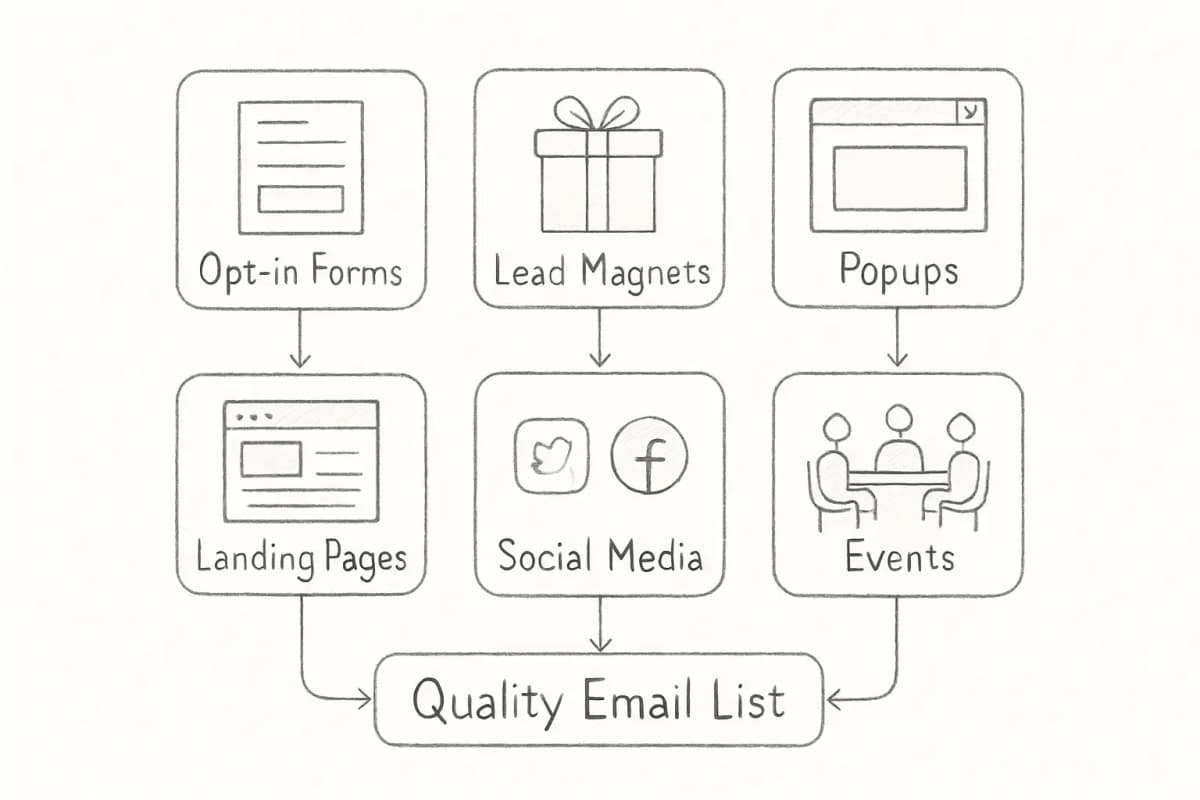
Your email list is your most valuable marketing asset, and the data backs that up. Email marketing earns an average of $36 for every dollar spent, making it the highest-ROI channel available to most businesses. But that return only materializes if you have a quality list to send to. A purchased list will not deliver those numbers. A list built with consent, value exchange, and clear intent will.
This guide covers the most effective methods to collect email addresses for email marketing, what makes each one work, and the compliance rules you need to follow to protect your deliverability and your business.
Key Takeaways
48% of consumers will give their email address in exchange for a discount, making incentive-based opt-ins one of the highest-converting collection methods.
Only 17% of organizations use email subscribe popups, and only 13% use gated content to grow their list, meaning most businesses are underleveraging the tools already available to them.
Average email list growth was just 4% in 2024, and slow growth combined with normal subscriber churn means many businesses are running to stand still.
GDPR fines can reach up to €20 million or 4% of annual global turnover, and CAN-SPAM violations can result in penalties of up to $46,517 per email, so collection methods must be legally sound.
Quality beats quantity: a smaller list of engaged, opted-in subscribers consistently outperforms a large list of unverified contacts.
Why Building Your Own Email List Matters
Email is owned media. This means you have complete control over communication with your subscribers, unlike social media channels where an algorithm change or platform ban can cut off your audience overnight.
In 2024, 9% of subscribers unsubscribed and 7% became non-deliverable due to bouncing. That is roughly 16% annual list loss before any growth effort. This makes consistent, active list-building a business necessity, not a one-time project.
The goal is not just to collect as many addresses as possible. Building an email list is about attracting the right audience who are genuinely interested in your products or services.
1. Opt-In Forms: The Foundation of Every Strategy
The simplest and easiest way to collect email addresses is to create opt-in forms that allow users to enter their email and subscribe to your communications.
Your email list is your most valuable marketing asset, and the data backs that up. Email marketing earns an average of $36 for every dollar spent, making it the highest-ROI channel available to most businesses. But that return only materializes if you have a quality list to send to. A purchased list will not deliver those numbers. A list built with consent, value exchange, and clear intent will.
This guide covers the most effective methods to collect email addresses for email marketing, what makes each one work, and the compliance rules you need to follow to protect your deliverability and your business.
Key Takeaways
48% of consumers will give their email address in exchange for a discount, making incentive-based opt-ins one of the highest-converting collection methods.
Only 17% of organizations use email subscribe popups, and only 13% use gated content to grow their list, meaning most businesses are underleveraging the tools already available to them.
Average email list growth was just 4% in 2024, and slow growth combined with normal subscriber churn means many businesses are running to stand still.
GDPR fines can reach up to €20 million or 4% of annual global turnover, and CAN-SPAM violations can result in penalties of up to $46,517 per email, so collection methods must be legally sound.
Quality beats quantity: a smaller list of engaged, opted-in subscribers consistently outperforms a large list of unverified contacts.
Why Building Your Own Email List Matters
Email is owned media. This means you have complete control over communication with your subscribers, unlike social media channels where an algorithm change or platform ban can cut off your audience overnight.
In 2024, 9% of subscribers unsubscribed and 7% became non-deliverable due to bouncing. That is roughly 16% annual list loss before any growth effort. This makes consistent, active list-building a business necessity, not a one-time project.
The goal is not just to collect as many addresses as possible. Building an email list is about attracting the right audience who are genuinely interested in your products or services.
1. Opt-In Forms: The Foundation of Every Strategy
The simplest and easiest way to collect email addresses is to create opt-in forms that allow users to enter their email and subscribe to your communications.
Exit-intent overlays triggered before a visitor leaves
When you create your form, make it a quick process with apparent benefits to the user. Give your forms some visual pop to catch the eye and keep the number of fields to a minimum, because users are more likely to ignore a form that requires them to fill out several fields upfront.
On copy, be specific. "Get your free 10-step checklist" converts better than "Sign up for updates." Tell people exactly what they are getting and how often you plan to send.
2. Popups Done Right
Popups are polarizing, but the data shows they work when configured properly. In 2025, across 1.24 billion popup displays, the average popup conversion rate was 2.1%. That number rises sharply with optimization.
Timing and trigger type are two of the biggest levers. Timer-led triggers outperform scroll-based triggers, and setting a popup to appear after 6 seconds is the optimal delay.
Mobile optimization is non-negotiable. Popups designed for mobile devices convert at 2.2%, compared to just 1.4% for desktop-only popups.
For teams that want faster results, gamification is worth testing. Lucky wheel gamified popups convert at 13.23% compared to 5.10% to 7.65% for standard email popups.
One practical rule: keep popup forms as short as possible, ideally 1 to 2 fields when your goal is immediate engagement. If you need more information up front, consider a multi-step approach, asking the essential information first and gradually following up once some trust or engagement is established.
3. Lead Magnets: Give Before You Ask
A lead magnet is a free resource offered in exchange for an email address. It is one of the most reliable collection methods available because it creates a clear, immediate value exchange.
44.3% of marketers say lead magnets offer the best ROI as a list-building method.
Effective lead magnets include:
Ebooks, guides, and whitepapers targeted at a specific problem
Templates, checklists, or calculators your audience will use repeatedly
Exclusive video training or mini-courses
Webinar registrations and live Q&A sessions
Quizzes that deliver a personalized result
People need to see a direct benefit in order to go through the trouble of filling out a signup form. The more specific the lead magnet to your audience's pain point, the higher your conversion rate.
Once someone downloads a lead magnet, that first email matters enormously. See Welcome Email Sequence Best Practices: 7 Proven Strategies to understand how to convert new subscribers into active buyers from the very first message.
Exit-intent overlays triggered before a visitor leaves
When you create your form, make it a quick process with apparent benefits to the user. Give your forms some visual pop to catch the eye and keep the number of fields to a minimum, because users are more likely to ignore a form that requires them to fill out several fields upfront.
On copy, be specific. "Get your free 10-step checklist" converts better than "Sign up for updates." Tell people exactly what they are getting and how often you plan to send.
2. Popups Done Right
Popups are polarizing, but the data shows they work when configured properly. In 2025, across 1.24 billion popup displays, the average popup conversion rate was 2.1%. That number rises sharply with optimization.
Timing and trigger type are two of the biggest levers. Timer-led triggers outperform scroll-based triggers, and setting a popup to appear after 6 seconds is the optimal delay.
Mobile optimization is non-negotiable. Popups designed for mobile devices convert at 2.2%, compared to just 1.4% for desktop-only popups.
For teams that want faster results, gamification is worth testing. Lucky wheel gamified popups convert at 13.23% compared to 5.10% to 7.65% for standard email popups.
One practical rule: keep popup forms as short as possible, ideally 1 to 2 fields when your goal is immediate engagement. If you need more information up front, consider a multi-step approach, asking the essential information first and gradually following up once some trust or engagement is established.
3. Lead Magnets: Give Before You Ask
A lead magnet is a free resource offered in exchange for an email address. It is one of the most reliable collection methods available because it creates a clear, immediate value exchange.
44.3% of marketers say lead magnets offer the best ROI as a list-building method.
Effective lead magnets include:
Ebooks, guides, and whitepapers targeted at a specific problem
Templates, checklists, or calculators your audience will use repeatedly
Exclusive video training or mini-courses
Webinar registrations and live Q&A sessions
Quizzes that deliver a personalized result
People need to see a direct benefit in order to go through the trouble of filling out a signup form. The more specific the lead magnet to your audience's pain point, the higher your conversion rate.
Once someone downloads a lead magnet, that first email matters enormously. See Welcome Email Sequence Best Practices: 7 Proven Strategies to understand how to convert new subscribers into active buyers from the very first message.
4. Dedicated Landing Pages
A dedicated landing page strips away navigation and distractions, focusing a visitor's attention entirely on the signup offer. Dedicated landing pages typically outperform popups, flyouts, and embedded forms. This superior performance comes from eliminating navigation distractions and focusing visitor attention on the signup offer. Landing pages work particularly well for traffic from paid advertising and social media.
For paid acquisition, this matters. Running a Facebook or Instagram lead ad to a generic homepage is inefficient. Running that same ad to a single-focus landing page with a compelling lead magnet is how teams build lists at scale.
Key elements of a high-converting signup landing page:
A headline that states the specific benefit
Two to three bullet points explaining what the subscriber gets
Social proof (subscriber count, testimonials, or publication logos)
A single, minimal opt-in form
A clear, action-oriented call to action button
5. Social Media and Paid Ads
Integrating email collection into your social media strategy is a powerful way to increase subscribers. By sharing direct sign-up links or using lead ads on platforms like Facebook, you can make the subscription process seamless, allowing users to sign up without leaving the platform.
For organic social, treat each platform slightly differently:
Instagram and TikTok: Add your lead magnet link in your bio and use Stories to drive traffic directly to your signup page.
LinkedIn: Share gated content previews in posts and add a newsletter signup link to your profile.
Facebook: Use the built-in "Sign Up" call-to-action button on your business page, and consider Facebook Lead Ads for paid campaigns.
For B2B businesses, LinkedIn Lead Gen Forms allow users to submit their professional details without leaving the platform, which typically reduces friction and increases conversions.
A content upgrade is a bonus resource embedded within a specific blog post or article, offered in exchange for an email address. Unlike a site-wide lead magnet, content upgrades are contextual. Someone reading a post on Instagram ad strategies is offered a complementary Instagram ad copy template. The relevance drives higher conversions.
A dedicated landing page strips away navigation and distractions, focusing a visitor's attention entirely on the signup offer. Dedicated landing pages typically outperform popups, flyouts, and embedded forms. This superior performance comes from eliminating navigation distractions and focusing visitor attention on the signup offer. Landing pages work particularly well for traffic from paid advertising and social media.
For paid acquisition, this matters. Running a Facebook or Instagram lead ad to a generic homepage is inefficient. Running that same ad to a single-focus landing page with a compelling lead magnet is how teams build lists at scale.
Key elements of a high-converting signup landing page:
A headline that states the specific benefit
Two to three bullet points explaining what the subscriber gets
Social proof (subscriber count, testimonials, or publication logos)
A single, minimal opt-in form
A clear, action-oriented call to action button
5. Social Media and Paid Ads
Integrating email collection into your social media strategy is a powerful way to increase subscribers. By sharing direct sign-up links or using lead ads on platforms like Facebook, you can make the subscription process seamless, allowing users to sign up without leaving the platform.
For organic social, treat each platform slightly differently:
Instagram and TikTok: Add your lead magnet link in your bio and use Stories to drive traffic directly to your signup page.
LinkedIn: Share gated content previews in posts and add a newsletter signup link to your profile.
Facebook: Use the built-in "Sign Up" call-to-action button on your business page, and consider Facebook Lead Ads for paid campaigns.
For B2B businesses, LinkedIn Lead Gen Forms allow users to submit their professional details without leaving the platform, which typically reduces friction and increases conversions.
A content upgrade is a bonus resource embedded within a specific blog post or article, offered in exchange for an email address. Unlike a site-wide lead magnet, content upgrades are contextual. Someone reading a post on Instagram ad strategies is offered a complementary Instagram ad copy template. The relevance drives higher conversions.
Authoritative blog content is an excellent way to attract email addresses from customers with a high likelihood of purchasing from your brand. Most blog platforms make it easy to add a simple opt-in form to blog posts and home pages, promising users more of the quality content they have already read on your site.
For B2B teams, broader gated content such as whitepapers, research reports, and webinar recordings work well. Two reliable B2B methods are gated content and surveys. Gated content includes webinars, ebooks, whitepapers, and guides.
7. Contests, Giveaways, and Events
Contests and giveaways are highly effective for collecting email addresses while boosting engagement. They create excitement and encourage people to share their email in exchange for a chance to win a valuable prize.
The key to making this work long-term is prize relevance. A generic gift card attracts everyone, including people who will never buy from you. A prize directly related to your product or service attracts an audience that is already predisposed to what you sell.
For in-person and event-based businesses, the opportunity is significant. If you host an event such as a product launch or meet-and-greet, provide a sign-up sheet for attendees to provide their email addresses. This is an effective way to grow your list with people who are already interested in your business. During the event, you could provide exclusive content or a special promotion to those who sign up, further incentivizing them to join.
8. Email Signature and Cross-Channel Touchpoints
Include a brief call-to-action and a link to your signup form in your email signature. This is a simple way to get your newsletter noticed, even if it does not lead to a large number of new subscribers right away. Update other email signatures too, including customer service emails, and have team members add a signup link to their own signatures.
Other often-overlooked touchpoints:
Post-purchase confirmation emails with a "Join our newsletter for exclusive deals" prompt
Checkout pages with a pre-filled opt-in checkbox (ensure it is unchecked by default for compliance)
Customer service chat conversations and follow-up emails
Thank-you pages after any form submission
Collecting Email Addresses Legally: GDPR and CAN-SPAM Basics
Legal compliance is not optional. Adding someone to your email list without their permission violates major laws like the GDPR and the CAN-SPAM Act. Consent needs to be clear, informed, and freely given. That means no auto-checked boxes, no pre-filled forms, and no surprises.
The two primary frameworks to understand:
GDPR (EU): The GDPR requires organizations to ask for an affirmative opt-in before sending communications, and you must make it easy for people to change their mind and opt out. Fines for non-compliance can reach up to €20 million.
CAN-SPAM (US): The CAN-SPAM Act applies to any business sending commercial emails in the US. It requires marketers to use honest subject lines, identify messages as ads, include a valid physical address, and provide a clear way to opt out.
The universal best practices that keep you compliant across all regions include clear opt-in language, logged consent records, a visible one-click unsubscribe in every email, a physical address in your footer, and a clean process for data deletion requests.
Authoritative blog content is an excellent way to attract email addresses from customers with a high likelihood of purchasing from your brand. Most blog platforms make it easy to add a simple opt-in form to blog posts and home pages, promising users more of the quality content they have already read on your site.
For B2B teams, broader gated content such as whitepapers, research reports, and webinar recordings work well. Two reliable B2B methods are gated content and surveys. Gated content includes webinars, ebooks, whitepapers, and guides.
7. Contests, Giveaways, and Events
Contests and giveaways are highly effective for collecting email addresses while boosting engagement. They create excitement and encourage people to share their email in exchange for a chance to win a valuable prize.
The key to making this work long-term is prize relevance. A generic gift card attracts everyone, including people who will never buy from you. A prize directly related to your product or service attracts an audience that is already predisposed to what you sell.
For in-person and event-based businesses, the opportunity is significant. If you host an event such as a product launch or meet-and-greet, provide a sign-up sheet for attendees to provide their email addresses. This is an effective way to grow your list with people who are already interested in your business. During the event, you could provide exclusive content or a special promotion to those who sign up, further incentivizing them to join.
8. Email Signature and Cross-Channel Touchpoints
Include a brief call-to-action and a link to your signup form in your email signature. This is a simple way to get your newsletter noticed, even if it does not lead to a large number of new subscribers right away. Update other email signatures too, including customer service emails, and have team members add a signup link to their own signatures.
Other often-overlooked touchpoints:
Post-purchase confirmation emails with a "Join our newsletter for exclusive deals" prompt
Checkout pages with a pre-filled opt-in checkbox (ensure it is unchecked by default for compliance)
Customer service chat conversations and follow-up emails
Thank-you pages after any form submission
Collecting Email Addresses Legally: GDPR and CAN-SPAM Basics
Legal compliance is not optional. Adding someone to your email list without their permission violates major laws like the GDPR and the CAN-SPAM Act. Consent needs to be clear, informed, and freely given. That means no auto-checked boxes, no pre-filled forms, and no surprises.
The two primary frameworks to understand:
GDPR (EU): The GDPR requires organizations to ask for an affirmative opt-in before sending communications, and you must make it easy for people to change their mind and opt out. Fines for non-compliance can reach up to €20 million.
CAN-SPAM (US): The CAN-SPAM Act applies to any business sending commercial emails in the US. It requires marketers to use honest subject lines, identify messages as ads, include a valid physical address, and provide a clear way to opt out.
The universal best practices that keep you compliant across all regions include clear opt-in language, logged consent records, a visible one-click unsubscribe in every email, a physical address in your footer, and a clean process for data deletion requests.
Purchasing email lists is generally not recommended and often violates both GDPR and CAN-SPAM. Sending unsolicited emails to purchased lists can damage your sender reputation and lead to legal repercussions. It is always best to build your email list organically through opt-in methods.
Once your list is growing with quality, opted-in subscribers, the next step is to segment it intelligently. Research shows that email list segmentation strategies can boost ROI by up to 760%, so the effort you put into clean collection pays dividends when you start sending.
How to Keep Your List Healthy After Collection
Collecting addresses is only half of the equation. In 2024, 9% of subscribers unsubscribed and 7% became non-deliverable due to bouncing, creating roughly 16% annual list loss. Only 35% of marketers regularly delete unengaged subscribers, while retaining inactive contacts inflates list size numbers and quietly drags down open rates and deliverability scores.
List hygiene practices to implement:
Use double opt-in to confirm new subscribers and filter fake or mistyped addresses
Remove hard bounces immediately after every send
Run re-engagement campaigns for subscribers inactive for 90 or more days
Suppress unresponsive contacts rather than continuing to send to them
Monitor your spam complaint rate and keep it below 0.1%
A clean, engaged list will always outperform a bloated, neglected one, in deliverability, open rates, and revenue per subscriber.
Frequently Asked Questions
What is the fastest way to collect email addresses for email marketing?
The fastest way to collect email addresses is by offering an immediate incentive, such as a discount or lead magnet, combined with a high-visibility opt-in form or popup. Pairing this with paid social ads, specifically Facebook or Instagram lead ads, lets you scale collection quickly with a targeted audience. Speed of list building should always be balanced with quality: incentives that attract your actual buyers will outperform those that attract everyone.
Purchasing email lists is generally not recommended and often violates both GDPR and CAN-SPAM. Sending unsolicited emails to purchased lists can damage your sender reputation and lead to legal repercussions. It is always best to build your email list organically through opt-in methods.
Once your list is growing with quality, opted-in subscribers, the next step is to segment it intelligently. Research shows that email list segmentation strategies can boost ROI by up to 760%, so the effort you put into clean collection pays dividends when you start sending.
How to Keep Your List Healthy After Collection
Collecting addresses is only half of the equation. In 2024, 9% of subscribers unsubscribed and 7% became non-deliverable due to bouncing, creating roughly 16% annual list loss. Only 35% of marketers regularly delete unengaged subscribers, while retaining inactive contacts inflates list size numbers and quietly drags down open rates and deliverability scores.
List hygiene practices to implement:
Use double opt-in to confirm new subscribers and filter fake or mistyped addresses
Remove hard bounces immediately after every send
Run re-engagement campaigns for subscribers inactive for 90 or more days
Suppress unresponsive contacts rather than continuing to send to them
Monitor your spam complaint rate and keep it below 0.1%
A clean, engaged list will always outperform a bloated, neglected one, in deliverability, open rates, and revenue per subscriber.
Frequently Asked Questions
What is the fastest way to collect email addresses for email marketing?
The fastest way to collect email addresses is by offering an immediate incentive, such as a discount or lead magnet, combined with a high-visibility opt-in form or popup. Pairing this with paid social ads, specifically Facebook or Instagram lead ads, lets you scale collection quickly with a targeted audience. Speed of list building should always be balanced with quality: incentives that attract your actual buyers will outperform those that attract everyone.
Is it legal to buy an email list?
Purchasing email lists is generally not recommended and often violates both GDPR and CAN-SPAM. Sending unsolicited emails to purchased lists can damage your sender reputation and lead to legal repercussions. Beyond legality, purchased lists deliver poor results because the contacts did not choose to hear from you, which translates into low open rates, high spam complaints, and potential domain blacklisting.
What is a good opt-in rate for an email popup?
The average email popup conversion rate in 2025 is 2.1%. As a practical benchmark, below 1.5% is usually underperforming, 1.5% to 3% is average, 3% to 5% is good, and 5% or higher is excellent. Rates improve significantly with better offers, timing optimization, mobile-first design, and A/B testing.
How do I collect email addresses without annoying my website visitors?
Timing and relevance are the two factors that determine whether an opt-in form feels helpful or intrusive. Timer-led triggers outperform scroll-based triggers, and 6 seconds is the optimal delay before showing a popup, giving visitors time to browse the current page. Exit-intent popups are another low-friction option since they appear only when a user is about to leave, creating no disruption during active browsing. Matching the offer to the content the visitor is already reading also reduces friction considerably.
No comments yet. Be the first!
Is it legal to buy an email list?
Purchasing email lists is generally not recommended and often violates both GDPR and CAN-SPAM. Sending unsolicited emails to purchased lists can damage your sender reputation and lead to legal repercussions. Beyond legality, purchased lists deliver poor results because the contacts did not choose to hear from you, which translates into low open rates, high spam complaints, and potential domain blacklisting.
What is a good opt-in rate for an email popup?
The average email popup conversion rate in 2025 is 2.1%. As a practical benchmark, below 1.5% is usually underperforming, 1.5% to 3% is average, 3% to 5% is good, and 5% or higher is excellent. Rates improve significantly with better offers, timing optimization, mobile-first design, and A/B testing.
How do I collect email addresses without annoying my website visitors?
Timing and relevance are the two factors that determine whether an opt-in form feels helpful or intrusive. Timer-led triggers outperform scroll-based triggers, and 6 seconds is the optimal delay before showing a popup, giving visitors time to browse the current page. Exit-intent popups are another low-friction option since they appear only when a user is about to leave, creating no disruption during active browsing. Matching the offer to the content the visitor is already reading also reduces friction considerably.