Email marketing remains one of the most cost-effective channels available to small businesses, and the numbers back that up. For every $1 spent, businesses see an average return of $36, translating to a 3,600% ROI. Yet many small business owners treat email as an afterthought, collecting addresses in a spreadsheet and sending campaigns sporadically. This guide covers exactly how to do email marketing for small business in a way that builds a real audience, drives consistent revenue, and scales with you.
Key Takeaways
Email marketing delivers an average return of $36 for every $1 spent, making it one of the highest-ROI channels available to small businesses.
Almost 81% of small businesses use email marketing to acquire customers, and 80% use it for retention.
Automated emails generate 320% more revenue than non-automated emails, making automation a priority from day one.
Segmented email campaigns are linked to a 760% increase in email revenue compared to sending the same message to your entire list.
Strong deliverability, clear subject lines, and consistent sending cadence are the three mechanical factors that separate high-performing programs from mediocre ones.
Why Email Marketing Works for Small Businesses
Small businesses compete with larger brands every day on attention, budget, and reach. Email levels that playing field.
About 93% of people use their email every day, and 42% check it three to five times a day. Additionally, 58% of users say email is the first thing they check online in the morning. No social media platform comes close to that kind of habitual, daily reach.
52% of consumers have made a purchase directly from an email they received, making email the most effective channel for driving sales. It beats social media posts by 13% and social media ads by 11%.
The top 8% of email programs, those hitting 45:1 or higher ROI, most commonly send newsletters and onboarding emails rather than promotional blasts. That tells you something important: relationship-first email beats broadcast-style promotion.
Step 1: Choose the Right Email Marketing Platform
Before you send a single email, you need an email service provider (ESP). Your choice matters because it affects deliverability, automation depth, and cost as you grow.
Email marketing remains one of the most cost-effective channels available to small businesses, and the numbers back that up. For every $1 spent, businesses see an average return of $36, translating to a 3,600% ROI. Yet many small business owners treat email as an afterthought, collecting addresses in a spreadsheet and sending campaigns sporadically. This guide covers exactly how to do email marketing for small business in a way that builds a real audience, drives consistent revenue, and scales with you.
Key Takeaways
Email marketing delivers an average return of $36 for every $1 spent, making it one of the highest-ROI channels available to small businesses.
Almost 81% of small businesses use email marketing to acquire customers, and 80% use it for retention.
Automated emails generate 320% more revenue than non-automated emails, making automation a priority from day one.
Segmented email campaigns are linked to a 760% increase in email revenue compared to sending the same message to your entire list.
Strong deliverability, clear subject lines, and consistent sending cadence are the three mechanical factors that separate high-performing programs from mediocre ones.
Why Email Marketing Works for Small Businesses
Small businesses compete with larger brands every day on attention, budget, and reach. Email levels that playing field.
About 93% of people use their email every day, and 42% check it three to five times a day. Additionally, 58% of users say email is the first thing they check online in the morning. No social media platform comes close to that kind of habitual, daily reach.
52% of consumers have made a purchase directly from an email they received, making email the most effective channel for driving sales. It beats social media posts by 13% and social media ads by 11%.
The top 8% of email programs, those hitting 45:1 or higher ROI, most commonly send newsletters and onboarding emails rather than promotional blasts. That tells you something important: relationship-first email beats broadcast-style promotion.
Step 1: Choose the Right Email Marketing Platform
Before you send a single email, you need an email service provider (ESP). Your choice matters because it affects deliverability, automation depth, and cost as you grow.
Mailchimp is best for beginners and small businesses looking for an all-in-one marketing tool, offering a wide set of features including AI and automation. Klaviyo is the better choice if you are growing an ecommerce business and need state-of-the-art automation and in-depth analytics.
Here is a practical breakdown for small business owners:
Mailchimp: Best for service businesses, local businesses, nonprofits, and B2B. It works well for small businesses, freelancers, nonprofits, and service-based companies that need a single platform to manage multiple marketing channels without a steep learning curve.
Klaviyo: Best for online stores. Klaviyo has deep ecommerce functionality with advanced automation, real-time segmentation, and revenue-focused analytics.
ActiveCampaign, Brevo, MailerLite: Good mid-range options with solid automation and competitive pricing.
When evaluating platforms, check deliverability rates. Keeping your list clean, using proper sender authentication, and maintaining a good reputation all help ensure your emails reach inboxes. Based on independent testing, top performers include ActiveCampaign at 94.2% and Constant Contact at 91.7%.
Step 2: Build Your Email List the Right Way
Never buy an email list. Contacts who have not explicitly subscribed to your communications will either unsubscribe at scale or remain disengaged, hurting your deliverability and sender reputation.
Instead, build your list organically using proven tactics:
Lead magnets are the most reliable list-building tool. Relevant lead magnets are essential to effective lead generation strategies, and when used strategically, it is not uncommon to see lead magnets generating conversion rates between 10% and 20%. Effective lead magnets include checklists, templates, mini-courses, discount codes, and free tools.
Signup forms and landing pages convert your website traffic into subscribers. Embedded signup forms hold an average of 7.39% conversion rate, though the number changes significantly based on placement and relevance. Place forms above the fold on your homepage, within blog posts, and on your highest-traffic pages.
Discount incentives work especially well for product-based businesses. Research from Statista found that 48% of consumers surveyed happily gave their email address to receive a discount.
Automated emails are where small businesses unlock disproportionate returns. You set them up once and they work continuously.
Mailchimp is best for beginners and small businesses looking for an all-in-one marketing tool, offering a wide set of features including AI and automation. Klaviyo is the better choice if you are growing an ecommerce business and need state-of-the-art automation and in-depth analytics.
Here is a practical breakdown for small business owners:
Mailchimp: Best for service businesses, local businesses, nonprofits, and B2B. It works well for small businesses, freelancers, nonprofits, and service-based companies that need a single platform to manage multiple marketing channels without a steep learning curve.
Klaviyo: Best for online stores. Klaviyo has deep ecommerce functionality with advanced automation, real-time segmentation, and revenue-focused analytics.
ActiveCampaign, Brevo, MailerLite: Good mid-range options with solid automation and competitive pricing.
When evaluating platforms, check deliverability rates. Keeping your list clean, using proper sender authentication, and maintaining a good reputation all help ensure your emails reach inboxes. Based on independent testing, top performers include ActiveCampaign at 94.2% and Constant Contact at 91.7%.
Step 2: Build Your Email List the Right Way
Never buy an email list. Contacts who have not explicitly subscribed to your communications will either unsubscribe at scale or remain disengaged, hurting your deliverability and sender reputation.
Instead, build your list organically using proven tactics:
Lead magnets are the most reliable list-building tool. Relevant lead magnets are essential to effective lead generation strategies, and when used strategically, it is not uncommon to see lead magnets generating conversion rates between 10% and 20%. Effective lead magnets include checklists, templates, mini-courses, discount codes, and free tools.
Signup forms and landing pages convert your website traffic into subscribers. Embedded signup forms hold an average of 7.39% conversion rate, though the number changes significantly based on placement and relevance. Place forms above the fold on your homepage, within blog posts, and on your highest-traffic pages.
Discount incentives work especially well for product-based businesses. Research from Statista found that 48% of consumers surveyed happily gave their email address to receive a discount.
Automated emails are where small businesses unlock disproportionate returns. You set them up once and they work continuously.
Automated workflows generate 30x higher returns compared to one-off email campaigns. Prioritize these four flows first:
Welcome sequence: The first email a new subscriber receives. Welcome emails achieve an average open rate of 83.63% and a click-through rate of 16.60%. Use this high-attention moment to introduce your brand, deliver your lead magnet, and set expectations. See our welcome email sequence best practices for proven structures.
Abandoned cart email (for ecommerce): Automated cart abandonment emails have a conversion rate of around 2%, which adds up significantly at volume.
Post-purchase sequence: Thank customers, set expectations for delivery, and introduce complementary products or services.
Re-engagement campaign: Re-engagement campaigns are designed to reconnect with inactive subscribers. By sending targeted emails with exclusive offers or personalized content, you can rekindle interest and encourage them to re-engage.
Step 4: Segment Your List for Higher ROI
Sending the same email to every subscriber on your list is one of the most common mistakes in small business email marketing.
Segmented email marketing campaigns receive 100.95% higher click rates than non-segmented ones, meaning they are far more likely to convert. This tactic is linked to a 760% increase in email revenue.
Start with these practical segments:
New subscribers (first 30 days): Nurture and educate
Active customers: Cross-sell and upsell
Lapsed customers: Win-back offers
Engagement-based segments: High openers vs. non-openers
Segments can be built based on demographic data such as age, gender, and location; customer preferences like interests and product categories; behavioral data like purchase history and click rates; and position in the customer journey such as leads, new customers, and loyal customers.
You do not need sophisticated segmentation from day one. Start small and focus on relevant data. You can always expand segments and their criteria as your needs grow and your expertise deepens.
The quality of your email content determines whether subscribers stay on your list or click unsubscribe. Good small business email content follows a simple formula: one clear idea, one goal, and one call to action.
Subject Lines
Automated workflows generate 30x higher returns compared to one-off email campaigns. Prioritize these four flows first:
Welcome sequence: The first email a new subscriber receives. Welcome emails achieve an average open rate of 83.63% and a click-through rate of 16.60%. Use this high-attention moment to introduce your brand, deliver your lead magnet, and set expectations. See our welcome email sequence best practices for proven structures.
Abandoned cart email (for ecommerce): Automated cart abandonment emails have a conversion rate of around 2%, which adds up significantly at volume.
Post-purchase sequence: Thank customers, set expectations for delivery, and introduce complementary products or services.
Re-engagement campaign: Re-engagement campaigns are designed to reconnect with inactive subscribers. By sending targeted emails with exclusive offers or personalized content, you can rekindle interest and encourage them to re-engage.
Step 4: Segment Your List for Higher ROI
Sending the same email to every subscriber on your list is one of the most common mistakes in small business email marketing.
Segmented email marketing campaigns receive 100.95% higher click rates than non-segmented ones, meaning they are far more likely to convert. This tactic is linked to a 760% increase in email revenue.
Start with these practical segments:
New subscribers (first 30 days): Nurture and educate
Active customers: Cross-sell and upsell
Lapsed customers: Win-back offers
Engagement-based segments: High openers vs. non-openers
Segments can be built based on demographic data such as age, gender, and location; customer preferences like interests and product categories; behavioral data like purchase history and click rates; and position in the customer journey such as leads, new customers, and loyal customers.
You do not need sophisticated segmentation from day one. Start small and focus on relevant data. You can always expand segments and their criteria as your needs grow and your expertise deepens.
The quality of your email content determines whether subscribers stay on your list or click unsubscribe. Good small business email content follows a simple formula: one clear idea, one goal, and one call to action.
Subject Lines
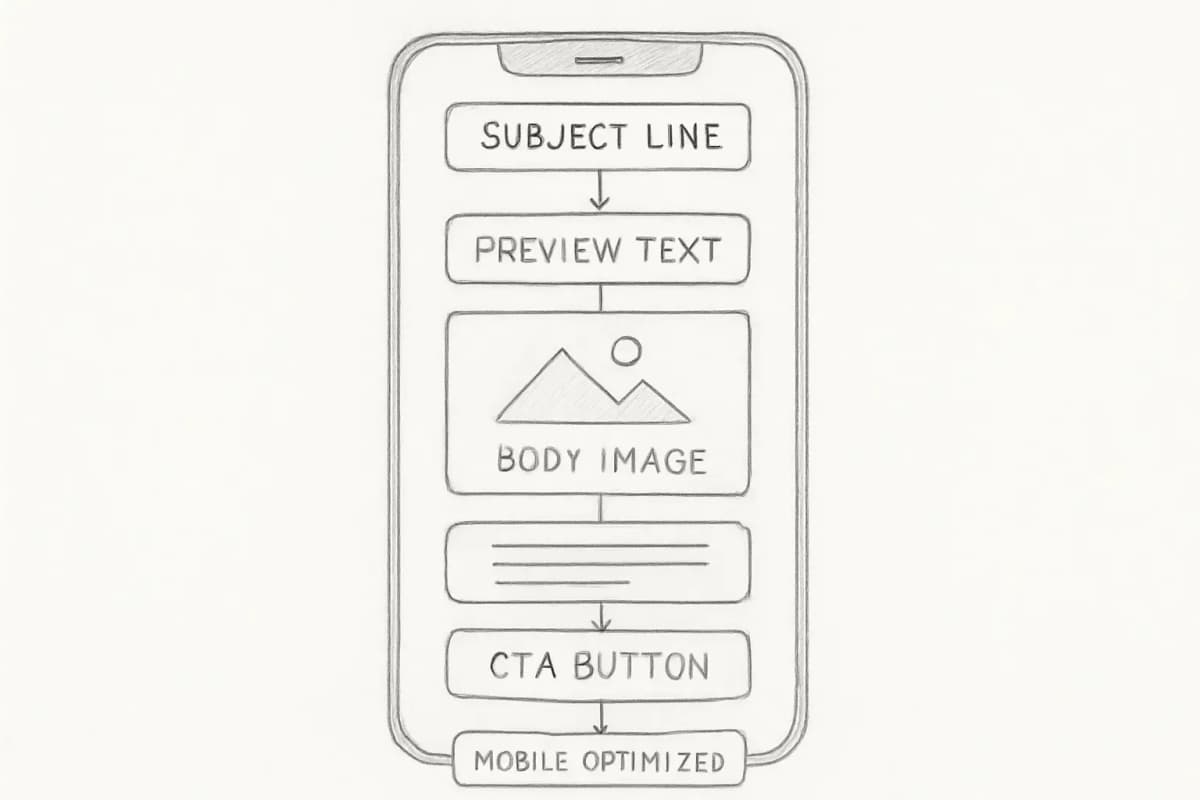
Your subject line is the single biggest lever for open rates. Personalized CTAs and subject lines convert 202% better than generic ones. Keep subject lines under 50 characters, be specific about the value inside, and test at least two variations per campaign.
For proven subject line formulas and data-backed techniques, see our article on email subject line best practices that boost open rates.
Email Body
Follow these principles:
Lead with the benefit, not the preamble
Use short paragraphs (2 to 3 lines maximum)
Keep in mind that 50% of people will delete an email if it is not optimized for mobile, so test every email on a phone before sending
Include a single, prominent call to action
Write in a conversational tone that reflects how you actually talk to customers
Step 6: Protect Your Deliverability
Great content means nothing if your emails land in spam. Deliverability is the technical foundation that every other email marketing tactic depends on.
Authentication is non-negotiable. SPF is an email authentication method allowing domain owners to specify which mail servers are authorized to send on their behalf. DKIM adds a digital signature to the email header, helping verify integrity and authenticity. DMARC builds on both SPF and DKIM, allowing domain owners to set policies specifying what action receivers should take if an email fails authentication.
Fully authenticated senders using SPF, DKIM, and DMARC are 2.7 times more likely to reach the inbox than unauthenticated senders.
Following Google and Yahoo's 2024 rollout of bulk sender requirements, Microsoft introduced its own email authentication rules. From May 2025, businesses sending more than 5,000 emails a day must comply or risk having messages throttled, sent to spam, or blocked entirely. Even if you send lower volumes, set up all three protocols now.
List hygiene is equally important. Hard bounce rates above 2% signal serious list quality problems. An unsubscribe rate under 0.5% is healthy; higher suggests a content-audience mismatch. Remove hard bounces immediately and suppress unengaged subscribers every 90 days.
Step 7: Track the Right Metrics and Improve
Measuring email performance tells you what to do more of and what to fix. Focus on metrics that connect to revenue, not just engagement proxies.
Bot-driven phantom engagement has made open rates unreliable, pushing high-performing teams toward revenue per email, list churn, and lifetime value as the metrics that matter.
The core metrics to track:
Your subject line is the single biggest lever for open rates. Personalized CTAs and subject lines convert 202% better than generic ones. Keep subject lines under 50 characters, be specific about the value inside, and test at least two variations per campaign.
For proven subject line formulas and data-backed techniques, see our article on email subject line best practices that boost open rates.
Email Body
Follow these principles:
Lead with the benefit, not the preamble
Use short paragraphs (2 to 3 lines maximum)
Keep in mind that 50% of people will delete an email if it is not optimized for mobile, so test every email on a phone before sending
Include a single, prominent call to action
Write in a conversational tone that reflects how you actually talk to customers
Step 6: Protect Your Deliverability
Great content means nothing if your emails land in spam. Deliverability is the technical foundation that every other email marketing tactic depends on.
Authentication is non-negotiable. SPF is an email authentication method allowing domain owners to specify which mail servers are authorized to send on their behalf. DKIM adds a digital signature to the email header, helping verify integrity and authenticity. DMARC builds on both SPF and DKIM, allowing domain owners to set policies specifying what action receivers should take if an email fails authentication.
Fully authenticated senders using SPF, DKIM, and DMARC are 2.7 times more likely to reach the inbox than unauthenticated senders.
Following Google and Yahoo's 2024 rollout of bulk sender requirements, Microsoft introduced its own email authentication rules. From May 2025, businesses sending more than 5,000 emails a day must comply or risk having messages throttled, sent to spam, or blocked entirely. Even if you send lower volumes, set up all three protocols now.
List hygiene is equally important. Hard bounce rates above 2% signal serious list quality problems. An unsubscribe rate under 0.5% is healthy; higher suggests a content-audience mismatch. Remove hard bounces immediately and suppress unengaged subscribers every 90 days.
Step 7: Track the Right Metrics and Improve
Measuring email performance tells you what to do more of and what to fix. Focus on metrics that connect to revenue, not just engagement proxies.
Bot-driven phantom engagement has made open rates unreliable, pushing high-performing teams toward revenue per email, list churn, and lifetime value as the metrics that matter.
The core metrics to track:
Metric
What It Tells You
Target
Click-through rate (CTR)
How compelling your content and CTA are
2.62% average across industries
Click-to-open rate (CTOR)
Content quality relative to opens
5.3% average across industries
Bounce rate
List hygiene and sender reputation
Under 2%
Unsubscribe rate
Content-audience fit
Under 0.5%
Revenue per email
Direct business impact
Varies by industry
A/B test one variable at a time: subject line, send time, CTA button copy, or email length. Even small wins compound over hundreds of campaigns.
How often should a small business send marketing emails?
Consistency matters more than frequency. Start with one email per week and adjust based on engagement. Newsletters with a weekly cadence see the highest open rates, at 48.31%, compared to other sending frequencies. If you see unsubscribes climb or clicks drop, reduce frequency before adding more content types.
What types of emails should small businesses send?
A balanced program includes welcome emails for new subscribers, a regular newsletter (weekly or biweekly), promotional emails tied to specific offers, and automated behavior-based emails such as abandoned cart and post-purchase sequences. The welcome email leads to the newsletter, which leads to a discount code or even an abandoned cart reminder in a well-structured program.
How do I grow my email list as a small business with no budget?
Focus on your existing traffic and existing customers first. Add signup forms to your website, offer a lead magnet relevant to your audience, promote your newsletter on social media, and include a signup link in your email signature. Research shows 48% of consumers will give their email address in exchange for a discount, so a simple percentage-off offer is an effective, low-cost list-building tool.
Does email marketing still work in 2025?
Yes, and the data is clear. 87% of marketing leaders say email marketing is critical to the success of their company. 59% of consumers say marketing emails influence their purchase decisions, with over 50% saying they purchase from an email at least once a month. The channel is not declining; it is maturing, and businesses that invest in quality over volume see the strongest returns.
Metric
What It Tells You
Target
Click-through rate (CTR)
How compelling your content and CTA are
2.62% average across industries
Click-to-open rate (CTOR)
Content quality relative to opens
5.3% average across industries
Bounce rate
List hygiene and sender reputation
Under 2%
Unsubscribe rate
Content-audience fit
Under 0.5%
Revenue per email
Direct business impact
Varies by industry
A/B test one variable at a time: subject line, send time, CTA button copy, or email length. Even small wins compound over hundreds of campaigns.
How often should a small business send marketing emails?
Consistency matters more than frequency. Start with one email per week and adjust based on engagement. Newsletters with a weekly cadence see the highest open rates, at 48.31%, compared to other sending frequencies. If you see unsubscribes climb or clicks drop, reduce frequency before adding more content types.
What types of emails should small businesses send?
A balanced program includes welcome emails for new subscribers, a regular newsletter (weekly or biweekly), promotional emails tied to specific offers, and automated behavior-based emails such as abandoned cart and post-purchase sequences. The welcome email leads to the newsletter, which leads to a discount code or even an abandoned cart reminder in a well-structured program.
How do I grow my email list as a small business with no budget?
Focus on your existing traffic and existing customers first. Add signup forms to your website, offer a lead magnet relevant to your audience, promote your newsletter on social media, and include a signup link in your email signature. Research shows 48% of consumers will give their email address in exchange for a discount, so a simple percentage-off offer is an effective, low-cost list-building tool.
Does email marketing still work in 2025?
Yes, and the data is clear. 87% of marketing leaders say email marketing is critical to the success of their company. 59% of consumers say marketing emails influence their purchase decisions, with over 50% saying they purchase from an email at least once a month. The channel is not declining; it is maturing, and businesses that invest in quality over volume see the strongest returns.