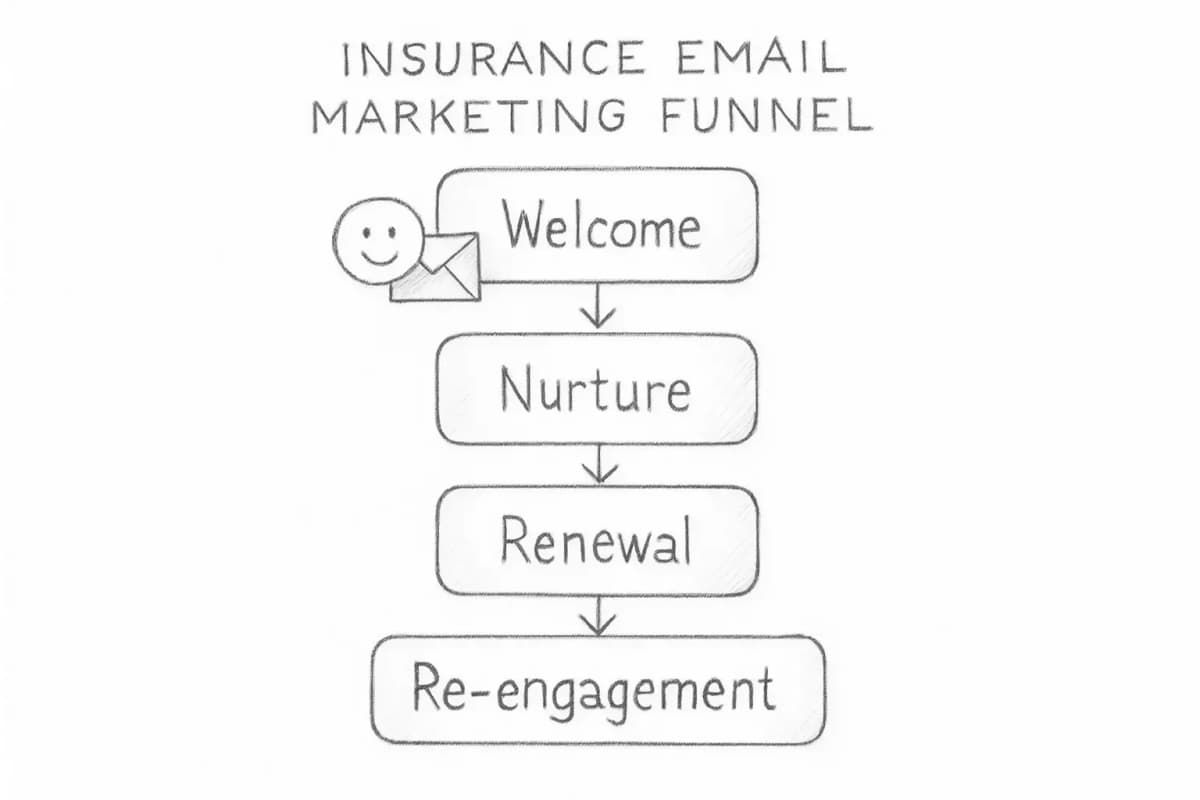
Insurance is a low-frequency, high-consideration purchase. Nobody wakes up excited to buy life insurance before breakfast. It is a low-frequency, high-consideration decision, which means the path from "quote requested" to "policy signed" is long and full of doubts. That makes email the ideal channel: it keeps you present during the consideration window without feeling pushy, and it scales across every stage of the client lifecycle without breaking your budget.
The insurance marketing email examples that actually convert share a few common traits. They are timely, they speak to a specific coverage concern, and they give the reader a clear next step. This guide breaks down the exact email types that work, what makes each one effective, and how to build them into a system that drives real results.
Key Takeaways
In Q2 2024, 99.1% of marketing emails sent by the financial services and insurance sector were delivered, with a 45.1% open rate, well above the cross-industry average.
Marketers report a 760% increase in email revenue from personalized and segmented campaigns.
The average email marketing ROI in the insurance sector hits $36 to $38 for every $1 spent.
About 55% of insurance emails are opened on mobile devices. If campaigns are not optimized for small screens, key messages and CTAs are missed. Use concise subject lines, single-column layouts, and buttons that are easy to tap.
Insurance businesses must comply with data protection and privacy laws, such as GDPR, GLBA for financial institutions, and HIPAA for healthcare email marketing.
Why Email Works So Well for Insurance Marketing
Insurance, like email marketing, relies on trust to work. Insurance coverage is a difficult decision to make, and it usually takes longer for coverage seekers to become policyholders. That trust-building window is precisely where email thrives.
Insurance emails that focus solely on selling rarely perform well. Successful insurance agents use email to educate clients, solve problems, and build trust, which naturally leads to more conversions.
The economics are compelling too. Email generates $36 for every $1 spent, meaning email marketing ROI is 3,600%. For a sector where acquiring a single policyholder can cost hundreds of dollars through paid channels, that math matters considerably.
Insurance is a low-frequency, high-consideration purchase. Nobody wakes up excited to buy life insurance before breakfast. It is a low-frequency, high-consideration decision, which means the path from "quote requested" to "policy signed" is long and full of doubts. That makes email the ideal channel: it keeps you present during the consideration window without feeling pushy, and it scales across every stage of the client lifecycle without breaking your budget.
The insurance marketing email examples that actually convert share a few common traits. They are timely, they speak to a specific coverage concern, and they give the reader a clear next step. This guide breaks down the exact email types that work, what makes each one effective, and how to build them into a system that drives real results.
Key Takeaways
In Q2 2024, 99.1% of marketing emails sent by the financial services and insurance sector were delivered, with a 45.1% open rate, well above the cross-industry average.
Marketers report a 760% increase in email revenue from personalized and segmented campaigns.
The average email marketing ROI in the insurance sector hits $36 to $38 for every $1 spent.
About 55% of insurance emails are opened on mobile devices. If campaigns are not optimized for small screens, key messages and CTAs are missed. Use concise subject lines, single-column layouts, and buttons that are easy to tap.
Insurance businesses must comply with data protection and privacy laws, such as GDPR, GLBA for financial institutions, and HIPAA for healthcare email marketing.
Why Email Works So Well for Insurance Marketing
Insurance, like email marketing, relies on trust to work. Insurance coverage is a difficult decision to make, and it usually takes longer for coverage seekers to become policyholders. That trust-building window is precisely where email thrives.
Insurance emails that focus solely on selling rarely perform well. Successful insurance agents use email to educate clients, solve problems, and build trust, which naturally leads to more conversions.
The economics are compelling too. Email generates $36 for every $1 spent, meaning email marketing ROI is 3,600%. For a sector where acquiring a single policyholder can cost hundreds of dollars through paid channels, that math matters considerably.
The use of GIFs and images led to an increase in click rates in the insurance sector by 40%, which suggests that design investment pays off even in a typically conservative industry.
The 7 Insurance Marketing Email Types That Convert
1. The Welcome Series
A welcome series sets the tone for your relationship with new prospects. Instead of sending a single email blast, use a short sequence that introduces your agency, explains your services, and shares a useful resource. This builds trust early and keeps leads engaged.
Welcome emails generate 320% more revenue per email than promotional ones. More than 8 out of 10 people will open a welcome email, generating 4x as many opens and 10x as many clicks as other email types.
A strong insurance welcome email should:
Introduce the agent by name and photo, not just the brand
Confirm what the subscriber signed up for
Deliver on any lead magnet promise (a coverage checklist, a premium calculator, a free guide)
Set expectations for what comes next and how often they will hear from you
See our guide to Welcome Email Sequence Best Practices: 7 Proven Strategies for a deeper look at sequencing and timing.
2. Policy Renewal Reminders
In insurance email marketing, renewal reminders are especially crucial. You can schedule automated emails to go out 30, 15, and 5 days before a policy expires.
To get a high level of insurance sales, you can use not one email but a series of several emails for existing clients. A three-email sequence works best:
30 days out: Inform. Tell the client their policy is approaching renewal, recap what it covers, and include a clear CTA to review or request changes.
15 days out: Remind. Highlight any new coverage options or loyalty discounts available at renewal.
5 days out: Urgency. Flag the expiration date explicitly and make the renewal action frictionless with a single click.
According to a recent study, 65% of consumers are more likely to renew their insurance policy if they receive a personalized and clear reminder email.
To prepare an effective renewal email, build it with a specific and clear subject line, for example, "Renew your auto insurance and get 20% more coverage than last."
3. Quote Follow-Up Emails
A prospect who requests a quote and goes quiet is not necessarily lost. Insurance is not an impulse buy. Nobody wakes up excited to buy life insurance before breakfast. It is a low-frequency, high-consideration decision, which means the path from "quote requested" to "policy signed" is long and full of doubts.
Quote follow-up emails should address the specific hesitation. Common structures that convert:
The use of GIFs and images led to an increase in click rates in the insurance sector by 40%, which suggests that design investment pays off even in a typically conservative industry.
The 7 Insurance Marketing Email Types That Convert
1. The Welcome Series
A welcome series sets the tone for your relationship with new prospects. Instead of sending a single email blast, use a short sequence that introduces your agency, explains your services, and shares a useful resource. This builds trust early and keeps leads engaged.
Welcome emails generate 320% more revenue per email than promotional ones. More than 8 out of 10 people will open a welcome email, generating 4x as many opens and 10x as many clicks as other email types.
A strong insurance welcome email should:
Introduce the agent by name and photo, not just the brand
Confirm what the subscriber signed up for
Deliver on any lead magnet promise (a coverage checklist, a premium calculator, a free guide)
Set expectations for what comes next and how often they will hear from you
See our guide to Welcome Email Sequence Best Practices: 7 Proven Strategies for a deeper look at sequencing and timing.
2. Policy Renewal Reminders
In insurance email marketing, renewal reminders are especially crucial. You can schedule automated emails to go out 30, 15, and 5 days before a policy expires.
To get a high level of insurance sales, you can use not one email but a series of several emails for existing clients. A three-email sequence works best:
30 days out: Inform. Tell the client their policy is approaching renewal, recap what it covers, and include a clear CTA to review or request changes.
15 days out: Remind. Highlight any new coverage options or loyalty discounts available at renewal.
5 days out: Urgency. Flag the expiration date explicitly and make the renewal action frictionless with a single click.
According to a recent study, 65% of consumers are more likely to renew their insurance policy if they receive a personalized and clear reminder email.
To prepare an effective renewal email, build it with a specific and clear subject line, for example, "Renew your auto insurance and get 20% more coverage than last."
3. Quote Follow-Up Emails
A prospect who requests a quote and goes quiet is not necessarily lost. Insurance is not an impulse buy. Nobody wakes up excited to buy life insurance before breakfast. It is a low-frequency, high-consideration decision, which means the path from "quote requested" to "policy signed" is long and full of doubts.
Quote follow-up emails should address the specific hesitation. Common structures that convert:
The objection handler: Acknowledge that choosing coverage can feel overwhelming, then answer the three most common questions for that policy type.
The social proof email: Share a brief client story (with permission) that mirrors the prospect's situation.
The comparison email: Show clearly what happens with and without coverage, using concrete dollar figures where possible.
Action-oriented CTA phrases such as "Review My Coverage" or "Get My Quote" perform better than vague phrases like "Click Here."
4. Educational Newsletters
Another effective use of email marketing is to keep clients informed on product and policy updates. Farmers Insurance does a good job of this by providing clients with updated information on their mobile app. Email marketing is a great option when it comes time to update clients on product or policy changes in a more personalized manner.
Educational content works because it reframes the insurance agent from a salesperson into a trusted advisor. Effective newsletter topics include:
Seasonal risk reminders (hurricane prep for homeowners, winter driving tips for auto policyholders)
Policy explainers that demystify common coverage terms
Life-event checklists, such as what to review when you buy a home or have a child
Claims process guides that reduce anxiety before a claim ever happens
Seasonal insurance emails help you stay timely and relevant. Certain types of insurance, such as travel coverage, might not always be top of mind. However, during peak seasons, your reminder can be exactly what your clients need.
5. Cross-Sell and Upsell Emails
Strategic cross-selling emails help clients get comprehensive coverage while increasing your revenue per customer.
The key is timing. Cross-sell emails convert best when triggered by a life event or a change in coverage status, not sent on a arbitrary schedule. Effective triggers include:
A client who just bought auto insurance and does not yet have renters or homeowners coverage
A new parent who only holds term life insurance
A homeowner approaching the first anniversary of their policy
A young professional who just requested a renters quote should not get the same content as a 50-year-old who just requested to renew their life insurance. Segmenting by life stage and policy type makes cross-sell campaigns feel relevant rather than opportunistic.
6. Re-Engagement Emails for Lapsed Contacts
Not every prospect converts on the first or second touch. Insurance is often a matter of catching a prospect at just the right time. Many past clients may just need a nudge to return.
A re-engagement sequence for lapsed contacts typically runs two to three emails:
Email 1: A simple "We noticed you haven't been in touch" check-in, with no hard sell.
Email 2: A relevant piece of educational content tied to their last known coverage interest.
Email 3: A final offer, such as a free coverage review, before removing them from active campaigns.
The objection handler: Acknowledge that choosing coverage can feel overwhelming, then answer the three most common questions for that policy type.
The social proof email: Share a brief client story (with permission) that mirrors the prospect's situation.
The comparison email: Show clearly what happens with and without coverage, using concrete dollar figures where possible.
Action-oriented CTA phrases such as "Review My Coverage" or "Get My Quote" perform better than vague phrases like "Click Here."
4. Educational Newsletters
Another effective use of email marketing is to keep clients informed on product and policy updates. Farmers Insurance does a good job of this by providing clients with updated information on their mobile app. Email marketing is a great option when it comes time to update clients on product or policy changes in a more personalized manner.
Educational content works because it reframes the insurance agent from a salesperson into a trusted advisor. Effective newsletter topics include:
Seasonal risk reminders (hurricane prep for homeowners, winter driving tips for auto policyholders)
Policy explainers that demystify common coverage terms
Life-event checklists, such as what to review when you buy a home or have a child
Claims process guides that reduce anxiety before a claim ever happens
Seasonal insurance emails help you stay timely and relevant. Certain types of insurance, such as travel coverage, might not always be top of mind. However, during peak seasons, your reminder can be exactly what your clients need.
5. Cross-Sell and Upsell Emails
Strategic cross-selling emails help clients get comprehensive coverage while increasing your revenue per customer.
The key is timing. Cross-sell emails convert best when triggered by a life event or a change in coverage status, not sent on a arbitrary schedule. Effective triggers include:
A client who just bought auto insurance and does not yet have renters or homeowners coverage
A new parent who only holds term life insurance
A homeowner approaching the first anniversary of their policy
A young professional who just requested a renters quote should not get the same content as a 50-year-old who just requested to renew their life insurance. Segmenting by life stage and policy type makes cross-sell campaigns feel relevant rather than opportunistic.
6. Re-Engagement Emails for Lapsed Contacts
Not every prospect converts on the first or second touch. Insurance is often a matter of catching a prospect at just the right time. Many past clients may just need a nudge to return.
A re-engagement sequence for lapsed contacts typically runs two to three emails:
Email 1: A simple "We noticed you haven't been in touch" check-in, with no hard sell.
Email 2: A relevant piece of educational content tied to their last known coverage interest.
Email 3: A final offer, such as a free coverage review, before removing them from active campaigns.
If you notice that someone has not opened any of your emails in a while, you can send them a re-engagement email in an attempt to get them back on track.
7. Survey and Feedback Emails
Customer feedback helps you identify where you do well and what products, services, and procedures to improve. Survey emails are also a great source of data that help you dive deeper into clients' preferences, fears, and aspirations.
For insurance agencies, a post-claim survey or annual satisfaction check-in accomplishes two things: it shows the client their opinion matters, and it surfaces retention risks before a policy lapses. Keep surveys to three to five questions and send them within a week of a significant interaction.
Segmentation: The Lever That Multiplies Every Example Above
Every email type listed above performs significantly better when sent to the right segment. As one Senior Marketing Manager at Ripe Thinking put it: "Segmentation is crucial in insurance because prospects and policyholders need different information. Our prospects need cover details and awareness of any offers we're running. Whereas policyholders need to be sent their documents and renewal reminders."
Effective segmentation for insurance includes: by insurance type (separating auto, home, life, and health insurance clients to send product-specific information), by customer lifecycle stage, by policy renewal dates, by demographic information, and by past interactions such as website visits or quote requests.
Your subject line determines whether your carefully crafted email gets opened or ignored. For insurance agents, effective subject lines balance urgency and value without triggering spam filters.
Proven structures for insurance subject lines:
Specificity over vagueness: "Your auto policy renews in 14 days" outperforms "Important policy update"
Benefit-led questions: "Are you underinsured? Here's how to check in 2 minutes"
Life-event hooks: "Just bought a home? Here's what your coverage may be missing"
How-to framing: For educational topics, the "how to" subject line is a great way to generate more email opens. For example: "How to choose the right Medicare supplement plan" or "How to get the most life insurance for the lowest cost." These subject lines tell your audience what they can expect to learn.
Personalized subject lines increase email open rates by 26%. Adding the client's name or policy type into the subject line is a low-effort, high-return tactic.
For a full framework on subject line testing and optimization, see our article on Email Subject Line Best Practices That Boost Open Rates by 27%.
If you notice that someone has not opened any of your emails in a while, you can send them a re-engagement email in an attempt to get them back on track.
7. Survey and Feedback Emails
Customer feedback helps you identify where you do well and what products, services, and procedures to improve. Survey emails are also a great source of data that help you dive deeper into clients' preferences, fears, and aspirations.
For insurance agencies, a post-claim survey or annual satisfaction check-in accomplishes two things: it shows the client their opinion matters, and it surfaces retention risks before a policy lapses. Keep surveys to three to five questions and send them within a week of a significant interaction.
Segmentation: The Lever That Multiplies Every Example Above
Every email type listed above performs significantly better when sent to the right segment. As one Senior Marketing Manager at Ripe Thinking put it: "Segmentation is crucial in insurance because prospects and policyholders need different information. Our prospects need cover details and awareness of any offers we're running. Whereas policyholders need to be sent their documents and renewal reminders."
Effective segmentation for insurance includes: by insurance type (separating auto, home, life, and health insurance clients to send product-specific information), by customer lifecycle stage, by policy renewal dates, by demographic information, and by past interactions such as website visits or quote requests.
Your subject line determines whether your carefully crafted email gets opened or ignored. For insurance agents, effective subject lines balance urgency and value without triggering spam filters.
Proven structures for insurance subject lines:
Specificity over vagueness: "Your auto policy renews in 14 days" outperforms "Important policy update"
Benefit-led questions: "Are you underinsured? Here's how to check in 2 minutes"
Life-event hooks: "Just bought a home? Here's what your coverage may be missing"
How-to framing: For educational topics, the "how to" subject line is a great way to generate more email opens. For example: "How to choose the right Medicare supplement plan" or "How to get the most life insurance for the lowest cost." These subject lines tell your audience what they can expect to learn.
Personalized subject lines increase email open rates by 26%. Adding the client's name or policy type into the subject line is a low-effort, high-return tactic.
For a full framework on subject line testing and optimization, see our article on Email Subject Line Best Practices That Boost Open Rates by 27%.
Compliance: The Non-Negotiable Layer
Insurance is a highly regulated industry, and email marketing adds another layer of compliance requirements. Failing to follow regulations can result in hefty fines and damage to your reputation.
The key regulations affecting insurance email marketing:
GLBA (Gramm-Leach-Bliley Act): Protects financial data and is relevant to auto, property, and life insurers.
GDPR, CCPA, and CPRA: Cover everything from opt-in requirements to the "right to be forgotten."
CAN-SPAM Act: Mandates accurate information for commercial emails and advertising messages.
Set up a double opt-in process to ensure subscribers confirm their email addresses during signup. That way, no mistyped or fake address will enter your list, which helps you keep it clean and free of spam traps.
Avoid buying an "insurance industry email list." Insurance email marketing performs best when subscribers opt in through a guide, calculator, or consultation offer, because permission-based lists protect deliverability and trust.
Measuring What Matters
When determining the success of an email marketing campaign, insurance companies need to consider their open rates, click-through rates, click-to-open rates, bounce rates, and unsubscribe rates. These varying indicators will allow you to see what campaigns sit well with readers and which ones do not, enabling you to edit and improve your emails accordingly.
Insurance email marketing requires constant testing and optimization to identify shifting audience interests and stay relevant over time. Always analyze key performance metrics such as open rate, click-through rate, conversion rate, and unsubscribe rate. A/B testing your email campaigns can be especially helpful. Regularly test different subject lines, CTAs, images, and send times to determine what works best.
Compliance: The Non-Negotiable Layer
Insurance is a highly regulated industry, and email marketing adds another layer of compliance requirements. Failing to follow regulations can result in hefty fines and damage to your reputation.
The key regulations affecting insurance email marketing:
GLBA (Gramm-Leach-Bliley Act): Protects financial data and is relevant to auto, property, and life insurers.
GDPR, CCPA, and CPRA: Cover everything from opt-in requirements to the "right to be forgotten."
CAN-SPAM Act: Mandates accurate information for commercial emails and advertising messages.
Set up a double opt-in process to ensure subscribers confirm their email addresses during signup. That way, no mistyped or fake address will enter your list, which helps you keep it clean and free of spam traps.
Avoid buying an "insurance industry email list." Insurance email marketing performs best when subscribers opt in through a guide, calculator, or consultation offer, because permission-based lists protect deliverability and trust.
Measuring What Matters
When determining the success of an email marketing campaign, insurance companies need to consider their open rates, click-through rates, click-to-open rates, bounce rates, and unsubscribe rates. These varying indicators will allow you to see what campaigns sit well with readers and which ones do not, enabling you to edit and improve your emails accordingly.
Insurance email marketing requires constant testing and optimization to identify shifting audience interests and stay relevant over time. Always analyze key performance metrics such as open rate, click-through rate, conversion rate, and unsubscribe rate. A/B testing your email campaigns can be especially helpful. Regularly test different subject lines, CTAs, images, and send times to determine what works best.
For a deeper look at tracking and interpreting campaign data, our Email Marketing Analytics Best Practices guide covers the metrics and tools worth prioritizing.
For a deeper look at tracking and interpreting campaign data, our Email Marketing Analytics Best Practices guide covers the metrics and tools worth prioritizing.
Frequently Asked Questions
What types of emails work best for insurance marketing?
Incorporating email marketing into your agency's strategy is essential for building relationships, driving engagement, and boosting conversions. From welcoming new clients to re-engaging lapsed ones, insurance marketing emails provide a foundation for effective communication with prospects, current customers, and win-backs. Renewal reminders, welcome sequences, quote follow-ups, and educational newsletters consistently outperform promotional blasts.
How often should an insurance agency send marketing emails?
Your audience will reward you with higher open and click rates if you do not send more than five newsletters a week. For insurance, a monthly educational newsletter combined with behavior-triggered emails (renewals, quote follow-ups, life events) strikes the right balance between staying present and avoiding inbox fatigue. 59% of people in a Manifest survey said the most common reason they unsubscribe is too-frequent emails.
How can I improve click-through rates on insurance emails?
When the text in a call-to-action button is changed from second-person viewpoint to first-person viewpoint, clicks improve by 90%. When you include a call-to-action button in your emails as opposed to a text link, conversion rates can increase by up to 28%. Combine that with specific CTA language (such as "Review My Coverage") rather than generic phrases, and place the CTA above the fold whenever possible.
What compliance rules apply to insurance email marketing?
Insurance marketers must follow the CAN-SPAM Act, GDPR for any European contacts, and sector-specific rules under the GLBA. Compliance best practices include using double opt-in, never emailing sensitive details (linking to secure portals instead), including clear unsubscribe options, and keeping audit trails. Your email service provider should log every consent and campaign.
Does personalization actually move the needle for insurance emails?
Yes, significantly. Personalization in email messages improves open rates by 29% and click-through rates by 41%. For insurance specifically, personalization means more than a first name in the subject line. It means sending home insurance tips to homeowners, auto tips to drivers, and renewal reminders tied to the exact policy expiration date, not a generic calendar cadence.
No comments yet. Be the first!
Frequently Asked Questions
What types of emails work best for insurance marketing?
Incorporating email marketing into your agency's strategy is essential for building relationships, driving engagement, and boosting conversions. From welcoming new clients to re-engaging lapsed ones, insurance marketing emails provide a foundation for effective communication with prospects, current customers, and win-backs. Renewal reminders, welcome sequences, quote follow-ups, and educational newsletters consistently outperform promotional blasts.
How often should an insurance agency send marketing emails?
Your audience will reward you with higher open and click rates if you do not send more than five newsletters a week. For insurance, a monthly educational newsletter combined with behavior-triggered emails (renewals, quote follow-ups, life events) strikes the right balance between staying present and avoiding inbox fatigue. 59% of people in a Manifest survey said the most common reason they unsubscribe is too-frequent emails.
How can I improve click-through rates on insurance emails?
When the text in a call-to-action button is changed from second-person viewpoint to first-person viewpoint, clicks improve by 90%. When you include a call-to-action button in your emails as opposed to a text link, conversion rates can increase by up to 28%. Combine that with specific CTA language (such as "Review My Coverage") rather than generic phrases, and place the CTA above the fold whenever possible.
What compliance rules apply to insurance email marketing?
Insurance marketers must follow the CAN-SPAM Act, GDPR for any European contacts, and sector-specific rules under the GLBA. Compliance best practices include using double opt-in, never emailing sensitive details (linking to secure portals instead), including clear unsubscribe options, and keeping audit trails. Your email service provider should log every consent and campaign.
Does personalization actually move the needle for insurance emails?
Yes, significantly. Personalization in email messages improves open rates by 29% and click-through rates by 41%. For insurance specifically, personalization means more than a first name in the subject line. It means sending home insurance tips to homeowners, auto tips to drivers, and renewal reminders tied to the exact policy expiration date, not a generic calendar cadence.