Photographers run referral-driven, relationship-first businesses, yet most leave email on the table. That is a real cost. Email marketing generates between $36 and $40 for every dollar spent, making it one of the highest-ROI channels available to any service business. For photographers specifically, a well-structured email program does something social media cannot: it keeps you in front of past clients, nurtures warm leads, and drives repeat bookings without depending on an algorithm. The right email marketing templates for photographers are the starting point for making that happen.
Key Takeaways
Hobbies-related industries like photography have a 27.74% email open rate, which sits above many commercial sectors and signals strong audience intent.
With email templates, photographers can save time, increase bookings, and improve client experience.
Personalized emails have a 29% higher open rate and a 41% higher click-through rate compared to non-personalized emails, and personalized subject lines are 26% more likely to be opened.
Automated emails account for just 2% of email sends but drive 30% of revenue, earning 16x more per send than scheduled campaigns.
Segmenting your list by client type (wedding, portrait, commercial) makes every template more relevant and every campaign more likely to convert.
Why Email Works Especially Well for Photographers
Photography is a trust business. Clients book you because they feel a personal connection to your work and your style. Email reinforces that connection in a way that an Instagram grid cannot. One of the main privileges of email marketing is that you are in charge of your contact lists, which is not the same with social media channels, which are prone to algorithm changes.
The data backs this up. Email marketing ranks as the most effective channel for 41% of marketing professionals, far outpacing social media and paid search, which tied for second place at just 16% each.
For photographers, this matters because the sales cycle is longer than most product categories. A couple researching wedding photographers might take months to book. A brand client may need multiple touchpoints before committing. Email templates play an important role in conveying your brand identity and photography style to your subscribers, and setting up templates right the first time makes it easy to keep a regular schedule when sending campaigns.
Photographers run referral-driven, relationship-first businesses, yet most leave email on the table. That is a real cost. Email marketing generates between $36 and $40 for every dollar spent, making it one of the highest-ROI channels available to any service business. For photographers specifically, a well-structured email program does something social media cannot: it keeps you in front of past clients, nurtures warm leads, and drives repeat bookings without depending on an algorithm. The right email marketing templates for photographers are the starting point for making that happen.
Key Takeaways
Hobbies-related industries like photography have a 27.74% email open rate, which sits above many commercial sectors and signals strong audience intent.
With email templates, photographers can save time, increase bookings, and improve client experience.
Personalized emails have a 29% higher open rate and a 41% higher click-through rate compared to non-personalized emails, and personalized subject lines are 26% more likely to be opened.
Automated emails account for just 2% of email sends but drive 30% of revenue, earning 16x more per send than scheduled campaigns.
Segmenting your list by client type (wedding, portrait, commercial) makes every template more relevant and every campaign more likely to convert.
Why Email Works Especially Well for Photographers
Photography is a trust business. Clients book you because they feel a personal connection to your work and your style. Email reinforces that connection in a way that an Instagram grid cannot. One of the main privileges of email marketing is that you are in charge of your contact lists, which is not the same with social media channels, which are prone to algorithm changes.
The data backs this up. Email marketing ranks as the most effective channel for 41% of marketing professionals, far outpacing social media and paid search, which tied for second place at just 16% each.
For photographers, this matters because the sales cycle is longer than most product categories. A couple researching wedding photographers might take months to book. A brand client may need multiple touchpoints before committing. Email templates play an important role in conveying your brand identity and photography style to your subscribers, and setting up templates right the first time makes it easy to keep a regular schedule when sending campaigns.
The 6 Essential Email Marketing Templates for Photographers
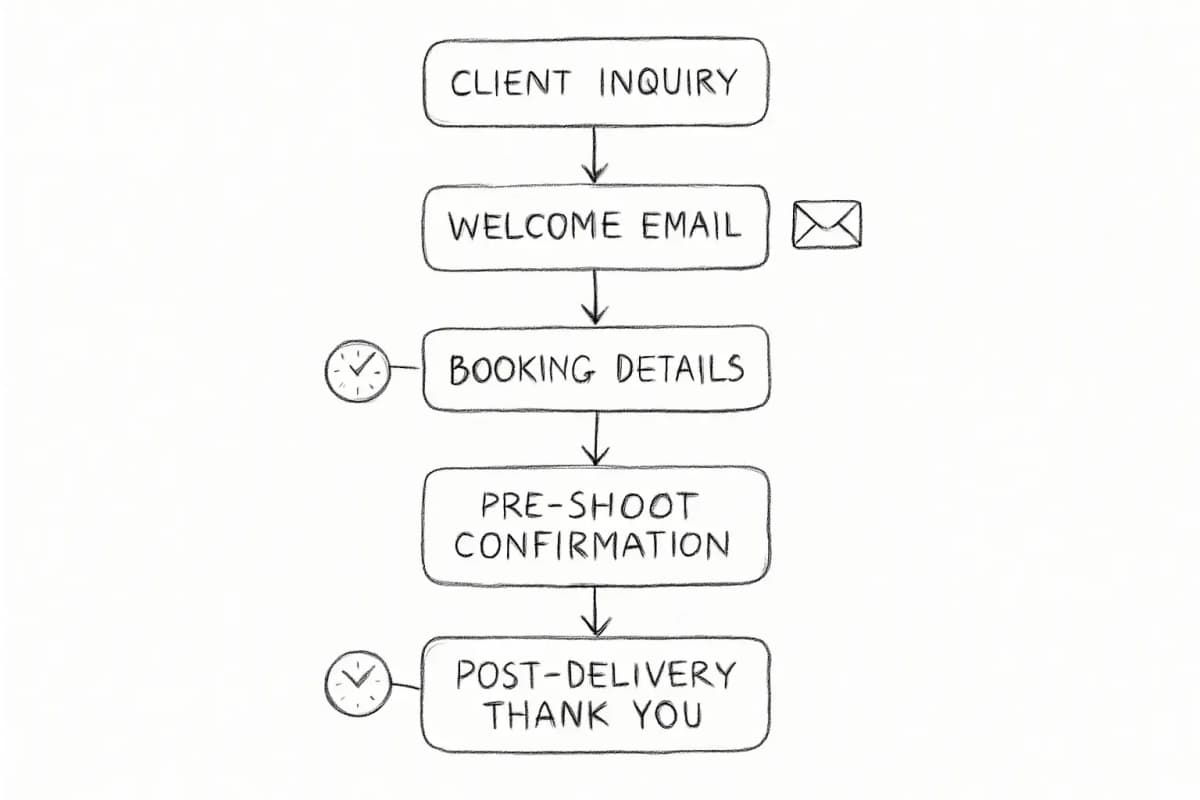
Not every touchpoint needs a bespoke email. There are three fundamental touchpoints with photography clients: inquiry, booking, and photo delivery. Depending on the client experience you offer, there may be additional emails in between, but these are the essentials. Below is an expanded set that covers the full client journey.
1. The Inquiry Response Template
Speed is a competitive advantage. When a prospective client fills out your contact form, the first email they receive from you shapes their entire perception of working with you. Your inquiry response should:
Acknowledge their specific project or date
Include a short summary of your style and approach
Link to a relevant portfolio gallery
Offer a clear next step, such as a discovery call link
A simple, personalized follow-up email is key to helping warm leads take the next step toward becoming clients. When you build on the personal connection you've already started, you increase your chances of converting them into a client.
2. The Booking Confirmation Template
Once a client signs a contract and pays a deposit, they need immediate reassurance. This email confirms the booking and sets expectations. Once the booking is confirmed, send a detailed email recapping everything, including the date, time, and location to confirm all session details, and deliverables, reiterating what is included in your package even if it was listed in the contract.
This is also a natural place to mention add-ons, such as albums, prints, or additional session hours, while the client's excitement is at its peak.
3. The Pre-Session Prep Template
Send this email 5 to 7 days before the session. It reduces client anxiety, lowers no-shows, and creates a better shoot day for everyone. Include:
Location details and parking instructions
What to wear guidance with example photos
What to expect from the day
A reminder of your communication preferences
Email templates save your client's time. Your clients won't have to spend time asking you questions if you answer them before they even ask. Templates also ensure you and your clients are on the same page throughout their whole experience.
4. The Gallery Delivery Template
This is the moment your client has been waiting for. Make it count. Do not just drop a link. Tell the story of the gallery. Share one or two images directly in the email body. Let them know how long the gallery will be available, how to download, and how to order prints.
Emails with images have a 42% higher CTR than those without. Balance is key, though. Include high-quality images that support your message and draw attention to your CTA. For a gallery delivery email, one or two strong images in the email body is more effective than a wall of thumbnails.
5. The Review Request Template
The 6 Essential Email Marketing Templates for Photographers
Not every touchpoint needs a bespoke email. There are three fundamental touchpoints with photography clients: inquiry, booking, and photo delivery. Depending on the client experience you offer, there may be additional emails in between, but these are the essentials. Below is an expanded set that covers the full client journey.
1. The Inquiry Response Template
Speed is a competitive advantage. When a prospective client fills out your contact form, the first email they receive from you shapes their entire perception of working with you. Your inquiry response should:
Acknowledge their specific project or date
Include a short summary of your style and approach
Link to a relevant portfolio gallery
Offer a clear next step, such as a discovery call link
A simple, personalized follow-up email is key to helping warm leads take the next step toward becoming clients. When you build on the personal connection you've already started, you increase your chances of converting them into a client.
2. The Booking Confirmation Template
Once a client signs a contract and pays a deposit, they need immediate reassurance. This email confirms the booking and sets expectations. Once the booking is confirmed, send a detailed email recapping everything, including the date, time, and location to confirm all session details, and deliverables, reiterating what is included in your package even if it was listed in the contract.
This is also a natural place to mention add-ons, such as albums, prints, or additional session hours, while the client's excitement is at its peak.
3. The Pre-Session Prep Template
Send this email 5 to 7 days before the session. It reduces client anxiety, lowers no-shows, and creates a better shoot day for everyone. Include:
Location details and parking instructions
What to wear guidance with example photos
What to expect from the day
A reminder of your communication preferences
Email templates save your client's time. Your clients won't have to spend time asking you questions if you answer them before they even ask. Templates also ensure you and your clients are on the same page throughout their whole experience.
4. The Gallery Delivery Template
This is the moment your client has been waiting for. Make it count. Do not just drop a link. Tell the story of the gallery. Share one or two images directly in the email body. Let them know how long the gallery will be available, how to download, and how to order prints.
Emails with images have a 42% higher CTR than those without. Balance is key, though. Include high-quality images that support your message and draw attention to your CTA. For a gallery delivery email, one or two strong images in the email body is more effective than a wall of thumbnails.
5. The Review Request Template
Reviews drive future bookings. Send this email within a week of gallery delivery, while the experience is still fresh. After delivering the final gallery, follow up with an email asking for a testimonial. You can include a few simple, guiding questions to make it easier for clients to write a thoughtful review, such as asking what their favorite part of the experience was or how they felt during the session.
Keep this email short. One warm paragraph, two guiding questions, and a direct link to your preferred review platform.
6. The Re-Engagement Template for Past Clients
It is easy to focus on new clients and overlook a simple way to boost income: reaching out to past clients. Brand photography clients need fresh visual content to keep their marketing up to date, and you can be the one to provide it.
This applies equally to wedding photographers (anniversary sessions), portrait photographers (yearly family sessions), and commercial photographers (seasonal content refreshes). A short, personal check-in email sent once or twice a year costs nothing and often reopens a booking conversation.
How to Design Photographer Email Templates That Actually Get Opened
A template is only as good as the engagement it generates. Design and structure matter as much as the content itself.
Match your visual brand. Most email marketing services offer a range of editable templates. Your email templates should align with your overall brand identity, including consistent colors, fonts, and design elements that your audience associates with your photography business and unique artistic vision.
Write subject lines that earn the open. It all starts with an intriguing subject line that will make your newsletter stand out in your subscriber's mailbox. It should be up to 60 characters, reflective of the email content, and intriguing enough for your target audience. For a gallery delivery email, something like "Your photos are ready, [First Name]" will outperform a generic "Gallery Notification" every time. For more on this topic, see our guide on email subject line best practices that boost open rates.
Optimize for mobile. 55% of email opens occur on mobile devices, reinforcing the importance of mobile-first email design. Every template you build should be tested on a smartphone before it goes live.
Include one clear CTA per email. Emails with too many links confuse subscribers about which action to take. Gallery delivery emails should link to the gallery. Booking confirmation emails should link to the questionnaire. Keep the action singular.
Segmenting Your List to Make Each Template More Effective
A wedding inquiry template sent to a commercial client looks tone-deaf. A family portrait upsell sent to someone who booked a corporate headshot misses entirely. Segmentation fixes this.
Instead of keeping your email subscribers all mushed together, segment your list based on your subscriber data, like demographics, client insights, subscriber engagement level, booking activity, or the types of email you send. Email segmentation can help you ensure you send the right messages at the right time. An email about "Pro tips for wedding photography" won't matter to previous wedding photography clients, but a reminder to book family photo sessions ahead of the holiday rush probably will.
The minimum viable segmentation for a photography business includes:
Reviews drive future bookings. Send this email within a week of gallery delivery, while the experience is still fresh. After delivering the final gallery, follow up with an email asking for a testimonial. You can include a few simple, guiding questions to make it easier for clients to write a thoughtful review, such as asking what their favorite part of the experience was or how they felt during the session.
Keep this email short. One warm paragraph, two guiding questions, and a direct link to your preferred review platform.
6. The Re-Engagement Template for Past Clients
It is easy to focus on new clients and overlook a simple way to boost income: reaching out to past clients. Brand photography clients need fresh visual content to keep their marketing up to date, and you can be the one to provide it.
This applies equally to wedding photographers (anniversary sessions), portrait photographers (yearly family sessions), and commercial photographers (seasonal content refreshes). A short, personal check-in email sent once or twice a year costs nothing and often reopens a booking conversation.
How to Design Photographer Email Templates That Actually Get Opened
A template is only as good as the engagement it generates. Design and structure matter as much as the content itself.
Match your visual brand. Most email marketing services offer a range of editable templates. Your email templates should align with your overall brand identity, including consistent colors, fonts, and design elements that your audience associates with your photography business and unique artistic vision.
Write subject lines that earn the open. It all starts with an intriguing subject line that will make your newsletter stand out in your subscriber's mailbox. It should be up to 60 characters, reflective of the email content, and intriguing enough for your target audience. For a gallery delivery email, something like "Your photos are ready, [First Name]" will outperform a generic "Gallery Notification" every time. For more on this topic, see our guide on email subject line best practices that boost open rates.
Optimize for mobile. 55% of email opens occur on mobile devices, reinforcing the importance of mobile-first email design. Every template you build should be tested on a smartphone before it goes live.
Include one clear CTA per email. Emails with too many links confuse subscribers about which action to take. Gallery delivery emails should link to the gallery. Booking confirmation emails should link to the questionnaire. Keep the action singular.
Segmenting Your List to Make Each Template More Effective
A wedding inquiry template sent to a commercial client looks tone-deaf. A family portrait upsell sent to someone who booked a corporate headshot misses entirely. Segmentation fixes this.
Instead of keeping your email subscribers all mushed together, segment your list based on your subscriber data, like demographics, client insights, subscriber engagement level, booking activity, or the types of email you send. Email segmentation can help you ensure you send the right messages at the right time. An email about "Pro tips for wedding photography" won't matter to previous wedding photography clients, but a reminder to book family photo sessions ahead of the holiday rush probably will.
The minimum viable segmentation for a photography business includes:
Leads (inquired but not booked)
Active clients (currently booked)
Past clients by session type (wedding, portrait, commercial)
Newsletter subscribers (opted in for general content)
Segmented campaigns can boost revenue by up to 760%. Even basic segmentation, like separating wedding leads from portrait clients, meaningfully improves every metric. For a deeper breakdown of list segmentation tactics, see our guide to email list segmentation strategies that boost ROI.
Building a Newsletter Template That Builds Long-Term Bookings
Beyond transactional emails, a regular newsletter keeps you present in subscribers' inboxes between sessions. If you're starting out with email marketing, consider sending a weekly, monthly, or quarterly newsletter to your clients. Include portfolio updates, behind-the-scenes glimpses of recent shoots, new offers, date availability, and calls to action to book a shoot or follow you on social media.
A newsletter template for photographers should include these consistent sections:
A personal note (2 to 3 sentences on what you've been shooting)
One portfolio highlight (a single image or small gallery excerpt with a link)
A practical tip or insight (camera settings, location ideas, what to wear)
A clear CTA (book a session, refer a friend, view the blog)
Email newsletters had a 40.08% open rate in 2024, lower than the 51.05% open rate recorded for automated emails. The gap between newsletters and automated emails comes down to relevance and personalization. The more your newsletter speaks to a specific audience segment, the closer its performance gets to automated email benchmarks.
A strong welcome sequence is also critical here. When someone joins your list, the first email they receive sets the tone for everything that follows. Review our guide on welcome email sequence best practices for a proven framework you can adapt for your photography business.
Automating Your Email Templates for Consistent Client Experience
Manual email management works until it doesn't. As your booking volume grows, templates without automation become a bottleneck. Automated emails are real-time, one-to-one emails sent when a client or customer takes a specific action. That means you can schedule emails for specific moments in the customer journey, like when a contract is signed or a deposit is made, ensuring your clients receive valuable emails at the exact moment they need them.
The most impactful automation sequences for photographers are:
Leads (inquired but not booked)
Active clients (currently booked)
Past clients by session type (wedding, portrait, commercial)
Newsletter subscribers (opted in for general content)
Segmented campaigns can boost revenue by up to 760%. Even basic segmentation, like separating wedding leads from portrait clients, meaningfully improves every metric. For a deeper breakdown of list segmentation tactics, see our guide to email list segmentation strategies that boost ROI.
Building a Newsletter Template That Builds Long-Term Bookings
Beyond transactional emails, a regular newsletter keeps you present in subscribers' inboxes between sessions. If you're starting out with email marketing, consider sending a weekly, monthly, or quarterly newsletter to your clients. Include portfolio updates, behind-the-scenes glimpses of recent shoots, new offers, date availability, and calls to action to book a shoot or follow you on social media.
A newsletter template for photographers should include these consistent sections:
A personal note (2 to 3 sentences on what you've been shooting)
One portfolio highlight (a single image or small gallery excerpt with a link)
A practical tip or insight (camera settings, location ideas, what to wear)
A clear CTA (book a session, refer a friend, view the blog)
Email newsletters had a 40.08% open rate in 2024, lower than the 51.05% open rate recorded for automated emails. The gap between newsletters and automated emails comes down to relevance and personalization. The more your newsletter speaks to a specific audience segment, the closer its performance gets to automated email benchmarks.
A strong welcome sequence is also critical here. When someone joins your list, the first email they receive sets the tone for everything that follows. Review our guide on welcome email sequence best practices for a proven framework you can adapt for your photography business.
Automating Your Email Templates for Consistent Client Experience
Manual email management works until it doesn't. As your booking volume grows, templates without automation become a bottleneck. Automated emails are real-time, one-to-one emails sent when a client or customer takes a specific action. That means you can schedule emails for specific moments in the customer journey, like when a contract is signed or a deposit is made, ensuring your clients receive valuable emails at the exact moment they need them.
The most impactful automation sequences for photographers are:
Post-inquiry sequence: Inquiry response, then a follow-up 3 days later if no reply
Annual re-engagement: Anniversary email or seasonal booking reminder
In 2024, automated emails drove 37% of all email-generated sales, despite accounting for just 2% of email volume. Setting up these sequences once means your client communication runs consistently whether you are on a shoot, editing, or on vacation.
In 2024, automated emails drove 37% of all email-generated sales, despite accounting for just 2% of email volume. Setting up these sequences once means your client communication runs consistently whether you are on a shoot, editing, or on vacation.
Measuring What Works and Improving Over Time
Templates are a starting point, not a fixed system. Email templates should be a springboard, not a rigid script. The most successful photographers continually refine their email strategies, experimenting with different templates and approaches to best suit their unique clientele and brand voice.
Track these metrics for each template type:
Open rate (benchmark: 27% or higher for photography-related content)
Click-through rate (benchmark: 2 to 3% for newsletters)
Reply rate (especially useful for inquiry and re-engagement emails)
Booking conversion rate (how many inquiry emails lead to confirmed sessions)
Once you create your first email campaign, track metrics like deliverability rate, inbox placement rate, open rate, and click-through rate. When you're just starting email marketing, these metrics give you a baseline of where you are starting.
The core set includes an inquiry response, booking confirmation, pre-session prep, gallery delivery, review request, and past-client re-engagement email. These six templates cover the complete client lifecycle and handle the most common communication touchpoints in a photography business.
How often should photographers send marketing emails?
For most photography businesses, a monthly newsletter plus event-triggered automated emails is the right cadence. If you're just starting out with email marketing, consider sending a weekly, monthly, or quarterly newsletter to your clients. The key is consistency. One well-crafted email per month outperforms sporadic sends of varying quality.
What email marketing platform works best for photographers?
Some email marketing services, such as MailerLite, offer photography-specific templates, which can help make it easier to get your email campaigns up and running. Flodesk is also widely used by photographers for its visual design tools. When choosing a platform, prioritize a drag-and-drop editor, list segmentation, and basic automation capabilities. Email marketing happens to be one of the most cost-effective marketing channels, with paid subscriptions starting from as low as $5 per month.
How do I grow my email list as a photographer?
Measuring What Works and Improving Over Time
Templates are a starting point, not a fixed system. Email templates should be a springboard, not a rigid script. The most successful photographers continually refine their email strategies, experimenting with different templates and approaches to best suit their unique clientele and brand voice.
Track these metrics for each template type:
Open rate (benchmark: 27% or higher for photography-related content)
Click-through rate (benchmark: 2 to 3% for newsletters)
Reply rate (especially useful for inquiry and re-engagement emails)
Booking conversion rate (how many inquiry emails lead to confirmed sessions)
Once you create your first email campaign, track metrics like deliverability rate, inbox placement rate, open rate, and click-through rate. When you're just starting email marketing, these metrics give you a baseline of where you are starting.
The core set includes an inquiry response, booking confirmation, pre-session prep, gallery delivery, review request, and past-client re-engagement email. These six templates cover the complete client lifecycle and handle the most common communication touchpoints in a photography business.
How often should photographers send marketing emails?
For most photography businesses, a monthly newsletter plus event-triggered automated emails is the right cadence. If you're just starting out with email marketing, consider sending a weekly, monthly, or quarterly newsletter to your clients. The key is consistency. One well-crafted email per month outperforms sporadic sends of varying quality.
What email marketing platform works best for photographers?
Some email marketing services, such as MailerLite, offer photography-specific templates, which can help make it easier to get your email campaigns up and running. Flodesk is also widely used by photographers for its visual design tools. When choosing a platform, prioritize a drag-and-drop editor, list segmentation, and basic automation capabilities. Email marketing happens to be one of the most cost-effective marketing channels, with paid subscriptions starting from as low as $5 per month.
How do I grow my email list as a photographer?
To attract new clients, offer a free download on your website that solves a quick problem for your ideal client. For example, if you are a brand photographer, you could create a free download with location guides for your area. Your ideal client might search for this and sign up for your list to access it. From there, you can nurture their interest with your newsletter, build trust, and eventually convert them into clients. You can also add a signup link to your social media bio and collect emails at every in-person event or shoot.
Should photographer email templates be image-heavy or text-based?
A balanced approach works best. Image-based emails receive a 4.84% CTR while text-based emails receive a CTR of 1.64%, and image-based emails overall have a higher open rate of 30.27%. For gallery delivery and newsletter emails, one or two strong images improve engagement. For inquiry responses and review requests, a clean, mostly text email often feels more personal and authentic, which is exactly the tone photographers want to set.
No comments yet. Be the first!
To attract new clients, offer a free download on your website that solves a quick problem for your ideal client. For example, if you are a brand photographer, you could create a free download with location guides for your area. Your ideal client might search for this and sign up for your list to access it. From there, you can nurture their interest with your newsletter, build trust, and eventually convert them into clients. You can also add a signup link to your social media bio and collect emails at every in-person event or shoot.
Should photographer email templates be image-heavy or text-based?
A balanced approach works best. Image-based emails receive a 4.84% CTR while text-based emails receive a CTR of 1.64%, and image-based emails overall have a higher open rate of 30.27%. For gallery delivery and newsletter emails, one or two strong images improve engagement. For inquiry responses and review requests, a clean, mostly text email often feels more personal and authentic, which is exactly the tone photographers want to set.