
HomeBlogEmail Analytics & PerformanceAI Email Marketing Analytics: Track ROI Like a Pro
Email Analytics & Performance

AI Email Marketing Analytics: Track ROI Like a Pro

Learn how AI email marketing analytics reveal customer behavior, predict engagement, and boost ROI. Real data, actionable insights, and tools that work.

M

Marcus Webb

July 17, 2026

14 min read
HomeBlogEmail Analytics & PerformanceAI Email Marketing Analytics: Track ROI Like a Pro
Email Analytics & Performance

AI Email Marketing Analytics: Track ROI Like a Pro

Learn how AI email marketing analytics reveal customer behavior, predict engagement, and boost ROI. Real data, actionable insights, and tools that work.

M

Marcus Webb

July 17, 2026

14 min read
Share:
Share:
#AI Tools#Industry Data#Marketing Analytics#ROI Tracking
Illustration for ai email marketing analytics

Stay in the loop

Get the latest posts delivered straight to your inbox. No spam, unsubscribe anytime.

Most email marketers track the wrong numbers. They obsess over open rates while Apple Mail Privacy Protection silently inflates those figures by 15 to 35%, according to Litmus{rel="nofollow"}, and they report clicks without connecting them to revenue. AI email marketing analytics changes that equation by shifting the entire measurement framework from vanity metrics to verifiable business outcomes.

If your goal is to understand what your campaigns actually earn, this guide covers the metrics that matter, the AI capabilities that surface them, and the practical steps to tie every send back to real ROI.


Key Takeaways

  • Businesses using AI in email campaigns report an average ROI increase of 21%.
  • Open rates for senders with a meaningful iOS audience are now inflated by 15 to 35%, and by early 2025, Apple Mail accounts for roughly 58% of all email opens globally. Click rate and revenue per recipient are now the reliable primary metrics.
  • AI-driven email marketing analytics uses machine learning algorithms to automatically analyze campaign data, predict subscriber behavior, and optimize performance in real time. Unlike traditional analytics, which report on past performance, AI-powered analytics identify patterns, predict future outcomes, and provide actionable recommendations.
  • Automated emails drove 37% of all ecommerce email revenue in 2024 despite representing just 2% of email volume.
  • Nearly 70% of email marketers expect up to half of their email operations to be AI-driven by the end of 2026.

Why Standard Email Analytics Are No Longer Enough

Traditional email reporting gives you a snapshot of the past. You see what opened, what clicked, and what bounced. What it cannot tell you is who is likely to buy next, when your list is drifting toward churn, or which campaign touchpoints actually influenced a closed deal.

Email marketing analytics have evolved far beyond open rates and click-throughs. Today's AI-powered analytics can predict which subscribers are most likely to convert, optimize send times for maximum engagement, and track every dollar of revenue back to specific campaigns.

Stay in the loop

Get the latest posts delivered straight to your inbox. No spam, unsubscribe anytime.

Most email marketers track the wrong numbers. They obsess over open rates while Apple Mail Privacy Protection silently inflates those figures by 15 to 35%, according to Litmus{rel="nofollow"}, and they report clicks without connecting them to revenue. AI email marketing analytics changes that equation by shifting the entire measurement framework from vanity metrics to verifiable business outcomes.

If your goal is to understand what your campaigns actually earn, this guide covers the metrics that matter, the AI capabilities that surface them, and the practical steps to tie every send back to real ROI.


Key Takeaways

  • Businesses using AI in email campaigns report an average ROI increase of 21%.
  • Open rates for senders with a meaningful iOS audience are now inflated by 15 to 35%, and by early 2025, Apple Mail accounts for roughly 58% of all email opens globally. Click rate and revenue per recipient are now the reliable primary metrics.
  • AI-driven email marketing analytics uses machine learning algorithms to automatically analyze campaign data, predict subscriber behavior, and optimize performance in real time. Unlike traditional analytics, which report on past performance, AI-powered analytics identify patterns, predict future outcomes, and provide actionable recommendations.
  • Automated emails drove 37% of all ecommerce email revenue in 2024 despite representing just 2% of email volume.
  • Nearly 70% of email marketers expect up to half of their email operations to be AI-driven by the end of 2026.

Why Standard Email Analytics Are No Longer Enough

Traditional email reporting gives you a snapshot of the past. You see what opened, what clicked, and what bounced. What it cannot tell you is who is likely to buy next, when your list is drifting toward churn, or which campaign touchpoints actually influenced a closed deal.

Email marketing analytics have evolved far beyond open rates and click-throughs. Today's AI-powered analytics can predict which subscribers are most likely to convert, optimize send times for maximum engagement, and track every dollar of revenue back to specific campaigns.

The shift matters because the stakes are high. On average, email marketing delivers a return of between $36 and $42 for every $1 spent, the highest ROI of any digital marketing channel. For context, paid search returns $2 per $1, social advertising $2.80, and display ads $1.35. Leaving that kind of channel on autopilot with basic reporting is a measurable missed opportunity.

The email marketing analytics best practices that worked in 2020 no longer apply to a landscape where Apple MPP distorts open data and AI can process behavioral signals at a scale no analyst can match manually.


The Apple MPP Problem: Why Open Rates Are Broken

Before going further into what AI analytics can do, it is worth understanding why the old anchor metric needs to go.

Apple's Mail Privacy Protection (MPP), introduced in September 2021, prevents senders from knowing if and when an email is opened by hiding IP addresses and preloading email content. This means that even if an Apple MPP user does not actually open an email, it will still appear as opened in the sender's analytics.

If your automation platform uses "opened email in last 30 days" as a proxy for active engagement, your segments now include a significant share of contacts who have not genuinely interacted with your brand in months. This degrades sender reputation over time, because you are mailing unengaged recipients who eventually mark you as spam.

The fix is straightforward. Leading email programs in 2025 have moved to a composite measurement framework that removes open rate from any decision-making role. The metrics that now anchor performance assessment include click-to-open rate on non-Apple segments. For the portion of your list using Gmail, Outlook, or other non-MPP clients, open rate still functions.

A reliable alternative: the click rate (total clicks divided by emails delivered) is the simplest universal replacement. It requires no client segmentation and reflects genuine engagement. According to Mailchimp's 2025 benchmark data, the cross-industry median click rate sits at 2.3%, with top performers in ecommerce and SaaS reaching 4 to 6%.


What AI Email Marketing Analytics Actually Does

AI-based email marketing uses machine learning and automation to analyze customer behavior, optimize send times, personalize content, and predict engagement. Instead of guessing, marketers get data-driven insights that improve open rates, conversions, and deliverability.

Specifically, the most capable AI analytics platforms operate across five functions:

1. Predictive engagement scoring Predictive engagement scoring identifies subscribers likely to convert. Content intelligence analytics measures which subject lines and content drive action. Send time optimization accuracy validates when AI-recommended send times outperform manual scheduling. Deliverability metrics track inbox placement rates using AI pattern detection. Revenue attribution analytics connects email touchpoints to closed deals.

2. Send-time optimization (STO) Predictive send time optimization is the use of AI to determine the best moment to deliver an email to each individual recipient. Instead of sending campaigns at a fixed time, STO evaluates historical engagement patterns and adjusts delivery based on when a person is most likely to open or click.

The shift matters because the stakes are high. On average, email marketing delivers a return of between $36 and $42 for every $1 spent, the highest ROI of any digital marketing channel. For context, paid search returns $2 per $1, social advertising $2.80, and display ads $1.35. Leaving that kind of channel on autopilot with basic reporting is a measurable missed opportunity.

The email marketing analytics best practices that worked in 2020 no longer apply to a landscape where Apple MPP distorts open data and AI can process behavioral signals at a scale no analyst can match manually.


The Apple MPP Problem: Why Open Rates Are Broken

Before going further into what AI analytics can do, it is worth understanding why the old anchor metric needs to go.

Apple's Mail Privacy Protection (MPP), introduced in September 2021, prevents senders from knowing if and when an email is opened by hiding IP addresses and preloading email content. This means that even if an Apple MPP user does not actually open an email, it will still appear as opened in the sender's analytics.

If your automation platform uses "opened email in last 30 days" as a proxy for active engagement, your segments now include a significant share of contacts who have not genuinely interacted with your brand in months. This degrades sender reputation over time, because you are mailing unengaged recipients who eventually mark you as spam.

The fix is straightforward. Leading email programs in 2025 have moved to a composite measurement framework that removes open rate from any decision-making role. The metrics that now anchor performance assessment include click-to-open rate on non-Apple segments. For the portion of your list using Gmail, Outlook, or other non-MPP clients, open rate still functions.

A reliable alternative: the click rate (total clicks divided by emails delivered) is the simplest universal replacement. It requires no client segmentation and reflects genuine engagement. According to Mailchimp's 2025 benchmark data, the cross-industry median click rate sits at 2.3%, with top performers in ecommerce and SaaS reaching 4 to 6%.


What AI Email Marketing Analytics Actually Does

AI-based email marketing uses machine learning and automation to analyze customer behavior, optimize send times, personalize content, and predict engagement. Instead of guessing, marketers get data-driven insights that improve open rates, conversions, and deliverability.

Specifically, the most capable AI analytics platforms operate across five functions:

1. Predictive engagement scoring Predictive engagement scoring identifies subscribers likely to convert. Content intelligence analytics measures which subject lines and content drive action. Send time optimization accuracy validates when AI-recommended send times outperform manual scheduling. Deliverability metrics track inbox placement rates using AI pattern detection. Revenue attribution analytics connects email touchpoints to closed deals.

2. Send-time optimization (STO) Predictive send time optimization is the use of AI to determine the best moment to deliver an email to each individual recipient. Instead of sending campaigns at a fixed time, STO evaluates historical engagement patterns and adjusts delivery based on when a person is most likely to open or click.

Individual-level send-time optimization calculates each subscriber's personal open probability window based on click behavior, conversion timing, and reply patterns. Modern STO has evolved beyond open rates due to Apple Mail Privacy Protection, now using click and conversion signals instead.

3. Behavioral segmentation Smart segmentation automatically creates segments based on behavioral patterns rather than manual rules, finding groups you would not have thought to create. Traditional subscriber segmentation requires you to define the rules. AI segmentation discovers the rules.

4. Revenue attribution Multi-touch attribution connects email engagement to CRM deal stages by tracking the customer journey across touchpoints and giving credit to all the interactions that influenced the outcome. Incrementality testing isolates the true impact of campaigns by comparing outcomes for recipients who received emails against a control group who did not, separating genuine lift from coincidental conversion.

5. Churn prediction Instead of relying on intuition and manual processes, AI analyzes subscriber behavior, predicts optimal timing, generates personalized content, and tracks revenue attribution automatically. Platforms with mature churn models can flag at-risk subscribers weeks before they disengage, giving you a window to intervene with targeted retention campaigns.


The Metrics That Actually Connect to ROI

Once your analytics layer is AI-powered, the metrics you track should change. Here is a practical framework:

Individual-level send-time optimization calculates each subscriber's personal open probability window based on click behavior, conversion timing, and reply patterns. Modern STO has evolved beyond open rates due to Apple Mail Privacy Protection, now using click and conversion signals instead.

3. Behavioral segmentation Smart segmentation automatically creates segments based on behavioral patterns rather than manual rules, finding groups you would not have thought to create. Traditional subscriber segmentation requires you to define the rules. AI segmentation discovers the rules.

4. Revenue attribution Multi-touch attribution connects email engagement to CRM deal stages by tracking the customer journey across touchpoints and giving credit to all the interactions that influenced the outcome. Incrementality testing isolates the true impact of campaigns by comparing outcomes for recipients who received emails against a control group who did not, separating genuine lift from coincidental conversion.

5. Churn prediction Instead of relying on intuition and manual processes, AI analyzes subscriber behavior, predicts optimal timing, generates personalized content, and tracks revenue attribution automatically. Platforms with mature churn models can flag at-risk subscribers weeks before they disengage, giving you a window to intervene with targeted retention campaigns.


The Metrics That Actually Connect to ROI

Once your analytics layer is AI-powered, the metrics you track should change. Here is a practical framework:

MetricWhy It MattersAI Advantage
Revenue per recipient (RPR)Ties every send to direct incomeSurfaces which segments generate the highest RPR
Click rateReflects genuine, MPP-unaffected engagementAI isolates the highest-click content patterns
Conversion rateMeasures campaign-to-purchase completionPredictive models identify pre-conversion behavior
Customer lifetime value (CLV)Forecasts long-term subscriber valueAI detects CLV trajectories 60 to 90 days in advance
Deliverability and inbox placementDetermines whether your emails arriveAI flags reputation risks before they affect sending
Pipeline influenceConnects emails to CRM deal progressionClosed-loop attribution maps every touchpoint
MetricWhy It MattersAI Advantage
Revenue per recipient (RPR)Ties every send to direct incomeSurfaces which segments generate the highest RPR
Click rateReflects genuine, MPP-unaffected engagementAI isolates the highest-click content patterns
Conversion rateMeasures campaign-to-purchase completionPredictive models identify pre-conversion behavior
Customer lifetime value (CLV)Forecasts long-term subscriber valueAI detects CLV trajectories 60 to 90 days in advance
Deliverability and inbox placementDetermines whether your emails arriveAI flags reputation risks before they affect sending
Pipeline influenceConnects emails to CRM deal progressionClosed-loop attribution maps every touchpoint

Connect AI-driven campaigns to revenue by tracking attribution, pipeline impact, and closed deals. Engagement metrics tell part of the story. Revenue metrics tell the one that matters to leadership.

For a deeper look at building out these measurement layers, the guide on email list segmentation strategies covers the segmentation side that feeds accurate attribution.


How to Implement AI Analytics Without Starting from Scratch

The most common mistake teams make is treating AI analytics as an all-or-nothing platform switch. It is not. The most important implementation principle is to start with high-impact, low-risk applications. AI-powered send-time optimization and subject line testing provide immediate value with minimal downside. Once teams build confidence and see results, they can tackle more complex applications like predictive content generation and cross-channel orchestration.

A phased approach that works in practice:

Connect AI-driven campaigns to revenue by tracking attribution, pipeline impact, and closed deals. Engagement metrics tell part of the story. Revenue metrics tell the one that matters to leadership.

For a deeper look at building out these measurement layers, the guide on email list segmentation strategies covers the segmentation side that feeds accurate attribution.


How to Implement AI Analytics Without Starting from Scratch

The most common mistake teams make is treating AI analytics as an all-or-nothing platform switch. It is not. The most important implementation principle is to start with high-impact, low-risk applications. AI-powered send-time optimization and subject line testing provide immediate value with minimal downside. Once teams build confidence and see results, they can tackle more complex applications like predictive content generation and cross-channel orchestration.

A phased approach that works in practice:

  1. Audit your current metrics. Remove open rate from primary KPIs. Set click rate, RPR, and conversion rate as your baseline measures.
  2. Enable send-time optimization. Most modern platforms (Klaviyo, HubSpot, ActiveCampaign, Mailchimp) have STO built in. Send-time optimization takes 4 to 6 weeks to accumulate enough data for reliable predictions. Run a 50/50 split test against fixed send times and measure by click rate.
  3. Connect email data to your CRM. Employ a system for analytics, iteration, and retargeting. This system should connect your email performance to web and app conversions as well as commerce and sales data to optimize business impact.
  4. Implement predictive segmentation. Predictive segmentation shows its full impact after 8 to 10 weeks. Use behavioral signals (browse history, purchase recency, email click patterns) rather than static demographic data.
  5. Build a holdout control group. Maintaining a 5 to 10% holdout that receives standard campaigns without AI optimization provides the baseline for measuring the actual contribution of the AI system rather than attributing all performance changes to AI improvements.
  1. Audit your current metrics. Remove open rate from primary KPIs. Set click rate, RPR, and conversion rate as your baseline measures.
  2. Enable send-time optimization. Most modern platforms (Klaviyo, HubSpot, ActiveCampaign, Mailchimp) have STO built in. Send-time optimization takes 4 to 6 weeks to accumulate enough data for reliable predictions. Run a 50/50 split test against fixed send times and measure by click rate.
  3. Connect email data to your CRM. Employ a system for analytics, iteration, and retargeting. This system should connect your email performance to web and app conversions as well as commerce and sales data to optimize business impact.
  4. Implement predictive segmentation. Predictive segmentation shows its full impact after 8 to 10 weeks. Use behavioral signals (browse history, purchase recency, email click patterns) rather than static demographic data.
  5. Build a holdout control group. Maintaining a 5 to 10% holdout that receives standard campaigns without AI optimization provides the baseline for measuring the actual contribution of the AI system rather than attributing all performance changes to AI improvements.

AI analytics tools automate attribution, revenue attribution, and performance reporting, reducing the analytical burden on marketing teams while improving reporting accuracy.


Choosing the Right AI Analytics Platform

AI is especially good at sifting through large amounts of email data and calling out patterns most teams would not catch on their own. At least 41% of companies are now using AI-driven analytics in some form. Many start with basics like segmentation and targeting, then move into things like send-time optimization (34%), behavioral prediction (32%), and journey mapping (30%).

When evaluating platforms, prioritize:

  • Explainability. Can the tool explain why it is making a recommendation, or is it a black box? Opaque suggestions are hard to act on and harder to trust.
  • CRM integration. Closed-loop revenue attribution only works if your email platform talks to your sales system. Platforms like HubSpot and ActiveCampaign are built for this natively.
  • MPP-adjusted STO. If your ESP offers machine-learning-based send-time features, confirm with the vendor whether the model has been updated to exclude MPP-generated opens.
  • Predictive analytics depth. Basic platforms offer segmentation. Advanced platforms surface churn scores, purchase probability, and CLV forecasts per subscriber.

For teams building out broader automation alongside analytics, the email marketing automation CRM setup guide covers the integration architecture in detail.


The Compounding Effect of AI on Email ROI

The numbers behind AI adoption in email are not marginal improvements. Brands using AI-driven personalization report up to 42% higher revenue, with click-through rates exceeding 13%.

AI-personalized emails generate 3.2 times more revenue per recipient. Programs integrating AI across the full workflow (dynamic content, send-time optimization, predictive segmentation) achieve 41% higher revenue than manual campaigns. The compounding effect of multiple AI layers produces a 3.2x revenue-per-recipient lift compared to batch-and-blast approaches.

The compounding part is what separates teams who deploy AI analytics early from those who wait. The email platform executes sends at individually predicted optimal times. Engagement data flows back into the data warehouse to improve both models on the next cycle. Every campaign makes the next one more precise.

AI analytics tools automate attribution, revenue attribution, and performance reporting, reducing the analytical burden on marketing teams while improving reporting accuracy.


Choosing the Right AI Analytics Platform

AI is especially good at sifting through large amounts of email data and calling out patterns most teams would not catch on their own. At least 41% of companies are now using AI-driven analytics in some form. Many start with basics like segmentation and targeting, then move into things like send-time optimization (34%), behavioral prediction (32%), and journey mapping (30%).

When evaluating platforms, prioritize:

  • Explainability. Can the tool explain why it is making a recommendation, or is it a black box? Opaque suggestions are hard to act on and harder to trust.
  • CRM integration. Closed-loop revenue attribution only works if your email platform talks to your sales system. Platforms like HubSpot and ActiveCampaign are built for this natively.
  • MPP-adjusted STO. If your ESP offers machine-learning-based send-time features, confirm with the vendor whether the model has been updated to exclude MPP-generated opens.
  • Predictive analytics depth. Basic platforms offer segmentation. Advanced platforms surface churn scores, purchase probability, and CLV forecasts per subscriber.

For teams building out broader automation alongside analytics, the email marketing automation CRM setup guide covers the integration architecture in detail.


The Compounding Effect of AI on Email ROI

The numbers behind AI adoption in email are not marginal improvements. Brands using AI-driven personalization report up to 42% higher revenue, with click-through rates exceeding 13%.

AI-personalized emails generate 3.2 times more revenue per recipient. Programs integrating AI across the full workflow (dynamic content, send-time optimization, predictive segmentation) achieve 41% higher revenue than manual campaigns. The compounding effect of multiple AI layers produces a 3.2x revenue-per-recipient lift compared to batch-and-blast approaches.

The compounding part is what separates teams who deploy AI analytics early from those who wait. The email platform executes sends at individually predicted optimal times. Engagement data flows back into the data warehouse to improve both models on the next cycle. Every campaign makes the next one more precise.

76% of companies saw ROI from marketing automation within a year. The return is not hypothetical and it is not slow. For teams already investing in AI email marketing personalization techniques, layering in analytics-driven attribution is the natural next step toward full ROI accountability.
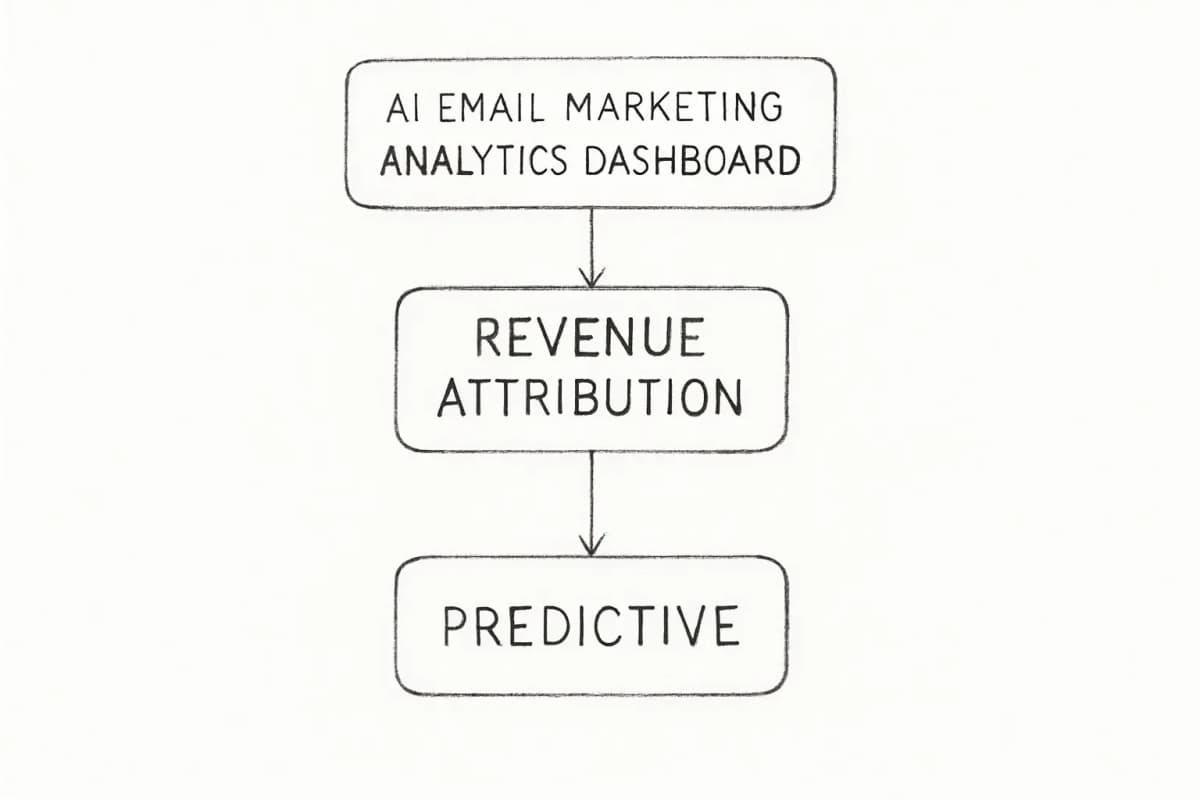

A visualization of an AI email marketing analytics dashboard showing revenue attribution, predictive


Frequently Asked Questions

What is AI email marketing analytics?

AI-driven email marketing analytics uses artificial intelligence and machine learning algorithms to automatically analyze email campaign data, predict subscriber behavior, and optimize marketing performance in real time. Unlike traditional analytics, which report on past performance, AI-powered analytics identify patterns, predict future outcomes, and provide actionable recommendations to enhance engagement and drive revenue growth.

Which metrics should I track instead of open rates?

Because Apple MPP inflates open data, metrics like click-through rates, reply rates, and conversions are now more reliable indicators of success. For revenue-focused reporting, prioritize revenue per recipient, click rate, conversion rate, and pipeline influence tracked through CRM attribution.

How long does it take for AI email analytics to show results?

Results vary by feature. Dynamic content delivers measurable lift in the first 2 to 3 campaigns. Send-time optimization takes 4 to 6 weeks to accumulate enough data for reliable predictions. Predictive segmentation shows its full impact after 8 to 10 weeks.

Do I need a large email list for AI analytics to work?

Not necessarily, but volume helps. With fewer than 500 customers and 6 months of purchase history, predictions can be unreliable noise. But for established stores with sufficient data, the predictions are genuinely actionable and can directly impact revenue attribution. For smaller lists, start with send-time optimization and content intelligence before moving into predictive segmentation.

What is the average ROI impact of using AI in email marketing?

Businesses using AI in email campaigns report an average ROI increase of 21%. More specifically, AI has delivered 41% more email revenue and 47% higher ad click-through rates, with AI-using companies reporting 22% higher ROI versus traditional methods. Results depend heavily on how well AI is integrated across segmentation, content, timing, and attribution, not just deployed as a single point solution.


76% of companies saw ROI from marketing automation within a year. The return is not hypothetical and it is not slow. For teams already investing in AI email marketing personalization techniques, layering in analytics-driven attribution is the natural next step toward full ROI accountability.


A visualization of an AI email marketing analytics dashboard showing revenue attribution, predictive


Frequently Asked Questions

What is AI email marketing analytics?

AI-driven email marketing analytics uses artificial intelligence and machine learning algorithms to automatically analyze email campaign data, predict subscriber behavior, and optimize marketing performance in real time. Unlike traditional analytics, which report on past performance, AI-powered analytics identify patterns, predict future outcomes, and provide actionable recommendations to enhance engagement and drive revenue growth.

Which metrics should I track instead of open rates?

Because Apple MPP inflates open data, metrics like click-through rates, reply rates, and conversions are now more reliable indicators of success. For revenue-focused reporting, prioritize revenue per recipient, click rate, conversion rate, and pipeline influence tracked through CRM attribution.

How long does it take for AI email analytics to show results?

Results vary by feature. Dynamic content delivers measurable lift in the first 2 to 3 campaigns. Send-time optimization takes 4 to 6 weeks to accumulate enough data for reliable predictions. Predictive segmentation shows its full impact after 8 to 10 weeks.

Do I need a large email list for AI analytics to work?

Not necessarily, but volume helps. With fewer than 500 customers and 6 months of purchase history, predictions can be unreliable noise. But for established stores with sufficient data, the predictions are genuinely actionable and can directly impact revenue attribution. For smaller lists, start with send-time optimization and content intelligence before moving into predictive segmentation.

What is the average ROI impact of using AI in email marketing?

Businesses using AI in email campaigns report an average ROI increase of 21%. More specifically, AI has delivered 41% more email revenue and 47% higher ad click-through rates, with AI-using companies reporting 22% higher ROI versus traditional methods. Results depend heavily on how well AI is integrated across segmentation, content, timing, and attribution, not just deployed as a single point solution.

No comments yet. Be the first!

Leave a comment

Comments are reviewed before publishing.

No comments yet. Be the first!

Leave a comment

Comments are reviewed before publishing.