
HomeBlogEmail Marketing StrategyAI-Based Email Marketing: Strategy and ROI
Email Marketing Strategy

AI-Based Email Marketing: Strategy and ROI

Learn how AI transforms email marketing with smarter segmentation, personalization, and automation. Boost open rates and conversions with data-driven tactics.

M

Marcus Webb

July 14, 2026

1 min read
HomeBlogEmail Marketing StrategyAI-Based Email Marketing: Strategy and ROI
Email Marketing Strategy

AI-Based Email Marketing: Strategy and ROI

Learn how AI transforms email marketing with smarter segmentation, personalization, and automation. Boost open rates and conversions with data-driven tactics.

M

Marcus Webb

July 14, 2026

1 min read
Share:
Share:
#AI and Automation#Email Personalization#Marketing Technology
Illustration for ai-based email marketing

Stay in the loop

Get the latest posts delivered straight to your inbox. No spam, unsubscribe anytime.

AI-based email marketing is not just a trend. It is the clearest path to measurable revenue improvement available to email marketers right now. Email already delivers between $36 and $42 for every $1 spent, outperforming paid search, social advertising, and display ads combined. When you layer AI on top of that foundation, the results compound. Marketers who use AI for email personalization report a 41% revenue increase and a 13.44% higher click-through rate. This post breaks down exactly how AI changes the mechanics of email marketing, and what strategy and measurement framework actually drives those results.


Key Takeaways

  • Nearly two-thirds of marketers (63%) now use AI tools for email campaigns, with 87% of AI adopters specifically applying it to email marketing.
  • Companies using AI-driven email strategies see up to 41% more revenue than those using traditional batch-and-blast sends.
  • 76% of marketing teams now produce and send a marketing email within 3 days; in 2024, 62% of teams took two weeks or more for a single email.
  • AI send-time optimization lifts open rates by 26%, with click-through rates improving by 41% compared to fixed-schedule sends.
  • According to the 2025 CMO Survey, 1 in 6 marketing activities are currently automated or enhanced by AI, with up to half expected to be automated within three years.

What AI-Based Email Marketing Actually Means

The term gets used loosely, so let's be precise. AI-based email marketing uses machine learning and automation to analyze customer behavior, optimize send times, personalize content, and predict engagement, giving marketers data-driven insights that improve open rates, conversions, and deliverability.

That definition covers four distinct layers of capability:

  1. Predictive analytics: Forecasting which subscribers will open, click, or convert based on behavioral patterns.
  2. Generative AI: Producing subject lines, body copy, and CTAs tailored to individual segments.
  3. Dynamic segmentation: Grouping subscribers by real-time behavior rather than static list attributes.
  4. Send-time optimization: Delivering each email at the moment a specific subscriber is most likely to engage.

Stay in the loop

Get the latest posts delivered straight to your inbox. No spam, unsubscribe anytime.

AI-based email marketing is not just a trend. It is the clearest path to measurable revenue improvement available to email marketers right now. Email already delivers between $36 and $42 for every $1 spent, outperforming paid search, social advertising, and display ads combined. When you layer AI on top of that foundation, the results compound. Marketers who use AI for email personalization report a 41% revenue increase and a 13.44% higher click-through rate. This post breaks down exactly how AI changes the mechanics of email marketing, and what strategy and measurement framework actually drives those results.


Key Takeaways

  • Nearly two-thirds of marketers (63%) now use AI tools for email campaigns, with 87% of AI adopters specifically applying it to email marketing.
  • Companies using AI-driven email strategies see up to 41% more revenue than those using traditional batch-and-blast sends.
  • 76% of marketing teams now produce and send a marketing email within 3 days; in 2024, 62% of teams took two weeks or more for a single email.
  • AI send-time optimization lifts open rates by 26%, with click-through rates improving by 41% compared to fixed-schedule sends.
  • According to the 2025 CMO Survey, 1 in 6 marketing activities are currently automated or enhanced by AI, with up to half expected to be automated within three years.

What AI-Based Email Marketing Actually Means

The term gets used loosely, so let's be precise. AI-based email marketing uses machine learning and automation to analyze customer behavior, optimize send times, personalize content, and predict engagement, giving marketers data-driven insights that improve open rates, conversions, and deliverability.

That definition covers four distinct layers of capability:

  1. Predictive analytics: Forecasting which subscribers will open, click, or convert based on behavioral patterns.
  2. Generative AI: Producing subject lines, body copy, and CTAs tailored to individual segments.
  3. Dynamic segmentation: Grouping subscribers by real-time behavior rather than static list attributes.
  4. Send-time optimization: Delivering each email at the moment a specific subscriber is most likely to engage.

Predictive AI answers the operational questions (when to send, to whom, at what frequency), while generative AI answers the creative questions (what subject line to test, how to personalize body copy, which call-to-action variant to try). Solving both problems with the same campaign produces compounding improvements.


AI-Powered Personalization: Beyond First-Name Tokens

Traditional personalization meant inserting a subscriber's first name. AI goes well beyond that. It analyzes browsing history, purchase behavior, and engagement patterns to recommend products, trigger abandoned cart reminders, and send tailored offers.

The commercial case is well-documented. Brands using AI-driven personalization report up to 42% higher revenue, with click-through rates exceeding 13%, lifting overall ROI by nearly 20%.

Unlike static lists based on fixed demographic filters, AI-driven segmentation continuously updates as new data flows in, meaning segments reflect current interests and behaviors, allowing marketers to target audiences at the moments that matter most.

For a practical look at how this plays out across different campaign types, see our guide to AI email marketing personalization techniques.

Subject lines are one of the fastest wins. AI-powered subject line tools can increase conversion rates by roughly 15 to 30%, while personalized subject lines can lift open rates by 41%. The mechanism is straightforward: AI-powered marketing platforms analyze historical performance data and customer behavior to generate optimized email subject lines, using predictive analytics to determine which lines are most likely to drive opens based on your audience's preferences.


Smarter Segmentation and Behavioral Targeting

Segmentation is the foundation that personalization builds on. Segmented email campaigns generate 30% more opens and 50% more click-throughs, and 78% of marketers say segmentation is their most effective tactic.

AI moves segmentation from a manual, periodic task to a continuous, automated process. AI-powered campaigns create dynamic, behavior-based segments that update automatically as subscriber actions change, identifying patterns like "engaged with pricing content three times in the past week" that manual segmentation would miss.

Instead of broadcasting at a fixed time, AI models ingest open timestamps, device usage patterns, and timezone data to select the moment engagement probability peaks for each individual. For a 10,000-contact list, this means 10,000 different delivery times, each calibrated to one person's behavior.

If you want to build a rigorous segmentation strategy before layering in AI, our post on email list segmentation strategies that boost ROI by 760% covers the structural groundwork.


AI and Email Automation: Where the Revenue Lives

Predictive AI answers the operational questions (when to send, to whom, at what frequency), while generative AI answers the creative questions (what subject line to test, how to personalize body copy, which call-to-action variant to try). Solving both problems with the same campaign produces compounding improvements.


AI-Powered Personalization: Beyond First-Name Tokens

Traditional personalization meant inserting a subscriber's first name. AI goes well beyond that. It analyzes browsing history, purchase behavior, and engagement patterns to recommend products, trigger abandoned cart reminders, and send tailored offers.

The commercial case is well-documented. Brands using AI-driven personalization report up to 42% higher revenue, with click-through rates exceeding 13%, lifting overall ROI by nearly 20%.

Unlike static lists based on fixed demographic filters, AI-driven segmentation continuously updates as new data flows in, meaning segments reflect current interests and behaviors, allowing marketers to target audiences at the moments that matter most.

For a practical look at how this plays out across different campaign types, see our guide to AI email marketing personalization techniques.

Subject lines are one of the fastest wins. AI-powered subject line tools can increase conversion rates by roughly 15 to 30%, while personalized subject lines can lift open rates by 41%. The mechanism is straightforward: AI-powered marketing platforms analyze historical performance data and customer behavior to generate optimized email subject lines, using predictive analytics to determine which lines are most likely to drive opens based on your audience's preferences.


Smarter Segmentation and Behavioral Targeting

Segmentation is the foundation that personalization builds on. Segmented email campaigns generate 30% more opens and 50% more click-throughs, and 78% of marketers say segmentation is their most effective tactic.

AI moves segmentation from a manual, periodic task to a continuous, automated process. AI-powered campaigns create dynamic, behavior-based segments that update automatically as subscriber actions change, identifying patterns like "engaged with pricing content three times in the past week" that manual segmentation would miss.

Instead of broadcasting at a fixed time, AI models ingest open timestamps, device usage patterns, and timezone data to select the moment engagement probability peaks for each individual. For a 10,000-contact list, this means 10,000 different delivery times, each calibrated to one person's behavior.

If you want to build a rigorous segmentation strategy before layering in AI, our post on email list segmentation strategies that boost ROI by 760% covers the structural groundwork.


AI and Email Automation: Where the Revenue Lives

Automated emails drove 37% of all ecommerce email revenue in 2024 despite representing just 2% of email volume. That asymmetry explains why automation is where AI investments pay off fastest.

The five highest-value automated flows are:

  1. Welcome sequences: Welcome emails achieve an 83.6% open rate in ecommerce, the highest of any automated email type.
  2. Abandoned cart reminders: Abandoned cart emails achieve an average click-through rate of 23.33%, the single highest-performing email type by click engagement across all automation types.
  3. Post-purchase flows: Reinforce buying decisions, cross-sell, and begin retention.
  4. Re-engagement campaigns: Recover dormant subscribers before they become a deliverability liability.
  5. Browse abandonment: Reach subscribers who showed intent but did not add to cart.

AI email automation combines machine learning with workflow triggers to deliver the right message to the right person at the exact moment they are most likely to engage. It goes beyond simple drip sequences by predicting subscriber behavior, generating personalized content, and continuously optimizing performance without manual intervention, which means less time configuring rules and more time shaping strategy.


How AI Affects Deliverability

Only 83.1% of marketing emails successfully land in recipient inboxes, with nearly one in six either filtered to spam (10.5%) or bouncing entirely (6.4%), a concerning trend as major inbox providers implement stricter filtering algorithms and authentication requirements.

AI helps on the technical side too. 81% of marketing teams use AI for email content creation, and beyond content, AI actively manages the sending process, monitors reputation, and optimizes every aspect of campaigns to maximize inbox placement.

Specifically, AI can:

  • Analyze email content for spam-triggering elements before a campaign goes out.
  • Monitor engagement patterns to identify at-risk subscribers before they become spam complainers.
  • Automatically suppress contacts who signal disinterest, keeping sender reputation intact.
  • Verify contact addresses in real time to prevent hard bounces.

Gmail and Yahoo both implemented stricter requirements in 2024 around SPF, DKIM, and DMARC authentication, easy-to-find unsubscribe options, and spam complaint thresholds below 0.3%. AI tools that monitor sending behavior and flag anomalies before they become deliverability problems are increasingly essential in this environment.

For a deeper dive into tracking what matters, see our guide on email marketing analytics best practices.


Measuring ROI from AI-Based Email Marketing

A typical email marketing ROI ranges from 10:1 to 36:1, with higher-performing programs exceeding that range. Results vary based on audience quality, segmentation, and execution.

When AI is involved, attributing performance correctly requires updated metrics. With Apple Mail Privacy Protection affecting 50% of email recipients, open rates are increasingly unreliable. Revenue per recipient, click-through rate, and conversion rate per send are the metrics that actually correlate with business outcomes.

Automated emails drove 37% of all ecommerce email revenue in 2024 despite representing just 2% of email volume. That asymmetry explains why automation is where AI investments pay off fastest.

The five highest-value automated flows are:

  1. Welcome sequences: Welcome emails achieve an 83.6% open rate in ecommerce, the highest of any automated email type.
  2. Abandoned cart reminders: Abandoned cart emails achieve an average click-through rate of 23.33%, the single highest-performing email type by click engagement across all automation types.
  3. Post-purchase flows: Reinforce buying decisions, cross-sell, and begin retention.
  4. Re-engagement campaigns: Recover dormant subscribers before they become a deliverability liability.
  5. Browse abandonment: Reach subscribers who showed intent but did not add to cart.

AI email automation combines machine learning with workflow triggers to deliver the right message to the right person at the exact moment they are most likely to engage. It goes beyond simple drip sequences by predicting subscriber behavior, generating personalized content, and continuously optimizing performance without manual intervention, which means less time configuring rules and more time shaping strategy.


How AI Affects Deliverability

Only 83.1% of marketing emails successfully land in recipient inboxes, with nearly one in six either filtered to spam (10.5%) or bouncing entirely (6.4%), a concerning trend as major inbox providers implement stricter filtering algorithms and authentication requirements.

AI helps on the technical side too. 81% of marketing teams use AI for email content creation, and beyond content, AI actively manages the sending process, monitors reputation, and optimizes every aspect of campaigns to maximize inbox placement.

Specifically, AI can:

  • Analyze email content for spam-triggering elements before a campaign goes out.
  • Monitor engagement patterns to identify at-risk subscribers before they become spam complainers.
  • Automatically suppress contacts who signal disinterest, keeping sender reputation intact.
  • Verify contact addresses in real time to prevent hard bounces.

Gmail and Yahoo both implemented stricter requirements in 2024 around SPF, DKIM, and DMARC authentication, easy-to-find unsubscribe options, and spam complaint thresholds below 0.3%. AI tools that monitor sending behavior and flag anomalies before they become deliverability problems are increasingly essential in this environment.

For a deeper dive into tracking what matters, see our guide on email marketing analytics best practices.


Measuring ROI from AI-Based Email Marketing

A typical email marketing ROI ranges from 10:1 to 36:1, with higher-performing programs exceeding that range. Results vary based on audience quality, segmentation, and execution.

When AI is involved, attributing performance correctly requires updated metrics. With Apple Mail Privacy Protection affecting 50% of email recipients, open rates are increasingly unreliable. Revenue per recipient, click-through rate, and conversion rate per send are the metrics that actually correlate with business outcomes.

The most reliable way to measure AI's specific contribution is an incremental holdout test. Randomly exclude 10% of your subscriber list from AI-personalized campaigns and send them the non-personalized version. Compare revenue per recipient between the two groups over 90 days. This isolates the AI personalization lift from other variables like seasonal trends, product changes, and list growth.

Key metrics to track:

  • Revenue per email sent (the most reliable ROI proxy)
  • Click-through rate (true engagement, not inflated by privacy tools)
  • Conversion rate per flow (welcome, cart, post-purchase separately)
  • List health (bounce rate, spam complaint rate, unsubscribe rate)
  • Send-time performance variance (AI-optimized vs. fixed schedule)

How to Build an AI Email Marketing Strategy

Moving from theory to practice requires a phased approach. Trying to implement every AI feature at once is one of the most common reasons teams see underwhelming results.

The most important implementation principle is to start with high-impact, low-risk applications. AI-powered send-time optimization and subject line testing provide immediate value with minimal downside. Once teams build confidence and see results, they can tackle more complex applications like predictive content generation and cross-channel orchestration.

A practical rollout sequence:

  1. Week 1 to 4: Activate send-time optimization on existing campaigns. Establish baseline revenue per email.
  2. Week 5 to 8: Add AI-generated subject line variants to your A/B testing rotation.
  3. Week 9 to 16: Migrate to behavioral segmentation. Replace static demographic lists with intent-based clusters.
  4. Month 5 and beyond: Build or refine automated flows (welcome, cart abandonment, re-engagement) using AI-triggered content.
  5. Ongoing: Run holdout tests quarterly to measure AI lift independently.

Your team should be trained not just on the tools but on how to interpret results and when to override AI suggestions. Encourage collaboration across departments to identify topics, test creative approaches, and ensure AI aligns with your business tone and goals.

AI augments your team's capabilities by handling repetitive tasks and improving decision-making. Human oversight remains essential for strategy, tone, brand voice, and compliance.

For a complete planning framework, our email marketing strategy template provides a structured starting point you can adapt for AI integration.

The most reliable way to measure AI's specific contribution is an incremental holdout test. Randomly exclude 10% of your subscriber list from AI-personalized campaigns and send them the non-personalized version. Compare revenue per recipient between the two groups over 90 days. This isolates the AI personalization lift from other variables like seasonal trends, product changes, and list growth.

Key metrics to track:

  • Revenue per email sent (the most reliable ROI proxy)
  • Click-through rate (true engagement, not inflated by privacy tools)
  • Conversion rate per flow (welcome, cart, post-purchase separately)
  • List health (bounce rate, spam complaint rate, unsubscribe rate)
  • Send-time performance variance (AI-optimized vs. fixed schedule)

How to Build an AI Email Marketing Strategy

Moving from theory to practice requires a phased approach. Trying to implement every AI feature at once is one of the most common reasons teams see underwhelming results.

The most important implementation principle is to start with high-impact, low-risk applications. AI-powered send-time optimization and subject line testing provide immediate value with minimal downside. Once teams build confidence and see results, they can tackle more complex applications like predictive content generation and cross-channel orchestration.

A practical rollout sequence:

  1. Week 1 to 4: Activate send-time optimization on existing campaigns. Establish baseline revenue per email.
  2. Week 5 to 8: Add AI-generated subject line variants to your A/B testing rotation.
  3. Week 9 to 16: Migrate to behavioral segmentation. Replace static demographic lists with intent-based clusters.
  4. Month 5 and beyond: Build or refine automated flows (welcome, cart abandonment, re-engagement) using AI-triggered content.
  5. Ongoing: Run holdout tests quarterly to measure AI lift independently.

Your team should be trained not just on the tools but on how to interpret results and when to override AI suggestions. Encourage collaboration across departments to identify topics, test creative approaches, and ensure AI aligns with your business tone and goals.

AI augments your team's capabilities by handling repetitive tasks and improving decision-making. Human oversight remains essential for strategy, tone, brand voice, and compliance.

For a complete planning framework, our email marketing strategy template provides a structured starting point you can adapt for AI integration.


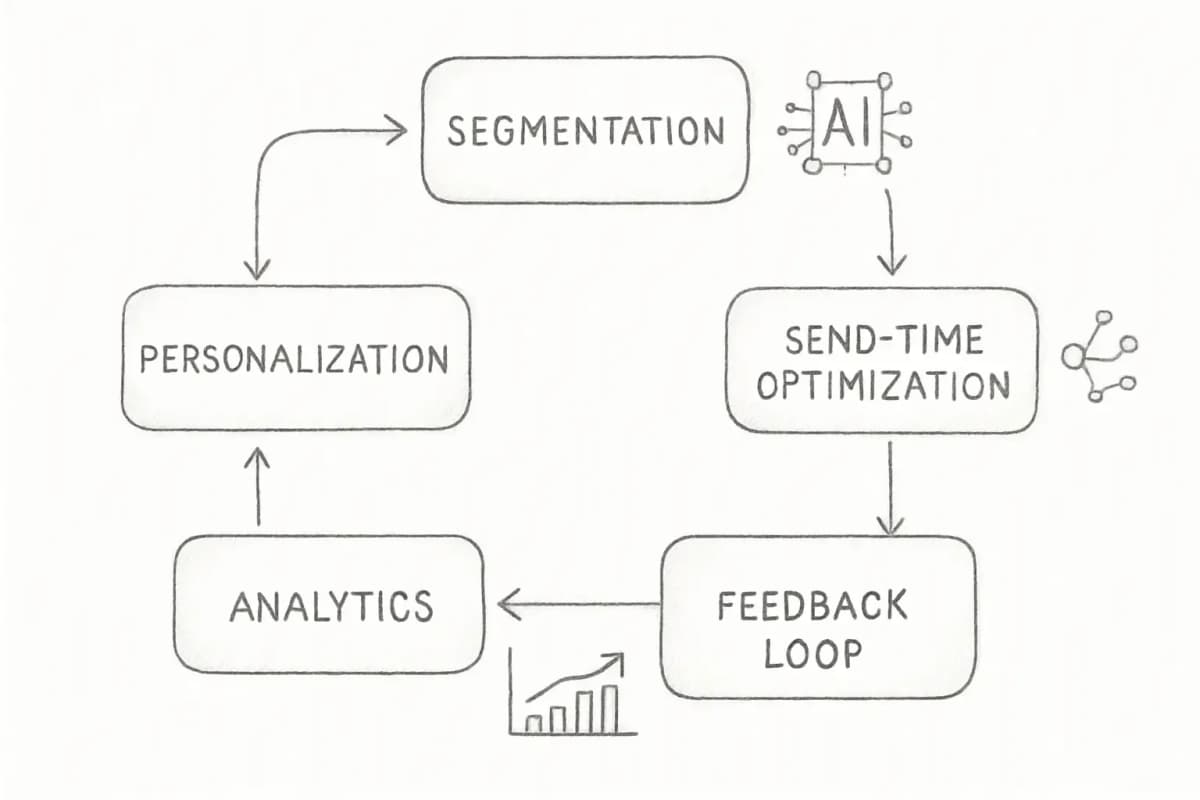
AI email marketing workflow diagram showing four connected stages in a circular feedback loop. Start with segmentation (dividing audience into targeted groups), flowing to personalization (customizing content and subject lines), then send-time optimization (determining best delivery moments), and finally analytics feedback loop (measuring performance metrics like open rates, clicks, conversions, and revenue impact). Arrows connect each stage back to the beginning, illustrating continuous improvement. Include visual indicators for AI automation (like machine learning icons or data streams) at each step.


Frequently Asked Questions

What is AI-based email marketing?

AI email marketing uses artificial intelligence to optimize email campaigns, automating tasks like segmentation, personalization, send times, and content creation to improve engagement and conversion rates. In practice, it combines machine learning models that predict subscriber behavior with generative AI tools that produce personalized content at scale.

Does AI email marketing actually improve ROI?

Yes, and the evidence is specific. Businesses using AI in email campaigns report an average ROI increase of 21%. At the campaign level, AI-powered email programs generate 41% more revenue than manual campaigns according to Salesforce benchmarks, and teams implementing the full AI stack see 3.2x higher revenue per recipient.

How does AI improve email deliverability?

AI actively manages the sending process, monitoring sender reputation and optimizing every aspect of campaigns to maximize inbox placement. It flags spam-trigger language in content before sending, suppresses disengaged contacts who would otherwise damage sender score, and verifies list quality in real time to prevent hard bounces.

What AI email marketing tools should I use?

Several leading platforms now offer embedded AI features, including HubSpot, Mailchimp, Klaviyo, and Constant Contact. These tools assist with content generation, performance optimization, and predictive analytics. The right choice depends on your business model: Klaviyo suits ecommerce stores on Shopify, WooCommerce, or BigCommerce, using real-time purchase data and browse behavior to power product recommendation engines, with predictive analytics including expected next order date and customer lifetime value available on all paid plans. HubSpot suits teams that want email tightly integrated with CRM data and lifecycle stage automation.


No comments yet. Be the first!

Leave a comment

Comments are reviewed before publishing.

AI email marketing workflow diagram showing four connected stages in a circular feedback loop. Start with segmentation (dividing audience into targeted groups), flowing to personalization (customizing content and subject lines), then send-time optimization (determining best delivery moments), and finally analytics feedback loop (measuring performance metrics like open rates, clicks, conversions, and revenue impact). Arrows connect each stage back to the beginning, illustrating continuous improvement. Include visual indicators for AI automation (like machine learning icons or data streams) at each step.


Frequently Asked Questions

What is AI-based email marketing?

AI email marketing uses artificial intelligence to optimize email campaigns, automating tasks like segmentation, personalization, send times, and content creation to improve engagement and conversion rates. In practice, it combines machine learning models that predict subscriber behavior with generative AI tools that produce personalized content at scale.

Does AI email marketing actually improve ROI?

Yes, and the evidence is specific. Businesses using AI in email campaigns report an average ROI increase of 21%. At the campaign level, AI-powered email programs generate 41% more revenue than manual campaigns according to Salesforce benchmarks, and teams implementing the full AI stack see 3.2x higher revenue per recipient.

How does AI improve email deliverability?

AI actively manages the sending process, monitoring sender reputation and optimizing every aspect of campaigns to maximize inbox placement. It flags spam-trigger language in content before sending, suppresses disengaged contacts who would otherwise damage sender score, and verifies list quality in real time to prevent hard bounces.

What AI email marketing tools should I use?

Several leading platforms now offer embedded AI features, including HubSpot, Mailchimp, Klaviyo, and Constant Contact. These tools assist with content generation, performance optimization, and predictive analytics. The right choice depends on your business model: Klaviyo suits ecommerce stores on Shopify, WooCommerce, or BigCommerce, using real-time purchase data and browse behavior to power product recommendation engines, with predictive analytics including expected next order date and customer lifetime value available on all paid plans. HubSpot suits teams that want email tightly integrated with CRM data and lifecycle stage automation.

No comments yet. Be the first!

Leave a comment

Comments are reviewed before publishing.

More from

Related posts

Illustration for email marketing automation benefits
Email Marketing StrategyJul 14, 2026 12 min

Email Marketing Automation Benefits: ROI & Efficiency Gains

Discover how email automation boosts conversions, saves time, and improves customer engagement. Learn the key benefits and ROI metrics that matter.

More from

Related posts

Illustration for email marketing automation benefits
Email Marketing StrategyJul 14, 2026 12 min

Email Marketing Automation Benefits: ROI & Efficiency Gains

Discover how email automation boosts conversions, saves time, and improves customer engagement. Learn the key benefits and ROI metrics that matter.

J
James Chen
J
James Chen
Illustration for "crm email marketing automation
Email Marketing StrategyJul 14, 2026 14 min

CRM Email Marketing Automation: Setup & Best Practices

Learn how to automate email campaigns through your CRM to save time, improve deliverability, and increase ROI. Step-by-step guide inside.

PPriya Kapoor
Illustration for "crm email marketing automation
Email Marketing StrategyJul 14, 2026 14 min

CRM Email Marketing Automation: Setup & Best Practices

Learn how to automate email campaigns through your CRM to save time, improve deliverability, and increase ROI. Step-by-step guide inside.

PPriya Kapoor
Illustration for what is the difference between email marketing and marketing automation
Email Marketing StrategyJul 14, 2026 11 min

Email Marketing vs Marketing Automation: Key Differences

Understand the core differences between email marketing and marketing automation. Learn which tool fits your business needs and how to use them together.

SSarah Mitchell
Illustration for what is the difference between email marketing and marketing automation
Email Marketing StrategyJul 14, 2026 11 min

Email Marketing vs Marketing Automation: Key Differences

Understand the core differences between email marketing and marketing automation. Learn which tool fits your business needs and how to use them together.

SSarah Mitchell