
HomeBlogEmail Marketing StrategyEmail Marketing Automation Benefits: ROI & Efficiency Gains
Email Marketing Strategy

Email Marketing Automation Benefits: ROI & Efficiency Gains

Discover how email automation boosts conversions, saves time, and improves customer engagement. Learn the key benefits and ROI metrics that matter.

J

James Chen

July 14, 2026

12 min read
HomeBlogEmail Marketing StrategyEmail Marketing Automation Benefits: ROI & Efficiency Gains
Email Marketing Strategy

Email Marketing Automation Benefits: ROI & Efficiency Gains

Discover how email automation boosts conversions, saves time, and improves customer engagement. Learn the key benefits and ROI metrics that matter.

J

James Chen

July 14, 2026

12 min read
Share:
Share:
#Email Automation#Marketing ROI#Customer Engagement#Lead Nurturing
Illustration for email marketing automation benefits

Stay in the loop

Get the latest posts delivered straight to your inbox. No spam, unsubscribe anytime.

Email marketing automation benefits are well documented, and the data makes a compelling case for adoption. In 2024, automated emails drove 37% of all email-generated sales while accounting for just 2% of total email volume. That gap between volume and revenue impact is the single best argument for building automation into your email strategy.

This post breaks down the core email marketing automation benefits, what each one is worth in measurable terms, and how to prioritize them for your business.


Key Takeaways

  • Automated emails generate 320% more revenue than non-automated emails.
  • A Forrester Total Economic Impact study found that marketing teams implementing automation can reduce campaign assembly effort by 73%.
  • Automated emails had 52% higher open rates, 332% higher click rates, and 2,361% better conversion rates compared to regular scheduled campaigns, according to Omnisend data.
  • Businesses using email automation save an average of 30% on operational costs.
  • Companies using automation report up to 77% higher conversion rates.

What Email Marketing Automation Actually Does

Email marketing automation is not a feature you turn on. It is a system of behavior-triggered workflows that send the right message to the right person at the right moment, without requiring manual action each time.

Email marketing automation is a system of event-triggered workflows that automatically send emails based on customer actions, using rules, segmentation, and behavioral data from your email service provider or customer data platform.

The practical implication is significant. One of the benefits of email automation is that it puts you in inboxes at optimal moments without adding to your workload. Automated emails are contextual to what your customers do on your site, their activity in emails, and the data you hold about them.

As of early 2024, email was the channel that relied the most on marketing automation, with 58% of surveyed professionals choosing it over both content and social media management.


Benefit 1: Revenue That Scales Beyond What Manual Campaigns Can Produce

The revenue case for automation is straightforward. The top 10% of email automations by performance earn $16.96 per recipient, compared to $0.95 for the top email campaigns. That is an 18x gap between the best manual campaigns and the best automated flows.

Stay in the loop

Get the latest posts delivered straight to your inbox. No spam, unsubscribe anytime.

Email marketing automation benefits are well documented, and the data makes a compelling case for adoption. In 2024, automated emails drove 37% of all email-generated sales while accounting for just 2% of total email volume. That gap between volume and revenue impact is the single best argument for building automation into your email strategy.

This post breaks down the core email marketing automation benefits, what each one is worth in measurable terms, and how to prioritize them for your business.


Key Takeaways

  • Automated emails generate 320% more revenue than non-automated emails.
  • A Forrester Total Economic Impact study found that marketing teams implementing automation can reduce campaign assembly effort by 73%.
  • Automated emails had 52% higher open rates, 332% higher click rates, and 2,361% better conversion rates compared to regular scheduled campaigns, according to Omnisend data.
  • Businesses using email automation save an average of 30% on operational costs.
  • Companies using automation report up to 77% higher conversion rates.

What Email Marketing Automation Actually Does

Email marketing automation is not a feature you turn on. It is a system of behavior-triggered workflows that send the right message to the right person at the right moment, without requiring manual action each time.

Email marketing automation is a system of event-triggered workflows that automatically send emails based on customer actions, using rules, segmentation, and behavioral data from your email service provider or customer data platform.

The practical implication is significant. One of the benefits of email automation is that it puts you in inboxes at optimal moments without adding to your workload. Automated emails are contextual to what your customers do on your site, their activity in emails, and the data you hold about them.

As of early 2024, email was the channel that relied the most on marketing automation, with 58% of surveyed professionals choosing it over both content and social media management.


Benefit 1: Revenue That Scales Beyond What Manual Campaigns Can Produce

The revenue case for automation is straightforward. The top 10% of email automations by performance earn $16.96 per recipient, compared to $0.95 for the top email campaigns. That is an 18x gap between the best manual campaigns and the best automated flows.

The combination of timing and relevance is why email automations accounted for 30% of revenue from 2% of sends in 2025. Omnisend's 2026 Ecommerce Marketing Report also shows they earned 16x more per send than scheduled emails.

Specific automation types carry the most weight:

  • Abandoned cart workflows are the highest earners with a top 10% revenue per recipient of $28.89. Welcome flows offer the second-best returns, with an average RPR of $2.65 and top 10% returns of $21.18 per recipient.
  • Welcome emails achieve an average open rate of 83.6%, making them one of the highest-performing automated email types.
  • Abandoned cart emails recover 3 to 5% of lost sales on average. They achieve an average open rate of 50.5%, a click rate of 6.25%, and a conversion rate of 3.33%, with top-performing brands reaching conversion rates of 7.69%.

For teams building or refining their first automation flows, a strong welcome email sequence and a structured abandoned cart recovery workflow are typically the highest-priority starting points.


Benefit 2: Significant Operational Efficiency Gains

Time is a real cost. Every manually assembled campaign takes design, copywriting, QA, scheduling, and post-send analysis. Automation compresses all of that.

Time savings might sound like a modest win, but across dozens of campaigns the hours quickly add up. According to SAP Engagement Cloud research, marketers are reclaiming more than two hours every time they run a campaign. That is time teams can reinvest into higher-value work such as refining segmentation, testing creative, or experimenting with new channels.

The production speed improvement is notable too. 76% of marketing teams now produce and send a marketing email within 3 days. In 2024, 62% of teams took two weeks or more for a single email.

Teams that use marketing automation platforms and analytics tools execute campaigns more consistently and at lower operational cost. Manual processes increase variability and resource requirements.

For smaller businesses and growth teams operating with lean resources, this efficiency is not a nice-to-have. It is what makes consistent email marketing execution possible at all.


Benefit 3: Personalization at Scale

Generic batch-and-blast emails perform poorly relative to behavior-triggered messages. The challenge has always been that real personalization takes time. Automation solves this by embedding personalization into workflows rather than campaign production.

Automated emails with personalization elements generate a 6x higher transaction rate than generic messages.

Behavior-based personalization using purchase history data boosts CTR by up to 39%. Companies using AI-driven email strategies see up to 41% more revenue than those using traditional batch-and-blast sends.

Personalization in email messages improves open rates by 29% and click-through rates by 41%. Personalized subject lines increase email open rates by 26%.

Automation makes this practical by letting you build personalization once, at the workflow level, and then have it apply dynamically across thousands of sends. If you want to go further, see the specific approaches covered in 7 Email Personalization Techniques That Boost Conversions 47%.

The combination of timing and relevance is why email automations accounted for 30% of revenue from 2% of sends in 2025. Omnisend's 2026 Ecommerce Marketing Report also shows they earned 16x more per send than scheduled emails.

Specific automation types carry the most weight:

  • Abandoned cart workflows are the highest earners with a top 10% revenue per recipient of $28.89. Welcome flows offer the second-best returns, with an average RPR of $2.65 and top 10% returns of $21.18 per recipient.
  • Welcome emails achieve an average open rate of 83.6%, making them one of the highest-performing automated email types.
  • Abandoned cart emails recover 3 to 5% of lost sales on average. They achieve an average open rate of 50.5%, a click rate of 6.25%, and a conversion rate of 3.33%, with top-performing brands reaching conversion rates of 7.69%.

For teams building or refining their first automation flows, a strong welcome email sequence and a structured abandoned cart recovery workflow are typically the highest-priority starting points.


Benefit 2: Significant Operational Efficiency Gains

Time is a real cost. Every manually assembled campaign takes design, copywriting, QA, scheduling, and post-send analysis. Automation compresses all of that.

Time savings might sound like a modest win, but across dozens of campaigns the hours quickly add up. According to SAP Engagement Cloud research, marketers are reclaiming more than two hours every time they run a campaign. That is time teams can reinvest into higher-value work such as refining segmentation, testing creative, or experimenting with new channels.

The production speed improvement is notable too. 76% of marketing teams now produce and send a marketing email within 3 days. In 2024, 62% of teams took two weeks or more for a single email.

Teams that use marketing automation platforms and analytics tools execute campaigns more consistently and at lower operational cost. Manual processes increase variability and resource requirements.

For smaller businesses and growth teams operating with lean resources, this efficiency is not a nice-to-have. It is what makes consistent email marketing execution possible at all.


Benefit 3: Personalization at Scale

Generic batch-and-blast emails perform poorly relative to behavior-triggered messages. The challenge has always been that real personalization takes time. Automation solves this by embedding personalization into workflows rather than campaign production.

Automated emails with personalization elements generate a 6x higher transaction rate than generic messages.

Behavior-based personalization using purchase history data boosts CTR by up to 39%. Companies using AI-driven email strategies see up to 41% more revenue than those using traditional batch-and-blast sends.

Personalization in email messages improves open rates by 29% and click-through rates by 41%. Personalized subject lines increase email open rates by 26%.

Automation makes this practical by letting you build personalization once, at the workflow level, and then have it apply dynamically across thousands of sends. If you want to go further, see the specific approaches covered in 7 Email Personalization Techniques That Boost Conversions 47%.


Benefit 4: Better Segmentation With Less Manual Work

Segmentation is one of the highest-leverage activities in email marketing, but it is time-intensive to maintain manually. Automation handles segment updates dynamically as subscriber behavior changes.

Segmented campaigns generate 760% more revenue than non-segmented campaigns.

Email marketing automation enables marketers to create highly segmented mailing lists based on subscriber activities, purchase history, lead stage, and more. As a result, marketers can send relevant and personalized emails to their subscribers, ensuring they receive promotional offers that appeal to them.

Dynamic segmentation can improve conversion rates by up to 15%, because it ensures that marketing messages are aligned with the recent needs of the customer, making the offer relevant and difficult to refuse.

The revenue potential of proper segmentation is one of the most under-discussed email marketing automation benefits. For a detailed breakdown of how to build this out, the email list segmentation strategies that boost ROI by 760% guide covers the tactical side.


Benefit 5: Stronger Customer Retention and Lifetime Value

Acquiring a new customer costs significantly more than retaining an existing one. Acquiring new customers can cost five times as much as retaining existing ones. Focusing on customer retention allows businesses to optimize their marketing budgets.

Automation supports retention by ensuring that no customer goes silent due to a missed touchpoint. Re-engagement flows, post-purchase sequences, and loyalty triggers all operate without requiring someone to remember to send them.

SAP Engagement Cloud research shows that six in ten marketers have seen engagement increase after adopting AI, and almost as many report stronger loyalty. More engaged and loyal customers buy more often, spend more per transaction, and are less likely to churn. These gains compound over time, turning automation into a long-term growth engine.

80% of SMEs claim email marketing helps retain customers.


Benefit 6: Higher ROI From the Email Channel Overall

Email already delivers the highest ROI of any digital marketing channel. On average, email marketing delivers a return of between $36 and $42 for every $1 spent. For context: paid search returns $2 per $1, social advertising $2.80, and display ads $1.35.

Automation makes that number substantially higher because it concentrates sends on high-intent moments rather than spreading them across your entire list on a fixed schedule.

Automated email campaigns generate a 320% higher ROI compared to manually executed campaigns.

Email marketing remains the most reliable high-ROI digital channel in 2024 to 2026, but averages only tell part of the story. The biggest gains come from automation, personalization, deliverability discipline, and realistic attribution, not from sending more emails.

To get the most from your analytics and attribute revenue accurately to your automation flows, the email marketing analytics best practices guide covers the measurement infrastructure you need.


The Core Automation Workflows to Build First

If you are starting from scratch or have limited automation in place, prioritize these workflows in order of revenue impact:


Benefit 4: Better Segmentation With Less Manual Work

Segmentation is one of the highest-leverage activities in email marketing, but it is time-intensive to maintain manually. Automation handles segment updates dynamically as subscriber behavior changes.

Segmented campaigns generate 760% more revenue than non-segmented campaigns.

Email marketing automation enables marketers to create highly segmented mailing lists based on subscriber activities, purchase history, lead stage, and more. As a result, marketers can send relevant and personalized emails to their subscribers, ensuring they receive promotional offers that appeal to them.

Dynamic segmentation can improve conversion rates by up to 15%, because it ensures that marketing messages are aligned with the recent needs of the customer, making the offer relevant and difficult to refuse.

The revenue potential of proper segmentation is one of the most under-discussed email marketing automation benefits. For a detailed breakdown of how to build this out, the email list segmentation strategies that boost ROI by 760% guide covers the tactical side.


Benefit 5: Stronger Customer Retention and Lifetime Value

Acquiring a new customer costs significantly more than retaining an existing one. Acquiring new customers can cost five times as much as retaining existing ones. Focusing on customer retention allows businesses to optimize their marketing budgets.

Automation supports retention by ensuring that no customer goes silent due to a missed touchpoint. Re-engagement flows, post-purchase sequences, and loyalty triggers all operate without requiring someone to remember to send them.

SAP Engagement Cloud research shows that six in ten marketers have seen engagement increase after adopting AI, and almost as many report stronger loyalty. More engaged and loyal customers buy more often, spend more per transaction, and are less likely to churn. These gains compound over time, turning automation into a long-term growth engine.

80% of SMEs claim email marketing helps retain customers.


Benefit 6: Higher ROI From the Email Channel Overall

Email already delivers the highest ROI of any digital marketing channel. On average, email marketing delivers a return of between $36 and $42 for every $1 spent. For context: paid search returns $2 per $1, social advertising $2.80, and display ads $1.35.

Automation makes that number substantially higher because it concentrates sends on high-intent moments rather than spreading them across your entire list on a fixed schedule.

Automated email campaigns generate a 320% higher ROI compared to manually executed campaigns.

Email marketing remains the most reliable high-ROI digital channel in 2024 to 2026, but averages only tell part of the story. The biggest gains come from automation, personalization, deliverability discipline, and realistic attribution, not from sending more emails.

To get the most from your analytics and attribute revenue accurately to your automation flows, the email marketing analytics best practices guide covers the measurement infrastructure you need.


The Core Automation Workflows to Build First

If you are starting from scratch or have limited automation in place, prioritize these workflows in order of revenue impact:

  1. Welcome series: The first emails a subscriber receives set the tone for the relationship. Welcome and abandoned cart emails made up 76% of all automation-related orders.
  2. Abandoned cart: Abandoned cart workflows are the highest earners, with a top 10% revenue per recipient of $28.89.
  3. Post-purchase sequence: Post-purchase upsells achieve 25 to 35% open rates and 6 to 10% conversion rates.
  4. Win-back campaign: Win-back campaigns achieve 20 to 30% open rates and 4 to 8% conversion rates.
  5. Browse abandonment: Targeting subscribers who visited specific product pages but did not add to cart captures purchase intent that would otherwise go unaddressed.

Once those core flows are running, you can layer in birthday emails, back-in-stock alerts, and lifecycle nurture sequences. Back-in-stock emails delivered the highest conversion rate (6.46%) among specific automation types, while birthday messages produced an average order value more than 4x higher than average ($744.37).
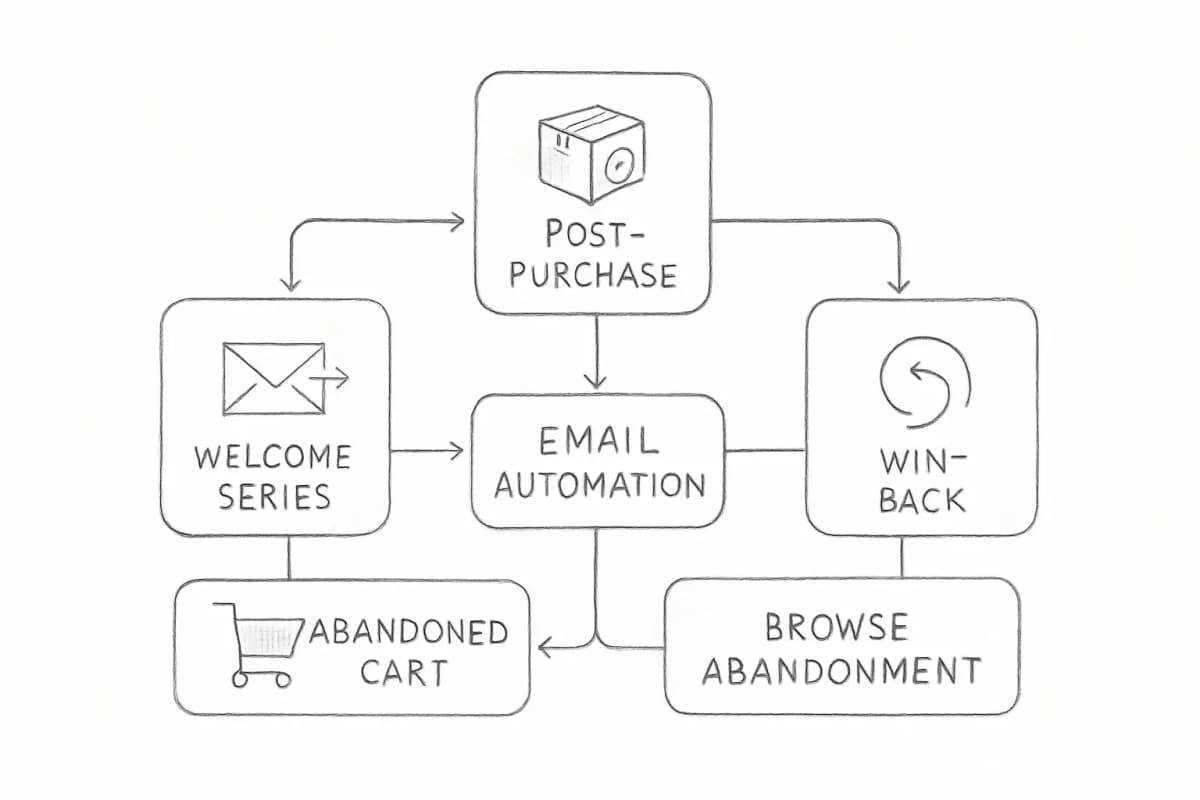

Visual diagram showing five core email automation workflows arranged horizontally or in a circular pattern. Each workflow should be represented as a distinct box or node containing: (1) Welcome Series with envelope and arrow icon, (2) Abandoned Cart with shopping cart icon, (3) Post-Purchase with package/checkmark icon, (4) Win-Back with returning arrow icon, and (5) Browse Abandonment with product browsing icon. Each node should connect to a central hub labeled 'Email Automation' or show them as parallel flows. Include brief descriptive text under each workflow type. Use a professional color scheme with blues, greens, and grays. The overall visual should convey that these are interconnected but distinct automation paths a business can deploy.


What Gets in the Way of Automation Success

Understanding the benefits is useful. Knowing where implementations fail is more useful.

61% of businesses believe that inaccurate data impacts the effectiveness of AI for personalization. 36% of marketing professionals spend around 6 months implementing an automation tool into their workflows. 29% of companies do not use some automation features because they lack knowledge about such features and how to use them.

The three most common failure points are: starting with messy data, setting up workflows without mapping the customer journey first, and building automations that never get reviewed or updated. Automation that runs unchecked can erode deliverability and subscriber trust just as effectively as manual campaigns can.

The biggest gains come from automation, personalization, deliverability discipline, and realistic attribution, not from sending more emails.

  1. Welcome series: The first emails a subscriber receives set the tone for the relationship. Welcome and abandoned cart emails made up 76% of all automation-related orders.
  2. Abandoned cart: Abandoned cart workflows are the highest earners, with a top 10% revenue per recipient of $28.89.
  3. Post-purchase sequence: Post-purchase upsells achieve 25 to 35% open rates and 6 to 10% conversion rates.
  4. Win-back campaign: Win-back campaigns achieve 20 to 30% open rates and 4 to 8% conversion rates.
  5. Browse abandonment: Targeting subscribers who visited specific product pages but did not add to cart captures purchase intent that would otherwise go unaddressed.

Once those core flows are running, you can layer in birthday emails, back-in-stock alerts, and lifecycle nurture sequences. Back-in-stock emails delivered the highest conversion rate (6.46%) among specific automation types, while birthday messages produced an average order value more than 4x higher than average ($744.37).


Visual diagram showing five core email automation workflows arranged horizontally or in a circular pattern. Each workflow should be represented as a distinct box or node containing: (1) Welcome Series with envelope and arrow icon, (2) Abandoned Cart with shopping cart icon, (3) Post-Purchase with package/checkmark icon, (4) Win-Back with returning arrow icon, and (5) Browse Abandonment with product browsing icon. Each node should connect to a central hub labeled 'Email Automation' or show them as parallel flows. Include brief descriptive text under each workflow type. Use a professional color scheme with blues, greens, and grays. The overall visual should convey that these are interconnected but distinct automation paths a business can deploy.


What Gets in the Way of Automation Success

Understanding the benefits is useful. Knowing where implementations fail is more useful.

61% of businesses believe that inaccurate data impacts the effectiveness of AI for personalization. 36% of marketing professionals spend around 6 months implementing an automation tool into their workflows. 29% of companies do not use some automation features because they lack knowledge about such features and how to use them.

The three most common failure points are: starting with messy data, setting up workflows without mapping the customer journey first, and building automations that never get reviewed or updated. Automation that runs unchecked can erode deliverability and subscriber trust just as effectively as manual campaigns can.

The biggest gains come from automation, personalization, deliverability discipline, and realistic attribution, not from sending more emails.

For teams connecting automation to a CRM for the first time, the email marketing automation CRM setup guide covers the integration decisions that determine whether your data feeds automation correctly.


Frequently Asked Questions

What are the main email marketing automation benefits for small businesses?

The most immediate email marketing automation benefits for small businesses are time savings and consistent follow-up. The three major benefits of email automation for businesses are saving time (30%), lead generation (22%), and an increase in revenue (17%). Small teams get the ability to run welcome flows, abandoned cart recovery, and re-engagement campaigns without adding headcount.

How much more revenue do automated emails generate compared to manual campaigns?

Automated emails had 52% higher open rates, 332% higher click rates, and an astounding 2,361% better conversion rates compared to regular scheduled campaigns, according to Omnisend data from 150,000 brands. In revenue per send terms, automated emails made up 2% of sends in 2025 but captured 30% of revenue and generated 16x more revenue per send than scheduled campaigns.

Does email automation reduce operational costs?

Yes. Businesses using email automation save an average of 30% on operational costs. This comes from reduced manual labor per campaign, faster production cycles, and fewer errors from human-executed sends. According to a Forrester Total Economic Impact study, marketing teams implementing automation can reduce campaign assembly effort by 73%, with these time savings translating into hundreds of hours reclaimed annually.

Which automated email workflow has the highest ROI?

Abandoned cart workflows are the highest earners, with a top 10% revenue per recipient of $28.89. Welcome flows are the second-best performers. For most businesses, building these two workflows first captures the majority of automation-driven revenue available from their list. Companies using marketing automation report up to 77% higher conversion rates overall.


No comments yet. Be the first!

Leave a comment

Comments are reviewed before publishing.

For teams connecting automation to a CRM for the first time, the email marketing automation CRM setup guide covers the integration decisions that determine whether your data feeds automation correctly.


Frequently Asked Questions

What are the main email marketing automation benefits for small businesses?

The most immediate email marketing automation benefits for small businesses are time savings and consistent follow-up. The three major benefits of email automation for businesses are saving time (30%), lead generation (22%), and an increase in revenue (17%). Small teams get the ability to run welcome flows, abandoned cart recovery, and re-engagement campaigns without adding headcount.

How much more revenue do automated emails generate compared to manual campaigns?

Automated emails had 52% higher open rates, 332% higher click rates, and an astounding 2,361% better conversion rates compared to regular scheduled campaigns, according to Omnisend data from 150,000 brands. In revenue per send terms, automated emails made up 2% of sends in 2025 but captured 30% of revenue and generated 16x more revenue per send than scheduled campaigns.

Does email automation reduce operational costs?

Yes. Businesses using email automation save an average of 30% on operational costs. This comes from reduced manual labor per campaign, faster production cycles, and fewer errors from human-executed sends. According to a Forrester Total Economic Impact study, marketing teams implementing automation can reduce campaign assembly effort by 73%, with these time savings translating into hundreds of hours reclaimed annually.

Which automated email workflow has the highest ROI?

Abandoned cart workflows are the highest earners, with a top 10% revenue per recipient of $28.89. Welcome flows are the second-best performers. For most businesses, building these two workflows first captures the majority of automation-driven revenue available from their list. Companies using marketing automation report up to 77% higher conversion rates overall.

No comments yet. Be the first!

Leave a comment

Comments are reviewed before publishing.

More from

Related posts

Illustration for ai-based email marketing
Email Marketing StrategyJul 14, 2026 12 min

AI-Based Email Marketing: Strategy and ROI

Learn how AI transforms email marketing with smarter segmentation, personalization, and automation. Boost open rates and conversions with data-driven tactics.

More from

Related posts

Illustration for ai-based email marketing
Email Marketing StrategyJul 14, 2026 12 min

AI-Based Email Marketing: Strategy and ROI

Learn how AI transforms email marketing with smarter segmentation, personalization, and automation. Boost open rates and conversions with data-driven tactics.

M
Marcus Webb
M
Marcus Webb
Illustration for "crm email marketing automation
Email Marketing StrategyJul 14, 2026 14 min

CRM Email Marketing Automation: Setup & Best Practices

Learn how to automate email campaigns through your CRM to save time, improve deliverability, and increase ROI. Step-by-step guide inside.

PPriya Kapoor
Illustration for "crm email marketing automation
Email Marketing StrategyJul 14, 2026 14 min

CRM Email Marketing Automation: Setup & Best Practices

Learn how to automate email campaigns through your CRM to save time, improve deliverability, and increase ROI. Step-by-step guide inside.

PPriya Kapoor
Illustration for what is the difference between email marketing and marketing automation
Email Marketing StrategyJul 14, 2026 11 min

Email Marketing vs Marketing Automation: Key Differences

Understand the core differences between email marketing and marketing automation. Learn which tool fits your business needs and how to use them together.

SSarah Mitchell
Illustration for what is the difference between email marketing and marketing automation
Email Marketing StrategyJul 14, 2026 11 min

Email Marketing vs Marketing Automation: Key Differences

Understand the core differences between email marketing and marketing automation. Learn which tool fits your business needs and how to use them together.

SSarah Mitchell