Businesses that invest in automated email marketing see a disproportionate return compared to every other digital channel, and the data is unambiguous. Automated emails drove 37% of all ecommerce email revenue in 2024 despite representing just 2% of email volume. That efficiency gap, revenue generated versus effort required, is exactly why automated email marketing belongs at the center of any serious growth strategy.
This guide covers everything you need to set up, structure, and continuously improve an automated email marketing program: the foundational concepts, the workflows that produce the most revenue, the platforms worth considering, and the metrics that actually matter.
Key Takeaways
- Email automations deliver 30 times more revenue per recipient than one-off promotional campaigns. The average return per recipient for campaigns sits at $0.11, while automated flows earn $1.94 per recipient.
- Automation emails dramatically outperform standard marketing campaigns, achieving a 30.63% open rate and 7.39% CTR versus the 20.73% and 2.27% averages for regular campaigns.
- Email marketing delivers $36 to $42 for every $1 spent, outperforming paid search ($2), social advertising ($2.80), and display ads ($1.35).
- The most valuable automated flows are welcome sequences, abandoned cart recovery, post-purchase, and re-engagement campaigns. Getting these four live should be your first priority.
- Platform choice matters, but strategy and segmentation consistently outperform tool selection. Start simple, validate, then expand.
What Automated Email Marketing Actually Is
Email automation is the process of sending predefined emails to subscribers when they meet certain criteria. Unlike traditional email campaigns, which require manual scheduling and sending, automated emails run in the background, ensuring that each recipient gets the right message at the right time.
The system operates on three core components:
- Triggers: A specific action or event that starts a sequence. A trigger is any action a person takes that your system notices. Someone signing up for your email list triggers a welcome message. Clicking a link about running shoes could trigger a follow-up email featuring similar products or a limited-time discount on athletic gear.
- Workflows: The full email sequence a subscriber moves through after a trigger fires. A workflow is the full path a customer follows after a trigger. A sequence is the series of automated emails they receive along that path.
- Segmentation: Instead of blasting emails to an entire list, automation allows businesses to personalize messaging based on user behavior, demographics, or purchase history.
The practical result: businesses can create workflows once and let them run in the background, meaning emails are sent at the right time without requiring human intervention. This allows marketing teams to shift their focus from operational tasks to more strategic efforts, such as refining content, analyzing data, and improving overall campaign performance.
The Business Case: Why Automation Outperforms Manual Campaigns
The performance gap between automated and broadcast emails is not subtle.
Compared to regular campaigns, automated messages see 52% better open rates and 332% higher clicks. Conversion rates for automated emails exceed campaigns by 2,361%. These improvements stem from better timing and relevance.
The timing advantage is structural. Trigger email marketing is a system where an event fires, a condition is checked, and an email sends automatically with no manual scheduling involved. A subscriber clicks a pricing page, abandons a form, or goes quiet for 30 days, and a pre-built message goes out in response. That relevance converts at rates a scheduled newsletter cannot match.
For ecommerce specifically, automated workflows generate 320% more revenue than standard promotional campaigns. Automated email flows, including abandoned cart and post-purchase messages, are highly effective revenue drivers. They generate up to 30 times more revenue per recipient compared to standard email campaigns.
The ROI case extends beyond ecommerce. Email marketing remains the most reliable high-ROI digital channel in 2024 through 2026, but the biggest gains come from automation, personalization, deliverability discipline, and realistic attribution, not from sending more emails.
The 5 Automated Flows Every Business Should Build First
Not all automation workflows carry equal weight. These five deliver the highest return for the time invested.
1. Welcome Email Sequence
Welcome emails achieve an 83.6% open rate in ecommerce, the highest of any automated email type. That open rate reflects peak subscriber interest, and a well-structured welcome sequence captures it.
Welcome email automation introduces new subscribers to your brand over several touchpoints. Set triggers for immediate delivery after signup, followed by educational content at 3-day intervals. Track open rates and engagement to optimize timing and content.
For a deeper look at welcome sequence structure, see our guide to welcome email sequence best practices.
2. Abandoned Cart Recovery
Abandoned cart emails achieve an average CTR of 23.33%, the single highest-performing email type by click engagement across all automation types.
Abandoned cart email automation targets customers who leave items in their shopping cart. Configure triggers for 1 hour, 24 hours, and 1 week after abandonment. Include product images, customer reviews, and time-sensitive incentives to drive completion.
3. Post-Purchase Sequence
Revenue optimization automation promotes complementary products after purchases. Set triggers 7 to 30 days post-purchase with related product recommendations and bundle offers based on buying patterns.
Post-purchase flows also serve retention. A thank-you email, a review request, and a cross-sell recommendation together form a sequence that increases lifetime value without any manual effort.
4. Re-Engagement Campaign
Triggered when a contact has not opened or clicked emails for a set period of time, such as 90 days, a re-engagement workflow identifies subscribers who are drifting away before they become permanently inactive.
Inaction works as a trigger. If someone does not open your emails for 60 days, that lack of engagement can trigger a re-engagement campaign. This matters for deliverability too. Inactive subscribers drag down your sender reputation and inbox placement rates.
5. Browse Abandonment
Browse abandonment automation targets visitors who viewed products without adding to cart. Set triggers 2 to 4 hours after browsing with personalized product recommendations and social proof elements.
This flow captures intent that would otherwise disappear silently. It works best on higher-traffic sites where browse data is plentiful enough to generate meaningful signals.
How to Choose the Right Automated Email Marketing Platform
Platform selection shapes what you can build. The right choice depends primarily on your business type, list size, and automation depth requirements.
In 2025 through 2026, platforms position as follows: HubSpot is best for CRM-first teams, offering automation, email, and pipeline in one platform but at the highest cost at scale. ActiveCampaign offers the deepest automation logic for B2B and SaaS, with strong behavioral branching, lead scoring, and lifecycle workflows.
Brevo (formerly Sendinblue) is the most cost-effective for high-volume senders, combining email, SMS, and WhatsApp natively. GetResponse is best for teams that also need webinar and conversion funnel tools alongside email automation at competitive pricing. Klaviyo leads on ecommerce behavioral segmentation and predictive analytics.
For ecommerce teams, Klaviyo is a data-driven email and SMS platform built primarily for ecommerce brands. It is deeply integrated into the Shopify ecosystem and treats every contact interaction as a potential data point for smarter targeting. Klaviyo organizes its features around ecommerce data models: ecommerce-first segmentation built on purchase behavior, browse history, and predicted customer lifetime value.
For B2B or SaaS teams with complex lifecycle requirements, ActiveCampaign is a marketing automation platform that blends email marketing with advanced automation and CRM functionalities. It excels in providing prebuilt automation workflows that help businesses nurture leads, re-engage inactive customers, and drive conversions with minimal effort. With segmentation tools, machine learning insights, and multi-channel automation, ActiveCampaign is an excellent choice for businesses looking to improve engagement efficiency.
If budget is the primary constraint, MailerLite is one of the best free options. The free plan includes 12,000 emails and up to 500 subscribers, automations, and an excellent landing page editor.
Setting Up Your First Automated Email Workflow: Step by Step
Setting up an email automation workflow may seem complicated at first, but with the right platform and planning, it is much easier than it seems. The core steps are: define your audience, set clear goals, choose effective triggers, and use a tool that simplifies automation from end to end.
Follow this sequence:
- Map your trigger events first. Map your trigger events before you touch a single setting. That sequencing matters more than most setup guides admit. Write down the moments in your funnel where contact behavior changes: form submission, link click, purchase, inactivity past 30 days, or cart abandonment.
- Define a clear goal for each workflow. Welcome sequences serve onboarding. Abandoned cart flows serve revenue recovery. Each workflow should have one measurable objective.
- Build and connect your sequences. Set up email automation by choosing an email marketing platform, creating automation triggers based on customer actions, designing the email content, and defining the email sequence. Test and optimize based on results to ensure the automation flows smoothly.
- Set frequency caps. Cap your email frequency. Recipients could fall into several different triggers or conditions, and you do not want them to hit a perfect storm and get eight emails in a day from you, which is entirely possible.
- Start small, then expand. Start your email automation program with only a few email flows. From there, visually map out your automated email workflows so you can see where there might be too much overlap.
For a more detailed breakdown of CRM integration within this setup process, the email marketing automation CRM setup guide covers the technical configuration in depth.
Personalization and Segmentation: The Multipliers
Automation delivers the timing. Personalization and segmentation determine whether the message actually converts.
Behavior-based personalization using purchase history data boosts CTR by up to 39%. Companies using AI-driven email strategies see up to 41% more revenue than those using traditional batch-and-blast sends.
Effective segmentation starts with behavior, not just demographics. Manual segmentation usually means "active versus inactive" or "bought versus did not buy." AI segmentation clusters subscribers by purchase recency, browse behavior, email engagement velocity, and predicted lifetime value.
Segmented promotional emails generate 760% more revenue than non-segmented blasts, according to DMA data. If you are sending the same promotion to your entire list, you are leaving money on the table.
For a practical framework on how to structure your list segments, see our guide on email list segmentation strategies that boost ROI. 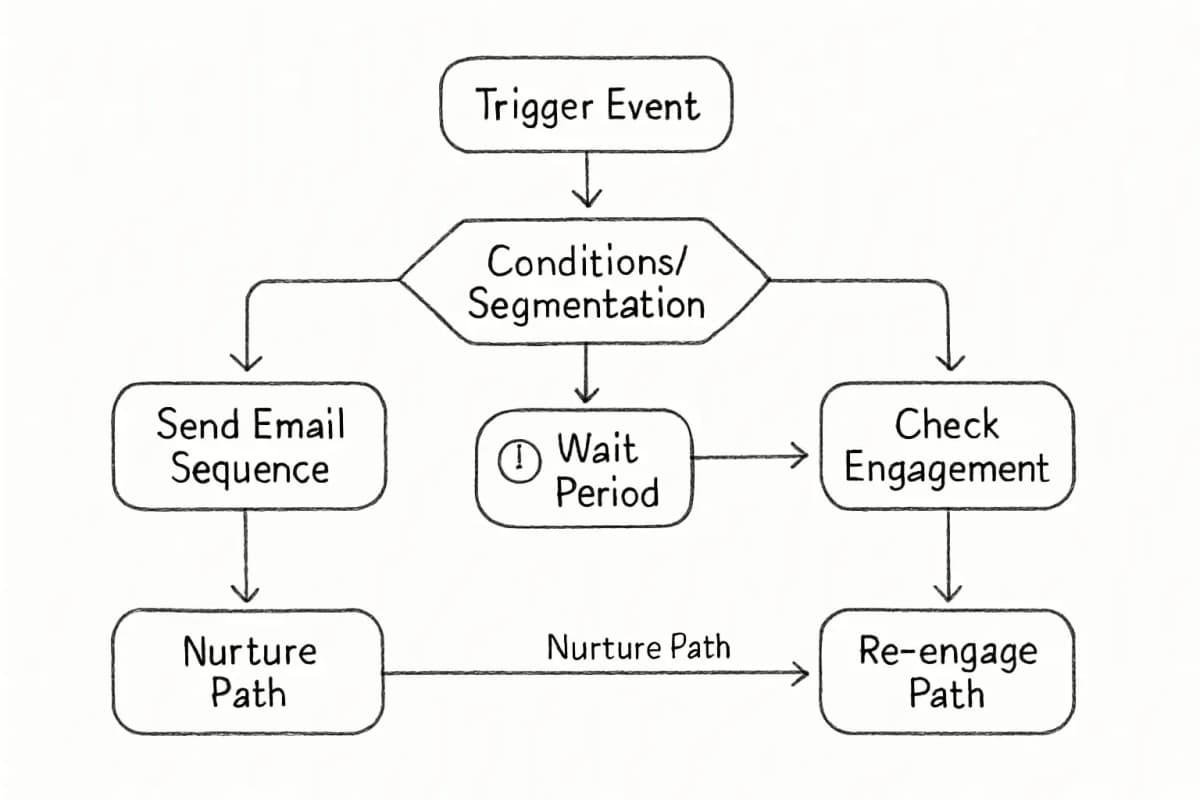
Measuring Automated Email Marketing Performance
Tracking the right metrics separates programs that improve from programs that stagnate.
Since Apple Mail accounts for 46% of email clients, Apple's Mail Privacy Protection has significantly skewed open rate data upward. Email marketers now prioritize click-through rates, click-to-open rates, and conversion metrics over open rates when evaluating campaign performance.
Focus on these metrics in priority order:
- Click-to-open rate (CTOR): The percentage of openers who clicked. CTOR tells marketers what percentage of people who opened an email actually clicked something. It is the truest measure of content quality.
- Conversion rate: The percentage of clickers who completed the goal action. A good email marketing conversion rate typically falls between 2% and 5% across all industries, though results vary significantly based on what action you are measuring and the industry.
- Revenue per email: The clearest measure of automation ROI. Back-in-stock automation had the highest revenue per email at $9.14 and the highest conversion rate at 6.72%, yet only 0.6% of brands used this automation in 2025, leaving a clear opportunity gap.
- Deliverability rate: The average deliverability rate sits at 85% in 2024, heavily influenced by authentication protocols like DMARC, SPF, and DKIM. Brands that implement proper authentication see deliverability rates above 90%.
- A/B test results: Brands that regularly A/B test their emails achieve 83% higher ROI than those that never test.
For a full breakdown of which metrics to track and how to act on them, the email marketing analytics best practices guide goes deeper on attribution and reporting.
Common Mistakes That Undermine Automated Email Programs
Even well-structured programs fail when these issues go unaddressed.
Ignoring list hygiene. Email automation tools are only effective if your emails reach your customers' inboxes. Maintaining a clean email list is crucial for deliverability and engagement.
Sounding like a robot. As you start to automate your email campaigns, there is a risk that your email content will start to lose personality. The last thing you want to do is sound like a robot to your audience. No matter what type of email you are sending, email content and voice are critical when you want to stand out in the inbox.
Treating automation as "set and forget." Automated email is often inaccurately referred to as "set it and forget it." This tactic can backfire. Do not forget about what you are sending and ensure that current events do not throw off your efforts.
Ignoring timing gaps. Timing is everything in email automation. Send messages too soon and you might annoy subscribers; wait too long and you risk losing momentum. Spacing your emails strategically builds trust and keeps your audience engaged.
Frequently Asked Questions
What is the difference between email automation and an email campaign?
An email campaign is a one-time scheduled send to a list. Email automation is the process of sending predefined emails to subscribers when they meet certain criteria. Unlike traditional email campaigns requiring manual scheduling and sending, automated emails run in the background, ensuring each recipient gets the right message at the right time. Campaigns require ongoing manual effort; automation requires upfront setup and periodic optimization.
How many automated workflows should a business set up first?
Start with three: a welcome sequence, a lead nurture series, and a re-engagement campaign for inactive subscribers. These three cover the full subscriber lifecycle from acquisition to retention. Build, test, and optimize these before adding complexity.
Which email automation trigger generates the highest revenue?
Back-in-stock emails had the highest revenue per email at $9.14 and the highest conversion rate at 6.72%, yet only 0.6% of brands in the dataset used this automation in 2025, which leaves a clear opportunity gap for stores with products that sell out and return later. For businesses without inventory constraints, abandoned cart emails achieve an average CTR of 23.33%, the single highest-performing email type by click engagement across all automation types.
How does deliverability affect automated email marketing performance?
Significantly. Inbox placement is harder than it used to be. Roughly 7% of emails now land in spam, directly reducing ROI. Email authentication was a primary focus in 2024 as businesses sought to protect their brand reputation and enhance security. Implementing protocols such as SPF, DKIM, and DMARC can help verify the authenticity of emails and reduce the risk of phishing and spoofing. Proper technical setup is not optional: it directly determines whether your automated sequences reach the inbox or get filtered before a subscriber ever sees them.