
Email
Email

A modern blog built with Payload CMS, Next.js, and shadcn/ui.

RSS FeedSitemap

Explore

  • Blog
  • News
  • Statistics
  • Authors

Categories

  • Automation
  • Email Marketing Tools & Platforms
  • Email Marketing Training
  • Email Marketing Benchmarks
  • Email Automation & AI
  • Email Marketing Operations & Growth
  • Email Marketing Tools & Reviews
  • Email Marketing Technology

Latest articles

  • Best AI Writing Tools for Email Marketing 2025Jul 21, 2026
  • Email Marketing Automation: Setup, Tools & Best PracticesJul 21, 2026
  • SaaS Email Marketing Automation: Tools, Setup, ROIJul 21, 2026
  • Best Email Marketing Automation Software 2024Jul 21, 2026

Popular topics

  • #SMB Marketing Data
  • #Small Business Email Marketing
  • #SaaS Tools
  • #financial services benchmarks
  • #fund manager email
  • #Omnisend
  • #Platform Reviews
  • #Wealth Management
  • #skill development
  • #email marketing courses
  • #outsourced email teams
  • #email team scaling
  • #email outsourcing
  • #offshore email marketing
  • #cybersecurity
  • #Postscript

Stay in the loop

Join 2,000+ readers. Unsubscribe anytime.

Subscribe
Email

© 2026 Email. All rights reserved.

SitemapRSS
HomeBlogAI Email Marketing ToolsCognition Labs AI Email Marketing: Features & ROI
AI Email Marketing Tools

Cognition Labs AI Email Marketing: Features & ROI

Explore Cognition Labs AI email marketing tools. Learn how automation and AI-driven personalization improve deliverability and campaign performance for your business.

R

Rachel Torres

July 21, 2026

13 min read
Share:
#AI Email Marketing#Email Automation#Personalization#Marketing Technology
Illustration for cognition labs ai email marketing

Stay in the loop

Get the latest posts delivered straight to your inbox. No spam, unsubscribe anytime.

Cognition Labs is primarily known as the company behind Devin, an autonomous AI software engineering agent. It is not a dedicated email marketing platform. However, searches for "Cognition Labs AI email marketing" reflect a real pattern of marketers asking how AI systems like Devin, and the broader class of autonomous AI agents it represents, can be applied to email marketing workflows. This article is best framed honestly around that intersection: what Cognition Labs actually is, what its agentic approach means for email marketing practitioners, and what outcomes teams can realistically expect when bringing AI agents of this caliber into their marketing stack.


What Cognition Labs Actually Is (And Why Marketers Are Asking About It)

If you landed here expecting a dedicated email platform, this article will give you something more useful: an honest look at what Cognition Labs is, what its technology actually does, and how the agentic AI approach it pioneered applies directly to email marketing automation and ROI.

Cognition AI, Inc., also known as Cognition Labs, is an American artificial intelligence company headquartered in San Francisco, California. The company is focused on developing AI software engineers, with its flagship product, Devin, designed to autonomously handle complex engineering tasks, from coding and debugging to deployment.

So why are marketers searching for "Cognition Labs AI email marketing"? Because agentic email marketing represents a fundamental shift from reactive automation to proactive, intelligent campaign orchestration, and Cognition Labs' Devin is the most prominent real-world example of what a capable autonomous AI agent looks like in production. Understanding that model of AI has direct implications for how you build, automate, and scale your email programs.

Key Takeaways

  • Cognition Labs built Devin, an autonomous AI agent, not an email marketing tool. But the agentic AI model it popularized is now reshaping how marketing automation works.
  • Email marketing delivers an average return of between $36 and $42 for every $1 spent, making it the highest-ROI digital marketing channel.
  • Companies using AI-driven email strategies see up to 41% more revenue than those using traditional batch-and-blast sends.
  • Real deployments of AI agents in marketing show 3 to 5x higher email click-through rates from individualized personalization and 60% faster content cycles.
  • Email marketing is the highest-ROI channel and, as of 2026, the workload best suited to a hybrid AI-agent architecture. Platforms including Klaviyo Marketing Agent, HubSpot Breeze, Customer.io AI Agent, Braze Sage AI, and ActiveCampaign's agents have all shipped production capabilities.

What Devin Teaches Us About Agentic AI for Email

Devin is an autonomous AI software engineering agent from Cognition Labs. Think of it as a tireless junior developer that can plan a task, navigate a codebase, run tests, propose fixes, and even open pull requests, while still benefiting from human oversight. Devin is a multi-step coding agent that operates tools like a shell, editor, and browser to complete end-to-end tasks with minimal guidance.

That architecture, plan autonomously, execute across tools, iterate, and deliver, is the same architecture now being applied to email marketing workflows. The distinction Cognition Labs drew for software development is the same distinction that now separates true AI agents from conventional email automation.

Traditional automation is rule-based. It relies on conditional triggers such as "if a user downloads this, send that" or "if a cart is abandoned, trigger this email." These workflows are useful, but they are fixed. Once built, they operate within boundaries defined by the marketer. AI marketing agents operate differently. Instead of following rigid logic, they interpret patterns. They look at outcomes and adjust behavior accordingly.

Devin executes entire software projects and resolves 13.9% of real-world GitHub issues end-to-end on SWE-bench, far outperforming GPT-4's 1.7% and Claude 2's 4.8% as of March 2024. The benchmark matters less than the mechanism: an agent that takes a goal, breaks it into steps, uses available tools, and delivers a result without a human approving each action.

That is what email teams now need to run at scale.


The Real ROI Case for AI-Driven Email Marketing

Before exploring how agentic AI applies to email, it helps to know what the numbers look like when AI is in the loop.

Nearly two-thirds of marketers now use AI tools for email campaigns, with 87% of AI adopters specifically applying it to email marketing. The revenue outcomes back the adoption:

  • Brands using AI-driven personalization report up to 42% higher revenue, with click-through rates exceeding 13%.
  • Automated emails drove 37% of all ecommerce email revenue in 2024, despite representing just 2% of email volume.
  • Businesses using AI in email campaigns report an average ROI increase of 21%.
  • Marketing teams using AI agents see 46% faster content creation and 32% quicker editing cycles. Some agencies report cutting operational costs by 40% while delivering work three times faster.

The ceiling is even higher for teams with fully integrated AI workflows. Omnisend reports that its U.S. clients generate an average of $79 in revenue for every $1 spent, reflecting the combined ROI of AI-powered automation and real-time personalization across email and SMS.

For a deeper look at what analytics and attribution should look like inside that kind of program, see our Email Marketing Analytics Best Practices guide.


How Cognition Labs-Style AI Agents Apply to Email Campaigns

The direct application of Cognition Labs' Devin to email marketing is building and automating the technical layer of your email infrastructure. Here is where that plays out concretely.

Building custom email infrastructure and integrations

Businesses can use Devin to build and deploy web apps and fix bugs in codebases. For email teams, that translates to:

  • Building custom API integrations between your CRM, ESP, and analytics stack
  • Writing and maintaining automation scripts for segmentation logic
  • Deploying and debugging webhook infrastructure that feeds behavioral triggers
  • Automating list hygiene workflows that prevent deliverability issues

By deploying Devin on Azure, Cognition enabled up to 2x developer productivity and cut project costs by 50% for enterprise customers. Marketing teams with engineering support could apply that same productivity gain to building the technical scaffolding their campaigns depend on.

Agentic personalization at scale

The more strategic application of the Cognition Labs model is the behavior of the agent itself. Unlike traditional systems that execute predetermined workflows, agentic AI operates as an autonomous decision-making layer that continuously analyzes customer data streams, behavioral signals, and engagement patterns to optimize campaigns in real-time. These AI agents process multi-dimensional customer data, including purchase history, browsing behavior, email engagement metrics, and cross-channel interactions, to dynamically adjust messaging frequency, content selection, and delivery timing.

For practical personalization strategies you can deploy today, see 7 Email Personalization Techniques That Boost Conversions 47%.

Autonomous A/B testing and campaign iteration

AI agents in marketing are autonomous systems that can plan, execute, and optimize multi-step marketing workflows, from campaign ideation and audience segmentation to content creation, ad optimization, and performance reporting, without requiring human input at every stage.

This mirrors Devin's engineering loop exactly: receive goal, plan steps, execute, measure, iterate. In email, that means an agent that generates subject line variants, measures open rate differences, selects the winner, and re-queues the next test without a marketer opening a dashboard.


What the Devin Model Gets Right (And Where It Falls Short for Marketers)

Cognition Labs designed Devin for engineering workflows, and that focus matters when evaluating how to apply its model to email marketing.

What the agentic approach gets right:

  • Long-horizon task completion without per-step human approval
  • Cross-tool coordination (shell, browser, editor) maps cleanly to ESP, CRM, and analytics integrations
  • Continuous iteration based on measured output rather than static rules

Where direct application has limits:

Limitations include variable reliability, potential for hallucinated actions, and the ongoing need for reproducibility and governance. In email marketing, those failure modes are costly. A hallucinated personalization field, a broken segmentation rule, or a misconfigured send time can damage sender reputation and subscriber trust simultaneously.

AI agents will likely not replace email marketers but will become their assistants. How realistic it is to transform this assistant from a junior specialist who requires too much attention and control into a strong intermediary who knows what he is doing remains to be seen.

The practical recommendation: begin small. Select low-risk, repetitive parts of your email process and give agents context to understand your brand and goals.


Agent-Ready Email Platforms to Use Now

If the Cognition Labs agentic model interests you and you want to apply it to email today, the tooling is there. You do not need Devin to run agentic email campaigns.

Klaviyo, HubSpot Breeze, ActiveCampaign, Customer.io, and Braze are the agent-ready tier. These five platforms have shipped genuine agent or near-agent capabilities, not just ML classification features.

What separates these platforms from standard automation:

  • Klaviyo: Klaviyo's AI spans over 40 features, from Segments AI that builds audience targeting from your full customer data set to personalized send-time optimization that delivers messages when each individual subscriber is most likely to engage.
  • HubSpot Breeze: Using Breeze agents, you can write content, generate landing pages, and enhance the personalization of emails and ad campaigns in real time.
  • Deliverability monitoring: Gmail moved from soft enforcement to permanent rejections using 5.7.x failure codes in November 2025. Microsoft Outlook and Hotmail followed in May 2025. The 0.3% complaint rate is the hard ceiling. A human checking complaint rates weekly is not adequate. An agent that monitors in real-time and triggers auto-suppression when the rate approaches 0.1% is the correct architecture for bulk senders.

To build out a complete strategy around these tools, the Email Marketing Strategy Template for 2025 covers how to structure your program from segmentation through automation.


Applying Agentic AI to Your Email Marketing Stack

If you want to move from theory to action, here is a practical sequence:

  1. Audit your current automation gaps. Identify which parts of your email program still require manual decisions, such as segment selection, send time, and content variant selection.
  2. Start with agent-assisted personalization. Use an agent-ready ESP to run dynamic content and behavioral triggers before moving to fully autonomous workflows.
  3. Automate list segmentation first. Segmented campaigns dramatically outperform generic sends, with AI-driven hyper-personalization boosting revenue 41% and click-through rates 13.44%.
  4. Build deliverability monitoring into the agent layer. Complaint rate monitoring and suppression should be automatic, not a weekly manual check.
  5. Layer in engineering automation. If your team has development resources, Cognition Labs' model applies directly to building custom integrations, segmentation scripts, and reporting infrastructure.

For guidance on list segmentation as a starting point, our Email List Segmentation Strategies That Boost ROI by 760% article covers the mechanics in detail.
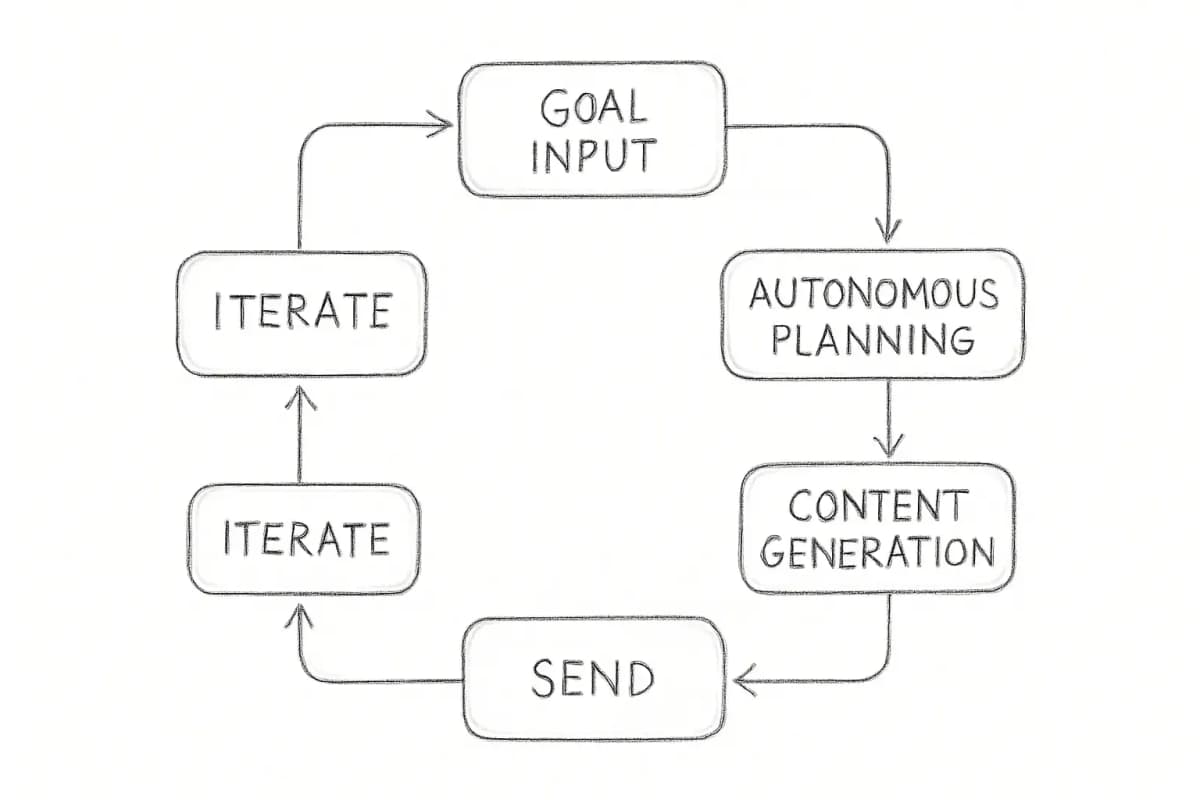

A flowchart diagram showing an autonomous AI email marketing workflow loop with six sequential steps connected by arrows in a circular pattern: (1) Goal Input at the top, (2) Autonomous Planning flowing right, (3) Content Generation flowing down, (4) Send flowing right, (5) Measure flowing down, and (6) Iterate flowing left back to Goal Input. The diagram should emphasize the cyclical nature of agentic AI systems autonomously optimizing email campaigns through continuous measurement and iteration.


Frequently Asked Questions

Does Cognition Labs have an email marketing product?

No. Cognition Labs is an applied AI lab focused on building autonomous agents that can perform substantive software engineering work, not just assist with code completion. Its flagship product, Devin, is positioned as an AI software engineer that can plan tasks, set up environments, write and test code, and iterate on fixes in a sandboxed workspace. The connection to email marketing comes from the broader class of agentic AI that Devin helped popularize, not from a Cognition Labs email product.

Can I use Devin to automate my email marketing workflows?

Devin is built for software engineering tasks, so direct use for campaign creation is outside its core design. However, engineering teams can use Devin to build and maintain the technical infrastructure behind email marketing, including API integrations, automation scripts, custom segmentation logic, and webhook systems. You describe a task, and Devin plans, codes, tests, and delivers the result as a pull request on your GitHub repository.

What does "agentic AI" mean for email marketing teams?

Agentic AI differs from traditional marketing automation on four fronts: goal-oriented rather than rule-based, adaptive reasoning, multi-system coordination, and continuous learning from feedback. In email marketing, that means an AI system that adjusts campaign behavior based on measured outcomes rather than waiting for a marketer to update a rule manually.

What ROI should I expect from AI-assisted email marketing?

Results vary by implementation maturity, but the data is directionally consistent. Email marketing delivers a return of between $36 and $42 for every $1 spent. For context, paid search returns $2 per $1, social advertising $2.80, and display ads $1.35. Teams that add AI-driven personalization and automation to that baseline can push those numbers considerably higher, as shown by the 41% revenue lift cited from AI-personalized campaigns.

No comments yet. Be the first!

Leave a comment

Comments are reviewed before publishing.

HomeBlogAI Email Marketing ToolsCognition Labs AI Email Marketing: Features & ROI
AI Email Marketing Tools

Cognition Labs AI Email Marketing: Features & ROI

Explore Cognition Labs AI email marketing tools. Learn how automation and AI-driven personalization improve deliverability and campaign performance for your business.

R

Rachel Torres

July 21, 2026

13 min read
Share:
#AI Email Marketing#Email Automation#Personalization#Marketing Technology
Illustration for cognition labs ai email marketing

Stay in the loop

Get the latest posts delivered straight to your inbox. No spam, unsubscribe anytime.

Cognition Labs is primarily known as the company behind Devin, an autonomous AI software engineering agent. It is not a dedicated email marketing platform. However, searches for "Cognition Labs AI email marketing" reflect a real pattern of marketers asking how AI systems like Devin, and the broader class of autonomous AI agents it represents, can be applied to email marketing workflows. This article is best framed honestly around that intersection: what Cognition Labs actually is, what its agentic approach means for email marketing practitioners, and what outcomes teams can realistically expect when bringing AI agents of this caliber into their marketing stack.


What Cognition Labs Actually Is (And Why Marketers Are Asking About It)

If you landed here expecting a dedicated email platform, this article will give you something more useful: an honest look at what Cognition Labs is, what its technology actually does, and how the agentic AI approach it pioneered applies directly to email marketing automation and ROI.

Cognition AI, Inc., also known as Cognition Labs, is an American artificial intelligence company headquartered in San Francisco, California. The company is focused on developing AI software engineers, with its flagship product, Devin, designed to autonomously handle complex engineering tasks, from coding and debugging to deployment.

So why are marketers searching for "Cognition Labs AI email marketing"? Because agentic email marketing represents a fundamental shift from reactive automation to proactive, intelligent campaign orchestration, and Cognition Labs' Devin is the most prominent real-world example of what a capable autonomous AI agent looks like in production. Understanding that model of AI has direct implications for how you build, automate, and scale your email programs.

Key Takeaways

  • Cognition Labs built Devin, an autonomous AI agent, not an email marketing tool. But the agentic AI model it popularized is now reshaping how marketing automation works.
  • Email marketing delivers an average return of between $36 and $42 for every $1 spent, making it the highest-ROI digital marketing channel.
  • Companies using AI-driven email strategies see up to 41% more revenue than those using traditional batch-and-blast sends.
  • Real deployments of AI agents in marketing show 3 to 5x higher email click-through rates from individualized personalization and 60% faster content cycles.
  • Email marketing is the highest-ROI channel and, as of 2026, the workload best suited to a hybrid AI-agent architecture. Platforms including Klaviyo Marketing Agent, HubSpot Breeze, Customer.io AI Agent, Braze Sage AI, and ActiveCampaign's agents have all shipped production capabilities.

What Devin Teaches Us About Agentic AI for Email

Devin is an autonomous AI software engineering agent from Cognition Labs. Think of it as a tireless junior developer that can plan a task, navigate a codebase, run tests, propose fixes, and even open pull requests, while still benefiting from human oversight. Devin is a multi-step coding agent that operates tools like a shell, editor, and browser to complete end-to-end tasks with minimal guidance.

That architecture, plan autonomously, execute across tools, iterate, and deliver, is the same architecture now being applied to email marketing workflows. The distinction Cognition Labs drew for software development is the same distinction that now separates true AI agents from conventional email automation.

Traditional automation is rule-based. It relies on conditional triggers such as "if a user downloads this, send that" or "if a cart is abandoned, trigger this email." These workflows are useful, but they are fixed. Once built, they operate within boundaries defined by the marketer. AI marketing agents operate differently. Instead of following rigid logic, they interpret patterns. They look at outcomes and adjust behavior accordingly.

Devin executes entire software projects and resolves 13.9% of real-world GitHub issues end-to-end on SWE-bench, far outperforming GPT-4's 1.7% and Claude 2's 4.8% as of March 2024. The benchmark matters less than the mechanism: an agent that takes a goal, breaks it into steps, uses available tools, and delivers a result without a human approving each action.

That is what email teams now need to run at scale.


The Real ROI Case for AI-Driven Email Marketing

Before exploring how agentic AI applies to email, it helps to know what the numbers look like when AI is in the loop.

Nearly two-thirds of marketers now use AI tools for email campaigns, with 87% of AI adopters specifically applying it to email marketing. The revenue outcomes back the adoption:

  • Brands using AI-driven personalization report up to 42% higher revenue, with click-through rates exceeding 13%.
  • Automated emails drove 37% of all ecommerce email revenue in 2024, despite representing just 2% of email volume.
  • Businesses using AI in email campaigns report an average ROI increase of 21%.
  • Marketing teams using AI agents see 46% faster content creation and 32% quicker editing cycles. Some agencies report cutting operational costs by 40% while delivering work three times faster.

The ceiling is even higher for teams with fully integrated AI workflows. Omnisend reports that its U.S. clients generate an average of $79 in revenue for every $1 spent, reflecting the combined ROI of AI-powered automation and real-time personalization across email and SMS.

For a deeper look at what analytics and attribution should look like inside that kind of program, see our Email Marketing Analytics Best Practices guide.


How Cognition Labs-Style AI Agents Apply to Email Campaigns

The direct application of Cognition Labs' Devin to email marketing is building and automating the technical layer of your email infrastructure. Here is where that plays out concretely.

Building custom email infrastructure and integrations

Businesses can use Devin to build and deploy web apps and fix bugs in codebases. For email teams, that translates to:

  • Building custom API integrations between your CRM, ESP, and analytics stack
  • Writing and maintaining automation scripts for segmentation logic
  • Deploying and debugging webhook infrastructure that feeds behavioral triggers
  • Automating list hygiene workflows that prevent deliverability issues

By deploying Devin on Azure, Cognition enabled up to 2x developer productivity and cut project costs by 50% for enterprise customers. Marketing teams with engineering support could apply that same productivity gain to building the technical scaffolding their campaigns depend on.

Agentic personalization at scale

The more strategic application of the Cognition Labs model is the behavior of the agent itself. Unlike traditional systems that execute predetermined workflows, agentic AI operates as an autonomous decision-making layer that continuously analyzes customer data streams, behavioral signals, and engagement patterns to optimize campaigns in real-time. These AI agents process multi-dimensional customer data, including purchase history, browsing behavior, email engagement metrics, and cross-channel interactions, to dynamically adjust messaging frequency, content selection, and delivery timing.

For practical personalization strategies you can deploy today, see 7 Email Personalization Techniques That Boost Conversions 47%.

Autonomous A/B testing and campaign iteration

AI agents in marketing are autonomous systems that can plan, execute, and optimize multi-step marketing workflows, from campaign ideation and audience segmentation to content creation, ad optimization, and performance reporting, without requiring human input at every stage.

This mirrors Devin's engineering loop exactly: receive goal, plan steps, execute, measure, iterate. In email, that means an agent that generates subject line variants, measures open rate differences, selects the winner, and re-queues the next test without a marketer opening a dashboard.


What the Devin Model Gets Right (And Where It Falls Short for Marketers)

Cognition Labs designed Devin for engineering workflows, and that focus matters when evaluating how to apply its model to email marketing.

What the agentic approach gets right:

  • Long-horizon task completion without per-step human approval
  • Cross-tool coordination (shell, browser, editor) maps cleanly to ESP, CRM, and analytics integrations
  • Continuous iteration based on measured output rather than static rules

Where direct application has limits:

Limitations include variable reliability, potential for hallucinated actions, and the ongoing need for reproducibility and governance. In email marketing, those failure modes are costly. A hallucinated personalization field, a broken segmentation rule, or a misconfigured send time can damage sender reputation and subscriber trust simultaneously.

AI agents will likely not replace email marketers but will become their assistants. How realistic it is to transform this assistant from a junior specialist who requires too much attention and control into a strong intermediary who knows what he is doing remains to be seen.

The practical recommendation: begin small. Select low-risk, repetitive parts of your email process and give agents context to understand your brand and goals.


Agent-Ready Email Platforms to Use Now

If the Cognition Labs agentic model interests you and you want to apply it to email today, the tooling is there. You do not need Devin to run agentic email campaigns.

Klaviyo, HubSpot Breeze, ActiveCampaign, Customer.io, and Braze are the agent-ready tier. These five platforms have shipped genuine agent or near-agent capabilities, not just ML classification features.

What separates these platforms from standard automation:

  • Klaviyo: Klaviyo's AI spans over 40 features, from Segments AI that builds audience targeting from your full customer data set to personalized send-time optimization that delivers messages when each individual subscriber is most likely to engage.
  • HubSpot Breeze: Using Breeze agents, you can write content, generate landing pages, and enhance the personalization of emails and ad campaigns in real time.
  • Deliverability monitoring: Gmail moved from soft enforcement to permanent rejections using 5.7.x failure codes in November 2025. Microsoft Outlook and Hotmail followed in May 2025. The 0.3% complaint rate is the hard ceiling. A human checking complaint rates weekly is not adequate. An agent that monitors in real-time and triggers auto-suppression when the rate approaches 0.1% is the correct architecture for bulk senders.

To build out a complete strategy around these tools, the Email Marketing Strategy Template for 2025 covers how to structure your program from segmentation through automation.


Applying Agentic AI to Your Email Marketing Stack

If you want to move from theory to action, here is a practical sequence:

  1. Audit your current automation gaps. Identify which parts of your email program still require manual decisions, such as segment selection, send time, and content variant selection.
  2. Start with agent-assisted personalization. Use an agent-ready ESP to run dynamic content and behavioral triggers before moving to fully autonomous workflows.
  3. Automate list segmentation first. Segmented campaigns dramatically outperform generic sends, with AI-driven hyper-personalization boosting revenue 41% and click-through rates 13.44%.
  4. Build deliverability monitoring into the agent layer. Complaint rate monitoring and suppression should be automatic, not a weekly manual check.
  5. Layer in engineering automation. If your team has development resources, Cognition Labs' model applies directly to building custom integrations, segmentation scripts, and reporting infrastructure.

For guidance on list segmentation as a starting point, our Email List Segmentation Strategies That Boost ROI by 760% article covers the mechanics in detail.


A flowchart diagram showing an autonomous AI email marketing workflow loop with six sequential steps connected by arrows in a circular pattern: (1) Goal Input at the top, (2) Autonomous Planning flowing right, (3) Content Generation flowing down, (4) Send flowing right, (5) Measure flowing down, and (6) Iterate flowing left back to Goal Input. The diagram should emphasize the cyclical nature of agentic AI systems autonomously optimizing email campaigns through continuous measurement and iteration.


Frequently Asked Questions

Does Cognition Labs have an email marketing product?

No. Cognition Labs is an applied AI lab focused on building autonomous agents that can perform substantive software engineering work, not just assist with code completion. Its flagship product, Devin, is positioned as an AI software engineer that can plan tasks, set up environments, write and test code, and iterate on fixes in a sandboxed workspace. The connection to email marketing comes from the broader class of agentic AI that Devin helped popularize, not from a Cognition Labs email product.

Can I use Devin to automate my email marketing workflows?

Devin is built for software engineering tasks, so direct use for campaign creation is outside its core design. However, engineering teams can use Devin to build and maintain the technical infrastructure behind email marketing, including API integrations, automation scripts, custom segmentation logic, and webhook systems. You describe a task, and Devin plans, codes, tests, and delivers the result as a pull request on your GitHub repository.

What does "agentic AI" mean for email marketing teams?

Agentic AI differs from traditional marketing automation on four fronts: goal-oriented rather than rule-based, adaptive reasoning, multi-system coordination, and continuous learning from feedback. In email marketing, that means an AI system that adjusts campaign behavior based on measured outcomes rather than waiting for a marketer to update a rule manually.

What ROI should I expect from AI-assisted email marketing?

Results vary by implementation maturity, but the data is directionally consistent. Email marketing delivers a return of between $36 and $42 for every $1 spent. For context, paid search returns $2 per $1, social advertising $2.80, and display ads $1.35. Teams that add AI-driven personalization and automation to that baseline can push those numbers considerably higher, as shown by the 41% revenue lift cited from AI-personalized campaigns.

No comments yet. Be the first!

Leave a comment

Comments are reviewed before publishing.