
Email
Email

A modern blog built with Payload CMS, Next.js, and shadcn/ui.

RSS FeedSitemap

Explore

  • Blog
  • News
  • Statistics
  • Authors

Categories

  • Hiring & Team Building
  • Email Campaign Strategy
  • Email Design & Templates
  • Email Compliance & Legal
  • Email Deliverability & Best Practices
  • Career Development
  • Email Strategy for Finance & Professional Services
  • Email Marketing Metrics

Latest articles

  • How to Hire an Email Marketing SpecialistJul 22, 2026
  • Email Marketing Campaigns Template: Ready-to-UseJul 22, 2026
  • Canva Email Marketing Templates: Design Fast, Convert MoreJul 22, 2026
  • Email Marketing Templates for FranchisesJul 22, 2026

Popular topics

  • #Specialist Skills
  • #Team Building
  • #Templates
  • #Canva
  • #Advanced Strategies
  • #multi-location businesses
  • #Marketing Regulations
  • #Lead Follow-Up
  • #iCloud Email
  • #Marketing Management
  • #Product Launch
  • #Electrician Marketing
  • #statistics
  • #Budget-Friendly
  • #Free Resources
  • #Miami businesses

Stay in the loop

Join 2,000+ readers. Unsubscribe anytime.

Subscribe
Email

© 2026 Email. All rights reserved.

SitemapRSS
HomeBlogPlatform Reviews & ComparisonsEmail Marketing for Dentists: Boost Patient Retention
Platform Reviews & Comparisons

Email Marketing for Dentists: Boost Patient Retention

Email marketing for dentists drives patient retention and appointments. Learn proven strategies to engage patients and grow your dental practice with effective campaigns.

R

Rachel Torres

April 22, 2026

10 min read
Share:
#dental marketing#patient retention#email campaigns#dental practice growth
Illustration for email marketing for dentist

Stay in the loop

Get the latest posts delivered straight to your inbox. No spam, unsubscribe anytime.

Dental practices face a real retention problem. The average dental practice retains only 41% of new patients, according to the American Dental Association. That means for every ten patients who walk through your door, nearly six will not return. Email marketing for dentists is one of the most direct, cost-effective tools to change that number, and it works at a fraction of the cost of paid ads or direct mail.

This guide covers how to build a dental email marketing strategy that keeps your schedule full, reduces no-shows, and turns one-time visitors into long-term patients.


Key Takeaways

  • Email marketing delivers an average ROI of $42 for every $1 spent, making it one of the highest-ROI marketing channels for dental practices.
  • Medical, dental, and healthcare emails rank second-highest for open rates across all industries, at 46.29%.
  • Automating appointment reminders reduces no-shows by nearly 23%.
  • Segmentation, personalization, and automation are the three levers that separate high-performing dental email programs from generic inbox clutter.
  • HIPAA compliance is non-negotiable: your email platform, consent process, and content all need to meet specific legal requirements before you send a single campaign.

Why Email Marketing Works Especially Well for Dentists

Most marketing channels work by interrupting people who were not thinking about you. Email is different. Your patient list is already warm. These are people who chose your practice, gave you their contact information, and have a standing reason to hear from you.

The lifetime value of a retained dental patient sits between $12,000 and $15,000. That number reframes what a single well-timed email is worth. A recall email that brings back one lapsed patient can generate thousands of dollars in recurring revenue over the next several years.

Before checking social media or other news, 58% of people read their email first thing in the morning. That gives your practice a direct line to patient attention during a focused window, before the day fills up with distractions.

Compare that to social media or paid ads. Every click on an ad for "dentist near me" can cost around $18.50, and not everyone who clicks ends up booking an appointment. Email removes that friction entirely.


The Core Types of Dental Email Campaigns

Not all emails serve the same purpose. A well-structured dental email marketing program uses several campaign types in parallel.

Appointment reminders and confirmations are the backbone of any practice's communication. Automating appointment reminders reduces no-shows by 22.95%. This directly protects revenue and keeps your hygiene chairs filled.

Recall campaigns target patients who are overdue for cleanings or follow-up care. Practices that do not pre-schedule hygiene patients lose 15% to 18% more patients overall. A well-timed recall email can recover much of that attrition before it compounds.

Post-visit follow-ups show patients that your care does not end when they leave the chair. Appointment reminders and confirmations reduce no-shows and streamline scheduling, while post-visit follow-ups demonstrate that your care extends beyond the appointment itself.

Re-engagement campaigns reach patients who have gone quiet. These emails can include a gentle reminder about overdue care, a special offer, or simply a check-in. Reactivation campaigns with personalized messaging and urgency, such as limited-time treatment discounts, can effectively motivate inactive patients to return.

Educational newsletters build trust over time. Educational emails consistently outperform promotional ones in the long term. When patients see your emails as informative rather than promotional, trust and authority increase, which naturally drives treatment acceptance.

Welcome emails have an open rate of 82%, making them your highest-impact single send. Use that moment to introduce your practice, set expectations, and give new patients a clear path to booking their first appointment. For guidance on structuring that first sequence, see our guide on welcome email sequence best practices.


Segmentation: Stop Sending the Same Email to Everyone

Sending the same email to your entire list is the fastest way to tank your engagement rates. Segmentation divides your list into smaller groups based on shared characteristics so you can send highly relevant messages.

For a dental practice, effective segments include:

  • Treatment history: patients interested in cosmetic procedures versus those due for routine preventive care
  • Appointment status: active patients versus those overdue by 3, 6, or 12 months
  • Insurance status: patients with expiring benefits who have not yet used them
  • Demographics: families with young children, seniors with implant interest, young professionals interested in whitening
  • Engagement level: patients who open every email versus those who have not opened in six months

Segmented campaigns drive approximately 14% higher open rates and 101% more clicks than unsegmented ones because relevance matters.

Approximately 90% of people do not maximize their dental benefits. Sending timely reminders to patients about expiring dental benefits encourages them to book appointments before the end of the benefit period, which helps maximize their benefits and ensures your schedule stays full.

For a deeper look at how segmentation drives results across email programs, read our breakdown of email list segmentation strategies that boost ROI.


Personalization Beyond "Dear [First Name]"

Using a patient's first name is a start, not a strategy. True personalization in dentist email marketing connects the message to the patient's actual history and circumstances.

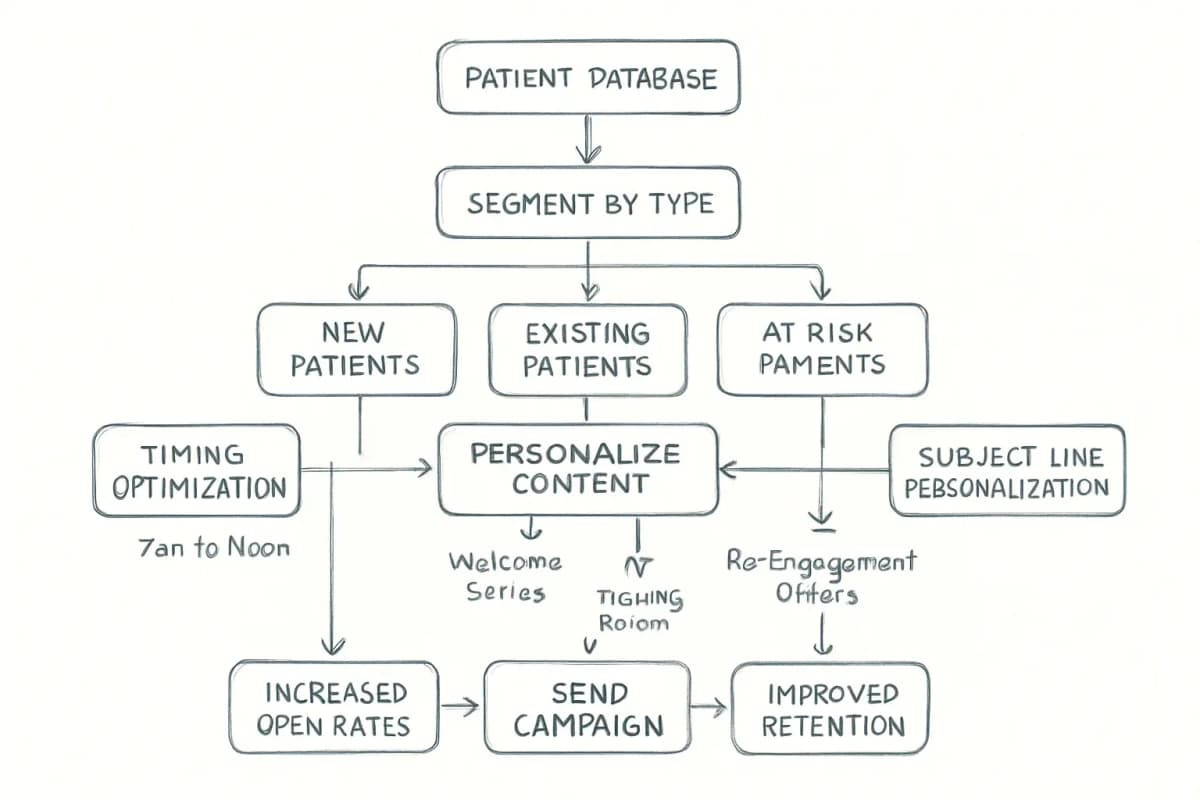
Effective personalization means including references to a patient's last dental service or offering targeted communications based on their treatment history. For instance, if a patient recently inquired about teeth whitening, following up with a relevant offer on that service creates a much stronger connection.

Effective dental email marketing leverages patient data to reference recent visits, treatment history, upcoming procedures, or eligibility for preventive care. Segmentation by age, treatment status, and engagement level further improves relevance and open rates.

Subject lines are another high-leverage point. The best time to send emails to dental patients is in the morning, between 7 a.m. and noon. Timing combined with a specific, relevant subject line significantly increases the chance your message gets opened. For research-backed subject line tactics, see our article on email subject line best practices that boost open rates. A vertical workflow diagram showing dental email marketing segmentation and personalization. Start with a 'Patient Database' box at the top. Arrow flows down to 'Segment by Patient Type' (showing branches for new patients, existing patients, and at-risk patients). Each segment branches into 'Personalize Message Content' boxes with examples like appointment reminders for existing patients, welcome series for new patients, and re-engagement offers for at-risk patients. Additional inputs show 'Timing Optimization' (7am to noon) and 'Subject Line Personalization' feeding into the personalization stage. All paths converge at the bottom into 'Send Automated Campaign' leading to outcome metrics like 'Increased Open Rates' and 'Improved Retention'. Use professional healthcare color scheme with blue and teal accents.

Automation: The Engine Behind Scalable Patient Communication

Manual outreach does not scale. Automation is what makes dental email marketing sustainable and scalable. Practice management software allows practices to combine automation with segmentation and personalization, making campaigns predictable, reliable, and measurable rather than a manual burden on staff.

A basic automation structure for a dental practice looks like this:

  1. New patient onboarding sequence: welcome email, practice introduction, first appointment reminder
  2. Pre-appointment reminder: sent 1 week and 1 to 2 days before each visit
  3. Post-visit follow-up: sent 24 to 48 hours after an appointment
  4. Recall trigger: sent automatically at the 5 or 6 month mark since last cleaning
  5. Lapsed patient reactivation: triggered at 12 and 18 months of inactivity

Sophisticated patient communication sequences can be triggered by appointments, treatment completions, time-based intervals, or patient behaviors, ensuring consistent engagement throughout the patient journey without manual effort from staff.

In one composite case study from dental practices using automated recall software, no-show rates decreased from 18% to 11.9% across all providers, and staff saved an average of 19 hours per week through automated recall and follow-up processes.


HIPAA Compliance in Dental Email Marketing

This is the section most marketing guides skip, and it is one of the most important areas for any dental practice to understand before launching an email program.

The HIPAA Privacy Rule states that patients have specific controls over whether their protected health information (PHI) is used for marketing purposes.

There are several non-negotiable requirements:

  • Patient consent: Patients must explicitly consent to receive marketing communications via email. Additionally, patients must have the ability to opt out of marketing emails and unsubscribe should they no longer wish to receive them.
  • No PHI in subject lines: PHI should never be contained in the subject line of an email, as subject lines cannot be encrypted.
  • Business Associate Agreements (BAAs): Any email provider that receives, transmits, and stores data on behalf of a healthcare client is considered a business associate under HIPAA. All HIPAA business associates are required to sign BAAs before working with healthcare clients.
  • Platform selection: Many popular tools such as HubSpot and Mailchimp are not HIPAA compliant, which makes it important to assess a vendor's HIPAA compliance before using them for patient emails.

In May 2022, a dental practice in North Carolina allegedly disclosed a patient's protected health information in response to a negative online review. The Office for Civil Rights imposed a $50,000 civil penalty. The risks of non-compliance are real and financially significant.


Metrics to Track in Your Dental Email Marketing Program

Without measurement, you are guessing. To truly measure the impact of your dental email marketing strategy, focus on key performance indicators like open rates, click-through rates, and conversion rates. For a dental practice, these metrics can reveal much about the effectiveness of email marketing efforts.

The metrics that matter most for dentist email marketing:

  • Open rate: a baseline signal of subject line and send-time effectiveness. Email marketers now prioritize click-through rates, click-to-open rates, and conversion metrics over open rates when evaluating campaign performance, especially given changes to Apple Mail privacy protections.
  • Click-through rate (CTR): shows whether your content is driving action. A benchmark CTR for dental emails is around 21.5%.
  • Appointment conversions: the number of bookings directly attributable to an email campaign
  • Recall compliance rate: the percentage of overdue patients who schedule after receiving a recall email
  • Unsubscribe rate: an unsubscribe rate above 0.5% could indicate issues with content relevance or send frequency.

For a full framework on measuring email performance, review our guide to email marketing analytics best practices.


Frequently Asked Questions

How often should a dental practice send emails?

Start with one to two emails per month. Add more only if the additional sends are timely and valuable. Overemailing is one of the fastest ways to increase unsubscribes and damage patient trust. Automation helps by ensuring each email is triggered by a relevant event rather than a fixed calendar schedule.

What email platform should dentists use?

Standard platforms like Mailchimp may not meet HIPAA requirements. Look for a platform with an intuitive interface and one that integrates with your existing patient management system, allowing for seamless patient communication. Prioritize vendors willing to sign a Business Associate Agreement and that offer encrypted data storage and transmission. Platforms built specifically for dental and healthcare practices, such as RevenueWell, Lighthouse 360, or DoctorConnect, are often the safest starting point.

Is it legal to email dental patients about promotions?

Yes, within specific conditions. Obtaining patient consent is essential. Consent forms should clearly explain how patient information will be used, emphasize the importance of privacy, and provide an option to opt out of receiving marketing emails. Avoid including any treatment-specific or diagnostic information in promotional content, and never reference a patient's condition in a subject line.

What types of emails get the best results for dental practices?

Welcome emails have the highest open rate at 82%. Beyond that, recall reminders and expiring-benefits campaigns tend to generate the most direct revenue because they target patients who are already predisposed to act. For dental practices, the most effective email campaigns include appointment reminders, recall notices, patient education, special offers for treatments, and practice updates.


No comments yet. Be the first!

Leave a comment

Comments are reviewed before publishing.

More from

Related posts

Illustration for attentive sms email marketing automation reviews
Platform Reviews & ComparisonsJul 21, 2026 13 min

Attentive SMS Email Marketing Automation Reviews

Read honest Attentive SMS reviews. Compare features, pricing, and integrations to see if this platform fits your email and SMS strategy.

RRachel Torres
Illustration for leading email marketing automation agencies 2025
Platform Reviews & ComparisonsJul 16, 2026 12 min

Leading Email Marketing Automation Agencies 2025

Find the top email marketing automation agencies for 2025. Compare platforms, pricing, and features to boost your campaign ROI. Get expert recommendations.

SSarah Mitchell
Illustration for marketing automation and email marketing platform
Platform Reviews & ComparisonsJul 12, 2026 9 min

Marketing Automation and Email Marketing Platforms

Compare top marketing automation and email marketing platforms. Learn which tools fit your budget, scale, and workflow. Find the right fit for your business.

JJames Chen
HomeBlogPlatform Reviews & ComparisonsEmail Marketing for Dentists: Boost Patient Retention
Platform Reviews & Comparisons

Email Marketing for Dentists: Boost Patient Retention

Email marketing for dentists drives patient retention and appointments. Learn proven strategies to engage patients and grow your dental practice with effective campaigns.

R

Rachel Torres

April 22, 2026

10 min read
Share:
#dental marketing#patient retention#email campaigns#dental practice growth
Illustration for email marketing for dentist

Stay in the loop

Get the latest posts delivered straight to your inbox. No spam, unsubscribe anytime.

Dental practices face a real retention problem. The average dental practice retains only 41% of new patients, according to the American Dental Association. That means for every ten patients who walk through your door, nearly six will not return. Email marketing for dentists is one of the most direct, cost-effective tools to change that number, and it works at a fraction of the cost of paid ads or direct mail.

This guide covers how to build a dental email marketing strategy that keeps your schedule full, reduces no-shows, and turns one-time visitors into long-term patients.


Key Takeaways

  • Email marketing delivers an average ROI of $42 for every $1 spent, making it one of the highest-ROI marketing channels for dental practices.
  • Medical, dental, and healthcare emails rank second-highest for open rates across all industries, at 46.29%.
  • Automating appointment reminders reduces no-shows by nearly 23%.
  • Segmentation, personalization, and automation are the three levers that separate high-performing dental email programs from generic inbox clutter.
  • HIPAA compliance is non-negotiable: your email platform, consent process, and content all need to meet specific legal requirements before you send a single campaign.

Why Email Marketing Works Especially Well for Dentists

Most marketing channels work by interrupting people who were not thinking about you. Email is different. Your patient list is already warm. These are people who chose your practice, gave you their contact information, and have a standing reason to hear from you.

The lifetime value of a retained dental patient sits between $12,000 and $15,000. That number reframes what a single well-timed email is worth. A recall email that brings back one lapsed patient can generate thousands of dollars in recurring revenue over the next several years.

Before checking social media or other news, 58% of people read their email first thing in the morning. That gives your practice a direct line to patient attention during a focused window, before the day fills up with distractions.

Compare that to social media or paid ads. Every click on an ad for "dentist near me" can cost around $18.50, and not everyone who clicks ends up booking an appointment. Email removes that friction entirely.


The Core Types of Dental Email Campaigns

Not all emails serve the same purpose. A well-structured dental email marketing program uses several campaign types in parallel.

Appointment reminders and confirmations are the backbone of any practice's communication. Automating appointment reminders reduces no-shows by 22.95%. This directly protects revenue and keeps your hygiene chairs filled.

Recall campaigns target patients who are overdue for cleanings or follow-up care. Practices that do not pre-schedule hygiene patients lose 15% to 18% more patients overall. A well-timed recall email can recover much of that attrition before it compounds.

Post-visit follow-ups show patients that your care does not end when they leave the chair. Appointment reminders and confirmations reduce no-shows and streamline scheduling, while post-visit follow-ups demonstrate that your care extends beyond the appointment itself.

Re-engagement campaigns reach patients who have gone quiet. These emails can include a gentle reminder about overdue care, a special offer, or simply a check-in. Reactivation campaigns with personalized messaging and urgency, such as limited-time treatment discounts, can effectively motivate inactive patients to return.

Educational newsletters build trust over time. Educational emails consistently outperform promotional ones in the long term. When patients see your emails as informative rather than promotional, trust and authority increase, which naturally drives treatment acceptance.

Welcome emails have an open rate of 82%, making them your highest-impact single send. Use that moment to introduce your practice, set expectations, and give new patients a clear path to booking their first appointment. For guidance on structuring that first sequence, see our guide on welcome email sequence best practices.


Segmentation: Stop Sending the Same Email to Everyone

Sending the same email to your entire list is the fastest way to tank your engagement rates. Segmentation divides your list into smaller groups based on shared characteristics so you can send highly relevant messages.

For a dental practice, effective segments include:

  • Treatment history: patients interested in cosmetic procedures versus those due for routine preventive care
  • Appointment status: active patients versus those overdue by 3, 6, or 12 months
  • Insurance status: patients with expiring benefits who have not yet used them
  • Demographics: families with young children, seniors with implant interest, young professionals interested in whitening
  • Engagement level: patients who open every email versus those who have not opened in six months

Segmented campaigns drive approximately 14% higher open rates and 101% more clicks than unsegmented ones because relevance matters.

Approximately 90% of people do not maximize their dental benefits. Sending timely reminders to patients about expiring dental benefits encourages them to book appointments before the end of the benefit period, which helps maximize their benefits and ensures your schedule stays full.

For a deeper look at how segmentation drives results across email programs, read our breakdown of email list segmentation strategies that boost ROI.


Personalization Beyond "Dear [First Name]"

Using a patient's first name is a start, not a strategy. True personalization in dentist email marketing connects the message to the patient's actual history and circumstances.

Effective personalization means including references to a patient's last dental service or offering targeted communications based on their treatment history. For instance, if a patient recently inquired about teeth whitening, following up with a relevant offer on that service creates a much stronger connection.

Effective dental email marketing leverages patient data to reference recent visits, treatment history, upcoming procedures, or eligibility for preventive care. Segmentation by age, treatment status, and engagement level further improves relevance and open rates.

Subject lines are another high-leverage point. The best time to send emails to dental patients is in the morning, between 7 a.m. and noon. Timing combined with a specific, relevant subject line significantly increases the chance your message gets opened. For research-backed subject line tactics, see our article on email subject line best practices that boost open rates. A vertical workflow diagram showing dental email marketing segmentation and personalization. Start with a 'Patient Database' box at the top. Arrow flows down to 'Segment by Patient Type' (showing branches for new patients, existing patients, and at-risk patients). Each segment branches into 'Personalize Message Content' boxes with examples like appointment reminders for existing patients, welcome series for new patients, and re-engagement offers for at-risk patients. Additional inputs show 'Timing Optimization' (7am to noon) and 'Subject Line Personalization' feeding into the personalization stage. All paths converge at the bottom into 'Send Automated Campaign' leading to outcome metrics like 'Increased Open Rates' and 'Improved Retention'. Use professional healthcare color scheme with blue and teal accents.


Automation: The Engine Behind Scalable Patient Communication

Manual outreach does not scale. Automation is what makes dental email marketing sustainable and scalable. Practice management software allows practices to combine automation with segmentation and personalization, making campaigns predictable, reliable, and measurable rather than a manual burden on staff.

A basic automation structure for a dental practice looks like this:

  1. New patient onboarding sequence: welcome email, practice introduction, first appointment reminder
  2. Pre-appointment reminder: sent 1 week and 1 to 2 days before each visit
  3. Post-visit follow-up: sent 24 to 48 hours after an appointment
  4. Recall trigger: sent automatically at the 5 or 6 month mark since last cleaning
  5. Lapsed patient reactivation: triggered at 12 and 18 months of inactivity

Sophisticated patient communication sequences can be triggered by appointments, treatment completions, time-based intervals, or patient behaviors, ensuring consistent engagement throughout the patient journey without manual effort from staff.

In one composite case study from dental practices using automated recall software, no-show rates decreased from 18% to 11.9% across all providers, and staff saved an average of 19 hours per week through automated recall and follow-up processes.


HIPAA Compliance in Dental Email Marketing

This is the section most marketing guides skip, and it is one of the most important areas for any dental practice to understand before launching an email program.

The HIPAA Privacy Rule states that patients have specific controls over whether their protected health information (PHI) is used for marketing purposes.

There are several non-negotiable requirements:

  • Patient consent: Patients must explicitly consent to receive marketing communications via email. Additionally, patients must have the ability to opt out of marketing emails and unsubscribe should they no longer wish to receive them.
  • No PHI in subject lines: PHI should never be contained in the subject line of an email, as subject lines cannot be encrypted.
  • Business Associate Agreements (BAAs): Any email provider that receives, transmits, and stores data on behalf of a healthcare client is considered a business associate under HIPAA. All HIPAA business associates are required to sign BAAs before working with healthcare clients.
  • Platform selection: Many popular tools such as HubSpot and Mailchimp are not HIPAA compliant, which makes it important to assess a vendor's HIPAA compliance before using them for patient emails.

In May 2022, a dental practice in North Carolina allegedly disclosed a patient's protected health information in response to a negative online review. The Office for Civil Rights imposed a $50,000 civil penalty. The risks of non-compliance are real and financially significant.


Metrics to Track in Your Dental Email Marketing Program

Without measurement, you are guessing. To truly measure the impact of your dental email marketing strategy, focus on key performance indicators like open rates, click-through rates, and conversion rates. For a dental practice, these metrics can reveal much about the effectiveness of email marketing efforts.

The metrics that matter most for dentist email marketing:

  • Open rate: a baseline signal of subject line and send-time effectiveness. Email marketers now prioritize click-through rates, click-to-open rates, and conversion metrics over open rates when evaluating campaign performance, especially given changes to Apple Mail privacy protections.
  • Click-through rate (CTR): shows whether your content is driving action. A benchmark CTR for dental emails is around 21.5%.
  • Appointment conversions: the number of bookings directly attributable to an email campaign
  • Recall compliance rate: the percentage of overdue patients who schedule after receiving a recall email
  • Unsubscribe rate: an unsubscribe rate above 0.5% could indicate issues with content relevance or send frequency.

For a full framework on measuring email performance, review our guide to email marketing analytics best practices.


Frequently Asked Questions

How often should a dental practice send emails?

Start with one to two emails per month. Add more only if the additional sends are timely and valuable. Overemailing is one of the fastest ways to increase unsubscribes and damage patient trust. Automation helps by ensuring each email is triggered by a relevant event rather than a fixed calendar schedule.

What email platform should dentists use?

Standard platforms like Mailchimp may not meet HIPAA requirements. Look for a platform with an intuitive interface and one that integrates with your existing patient management system, allowing for seamless patient communication. Prioritize vendors willing to sign a Business Associate Agreement and that offer encrypted data storage and transmission. Platforms built specifically for dental and healthcare practices, such as RevenueWell, Lighthouse 360, or DoctorConnect, are often the safest starting point.

Is it legal to email dental patients about promotions?

Yes, within specific conditions. Obtaining patient consent is essential. Consent forms should clearly explain how patient information will be used, emphasize the importance of privacy, and provide an option to opt out of receiving marketing emails. Avoid including any treatment-specific or diagnostic information in promotional content, and never reference a patient's condition in a subject line.

What types of emails get the best results for dental practices?

Welcome emails have the highest open rate at 82%. Beyond that, recall reminders and expiring-benefits campaigns tend to generate the most direct revenue because they target patients who are already predisposed to act. For dental practices, the most effective email campaigns include appointment reminders, recall notices, patient education, special offers for treatments, and practice updates.

No comments yet. Be the first!

Leave a comment

Comments are reviewed before publishing.

More from

Related posts

Illustration for attentive sms email marketing automation reviews
Platform Reviews & ComparisonsJul 21, 2026 13 min

Attentive SMS Email Marketing Automation Reviews

Read honest Attentive SMS reviews. Compare features, pricing, and integrations to see if this platform fits your email and SMS strategy.

RRachel Torres
Illustration for leading email marketing automation agencies 2025
Platform Reviews & ComparisonsJul 16, 2026 12 min

Leading Email Marketing Automation Agencies 2025

Find the top email marketing automation agencies for 2025. Compare platforms, pricing, and features to boost your campaign ROI. Get expert recommendations.

SSarah Mitchell
Illustration for marketing automation and email marketing platform
Platform Reviews & ComparisonsJul 12, 2026 9 min

Marketing Automation and Email Marketing Platforms

Compare top marketing automation and email marketing platforms. Learn which tools fit your budget, scale, and workflow. Find the right fit for your business.

JJames Chen