
Email
Email

A modern blog built with Payload CMS, Next.js, and shadcn/ui.

RSS FeedSitemap

Explore

  • Blog
  • News
  • Statistics
  • Authors

Categories

  • CRM & Email Marketing Tools
  • Email Analytics & Reporting
  • Email Security & Compliance
  • Email Automation
  • Email List Building
  • Seasonal & Holiday Email Marketing
  • Email Marketing Benchmarks & Statistics
  • Email Design & Personalization

Latest articles

  • AI Email Marketing Processes: Automate StrategyJul 20, 2026
  • Email Marketing Automation Software Comparison 2024Jul 20, 2026
  • Best Email Marketing Software for AutomationJul 20, 2026
  • Cybersecurity Email Marketing Automation GuideJul 20, 2026

Popular topics

  • #deliverability and segmentation
  • #beauty brand email strategy
  • #skincare email marketing
  • #Marketing
  • #email engagement metrics
  • #Content Generation
  • #Sales Efficiency
  • #Cyber Monday Trends
  • #Email Campaign Benchmarks
  • #Holiday Marketing Statistics
  • #BFCM Email Strategy
  • #Enterprise Email
  • #credit card marketing
  • #Business Software
  • #CRM Software
  • #MarTech

Stay in the loop

Join 2,000+ readers. Unsubscribe anytime.

Subscribe
Email

© 2026 Email. All rights reserved.

SitemapRSS
HomeBlogEmail CopywritingCopywriter Email Marketing: Write Emails That Convert
Email Copywriting

Copywriter Email Marketing: Write Emails That Convert

Learn how copywriter email marketing techniques drive higher open rates and sales. Expert strategies, proven formulas, and real examples inside.

M

Marcus Webb

April 21, 2026

11 min read
Share:
#Email Copywriting#Email Workflows#Email Strategy
Illustration for copywriter email marketing

Stay in the loop

Get the latest posts delivered straight to your inbox. No spam, unsubscribe anytime.

Good, I now have comprehensive data. Let me write the full blog post.

Email marketing already delivers an average return of $36 to $42 for every dollar spent, making it the highest-ROI channel in digital marketing. But that number is not automatic. It depends almost entirely on one thing: the quality of the copy inside your emails. Good copywriter email marketing is what turns a list of addresses into a revenue-generating asset.

This guide covers how to write email copy that gets opened, holds attention, and drives clicks. Every section is built around real data, not theory.


Key Takeaways

  • Email marketing generates between $36 and $40 for every dollar spent, translating to a 3,600% to 4,000% return on investment, outperforming most other marketing channels.
  • Emails with personalized subject lines are 26% more likely to be opened.
  • Using multiple CTAs in an email often means subscribers click none of them. Your copy should include a single CTA that clearly states what you want readers to do.
  • Companies that A/B test all their emails see a 37% increase in email marketing ROI compared to those that do not.
  • Open rates rose for the fifth consecutive year in 2025, while automated emails reached a 38% open rate and generated $2.87 per email compared to $0.18 for standard campaigns.

Why Email Copywriting Determines Campaign Performance

Most email campaigns fail at the copy level, not the technical level. A finely tuned sending infrastructure and a clean list still cannot rescue an email that starts with a generic greeting, buries the offer, or asks readers to do three things at once.

The average time consumers spend reading brand emails has dropped from 13.4 seconds in 2018 to just 10 seconds. That number is expected to keep falling, which means your copy must grab the reader and hold them immediately.

59% of consumers say marketing emails have influenced their purchases. That influence does not come from design or frequency. It comes from copy that speaks to a specific problem, makes a relevant offer, and removes the friction between reading and clicking.

The core disciplines of copywriting email marketing cover four elements: the subject line, the preview text, the body copy, and the call to action. Getting all four right in the same email is what separates high-converting campaigns from forgettable ones.


How to Write Subject Lines That Get Opened

The subject line is the single most important line in any email. If it does not earn the open, nothing else matters.

Treat your subject line the way you would treat a blog headline. If you spend four hours on an email, roughly half of that time should go to the subject line.

Three factors separate subject lines that perform from those that do not:

1. Length. Research shows that short subject lines, between six and ten words, achieve the best open rates, likely because most people read emails on mobile. A long subject line may look fine in a browser but mobile users will not see the full message and are unlikely to click.

2. Personalization. Emails with personalized content have a 29% higher open rate and a 41% higher click-through rate. Even inserting a first name or referencing a recent behavior moves the needle significantly.

3. Context. As email copywriter Nikki Elbaz puts it: "Consider the context of your email. By context, I mean the inbox. What kinds of emails does your subscriber usually receive? Will emojis or questions stand out or blend in?"

What to avoid: words like "Free!!" or "Urgent" can send emails straight to the promotions or junk folder. Spam filters have become sophisticated at detecting promotional language and pressure tactics. Even ALL CAPS subject lines or multiple exclamation marks can lower sender reputation over time.

For a deeper breakdown of what works by industry and send volume, read our guide on email subject line best practices that boost open rates by 27%.


Writing Body Copy That Holds Attention

Once the email is open, you have roughly ten seconds to justify the reader's time. Body copy that earns those seconds follows a clear structure.

Lead with the point

Open with the most important thing. Do not warm up with pleasantries or backstory. State the benefit, the offer, or the insight in the first sentence.

Write for one reader, not a list

The key to effective email copywriting is understanding your audience and how you can help them. Once you understand that, you can speak to them in a conversational tone. Write as if you are addressing a single person, not a segment of thousands.

Keep paragraphs short

On mobile, a paragraph of five sentences looks like a wall of text. Break copy into two to three sentence blocks. Use bullets when you are listing more than three items. White space is not wasted space.

Use storytelling where it fits

Storytelling techniques make your message not only informative but also memorable, weaving in relatable anecdotes or examples that resonate with your audience. A brief, relevant story can carry a reader from the opening to the CTA more effectively than a list of features.

Match the copy to the segment

PetLab Co. implemented a precise email segmentation strategy, conducting thorough A/B testing to optimize CTAs, send times, and subject lines. The result was a 53% increase in email click rates and a 24% rise in open rates. The copy did not change significantly. The audience targeting did.

For tactics on matching copy to audience, see our guide on email list segmentation strategies that boost ROI by 760%.


Calls to Action That Actually Convert

The CTA is where copy translates to revenue. Most CTAs fail because they ask for too much, say too little, or compete with three other buttons in the same email.

Use one primary CTA. Limit your email to one primary CTA. Multiple competing calls to action dilute attention and reduce conversion rates. If you need a secondary CTA, keep it below the fold in a less prominent format.

Use first-person phrasing. One A/B test found that "Start my free trial" had a 90% higher conversion rate than "Start your free trial." The hypothesis is that prospects subconsciously take ownership when they see "my," whereas "your" sounds like the company talking at them.

Match CTA friction to relationship stage. The CTA determines whether a prospect replies or ignores the email. Most sales emails ask for too much too soon. A 30-minute demo request in a first touch scares off cold prospects. Interest-based CTAs that lower friction increase reply rates.

Position matters. Emails with CTAs above the fold see up to 84% more engagement. Do not make readers scroll to find the action you want them to take.


Personalization Beyond the First Name

Calling someone by name in a subject line is table stakes now. The emails that stand out go further.

Personalized emails deliver 6x higher transaction rates. That lift does not come from a {{first_name}} tag. It comes from behavioral data informing what offer, product, or message is relevant to a specific subscriber at a specific moment.

Effective personalization in email marketing copywriting includes:

  • Behavioral triggers: Emails sent because of what a subscriber did (visited a product page, downloaded a resource, abandoned a cart) outperform broadcast emails by wide margins. Broadcast emails have a conversion rate of just 0.09%, while behavior-based emails achieve a 37.04% open rate, 25.5% click-to-open rate, and 5.5% conversion rate.
  • Dynamic content: Marketers using dynamic content report 258% higher ROI compared to static content campaigns.
  • Segmented messaging: Segmented campaigns generate 760% more revenue compared to broadcast campaigns.

For practical techniques that move beyond basic personalization, see our article on 7 email personalization techniques that boost conversions 47%.


Email Marketing Copy Examples: What Good Looks Like

Understanding the principles is easier when you can see them applied. Here are the common email types and what the copy must do in each one.

Welcome emails

Welcome emails are among the most effective campaigns in email marketing, achieving an average open rate of 83.63% and a click-through rate of 16.60%. The copy job here is to confirm the subscriber made the right choice, deliver on the signup promise, and set the tone for the relationship. Keep it warm, specific, and short.

Promotional emails

The copy must answer one question immediately: why should I care about this right now? State the offer, the deadline, and the action in the first three lines. Urgency works when it is genuine. When it is manufactured, it erodes trust.

Nurture emails

These emails are not asking for a purchase. They are building the case for one. B2B buyers typically engage with three to five pieces of content before converting, and decision-makers prefer educational content over promotional pitches, with case studies and whitepapers generating 40% higher engagement than product-focused emails. Write to inform and earn credibility, not to close.

Re-engagement emails

The only goal is to get a response. Short copy, a direct question, and a single easy action. "Still interested?" often outperforms elaborate win-back sequences because it respects the reader's attention.
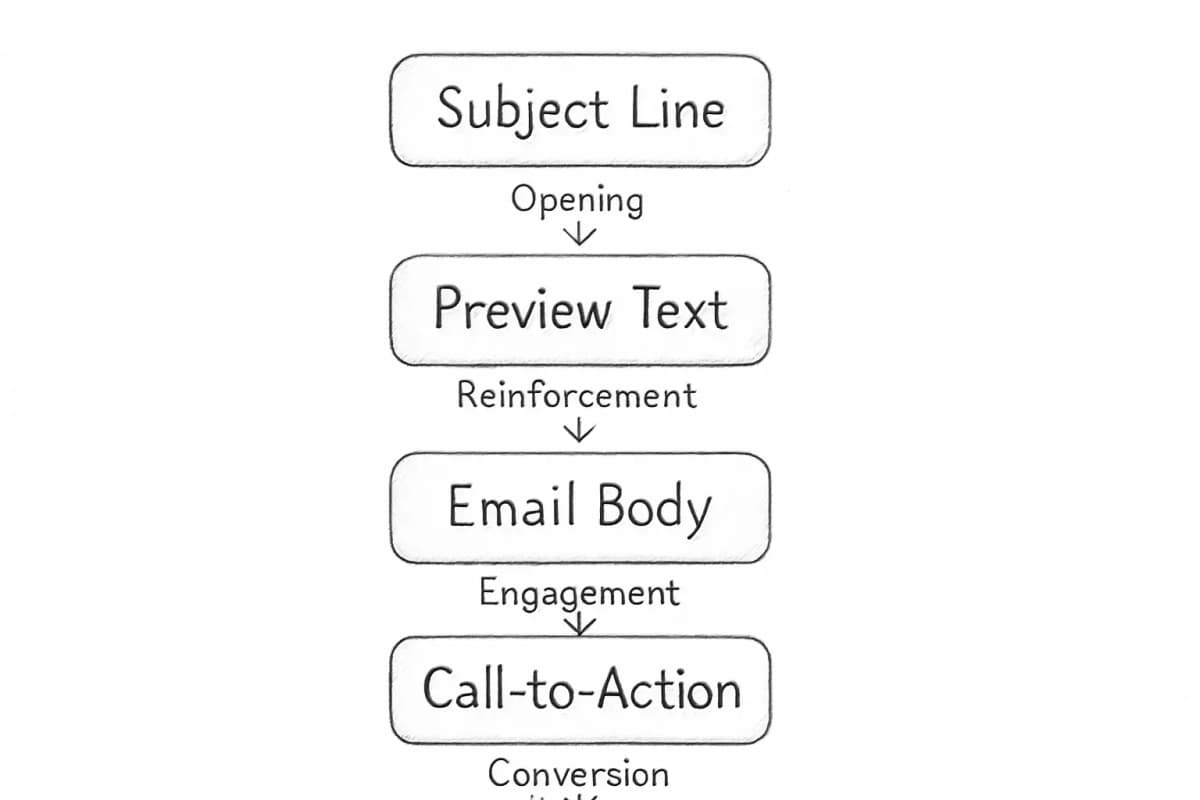
Email copywriting structure diagram showing the four key components of an email in sequential order: subject line at the top, preview text below it, email body in the middle section, and call-to-action (CTA) button at the bottom. Each component should be in a separate box connected by arrows flowing downward to show the reading progression. Include brief notes under each component explaining its purpose: subject line for opening, preview text for reinforcement, body for engagement, and CTA for conversion.


Testing and Iteration: The Only Way to Know What Works

No copywriter email marketing strategy survives first contact with a real audience unchanged. Testing is what separates opinion from knowledge.

Companies that A/B test all their emails see a 37% increase in email marketing ROI than those that do not.

The discipline of testing is simple: change one thing at a time. If you are testing subject lines, keep the body and CTA identical across variants. If you are testing CTAs, lock the subject line. This isolation is what lets you attribute results to specific changes rather than guessing at what moved the needle.

What to test first, in order of impact:

  1. Subject line (affects open rate, which gates everything else)
  2. CTA copy and placement (affects click rate directly)
  3. Opening line (affects read-through rate)
  4. Email length (short versus long, tested by audience type)
  5. Send time (day of week, time of day)

Email marketers now prioritize click-through rates, click-to-open rates, and conversion metrics over open rates when evaluating campaign performance, partly because Apple's Mail Privacy Protection has made open rate data less reliable. Track what people do after they open, not just whether they opened.

For a full framework on measuring what matters, see our guide on email marketing analytics best practices.


Frequently Asked Questions

What does a copywriter do in email marketing?

A copywriter in email marketing is responsible for writing every text element of a campaign: the subject line, preview text, opening line, body copy, and call to action. Each element serves a specific conversion function. The subject line earns the open, the body builds the case, and the CTA drives the action. Strong copywriting email marketing ensures these elements work together as a sequence rather than independent components.

How long should marketing email copy be?

There is no universal rule. Length should match the goal. A promotional email announcing a 48-hour sale can be three sentences. A nurture email introducing a complex product benefit may need 200 to 300 words. Structure helps regardless of length: short paragraphs, subheadings, and bullet points all make copy easier to read. The real measure is whether every sentence is earning its place.

What makes a CTA convert in email marketing copy?

The most effective CTAs are specific, low-friction, and written from the reader's perspective. Different psychological frameworks drive different outcomes: urgency-driven ("Only 3 spots left"), benefit-driven ("Save 12 hours this month"), or curiosity-driven ("Here's what changed") each work in different contexts. The best approach is to match the CTA type to the reader's stage in the buying journey, then test variants to confirm what works for your specific audience.

How does personalization improve email marketing copywriting?

Personalization improves performance at every stage of the email. Emails with personalization achieve 29% higher open rates and 41% higher click-through rates compared to generic messages. This performance improvement directly translates to revenue, with personalized emails generating 6x higher transaction rates. The most impactful personalization goes beyond first names and uses behavioral data to determine which message, offer, or content is relevant to each subscriber.
No comments yet. Be the first!

Leave a comment

Comments are reviewed before publishing.

More from

Related posts

Illustration for how to write effective email marketing content
Email CopywritingMay 17, 2026 11 min

How to Write Effective Email Marketing Content

Learn proven strategies to write email content that converts. From subject lines to CTAs, discover what actually moves subscribers to take action.

PPriya Kapoor
Illustration for how to write email marketing copy
Email CopywritingMay 16, 2026 11 min

How to Write Email Marketing Copy That Converts

Learn proven strategies to write email copy that engages subscribers and drives clicks. Expert tips on subject lines, CTAs, and personalization techniques.

RRachel Torres
Illustration for how to write email for marketing
Email CopywritingMay 15, 2026 12 min

How to Write Email for Marketing: A Complete Guide

Learn how to write marketing emails that convert. Proven strategies for subject lines, copy, CTAs, and segmentation to boost open rates and ROI.

SSarah Mitchell
HomeBlogEmail CopywritingCopywriter Email Marketing: Write Emails That Convert
Email Copywriting

Copywriter Email Marketing: Write Emails That Convert

Learn how copywriter email marketing techniques drive higher open rates and sales. Expert strategies, proven formulas, and real examples inside.

M

Marcus Webb

April 21, 2026

11 min read
Share:
#Email Copywriting#Email Workflows#Email Strategy
Illustration for copywriter email marketing

Stay in the loop

Get the latest posts delivered straight to your inbox. No spam, unsubscribe anytime.

Good, I now have comprehensive data. Let me write the full blog post.

Email marketing already delivers an average return of $36 to $42 for every dollar spent, making it the highest-ROI channel in digital marketing. But that number is not automatic. It depends almost entirely on one thing: the quality of the copy inside your emails. Good copywriter email marketing is what turns a list of addresses into a revenue-generating asset.

This guide covers how to write email copy that gets opened, holds attention, and drives clicks. Every section is built around real data, not theory.


Key Takeaways

  • Email marketing generates between $36 and $40 for every dollar spent, translating to a 3,600% to 4,000% return on investment, outperforming most other marketing channels.
  • Emails with personalized subject lines are 26% more likely to be opened.
  • Using multiple CTAs in an email often means subscribers click none of them. Your copy should include a single CTA that clearly states what you want readers to do.
  • Companies that A/B test all their emails see a 37% increase in email marketing ROI compared to those that do not.
  • Open rates rose for the fifth consecutive year in 2025, while automated emails reached a 38% open rate and generated $2.87 per email compared to $0.18 for standard campaigns.

Why Email Copywriting Determines Campaign Performance

Most email campaigns fail at the copy level, not the technical level. A finely tuned sending infrastructure and a clean list still cannot rescue an email that starts with a generic greeting, buries the offer, or asks readers to do three things at once.

The average time consumers spend reading brand emails has dropped from 13.4 seconds in 2018 to just 10 seconds. That number is expected to keep falling, which means your copy must grab the reader and hold them immediately.

59% of consumers say marketing emails have influenced their purchases. That influence does not come from design or frequency. It comes from copy that speaks to a specific problem, makes a relevant offer, and removes the friction between reading and clicking.

The core disciplines of copywriting email marketing cover four elements: the subject line, the preview text, the body copy, and the call to action. Getting all four right in the same email is what separates high-converting campaigns from forgettable ones.


How to Write Subject Lines That Get Opened

The subject line is the single most important line in any email. If it does not earn the open, nothing else matters.

Treat your subject line the way you would treat a blog headline. If you spend four hours on an email, roughly half of that time should go to the subject line.

Three factors separate subject lines that perform from those that do not:

1. Length. Research shows that short subject lines, between six and ten words, achieve the best open rates, likely because most people read emails on mobile. A long subject line may look fine in a browser but mobile users will not see the full message and are unlikely to click.

2. Personalization. Emails with personalized content have a 29% higher open rate and a 41% higher click-through rate. Even inserting a first name or referencing a recent behavior moves the needle significantly.

3. Context. As email copywriter Nikki Elbaz puts it: "Consider the context of your email. By context, I mean the inbox. What kinds of emails does your subscriber usually receive? Will emojis or questions stand out or blend in?"

What to avoid: words like "Free!!" or "Urgent" can send emails straight to the promotions or junk folder. Spam filters have become sophisticated at detecting promotional language and pressure tactics. Even ALL CAPS subject lines or multiple exclamation marks can lower sender reputation over time.

For a deeper breakdown of what works by industry and send volume, read our guide on email subject line best practices that boost open rates by 27%.


Writing Body Copy That Holds Attention

Once the email is open, you have roughly ten seconds to justify the reader's time. Body copy that earns those seconds follows a clear structure.

Lead with the point

Open with the most important thing. Do not warm up with pleasantries or backstory. State the benefit, the offer, or the insight in the first sentence.

Write for one reader, not a list

The key to effective email copywriting is understanding your audience and how you can help them. Once you understand that, you can speak to them in a conversational tone. Write as if you are addressing a single person, not a segment of thousands.

Keep paragraphs short

On mobile, a paragraph of five sentences looks like a wall of text. Break copy into two to three sentence blocks. Use bullets when you are listing more than three items. White space is not wasted space.

Use storytelling where it fits

Storytelling techniques make your message not only informative but also memorable, weaving in relatable anecdotes or examples that resonate with your audience. A brief, relevant story can carry a reader from the opening to the CTA more effectively than a list of features.

Match the copy to the segment

PetLab Co. implemented a precise email segmentation strategy, conducting thorough A/B testing to optimize CTAs, send times, and subject lines. The result was a 53% increase in email click rates and a 24% rise in open rates. The copy did not change significantly. The audience targeting did.

For tactics on matching copy to audience, see our guide on email list segmentation strategies that boost ROI by 760%.


Calls to Action That Actually Convert

The CTA is where copy translates to revenue. Most CTAs fail because they ask for too much, say too little, or compete with three other buttons in the same email.

Use one primary CTA. Limit your email to one primary CTA. Multiple competing calls to action dilute attention and reduce conversion rates. If you need a secondary CTA, keep it below the fold in a less prominent format.

Use first-person phrasing. One A/B test found that "Start my free trial" had a 90% higher conversion rate than "Start your free trial." The hypothesis is that prospects subconsciously take ownership when they see "my," whereas "your" sounds like the company talking at them.

Match CTA friction to relationship stage. The CTA determines whether a prospect replies or ignores the email. Most sales emails ask for too much too soon. A 30-minute demo request in a first touch scares off cold prospects. Interest-based CTAs that lower friction increase reply rates.

Position matters. Emails with CTAs above the fold see up to 84% more engagement. Do not make readers scroll to find the action you want them to take.


Personalization Beyond the First Name

Calling someone by name in a subject line is table stakes now. The emails that stand out go further.

Personalized emails deliver 6x higher transaction rates. That lift does not come from a {{first_name}} tag. It comes from behavioral data informing what offer, product, or message is relevant to a specific subscriber at a specific moment.

Effective personalization in email marketing copywriting includes:

  • Behavioral triggers: Emails sent because of what a subscriber did (visited a product page, downloaded a resource, abandoned a cart) outperform broadcast emails by wide margins. Broadcast emails have a conversion rate of just 0.09%, while behavior-based emails achieve a 37.04% open rate, 25.5% click-to-open rate, and 5.5% conversion rate.
  • Dynamic content: Marketers using dynamic content report 258% higher ROI compared to static content campaigns.
  • Segmented messaging: Segmented campaigns generate 760% more revenue compared to broadcast campaigns.

For practical techniques that move beyond basic personalization, see our article on 7 email personalization techniques that boost conversions 47%.


Email Marketing Copy Examples: What Good Looks Like

Understanding the principles is easier when you can see them applied. Here are the common email types and what the copy must do in each one.

Welcome emails

Welcome emails are among the most effective campaigns in email marketing, achieving an average open rate of 83.63% and a click-through rate of 16.60%. The copy job here is to confirm the subscriber made the right choice, deliver on the signup promise, and set the tone for the relationship. Keep it warm, specific, and short.

Promotional emails

The copy must answer one question immediately: why should I care about this right now? State the offer, the deadline, and the action in the first three lines. Urgency works when it is genuine. When it is manufactured, it erodes trust.

Nurture emails

These emails are not asking for a purchase. They are building the case for one. B2B buyers typically engage with three to five pieces of content before converting, and decision-makers prefer educational content over promotional pitches, with case studies and whitepapers generating 40% higher engagement than product-focused emails. Write to inform and earn credibility, not to close.

Re-engagement emails

The only goal is to get a response. Short copy, a direct question, and a single easy action. "Still interested?" often outperforms elaborate win-back sequences because it respects the reader's attention.

Email copywriting structure diagram showing the four key components of an email in sequential order: subject line at the top, preview text below it, email body in the middle section, and call-to-action (CTA) button at the bottom. Each component should be in a separate box connected by arrows flowing downward to show the reading progression. Include brief notes under each component explaining its purpose: subject line for opening, preview text for reinforcement, body for engagement, and CTA for conversion.


Testing and Iteration: The Only Way to Know What Works

No copywriter email marketing strategy survives first contact with a real audience unchanged. Testing is what separates opinion from knowledge.

Companies that A/B test all their emails see a 37% increase in email marketing ROI than those that do not.

The discipline of testing is simple: change one thing at a time. If you are testing subject lines, keep the body and CTA identical across variants. If you are testing CTAs, lock the subject line. This isolation is what lets you attribute results to specific changes rather than guessing at what moved the needle.

What to test first, in order of impact:

  1. Subject line (affects open rate, which gates everything else)
  2. CTA copy and placement (affects click rate directly)
  3. Opening line (affects read-through rate)
  4. Email length (short versus long, tested by audience type)
  5. Send time (day of week, time of day)

Email marketers now prioritize click-through rates, click-to-open rates, and conversion metrics over open rates when evaluating campaign performance, partly because Apple's Mail Privacy Protection has made open rate data less reliable. Track what people do after they open, not just whether they opened.

For a full framework on measuring what matters, see our guide on email marketing analytics best practices.


Frequently Asked Questions

What does a copywriter do in email marketing?

A copywriter in email marketing is responsible for writing every text element of a campaign: the subject line, preview text, opening line, body copy, and call to action. Each element serves a specific conversion function. The subject line earns the open, the body builds the case, and the CTA drives the action. Strong copywriting email marketing ensures these elements work together as a sequence rather than independent components.

How long should marketing email copy be?

There is no universal rule. Length should match the goal. A promotional email announcing a 48-hour sale can be three sentences. A nurture email introducing a complex product benefit may need 200 to 300 words. Structure helps regardless of length: short paragraphs, subheadings, and bullet points all make copy easier to read. The real measure is whether every sentence is earning its place.

What makes a CTA convert in email marketing copy?

The most effective CTAs are specific, low-friction, and written from the reader's perspective. Different psychological frameworks drive different outcomes: urgency-driven ("Only 3 spots left"), benefit-driven ("Save 12 hours this month"), or curiosity-driven ("Here's what changed") each work in different contexts. The best approach is to match the CTA type to the reader's stage in the buying journey, then test variants to confirm what works for your specific audience.

How does personalization improve email marketing copywriting?

Personalization improves performance at every stage of the email. Emails with personalization achieve 29% higher open rates and 41% higher click-through rates compared to generic messages. This performance improvement directly translates to revenue, with personalized emails generating 6x higher transaction rates. The most impactful personalization goes beyond first names and uses behavioral data to determine which message, offer, or content is relevant to each subscriber.
No comments yet. Be the first!

Leave a comment

Comments are reviewed before publishing.

More from

Related posts

Illustration for how to write effective email marketing content
Email CopywritingMay 17, 2026 11 min

How to Write Effective Email Marketing Content

Learn proven strategies to write email content that converts. From subject lines to CTAs, discover what actually moves subscribers to take action.

PPriya Kapoor
Illustration for how to write email marketing copy
Email CopywritingMay 16, 2026 11 min

How to Write Email Marketing Copy That Converts

Learn proven strategies to write email copy that engages subscribers and drives clicks. Expert tips on subject lines, CTAs, and personalization techniques.

RRachel Torres
Illustration for how to write email for marketing
Email CopywritingMay 15, 2026 12 min

How to Write Email for Marketing: A Complete Guide

Learn how to write marketing emails that convert. Proven strategies for subject lines, copy, CTAs, and segmentation to boost open rates and ROI.

SSarah Mitchell