HomeBlogEmail CopywritingEmail Marketing Copywriting Tips That Drive Conversions
Email Copywriting

Email Marketing Copywriting Tips That Drive Conversions

Learn proven email copywriting techniques to boost open rates, clicks, and sales. Expert tips on subject lines, CTAs, and messaging that converts.

R

Rachel Torres

May 9, 2026

10 min read
HomeBlogEmail CopywritingEmail Marketing Copywriting Tips That Drive Conversions
Email Copywriting

Email Marketing Copywriting Tips That Drive Conversions

Learn proven email copywriting techniques to boost open rates, clicks, and sales. Expert tips on subject lines, CTAs, and messaging that converts.

R

Rachel Torres

May 9, 2026

10 min read
Share:
Share:
#Copywriting#Email Strategy#Email Workflows#Subject Lines
Illustration for email marketing copywriting tips

Stay in the loop

Get the latest posts delivered straight to your inbox. No spam, unsubscribe anytime.

Good. I now have sufficient data to write a comprehensive, well-cited blog post. Let me compose the article.

Your email copy is doing more work than you might realize. It decides whether someone opens, reads, clicks, or deletes within seconds. The average time consumers spend reading brand emails has dropped to just 10 seconds. If your words do not land fast, they do not land at all.

The good news: email marketing remains the highest-ROI channel in digital marketing. On average, businesses net $36 for every dollar spent on email marketing. But that return depends almost entirely on the quality of your copy. This guide covers the email marketing copywriting tips that actually move the needle, from the subject line to the CTA, backed by data.

Key Takeaways

  • 64% of recipients decide to open or delete emails based on the subject line alone.
  • Personalized email campaigns receive an average of 29% higher open rates and 41% higher click-through rates compared to generic ones.
  • A study from Campaign Monitor found that emails with a single, focused CTA can increase click-through rates by more than 370%.
  • Companies that A/B test all their emails see a 37% increase in email marketing ROI compared to those that do not.
  • Emails with preheader text have an open rate of 32.95% and a CTR of 3.12%, compared to 25.72% and 1.97% without them.

1. Write Subject Lines That Get Opened, Not Ignored

Your subject line is the first and often the only impression you get. Studies show that more than 47% of people open emails based solely on the subject line, and 69% of email recipients report emails as spam based on the subject line alone. That is an enormous amount of pressure on a short piece of text.

Keep it short. Emails with a subject line of fewer than 50 characters had the highest conversions. On mobile specifically, character limits are tight. The Gmail app on a Google Pixel 7 displays a maximum of just 33 characters for subject lines. Your key message needs to land in the first few words.

Personalize it. Personalized subject lines, whether they include a relevant event, the recipient's name, company, or location, significantly boost both open and reply rates. Emails with personalized subject lines boast a 46% open rate, compared to 35% without.

Stay in the loop

Get the latest posts delivered straight to your inbox. No spam, unsubscribe anytime.

Good. I now have sufficient data to write a comprehensive, well-cited blog post. Let me compose the article.

Your email copy is doing more work than you might realize. It decides whether someone opens, reads, clicks, or deletes within seconds. The average time consumers spend reading brand emails has dropped to just 10 seconds. If your words do not land fast, they do not land at all.

The good news: email marketing remains the highest-ROI channel in digital marketing. On average, businesses net $36 for every dollar spent on email marketing. But that return depends almost entirely on the quality of your copy. This guide covers the email marketing copywriting tips that actually move the needle, from the subject line to the CTA, backed by data.

Key Takeaways

  • 64% of recipients decide to open or delete emails based on the subject line alone.
  • Personalized email campaigns receive an average of 29% higher open rates and 41% higher click-through rates compared to generic ones.
  • A study from Campaign Monitor found that emails with a single, focused CTA can increase click-through rates by more than 370%.
  • Companies that A/B test all their emails see a 37% increase in email marketing ROI compared to those that do not.
  • Emails with preheader text have an open rate of 32.95% and a CTR of 3.12%, compared to 25.72% and 1.97% without them.

1. Write Subject Lines That Get Opened, Not Ignored

Your subject line is the first and often the only impression you get. Studies show that more than 47% of people open emails based solely on the subject line, and 69% of email recipients report emails as spam based on the subject line alone. That is an enormous amount of pressure on a short piece of text.

Keep it short. Emails with a subject line of fewer than 50 characters had the highest conversions. On mobile specifically, character limits are tight. The Gmail app on a Google Pixel 7 displays a maximum of just 33 characters for subject lines. Your key message needs to land in the first few words.

Personalize it. Personalized subject lines, whether they include a relevant event, the recipient's name, company, or location, significantly boost both open and reply rates. Emails with personalized subject lines boast a 46% open rate, compared to 35% without.

Use numbers when they add context. A study analyzing 115 million emails found that open and reply rates are higher when a number is present in the subject line. Numbers get your emails noticed, demonstrate a clear and straightforward message, and set the right expectations.

Subject line patterns worth testing:

  • Curiosity gap: hint at something without giving it away
  • Benefit-first: state the value before anything else
  • Specificity: use a number or named outcome
  • Personalization: reference name, location, or behavior

For a deeper dive into what moves open rates, see our guide on email subject line best practices that boost open rates.


2. Treat the Preheader as a Second Subject Line

Most marketers write a subject line, then ignore the preheader. That is a wasted opportunity. Emails with preheaders have an open rate of 32.95% and a CTR of 3.12%, compared to an open rate of 25.72% and a CTR of 1.97% for emails without them.

The email preheader is the first line of text that appears next to the subject line in a recipient's inbox. On mobile devices, the preheader text is often more prominent than the subject line itself.

The preheader is free real estate. Use it to complement the subject line, not repeat it. If your subject line says "Your order just shipped," the preheader should add something new, like the expected delivery date or a related offer, not echo "Your order is on its way."

Aim for 40 to 50 characters in your preheader text as a general rule. Test your email across multiple clients before sending, since display limits vary by device and app.


3. Open the Email Body With the Point

Most email body copy buries the lead. Readers are scanning, not reading. People are busy, and there is a good chance your recipient is scanning your message rather than reading closely. Make it easy to parse your message quickly by using headers, keeping text blocks short, and adding relevant images.

The strongest email marketing copywriting tips for body copy all share one quality: clarity over cleverness. Here is how to open strong:

  • State the purpose in the first sentence
  • Address the reader's situation or problem directly
  • Lead with benefit, not feature
  • Use "you" language throughout

Stick to short sentences in the active voice, and use the second person to talk directly to your reader. Avoid industry jargon, which can alienate your email recipients.

Formatting matters. 41% of content that does not perform well has too many complex words, and 43% of low-performing content has too many long sentences. Short paragraphs and clear breaks are not a stylistic preference; they are a conversion tactic.


4. Personalize Beyond First Names

Name insertion is table stakes. Real personalization uses behavioral data to deliver copy that feels written for one person, not a list of thousands. About 78% of customers admit they would engage with a message tailored to their interests.

Use numbers when they add context. A study analyzing 115 million emails found that open and reply rates are higher when a number is present in the subject line. Numbers get your emails noticed, demonstrate a clear and straightforward message, and set the right expectations.

Subject line patterns worth testing:

  • Curiosity gap: hint at something without giving it away
  • Benefit-first: state the value before anything else
  • Specificity: use a number or named outcome
  • Personalization: reference name, location, or behavior

For a deeper dive into what moves open rates, see our guide on email subject line best practices that boost open rates.


2. Treat the Preheader as a Second Subject Line

Most marketers write a subject line, then ignore the preheader. That is a wasted opportunity. Emails with preheaders have an open rate of 32.95% and a CTR of 3.12%, compared to an open rate of 25.72% and a CTR of 1.97% for emails without them.

The email preheader is the first line of text that appears next to the subject line in a recipient's inbox. On mobile devices, the preheader text is often more prominent than the subject line itself.

The preheader is free real estate. Use it to complement the subject line, not repeat it. If your subject line says "Your order just shipped," the preheader should add something new, like the expected delivery date or a related offer, not echo "Your order is on its way."

Aim for 40 to 50 characters in your preheader text as a general rule. Test your email across multiple clients before sending, since display limits vary by device and app.


3. Open the Email Body With the Point

Most email body copy buries the lead. Readers are scanning, not reading. People are busy, and there is a good chance your recipient is scanning your message rather than reading closely. Make it easy to parse your message quickly by using headers, keeping text blocks short, and adding relevant images.

The strongest email marketing copywriting tips for body copy all share one quality: clarity over cleverness. Here is how to open strong:

  • State the purpose in the first sentence
  • Address the reader's situation or problem directly
  • Lead with benefit, not feature
  • Use "you" language throughout

Stick to short sentences in the active voice, and use the second person to talk directly to your reader. Avoid industry jargon, which can alienate your email recipients.

Formatting matters. 41% of content that does not perform well has too many complex words, and 43% of low-performing content has too many long sentences. Short paragraphs and clear breaks are not a stylistic preference; they are a conversion tactic.


4. Personalize Beyond First Names

Name insertion is table stakes. Real personalization uses behavioral data to deliver copy that feels written for one person, not a list of thousands. About 78% of customers admit they would engage with a message tailored to their interests.

Subject lines without personalization have an average open rate of 16.67%, while personalized subject lines reach 35.69%. Personalized email copy can also result in a 28.57% increase in click-through rates.

Deeper personalization tactics that work:

  • Reference a product a subscriber browsed but did not buy
  • Trigger emails based on engagement milestones
  • Use dynamic content blocks to swap copy by segment
  • Reflect back location, industry, or past purchase behavior

Messages with irrelevant content or offers frustrate over 50% of customers, and 41% are disappointed when a campaign does not reflect their wants and needs. Personalization is no longer a differentiator. It is an expectation.

For more strategies on using personalization at scale, explore our guide on email personalization techniques that boost conversions 47%.


5. Segment Your List Before You Write a Word

Copywriting and segmentation are inseparable. The best-written email sent to the wrong audience fails. Segmented promotional emails generate 760% more revenue than non-segmented blasts, according to DMA data.

Before writing any email, define who will receive it. That single constraint changes everything: the tone, the hook, the offer, the CTA. An email to a first-time buyer should read completely differently from one sent to a loyal, repeat customer.

Almost all professionals (90%) agree that segmentation is one of the key best practices that can boost email performance.

Useful segmentation variables for copy targeting:

  • Purchase history and frequency
  • Engagement level (active vs. lapsed)
  • Funnel stage (prospect vs. customer)
  • Product category interest
  • Geography or industry

Our guide on email list segmentation strategies that boost ROI by 760% covers the full segmentation playbook.


6. Write CTAs That Tell People Exactly What to Do

A CTA directly encourages the recipient to take the next step. The lack of a compelling CTA leads to missed opportunities for interaction and conversion.

The most common CTA mistakes are vagueness and volume. "Click here" tells the reader nothing. Three CTAs in one email split attention and reduce total clicks.

A study from Campaign Monitor showed emails with a single, focused CTA can increase click-through rates by more than 370%.

Strong email CTAs follow these principles:

Subject lines without personalization have an average open rate of 16.67%, while personalized subject lines reach 35.69%. Personalized email copy can also result in a 28.57% increase in click-through rates.

Deeper personalization tactics that work:

  • Reference a product a subscriber browsed but did not buy
  • Trigger emails based on engagement milestones
  • Use dynamic content blocks to swap copy by segment
  • Reflect back location, industry, or past purchase behavior

Messages with irrelevant content or offers frustrate over 50% of customers, and 41% are disappointed when a campaign does not reflect their wants and needs. Personalization is no longer a differentiator. It is an expectation.

For more strategies on using personalization at scale, explore our guide on email personalization techniques that boost conversions 47%.


5. Segment Your List Before You Write a Word

Copywriting and segmentation are inseparable. The best-written email sent to the wrong audience fails. Segmented promotional emails generate 760% more revenue than non-segmented blasts, according to DMA data.

Before writing any email, define who will receive it. That single constraint changes everything: the tone, the hook, the offer, the CTA. An email to a first-time buyer should read completely differently from one sent to a loyal, repeat customer.

Almost all professionals (90%) agree that segmentation is one of the key best practices that can boost email performance.

Useful segmentation variables for copy targeting:

  • Purchase history and frequency
  • Engagement level (active vs. lapsed)
  • Funnel stage (prospect vs. customer)
  • Product category interest
  • Geography or industry

Our guide on email list segmentation strategies that boost ROI by 760% covers the full segmentation playbook.


6. Write CTAs That Tell People Exactly What to Do

A CTA directly encourages the recipient to take the next step. The lack of a compelling CTA leads to missed opportunities for interaction and conversion.

The most common CTA mistakes are vagueness and volume. "Click here" tells the reader nothing. Three CTAs in one email split attention and reduce total clicks.

A study from Campaign Monitor showed emails with a single, focused CTA can increase click-through rates by more than 370%.

Strong email CTAs follow these principles:

  1. One CTA per email. Multiple competing actions dilute focus.
  2. Use specific language. "Download the free checklist" outperforms "Learn more."
  3. Write in the first person. "Start my free trial" converts better than "Start your free trial."
  4. Make it visible. Place the CTA above the fold and again near the bottom for longer emails.
  5. Match the CTA to the email goal. A nurture email CTA differs from a promotional one.

Personalized CTAs convert 202% better than standard CTAs. If you can tie the CTA copy to the reader's specific context, such as referencing a product they viewed or a goal they expressed, it will outperform any generic version.


7. Optimize for Mobile Before You Hit Send

In 2025, mobile devices accounted for more than 55% of all email opens globally. Making emails mobile-friendly is no longer optional if you want to increase conversion rates.

Yet the gap between reality and practice remains. About 42% of recipients will delete emails not optimized for mobile. And 44% of marketers still do not optimize their email campaigns for smartphones.

Mobile-first copy and design principles:

  • Keep subject lines under 40 characters to avoid truncation on most devices
  • Write preheader text that adds value in the first 33 to 40 characters
  • Use single-column layouts that scale cleanly
  • Make CTA buttons large enough to tap without precision
  • Keep each chunk of body text shorter than 20 words as a starting point
  • Compress images to reduce load times on cellular connections

72% of recipients base their impression of a brand on the usability of its mobile emails. A slow-loading, hard-to-read email does not just lose the click. It damages the brand relationship.


8. Test Every Element, Then Test Again

Good email marketing copywriting is not set-and-forget. Companies that A/B test all their emails see a 37% increase in their email marketing ROI compared to those that do not.

The most productive elements to test in isolation:

  • Subject line length and tone
  • Preheader text
  • Opening sentence
  • Body copy length (short vs. long)
  • CTA text, color, and placement
  • Personalization level

It is important to A/B test every part of your email, from subject lines to CTAs. Test only one element at a time, otherwise your results will be inconclusive. Make sure you have a significant sample size, and move to the next test once you find a winning element.

Track clicks over opens as your primary signal. Click rate matters more than open rate because Apple Mail Privacy Protection inflates opens artificially. Use click-through rate and conversion rate as the true measures of copy effectiveness.

  1. One CTA per email. Multiple competing actions dilute focus.
  2. Use specific language. "Download the free checklist" outperforms "Learn more."
  3. Write in the first person. "Start my free trial" converts better than "Start your free trial."
  4. Make it visible. Place the CTA above the fold and again near the bottom for longer emails.
  5. Match the CTA to the email goal. A nurture email CTA differs from a promotional one.

Personalized CTAs convert 202% better than standard CTAs. If you can tie the CTA copy to the reader's specific context, such as referencing a product they viewed or a goal they expressed, it will outperform any generic version.


7. Optimize for Mobile Before You Hit Send

In 2025, mobile devices accounted for more than 55% of all email opens globally. Making emails mobile-friendly is no longer optional if you want to increase conversion rates.

Yet the gap between reality and practice remains. About 42% of recipients will delete emails not optimized for mobile. And 44% of marketers still do not optimize their email campaigns for smartphones.

Mobile-first copy and design principles:

  • Keep subject lines under 40 characters to avoid truncation on most devices
  • Write preheader text that adds value in the first 33 to 40 characters
  • Use single-column layouts that scale cleanly
  • Make CTA buttons large enough to tap without precision
  • Keep each chunk of body text shorter than 20 words as a starting point
  • Compress images to reduce load times on cellular connections

72% of recipients base their impression of a brand on the usability of its mobile emails. A slow-loading, hard-to-read email does not just lose the click. It damages the brand relationship.


8. Test Every Element, Then Test Again

Good email marketing copywriting is not set-and-forget. Companies that A/B test all their emails see a 37% increase in their email marketing ROI compared to those that do not.

The most productive elements to test in isolation:

  • Subject line length and tone
  • Preheader text
  • Opening sentence
  • Body copy length (short vs. long)
  • CTA text, color, and placement
  • Personalization level

It is important to A/B test every part of your email, from subject lines to CTAs. Test only one element at a time, otherwise your results will be inconclusive. Make sure you have a significant sample size, and move to the next test once you find a winning element.

Track clicks over opens as your primary signal. Click rate matters more than open rate because Apple Mail Privacy Protection inflates opens artificially. Use click-through rate and conversion rate as the true measures of copy effectiveness.

Before any campaign goes live, run through your email marketing campaign checklist to catch issues before they reach the inbox.
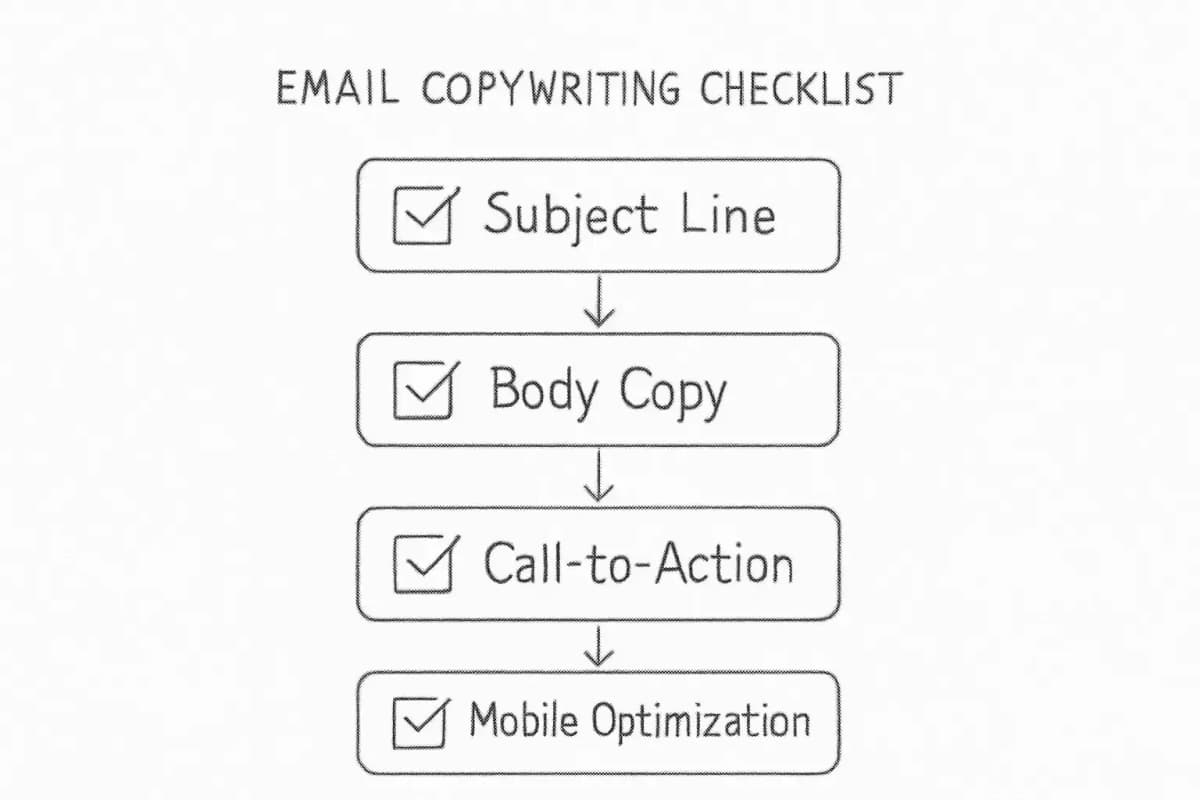

Email copywriting checklist displayed as a vertical checklist with four main sections: subject line optimization at the top, followed by body copy quality, call-to-action clarity, and mobile optimization at the bottom. Each section should have a checkbox icon and brief descriptive text. Use a clean, professional design with checkmarks to indicate completion. The layout should feel like a practical pre-send review tool that email marketers would use before launching campaigns.


Frequently Asked Questions

What is email marketing copywriting?

Email copywriting is creating compelling written content for emails using persuasive language, storytelling, and clear CTAs to engage readers and drive desired actions like purchases or sign-ups. It often includes writing compelling subject lines, an introduction, body content, and clear calls to action.

How long should marketing email copy be?

There is no universal answer, but the principle is that every sentence should serve the reader or the goal, and nothing more. Shorter emails tend to perform better for promotional and transactional sends. Nurture and educational emails can be longer, provided the content earns the reader's attention. The average time consumers spend reading brand emails is just 10 seconds, so regardless of length, your key message and CTA must appear early.

How many CTAs should an email have?

One primary CTA per email is the standard recommendation. Every email should have a single primary call to action. Multiple CTAs dilute click-through rate. You can repeat the same CTA in different places in a longer email, but the action you want the reader to take should be singular and consistent throughout.

How does personalization improve email copywriting results?

Personalized email campaigns receive an average of 29% higher open rates and 41% higher click-through rates compared to generic counterparts. Crafting emails tailored to individual preferences and behaviors can significantly enhance engagement. Effective personalization goes beyond first names and includes referencing past behavior, purchase history, location, or funnel stage to make the copy feel relevant to each recipient.
No comments yet. Be the first!

Leave a comment

Comments are reviewed before publishing.

Before any campaign goes live, run through your email marketing campaign checklist to catch issues before they reach the inbox.


Email copywriting checklist displayed as a vertical checklist with four main sections: subject line optimization at the top, followed by body copy quality, call-to-action clarity, and mobile optimization at the bottom. Each section should have a checkbox icon and brief descriptive text. Use a clean, professional design with checkmarks to indicate completion. The layout should feel like a practical pre-send review tool that email marketers would use before launching campaigns.


Frequently Asked Questions

What is email marketing copywriting?

Email copywriting is creating compelling written content for emails using persuasive language, storytelling, and clear CTAs to engage readers and drive desired actions like purchases or sign-ups. It often includes writing compelling subject lines, an introduction, body content, and clear calls to action.

How long should marketing email copy be?

There is no universal answer, but the principle is that every sentence should serve the reader or the goal, and nothing more. Shorter emails tend to perform better for promotional and transactional sends. Nurture and educational emails can be longer, provided the content earns the reader's attention. The average time consumers spend reading brand emails is just 10 seconds, so regardless of length, your key message and CTA must appear early.

How many CTAs should an email have?

One primary CTA per email is the standard recommendation. Every email should have a single primary call to action. Multiple CTAs dilute click-through rate. You can repeat the same CTA in different places in a longer email, but the action you want the reader to take should be singular and consistent throughout.

How does personalization improve email copywriting results?

Personalized email campaigns receive an average of 29% higher open rates and 41% higher click-through rates compared to generic counterparts. Crafting emails tailored to individual preferences and behaviors can significantly enhance engagement. Effective personalization goes beyond first names and includes referencing past behavior, purchase history, location, or funnel stage to make the copy feel relevant to each recipient.
No comments yet. Be the first!

Leave a comment

Comments are reviewed before publishing.

More from

Related posts

Illustration for how to write effective email marketing content
Email CopywritingMay 17, 2026 11 min

How to Write Effective Email Marketing Content

Learn proven strategies to write email content that converts. From subject lines to CTAs, discover what actually moves subscribers to take action.

More from

Related posts

Illustration for how to write effective email marketing content
Email CopywritingMay 17, 2026 11 min

How to Write Effective Email Marketing Content

Learn proven strategies to write email content that converts. From subject lines to CTAs, discover what actually moves subscribers to take action.

P
Priya Kapoor
P
Priya Kapoor
Illustration for how to write email marketing copy
Email CopywritingMay 16, 2026 11 min

How to Write Email Marketing Copy That Converts

Learn proven strategies to write email copy that engages subscribers and drives clicks. Expert tips on subject lines, CTAs, and personalization techniques.

RRachel Torres
Illustration for how to write email marketing copy
Email CopywritingMay 16, 2026 11 min

How to Write Email Marketing Copy That Converts

Learn proven strategies to write email copy that engages subscribers and drives clicks. Expert tips on subject lines, CTAs, and personalization techniques.

RRachel Torres
Illustration for how to write email for marketing
Email CopywritingMay 15, 2026 12 min

How to Write Email for Marketing: A Complete Guide

Learn how to write marketing emails that convert. Proven strategies for subject lines, copy, CTAs, and segmentation to boost open rates and ROI.

SSarah Mitchell
Illustration for how to write email for marketing
Email CopywritingMay 15, 2026 12 min

How to Write Email for Marketing: A Complete Guide

Learn how to write marketing emails that convert. Proven strategies for subject lines, copy, CTAs, and segmentation to boost open rates and ROI.

SSarah Mitchell