
HomeBlogEmail Strategy & OptimizationEmail Marketing Machine Learning: Boost ROI
Email Strategy & Optimization

Email Marketing Machine Learning: Boost ROI

Machine learning automates email campaigns, improves targeting, and increases conversions. Learn how AI optimizes deliverability and personalization for better results.

S

Sarah Mitchell

July 14, 2026

HomeBlogEmail Strategy & OptimizationEmail Marketing Machine Learning: Boost ROI
Email Strategy & Optimization

Email Marketing Machine Learning: Boost ROI

Machine learning automates email campaigns, improves targeting, and increases conversions. Learn how AI optimizes deliverability and personalization for better results.

S

Sarah Mitchell

July 14, 2026

10 min read
10 min read
Share:
Share:
#Machine Learning#Email Personalization#marketing automation#AI & Email
Illustration for email marketing machine learning

Stay in the loop

Get the latest posts delivered straight to your inbox. No spam, unsubscribe anytime.

Machine learning has quietly become the most impactful technical lever available to email marketers. While the average email program still returns $36 to $42 for every $1 spent, teams applying email marketing machine learning consistently outpace those averages. Companies using AI-driven email strategies see up to 41% more revenue than those using traditional batch-and-blast sends. That gap is widening fast, and the underlying reason is straightforward: machine learning replaces human guesswork with continuous, data-driven decisions at a scale no team can replicate manually.

This guide covers exactly how that works, which applications deliver the clearest ROI, and how to layer them into your existing program.


Key Takeaways

  • Brands using AI-driven personalization report up to 42% higher revenue, with click-through rates exceeding 13%.
  • Individual-level send-time optimization calculates each subscriber's personal open probability window based on click behavior, conversion timing, and reply patterns, delivering a 15 to 25% open rate improvement.
  • AI-driven behavioral segments based on purchase propensity, churn risk, and lifetime value produce 18 to 45% higher revenue per recipient compared to traditional demographic segmentation.
  • AI production speed is improving rapidly: 76% of marketing teams now produce and send a marketing email within 3 days, compared to 62% of teams who took two weeks or more for a single email in 2024.
  • Approximately one in six marketing emails never reaches the recipient's inbox, with average deliverability rates hovering around 83% across major email service providers. Machine learning on both the sender and provider side is reshaping this dynamic.

What Email Marketing Machine Learning Actually Does

Machine learning in email is not a single feature. It is a category of techniques that allow software systems to learn from behavioral data and improve outcomes over time without being manually reprogrammed.

Stay in the loop

Get the latest posts delivered straight to your inbox. No spam, unsubscribe anytime.

Machine learning has quietly become the most impactful technical lever available to email marketers. While the average email program still returns $36 to $42 for every $1 spent, teams applying email marketing machine learning consistently outpace those averages. Companies using AI-driven email strategies see up to 41% more revenue than those using traditional batch-and-blast sends. That gap is widening fast, and the underlying reason is straightforward: machine learning replaces human guesswork with continuous, data-driven decisions at a scale no team can replicate manually.

This guide covers exactly how that works, which applications deliver the clearest ROI, and how to layer them into your existing program.


Key Takeaways

  • Brands using AI-driven personalization report up to 42% higher revenue, with click-through rates exceeding 13%.
  • Individual-level send-time optimization calculates each subscriber's personal open probability window based on click behavior, conversion timing, and reply patterns, delivering a 15 to 25% open rate improvement.
  • AI-driven behavioral segments based on purchase propensity, churn risk, and lifetime value produce 18 to 45% higher revenue per recipient compared to traditional demographic segmentation.
  • AI production speed is improving rapidly: 76% of marketing teams now produce and send a marketing email within 3 days, compared to 62% of teams who took two weeks or more for a single email in 2024.
  • Approximately one in six marketing emails never reaches the recipient's inbox, with average deliverability rates hovering around 83% across major email service providers. Machine learning on both the sender and provider side is reshaping this dynamic.

What Email Marketing Machine Learning Actually Does

Machine learning in email is not a single feature. It is a category of techniques that allow software systems to learn from behavioral data and improve outcomes over time without being manually reprogrammed.

Machine learning email marketing uses algorithms that automatically learn and improve from customer data without explicit programming. Unlike traditional email automation that follows rigid if-then rules, ML systems identify patterns in subscriber behavior and make predictions about future actions.

The technology falls into two categories that work together: predictive ML analyzes historical data to identify patterns and forecasts which subscribers are most likely to convert or at risk of churning, while generative ML creates new content including subject lines, email copy, and product recommendations based on patterns learned from successful examples.

In practice, that means your platform can autonomously decide who receives a message, when it arrives, what content appears, and which subject line gets used, all calibrated to the individual subscriber rather than to a broad segment.


Send-Time Optimization: The Easiest Win

Send-time optimization (STO) is the most accessible machine learning application for most marketing teams because it requires no new content or list restructuring.

Send-time optimization represents one of the most immediately impactful ML applications in email marketing. The technology analyzes each subscriber's historical engagement patterns, including when they typically open emails, click links, and convert, to determine the optimal moment to deliver each message.

AI send-time optimization lifts open rates by 26%: machine learning models that predict when each subscriber is most likely to open and engage can boost open rates by 26% and click-through rates by 41% compared to fixed-schedule sends.

The system also adapts over time. As new engagement data arrives, the ML model updates its understanding. The system adapts to changing behavior patterns without marketers needing to modify rules.

One important note: modern STO has evolved beyond open rates due to Apple Mail Privacy Protection, now using click and conversion signals instead of raw open data. If your platform still measures STO success purely through opens, that is a signal to re-evaluate.


Predictive Segmentation and Behavioral Scoring

Most email teams segment by demographics, job title, or basic behavior like "opened in the last 30 days." Machine learning makes that approach look coarse.

Instead of "subscribers who opened in the last 30 days," predictive segments might be "subscribers with a high probability of purchase in the next 14 days" or "subscribers showing early churn signals." These segments update continuously as new data arrives.

Models continuously score each subscriber on behavioral signals including conversion likelihood, predicted lifetime value, purchase frequency, content preference, and churn probability, and update those scores as new data comes in. One documented case showed 28% higher conversions compared to legacy segment performance, with high-propensity customers identified by the model being five times more likely to buy than the rest of the list.

AI-driven behavioral segments based on purchase propensity, churn risk, and lifetime value produce 18 to 45% higher revenue per recipient compared to traditional demographic segmentation.

Machine learning email marketing uses algorithms that automatically learn and improve from customer data without explicit programming. Unlike traditional email automation that follows rigid if-then rules, ML systems identify patterns in subscriber behavior and make predictions about future actions.

The technology falls into two categories that work together: predictive ML analyzes historical data to identify patterns and forecasts which subscribers are most likely to convert or at risk of churning, while generative ML creates new content including subject lines, email copy, and product recommendations based on patterns learned from successful examples.

In practice, that means your platform can autonomously decide who receives a message, when it arrives, what content appears, and which subject line gets used, all calibrated to the individual subscriber rather than to a broad segment.


Send-Time Optimization: The Easiest Win

Send-time optimization (STO) is the most accessible machine learning application for most marketing teams because it requires no new content or list restructuring.

Send-time optimization represents one of the most immediately impactful ML applications in email marketing. The technology analyzes each subscriber's historical engagement patterns, including when they typically open emails, click links, and convert, to determine the optimal moment to deliver each message.

AI send-time optimization lifts open rates by 26%: machine learning models that predict when each subscriber is most likely to open and engage can boost open rates by 26% and click-through rates by 41% compared to fixed-schedule sends.

The system also adapts over time. As new engagement data arrives, the ML model updates its understanding. The system adapts to changing behavior patterns without marketers needing to modify rules.

One important note: modern STO has evolved beyond open rates due to Apple Mail Privacy Protection, now using click and conversion signals instead of raw open data. If your platform still measures STO success purely through opens, that is a signal to re-evaluate.


Predictive Segmentation and Behavioral Scoring

Most email teams segment by demographics, job title, or basic behavior like "opened in the last 30 days." Machine learning makes that approach look coarse.

Instead of "subscribers who opened in the last 30 days," predictive segments might be "subscribers with a high probability of purchase in the next 14 days" or "subscribers showing early churn signals." These segments update continuously as new data arrives.

Models continuously score each subscriber on behavioral signals including conversion likelihood, predicted lifetime value, purchase frequency, content preference, and churn probability, and update those scores as new data comes in. One documented case showed 28% higher conversions compared to legacy segment performance, with high-propensity customers identified by the model being five times more likely to buy than the rest of the list.

AI-driven behavioral segments based on purchase propensity, churn risk, and lifetime value produce 18 to 45% higher revenue per recipient compared to traditional demographic segmentation.

For a practical overview of foundational segmentation principles that complement ML-driven approaches, see our guide on email list segmentation strategies that boost ROI by 760%.


Dynamic Content Personalization at Scale

Inserting a subscriber's first name is table stakes. Machine learning enables a different category of personalization: content that changes at the individual level across every element of the email.

AI-powered content personalization goes beyond inserting a first name into the subject line. Modern email platforms use machine learning to dynamically select subject lines, images, product recommendations, and entire content blocks based on each subscriber's predicted preferences and behavior patterns. The result is an email that feels individually crafted even when it is generated at scale.

Studies show AI-powered subject line tools can increase conversion rates by around 15 to 30%, while personalized subject lines can lift open rates by 41%.

AI-driven personalization of email copy results in a 13%+ increase in CTR. Behavior-based personalization using purchase history data boosts CTR by up to 39%.

This directly supports stronger subject line performance as well. For research-backed subject line techniques, see email subject line best practices that boost open rates by 27%.

For a deeper look at how AI shapes each personalization layer, our post on AI email marketing personalization techniques walks through specific implementation patterns.


Churn Prediction and Re-Engagement Automation

One of the highest-value but least-used ML applications is churn prediction. The model identifies subscribers showing early disengagement signals before they fully lapse, allowing a targeted intervention while the relationship is still salvageable.

Predictive analytics can be used to identify customers who are at risk of churning. By analyzing patterns in customer behavior, such as a decrease in engagement or purchase frequency, AI models can flag these customers and trigger re-engagement campaigns aimed at retaining them.

Users inactive for 14+ days flagged by churn models, with an educational "tips and quick wins" sequence, saw churn reduced by 22%.

This connects directly to sender reputation. Every inactive subscriber you retain through timely re-engagement is one fewer low-engagement record dragging down your deliverability metrics.


Machine Learning and Email Deliverability

Machine learning operates on both sides of email deliverability: you can use it to protect your sender reputation, and the major inbox providers use it to decide where your messages land.

Email providers like Gmail and Outlook have taken spam filtering to the next level with machine learning algorithms that analyze sender behavior in real time. These systems do not just look for spammy keywords; they dig deeper into your sending patterns and engagement history.

For a practical overview of foundational segmentation principles that complement ML-driven approaches, see our guide on email list segmentation strategies that boost ROI by 760%.


Dynamic Content Personalization at Scale

Inserting a subscriber's first name is table stakes. Machine learning enables a different category of personalization: content that changes at the individual level across every element of the email.

AI-powered content personalization goes beyond inserting a first name into the subject line. Modern email platforms use machine learning to dynamically select subject lines, images, product recommendations, and entire content blocks based on each subscriber's predicted preferences and behavior patterns. The result is an email that feels individually crafted even when it is generated at scale.

Studies show AI-powered subject line tools can increase conversion rates by around 15 to 30%, while personalized subject lines can lift open rates by 41%.

AI-driven personalization of email copy results in a 13%+ increase in CTR. Behavior-based personalization using purchase history data boosts CTR by up to 39%.

This directly supports stronger subject line performance as well. For research-backed subject line techniques, see email subject line best practices that boost open rates by 27%.

For a deeper look at how AI shapes each personalization layer, our post on AI email marketing personalization techniques walks through specific implementation patterns.


Churn Prediction and Re-Engagement Automation

One of the highest-value but least-used ML applications is churn prediction. The model identifies subscribers showing early disengagement signals before they fully lapse, allowing a targeted intervention while the relationship is still salvageable.

Predictive analytics can be used to identify customers who are at risk of churning. By analyzing patterns in customer behavior, such as a decrease in engagement or purchase frequency, AI models can flag these customers and trigger re-engagement campaigns aimed at retaining them.

Users inactive for 14+ days flagged by churn models, with an educational "tips and quick wins" sequence, saw churn reduced by 22%.

This connects directly to sender reputation. Every inactive subscriber you retain through timely re-engagement is one fewer low-engagement record dragging down your deliverability metrics.


Machine Learning and Email Deliverability

Machine learning operates on both sides of email deliverability: you can use it to protect your sender reputation, and the major inbox providers use it to decide where your messages land.

Email providers like Gmail and Outlook have taken spam filtering to the next level with machine learning algorithms that analyze sender behavior in real time. These systems do not just look for spammy keywords; they dig deeper into your sending patterns and engagement history.

Gmail's 2025 algorithm tracks engagement with precision across opens, clicks, replies, forwards, time spent reading, and scrolling behavior. Campaigns with strong ML-driven personalization tend to generate higher engagement naturally, which feeds positively back into inbox placement.

On the sender side, AI spam checkers offer a proactive solution by analyzing email content before you send, identifying trigger words, suspicious formatting, and authentication issues that harm deliverability. These tools use machine learning algorithms to simulate how spam filters evaluate your messages, providing actionable recommendations to fix problems before they impact your send.

Validity (2025) found that senders who maintain bounce rates under 1.5% see 10 to 12% higher inbox placement. Keeping that bounce rate low is itself a machine learning problem at scale, with modern platforms using classification models to flag risky addresses before they are sent to.


How to Start Applying Machine Learning to Your Email Program

You do not need to build models or hire a data scientist. Most enterprise-grade email platforms already expose ML features through their settings. The practical approach is to layer them in order of implementation complexity.

Gmail's 2025 algorithm tracks engagement with precision across opens, clicks, replies, forwards, time spent reading, and scrolling behavior. Campaigns with strong ML-driven personalization tend to generate higher engagement naturally, which feeds positively back into inbox placement.

On the sender side, AI spam checkers offer a proactive solution by analyzing email content before you send, identifying trigger words, suspicious formatting, and authentication issues that harm deliverability. These tools use machine learning algorithms to simulate how spam filters evaluate your messages, providing actionable recommendations to fix problems before they impact your send.

Validity (2025) found that senders who maintain bounce rates under 1.5% see 10 to 12% higher inbox placement. Keeping that bounce rate low is itself a machine learning problem at scale, with modern platforms using classification models to flag risky addresses before they are sent to.


How to Start Applying Machine Learning to Your Email Program

You do not need to build models or hire a data scientist. Most enterprise-grade email platforms already expose ML features through their settings. The practical approach is to layer them in order of implementation complexity.

  1. Enable send-time optimization on your next three campaigns. It requires no new content creation, no segmentation changes, and no model training on your part. The platform learns from existing engagement data.
  2. Switch to behavioral segmentation. Replace age or location-based segments with engagement-based and purchase-propensity segments. Most platforms supporting ML have a predictive scoring feature built in.
  3. Test AI-generated subject line variants. Add AI-assisted subject line and preview text generation to speed up campaign creation. Test two to three variants per send and let the model identify patterns.
  4. Add dynamic content blocks to your highest-volume sends. Introduce dynamic content personalization in your newsletter or nurture sequences. Start with one or two content blocks such as a hero image, CTA, or featured resource and create three to five variants. Let the model choose the best match per recipient. Track click-through and conversion rates by variant to validate performance.
  5. Activate churn prediction. Identify the inactive cohort your platform flags and route them into a dedicated re-engagement sequence before they go fully dark.
  6. Establish a baseline first. You cannot measure ML's impact without a baseline. Before you enable any machine learning feature, document your current performance: open rate and click-through rate by segment and campaign type, conversion rate from email to your goal action, and revenue per email and customer lifetime value by acquisition source.
  1. Enable send-time optimization on your next three campaigns. It requires no new content creation, no segmentation changes, and no model training on your part. The platform learns from existing engagement data.
  2. Switch to behavioral segmentation. Replace age or location-based segments with engagement-based and purchase-propensity segments. Most platforms supporting ML have a predictive scoring feature built in.
  3. Test AI-generated subject line variants. Add AI-assisted subject line and preview text generation to speed up campaign creation. Test two to three variants per send and let the model identify patterns.
  4. Add dynamic content blocks to your highest-volume sends. Introduce dynamic content personalization in your newsletter or nurture sequences. Start with one or two content blocks such as a hero image, CTA, or featured resource and create three to five variants. Let the model choose the best match per recipient. Track click-through and conversion rates by variant to validate performance.
  5. Activate churn prediction. Identify the inactive cohort your platform flags and route them into a dedicated re-engagement sequence before they go fully dark.
  6. Establish a baseline first. You cannot measure ML's impact without a baseline. Before you enable any machine learning feature, document your current performance: open rate and click-through rate by segment and campaign type, conversion rate from email to your goal action, and revenue per email and customer lifetime value by acquisition source.

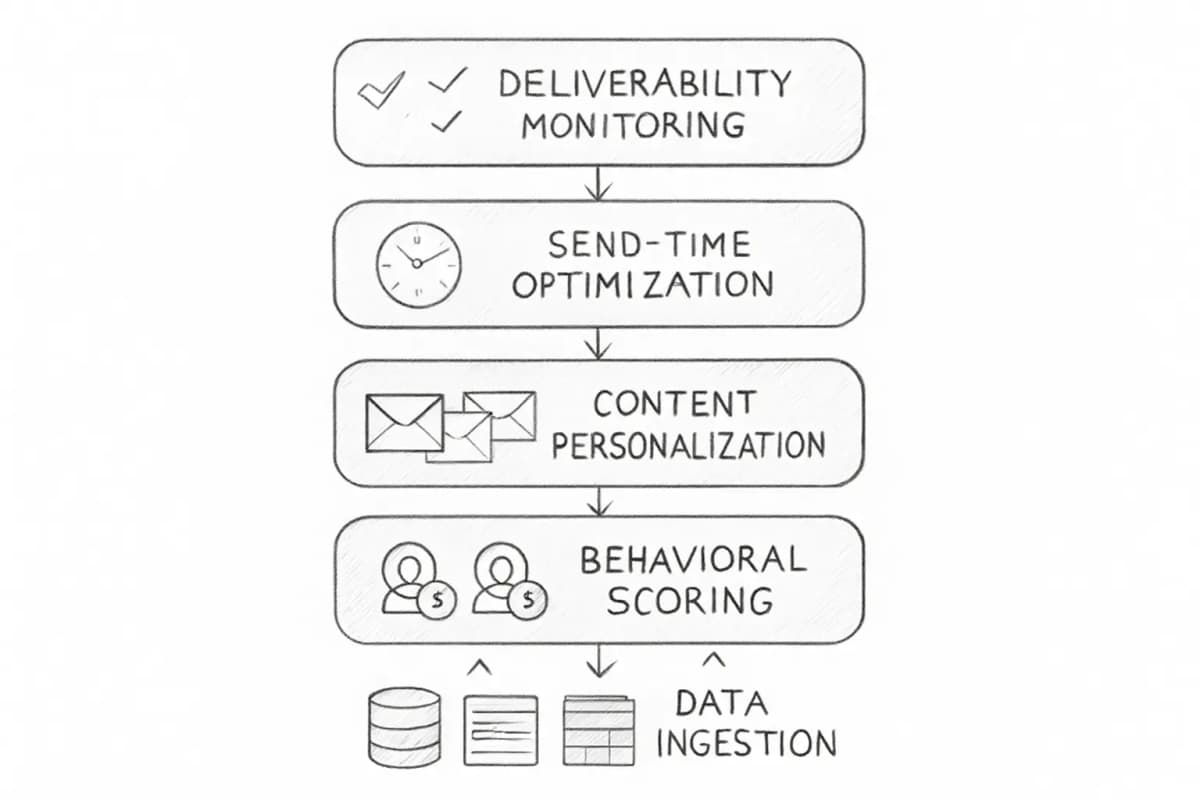
A vertical stack diagram showing the machine learning pipeline for email marketing. Five layers stacked from bottom to top, each in a distinct color with connecting arrows between them. Bottom layer: Data Ingestion (showing data flowing in from multiple sources). Second layer: Behavioral Scoring (with user profiles and scoring indicators). Middle layer: Content Personalization (showing email variations). Fourth layer: Send-Time Optimization (with clock/timing icons). Top layer: Deliverability Monitoring (with checkmarks and performance metrics). Each layer should show how it feeds into the next layer above it.


Frequently Asked Questions

What is email marketing machine learning?

Machine learning email marketing uses algorithms that automatically learn and improve from customer data without explicit programming. Unlike traditional email automation that follows rigid if-then rules, ML systems identify patterns in subscriber behavior and make predictions about future actions. In practice, it covers applications such as send-time optimization, predictive segmentation, AI-generated subject lines, dynamic content selection, and churn prediction.

How much does machine learning improve email marketing ROI?

The performance lift varies by application. AI-powered email programs generate 41% more revenue than manual campaigns according to Salesforce benchmarks, and teams implementing the full AI stack see 3.2x higher revenue per recipient. Individual features like send-time optimization deliver more modest but measurable gains, typically a 15 to 26% lift in open rates.

Does machine learning help with email deliverability?

Yes, from two directions. Machine learning is revolutionizing email deliverability by optimizing send times, lowering bounce rates, improving sender reputation, and avoiding spam filters. At the same time, inbox providers like Gmail use their own ML models to assess sender reputation and engagement history. Strong personalization that drives genuine engagement tends to improve deliverability as a byproduct.

What email platforms support machine learning features?

Several platforms include built-in ML capabilities. Klaviyo offers predictive churn scoring, customer lifetime value modeling, repeat purchase prediction, and send-time optimization. Mailchimp includes AI-assisted send-time optimization and content tools. HubSpot provides predictive lead scoring and lifecycle automation. The right choice depends on your list size, data stack, and whether you need B2B or B2C feature depth.

Is machine learning in email marketing only for large companies?

No. While enterprise platforms have more mature ML capabilities, many mid-market tools expose the core features, particularly STO, AI subject line testing, and behavioral segmentation, at lower price tiers. By continuously learning from user behavior, machine learning ensures that campaigns evolve over time to become increasingly effective, regardless of list size, as long as there is sufficient behavioral data to train from.


A vertical stack diagram showing the machine learning pipeline for email marketing. Five layers stacked from bottom to top, each in a distinct color with connecting arrows between them. Bottom layer: Data Ingestion (showing data flowing in from multiple sources). Second layer: Behavioral Scoring (with user profiles and scoring indicators). Middle layer: Content Personalization (showing email variations). Fourth layer: Send-Time Optimization (with clock/timing icons). Top layer: Deliverability Monitoring (with checkmarks and performance metrics). Each layer should show how it feeds into the next layer above it.


Frequently Asked Questions

What is email marketing machine learning?

Machine learning email marketing uses algorithms that automatically learn and improve from customer data without explicit programming. Unlike traditional email automation that follows rigid if-then rules, ML systems identify patterns in subscriber behavior and make predictions about future actions. In practice, it covers applications such as send-time optimization, predictive segmentation, AI-generated subject lines, dynamic content selection, and churn prediction.

How much does machine learning improve email marketing ROI?

The performance lift varies by application. AI-powered email programs generate 41% more revenue than manual campaigns according to Salesforce benchmarks, and teams implementing the full AI stack see 3.2x higher revenue per recipient. Individual features like send-time optimization deliver more modest but measurable gains, typically a 15 to 26% lift in open rates.

Does machine learning help with email deliverability?

Yes, from two directions. Machine learning is revolutionizing email deliverability by optimizing send times, lowering bounce rates, improving sender reputation, and avoiding spam filters. At the same time, inbox providers like Gmail use their own ML models to assess sender reputation and engagement history. Strong personalization that drives genuine engagement tends to improve deliverability as a byproduct.

What email platforms support machine learning features?

Several platforms include built-in ML capabilities. Klaviyo offers predictive churn scoring, customer lifetime value modeling, repeat purchase prediction, and send-time optimization. Mailchimp includes AI-assisted send-time optimization and content tools. HubSpot provides predictive lead scoring and lifecycle automation. The right choice depends on your list size, data stack, and whether you need B2B or B2C feature depth.

Is machine learning in email marketing only for large companies?

No. While enterprise platforms have more mature ML capabilities, many mid-market tools expose the core features, particularly STO, AI subject line testing, and behavioral segmentation, at lower price tiers. By continuously learning from user behavior, machine learning ensures that campaigns evolve over time to become increasingly effective, regardless of list size, as long as there is sufficient behavioral data to train from.

No comments yet. Be the first!

Leave a comment

Comments are reviewed before publishing.

No comments yet. Be the first!

Leave a comment

Comments are reviewed before publishing.

More from

Related posts

Illustration for predictive email marketing
Email Strategy & OptimizationJul 14, 2026 12 min

Predictive Email Marketing: Use AI to Boost Open Rates

Learn how predictive email marketing uses AI to forecast user behavior, optimize send times, and increase engagement. Data-backed strategies inside.

More from

Related posts

Illustration for predictive email marketing
Email Strategy & OptimizationJul 14, 2026 12 min

Predictive Email Marketing: Use AI to Boost Open Rates

Learn how predictive email marketing uses AI to forecast user behavior, optimize send times, and increase engagement. Data-backed strategies inside.

M
Marcus Webb
M
Marcus Webb