
HomeBlogEmail Marketing Tools & PlatformsEmail Marketing Software With Automation: Top Tools & Strategies
Email Marketing Tools & Platforms

Email Marketing Software With Automation: Top Tools & Strategies

Compare the best email marketing software with automation features. See how to save time, boost deliverability, and increase ROI with the right platform.

J

James Chen

July 15, 2026

HomeBlogEmail Marketing Tools & PlatformsEmail Marketing Software With Automation: Top Tools & Strategies
Email Marketing Tools & Platforms

Email Marketing Software With Automation: Top Tools & Strategies

Compare the best email marketing software with automation features. See how to save time, boost deliverability, and increase ROI with the right platform.

J

James Chen

July 15, 2026

17 min read
17 min read
Share:
Share:
#Automation#Email Marketing Software#Marketing Tools#workflow automation
Illustration for email marketing software with automation

Stay in the loop

Get the latest posts delivered straight to your inbox. No spam, unsubscribe anytime.

Email marketing delivers between $36 and $42 for every $1 spent, making it the highest-ROI channel in digital marketing. But those returns are not evenly distributed. The businesses pulling ahead are the ones using email marketing software with automation to send the right message at exactly the right moment, not just blasting their list and hoping for the best.

Automated emails drove 37% of all ecommerce email revenue in 2024 despite representing just 2% of email volume. That asymmetry tells you everything you need to know about where the real opportunity sits.

This guide breaks down how automation works, which tools are worth your budget, and what strategies will move the revenue needle in 2025 and beyond.


Key Takeaways

  • Automated email campaigns generate a 320% higher ROI compared to manually executed campaigns.
  • In 2024, automated emails drove 37% of all email-generated sales, despite accounting for just 2% of email volume.
  • Triggered emails average 70.5% higher open rates and 152% higher click-through rates than standard bulk emails.
  • Average inbox deliverability sits at 83.1%, meaning roughly 1 in 6 marketing emails never reach the inbox, making platform and authentication choices critical.
  • The right tool depends on your use case: ecommerce, B2B/SaaS, or small business all point to different platforms.

What Email Marketing Software With Automation Actually Does

Most teams understand that automation saves time. Fewer understand how much revenue it creates when configured properly.

Email marketing automation platforms automate sending targeted, personalized emails based on user behavior and customer data. These tools help teams trigger emails when users take specific actions (like viewing a page or abandoning a cart), build automated customer journeys with branching logic, and segment audiences using unified behavioral, demographic, and transactional data.

Unlike traditional email marketing software, which focuses on manual list sends, automation platforms deliver continuous, context-aware communication powered by workflows and integrations.

The practical difference: a manual campaign reaches your list once. An automated workflow reaches each subscriber at the moment their behavior indicates they are ready to act, and it does so at scale without manual effort.

Stay in the loop

Get the latest posts delivered straight to your inbox. No spam, unsubscribe anytime.

Email marketing delivers between $36 and $42 for every $1 spent, making it the highest-ROI channel in digital marketing. But those returns are not evenly distributed. The businesses pulling ahead are the ones using email marketing software with automation to send the right message at exactly the right moment, not just blasting their list and hoping for the best.

Automated emails drove 37% of all ecommerce email revenue in 2024 despite representing just 2% of email volume. That asymmetry tells you everything you need to know about where the real opportunity sits.

This guide breaks down how automation works, which tools are worth your budget, and what strategies will move the revenue needle in 2025 and beyond.


Key Takeaways

  • Automated email campaigns generate a 320% higher ROI compared to manually executed campaigns.
  • In 2024, automated emails drove 37% of all email-generated sales, despite accounting for just 2% of email volume.
  • Triggered emails average 70.5% higher open rates and 152% higher click-through rates than standard bulk emails.
  • Average inbox deliverability sits at 83.1%, meaning roughly 1 in 6 marketing emails never reach the inbox, making platform and authentication choices critical.
  • The right tool depends on your use case: ecommerce, B2B/SaaS, or small business all point to different platforms.

What Email Marketing Software With Automation Actually Does

Most teams understand that automation saves time. Fewer understand how much revenue it creates when configured properly.

Email marketing automation platforms automate sending targeted, personalized emails based on user behavior and customer data. These tools help teams trigger emails when users take specific actions (like viewing a page or abandoning a cart), build automated customer journeys with branching logic, and segment audiences using unified behavioral, demographic, and transactional data.

Unlike traditional email marketing software, which focuses on manual list sends, automation platforms deliver continuous, context-aware communication powered by workflows and integrations.

The practical difference: a manual campaign reaches your list once. An automated workflow reaches each subscriber at the moment their behavior indicates they are ready to act, and it does so at scale without manual effort.

Email automation software helps you automate repetitive tasks, such as welcome emails, abandoned cart reminders, or follow-up messages, without manual effort. It also enables you to segment your audience based on behavior, personalize email content by grouping contacts by their purchase history, location, or interests, and track performance to improve campaigns by tracking which emails drive clicks, purchases, or unsubscribes.


The Automation Workflows That Drive the Most Revenue

Not all automated workflows are equal. Some are table stakes. Others are where serious revenue gets made.

Welcome Sequences

Welcome emails achieve an 83.6% open rate in ecommerce, the highest of any automated email type. That open rate only happens once. A strong welcome sequence uses it to establish brand trust, set expectations, and move new subscribers toward a first purchase or conversion. For a deeper look at structuring these, see Welcome Email Sequence Best Practices: 7 Proven Strategies.

Abandoned Cart Flows

Abandoned cart emails achieve an average click-through rate of 23.33%, the single highest-performing email type by click engagement across all automation types. Automated email flows, including abandoned cart and post-purchase messages, are highly effective revenue drivers. They generate up to 30 times more revenue per recipient compared to standard email campaigns.

Behavioral Drip Campaigns

Marketing automation platforms make it possible to deliver emails based on actions, preferences, and even predictive signals. Instead of sending the same follow-up sequence to everyone who downloaded a resource, automation now allows branching paths. If someone clicks through to read more content, the next email adapts to that interest. If another person doesn't engage, they may get a lighter touchpoint or a different call to action.

Re-engagement Campaigns

Well-designed email workflows help nurture leads, onboard new users, re-engage inactive contacts, and drive conversions through targeted, behavior-based communication. A re-engagement sequence targeting inactive subscribers protects your sender reputation and recovers revenue that would otherwise be lost to list decay.

For an in-depth look at segmenting your automation flows by audience type, see Email List Segmentation Strategies That Boost ROI by 760%.


Top Email Marketing Software With Automation: Platform Breakdown

Email automation software helps you automate repetitive tasks, such as welcome emails, abandoned cart reminders, or follow-up messages, without manual effort. It also enables you to segment your audience based on behavior, personalize email content by grouping contacts by their purchase history, location, or interests, and track performance to improve campaigns by tracking which emails drive clicks, purchases, or unsubscribes.


The Automation Workflows That Drive the Most Revenue

Not all automated workflows are equal. Some are table stakes. Others are where serious revenue gets made.

Welcome Sequences

Welcome emails achieve an 83.6% open rate in ecommerce, the highest of any automated email type. That open rate only happens once. A strong welcome sequence uses it to establish brand trust, set expectations, and move new subscribers toward a first purchase or conversion. For a deeper look at structuring these, see Welcome Email Sequence Best Practices: 7 Proven Strategies.

Abandoned Cart Flows

Abandoned cart emails achieve an average click-through rate of 23.33%, the single highest-performing email type by click engagement across all automation types. Automated email flows, including abandoned cart and post-purchase messages, are highly effective revenue drivers. They generate up to 30 times more revenue per recipient compared to standard email campaigns.

Behavioral Drip Campaigns

Marketing automation platforms make it possible to deliver emails based on actions, preferences, and even predictive signals. Instead of sending the same follow-up sequence to everyone who downloaded a resource, automation now allows branching paths. If someone clicks through to read more content, the next email adapts to that interest. If another person doesn't engage, they may get a lighter touchpoint or a different call to action.

Re-engagement Campaigns

Well-designed email workflows help nurture leads, onboard new users, re-engage inactive contacts, and drive conversions through targeted, behavior-based communication. A re-engagement sequence targeting inactive subscribers protects your sender reputation and recovers revenue that would otherwise be lost to list decay.

For an in-depth look at segmenting your automation flows by audience type, see Email List Segmentation Strategies That Boost ROI by 760%.


Top Email Marketing Software With Automation: Platform Breakdown

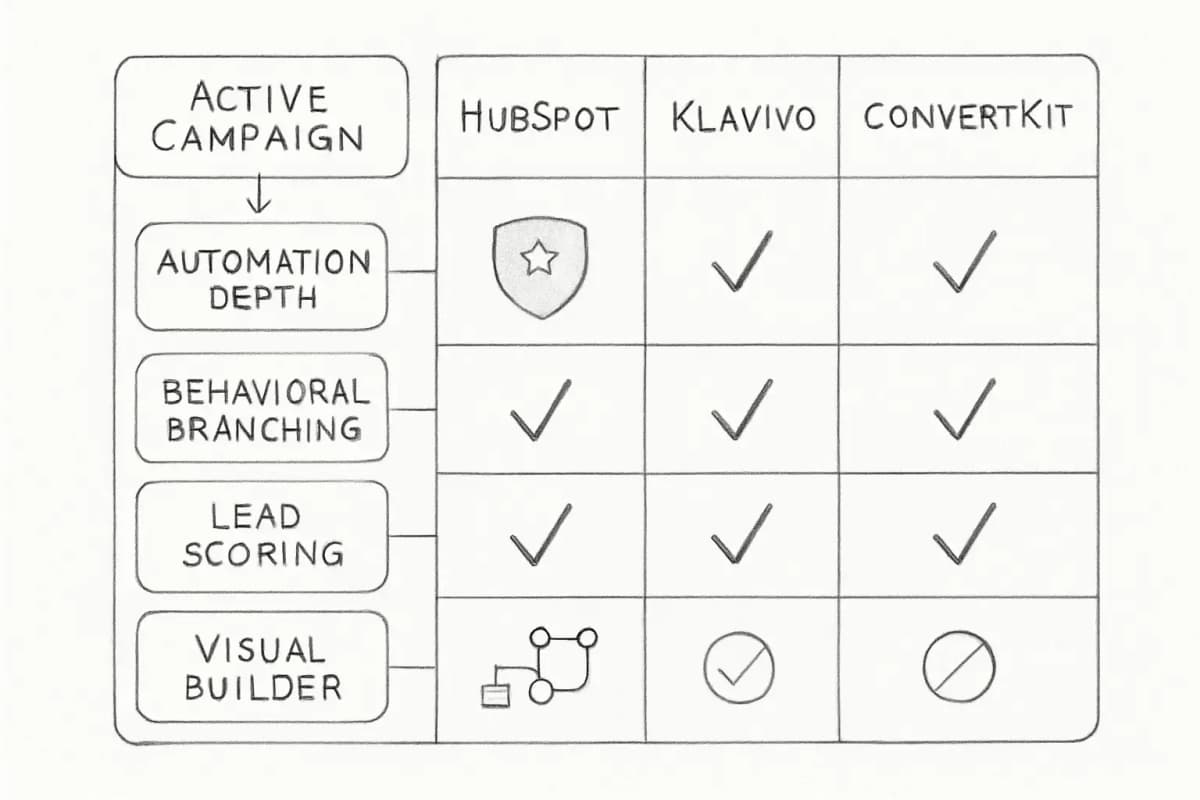
Choosing the wrong platform costs you more than money. It costs you months of migration work and automation rebuilds. Here is how the leading platforms actually compare. Email marketing platform comparison table or matrix showing ActiveCampaign, and other leading platforms (such as HubSpot, Klaviyo, ConvertKit) side-by-side with key automation features highlighted. Include columns for automation depth, behavioral branching capabilities, lead scoring, lifecycle workflows, and visual workflow builder complexity. Use a clean table or grid layout with checkmarks, feature icons, or capability badges to show which platforms excel in which areas. The visual should emphasize that ActiveCampaign offers the deepest automation logic compared to competitors.
ActiveCampaign: Best for Advanced Automation Depth

ActiveCampaign offers the deepest automation logic for B2B and SaaS, with strong behavioral branching, lead scoring, and lifecycle workflows. In the visual workflow builder, you can use deep conditional logic and triggers tied to real behavior, like site activity, purchases, and custom events, then optimize paths with goals and automation-level testing. Automations can also coordinate email, SMS, WhatsApp, site messaging, and CRM actions such as lead scoring and deal stage updates in one connected sequence.

ActiveCampaign's automation builder is powered by AI, and a library of over 1,000 pre-built automation recipes is available, categorized by industry so you can find relevant starting points fast. Pricing starts at $15/month for up to 1,000 contacts.

Best for: Growing businesses, B2B teams, and SaaS companies that need sophisticated lifecycle workflows without enterprise pricing.

Klaviyo: Best for Ecommerce

Klaviyo is a data-driven email and SMS platform built primarily for ecommerce brands. Its email marketing software is deeply integrated into the Shopify ecosystem and treats every contact interaction as a potential data point for smarter targeting.

Klaviyo organizes its features around ecommerce data models, with ecommerce-first segmentation that lets you build segments based on purchase behavior, browse history, and predicted customer lifetime value. It includes strong lifecycle flows with pre-built automations for cart recovery, browse abandonment, post-purchase follow-up, and win-back campaigns. Email and SMS are tightly integrated, with predictive purchasing analytics powered by AI.

Best for: DTC brands and ecommerce stores, particularly those on Shopify or WooCommerce.

HubSpot: Best for CRM-First Teams

HubSpot Marketing Hub is the strongest all-in-one option for most B2B and SaaS teams, combining a native CRM, deep workflow automation, and AI tools in one platform, with a free tier that is actually usable. The native connection between Marketing Hub and Sales Hub means the lead handoff is part of the same workflow, not a separate integration to maintain.

Best for: B2B and SaaS teams where marketing and sales alignment is a priority.

Mailchimp: Best for Beginners

Mailchimp is a strong starting point: quick setup, approachable tools, and a good fit when your program is mostly newsletters and straightforward campaigns. Mailchimp's Marketing Automation Flows handle basic sequences like welcome series and abandoned cart reminders, but teams needing sophisticated conditional branching, goal tracking, or multi-step behavioral workflows will find the platform restrictive compared to ActiveCampaign or Klaviyo.

Best for: Small businesses or solopreneurs sending newsletters and basic promotional emails.

Brevo (formerly Sendinblue): Best for Budget-Conscious High-Volume Senders

Brevo is the most cost-effective option for high-volume senders, with email, SMS, and WhatsApp natively supported, though it is weaker on CRM depth. Brevo's free plan includes 100,000 contacts and lets you send 300 emails a day.

Choosing the wrong platform costs you more than money. It costs you months of migration work and automation rebuilds. Here is how the leading platforms actually compare. Email marketing platform comparison table or matrix showing ActiveCampaign, and other leading platforms (such as HubSpot, Klaviyo, ConvertKit) side-by-side with key automation features highlighted. Include columns for automation depth, behavioral branching capabilities, lead scoring, lifecycle workflows, and visual workflow builder complexity. Use a clean table or grid layout with checkmarks, feature icons, or capability badges to show which platforms excel in which areas. The visual should emphasize that ActiveCampaign offers the deepest automation logic compared to competitors.

ActiveCampaign: Best for Advanced Automation Depth

ActiveCampaign offers the deepest automation logic for B2B and SaaS, with strong behavioral branching, lead scoring, and lifecycle workflows. In the visual workflow builder, you can use deep conditional logic and triggers tied to real behavior, like site activity, purchases, and custom events, then optimize paths with goals and automation-level testing. Automations can also coordinate email, SMS, WhatsApp, site messaging, and CRM actions such as lead scoring and deal stage updates in one connected sequence.

ActiveCampaign's automation builder is powered by AI, and a library of over 1,000 pre-built automation recipes is available, categorized by industry so you can find relevant starting points fast. Pricing starts at $15/month for up to 1,000 contacts.

Best for: Growing businesses, B2B teams, and SaaS companies that need sophisticated lifecycle workflows without enterprise pricing.

Klaviyo: Best for Ecommerce

Klaviyo is a data-driven email and SMS platform built primarily for ecommerce brands. Its email marketing software is deeply integrated into the Shopify ecosystem and treats every contact interaction as a potential data point for smarter targeting.

Klaviyo organizes its features around ecommerce data models, with ecommerce-first segmentation that lets you build segments based on purchase behavior, browse history, and predicted customer lifetime value. It includes strong lifecycle flows with pre-built automations for cart recovery, browse abandonment, post-purchase follow-up, and win-back campaigns. Email and SMS are tightly integrated, with predictive purchasing analytics powered by AI.

Best for: DTC brands and ecommerce stores, particularly those on Shopify or WooCommerce.

HubSpot: Best for CRM-First Teams

HubSpot Marketing Hub is the strongest all-in-one option for most B2B and SaaS teams, combining a native CRM, deep workflow automation, and AI tools in one platform, with a free tier that is actually usable. The native connection between Marketing Hub and Sales Hub means the lead handoff is part of the same workflow, not a separate integration to maintain.

Best for: B2B and SaaS teams where marketing and sales alignment is a priority.

Mailchimp: Best for Beginners

Mailchimp is a strong starting point: quick setup, approachable tools, and a good fit when your program is mostly newsletters and straightforward campaigns. Mailchimp's Marketing Automation Flows handle basic sequences like welcome series and abandoned cart reminders, but teams needing sophisticated conditional branching, goal tracking, or multi-step behavioral workflows will find the platform restrictive compared to ActiveCampaign or Klaviyo.

Best for: Small businesses or solopreneurs sending newsletters and basic promotional emails.

Brevo (formerly Sendinblue): Best for Budget-Conscious High-Volume Senders

Brevo is the most cost-effective option for high-volume senders, with email, SMS, and WhatsApp natively supported, though it is weaker on CRM depth. Brevo's free plan includes 100,000 contacts and lets you send 300 emails a day.

Best for: Service businesses, agencies, and teams prioritizing multichannel reach on a tight budget.

For teams building SaaS-specific lifecycle programs, our SaaS Email Marketing Strategy guide covers the automation flows that matter most in that context.


Key Features to Evaluate Before You Commit

Today's marketing teams need platforms that offer predictive analytics, journey-based targeting, drag-and-drop journey builders and behavioral triggers, unified customer data for accurate segmentation, AI-powered content and optimization features, strong deliverability and compliance safeguards, and transparent pricing and easy migration support.

Beyond the feature list, pay attention to:

  • Automation depth vs. ease of use. A powerful workflow builder means nothing if your team never uses it.
  • Pricing model. Some platforms charge per contact, others per email volume. Know which model works for your list size and send frequency.
  • Native integrations. Your email tool doesn't live in a vacuum. It needs to sync with the rest of your systems to really pull its weight. CRM sync, ecommerce platform connections, and ad platform integrations all matter.
  • Deliverability infrastructure. Both major platforms support key deliverability fundamentals such as bounce suppression, IP warmup, and authentication, but the strongest tools offer access to feedback loop data, stricter list quality controls, and integration with list-cleaning services to proactively protect sender reputation.

Deliverability: The Foundation That Makes Automation Work

You can build the most sophisticated automated workflow in the industry. If your emails land in spam, none of it matters.

Average inbox deliverability is 83.1%, meaning roughly 1 in 6 marketing emails never reach inboxes. Only about 33.4% of top 1 million domains publish valid DMARC, and approximately 85.7% do not enforce it.

The authentication stack every email program needs:

  • SPF (Sender Policy Framework): Shows which IP addresses or domains can send mail on your behalf via a DNS TXT entry, so mailbox providers know that if it is sent from your company's domain or IP address, it is from you.
  • DKIM (DomainKeys Identified Mail): Matches a public and private key, like a digital signature, to associate a given email message with your organization as part of the authentication process.
  • DMARC: Takes the most effort, but is also the most important to get right. DMARC defines how receiving inbox providers should handle messages that fail an authentication check.

Google, Yahoo, and Microsoft now enforce bulk sender rules requiring spam complaints under 0.3% and bounces under 2%. These are not optional guidelines. Violate them and your deliverability collapses regardless of which platform you use.

When you get SPF, DKIM, and DMARC right, fully authenticated senders are about 2.7 times more likely to reach the inbox than unauthenticated senders.

Best for: Service businesses, agencies, and teams prioritizing multichannel reach on a tight budget.

For teams building SaaS-specific lifecycle programs, our SaaS Email Marketing Strategy guide covers the automation flows that matter most in that context.


Key Features to Evaluate Before You Commit

Today's marketing teams need platforms that offer predictive analytics, journey-based targeting, drag-and-drop journey builders and behavioral triggers, unified customer data for accurate segmentation, AI-powered content and optimization features, strong deliverability and compliance safeguards, and transparent pricing and easy migration support.

Beyond the feature list, pay attention to:

  • Automation depth vs. ease of use. A powerful workflow builder means nothing if your team never uses it.
  • Pricing model. Some platforms charge per contact, others per email volume. Know which model works for your list size and send frequency.
  • Native integrations. Your email tool doesn't live in a vacuum. It needs to sync with the rest of your systems to really pull its weight. CRM sync, ecommerce platform connections, and ad platform integrations all matter.
  • Deliverability infrastructure. Both major platforms support key deliverability fundamentals such as bounce suppression, IP warmup, and authentication, but the strongest tools offer access to feedback loop data, stricter list quality controls, and integration with list-cleaning services to proactively protect sender reputation.

Deliverability: The Foundation That Makes Automation Work

You can build the most sophisticated automated workflow in the industry. If your emails land in spam, none of it matters.

Average inbox deliverability is 83.1%, meaning roughly 1 in 6 marketing emails never reach inboxes. Only about 33.4% of top 1 million domains publish valid DMARC, and approximately 85.7% do not enforce it.

The authentication stack every email program needs:

  • SPF (Sender Policy Framework): Shows which IP addresses or domains can send mail on your behalf via a DNS TXT entry, so mailbox providers know that if it is sent from your company's domain or IP address, it is from you.
  • DKIM (DomainKeys Identified Mail): Matches a public and private key, like a digital signature, to associate a given email message with your organization as part of the authentication process.
  • DMARC: Takes the most effort, but is also the most important to get right. DMARC defines how receiving inbox providers should handle messages that fail an authentication check.

Google, Yahoo, and Microsoft now enforce bulk sender rules requiring spam complaints under 0.3% and bounces under 2%. These are not optional guidelines. Violate them and your deliverability collapses regardless of which platform you use.

When you get SPF, DKIM, and DMARC right, fully authenticated senders are about 2.7 times more likely to reach the inbox than unauthenticated senders.

Good deliverability also depends on list hygiene. Remove inactive subscribers regularly, suppress hard bounces immediately, and avoid sending to contacts who have not engaged in over 12 months. For a systematic approach to this, the Email Marketing Automation CRM Setup Guide covers how to connect your platform and CRM for automatic list maintenance.


Automation Strategies That Improve ROI Beyond the Basics

Behavioral Segmentation Inside Workflows

Segmented email campaigns generate 30% more opens and 50% more click-throughs, according to HubSpot's 2025 State of Marketing Report. And 78% of marketers say segmentation is their most effective tactic.

The most effective approach combines segmentation with automation triggers. When a contact visits a pricing page, downloads a resource, or adds a product to a cart, that action should fire a specific workflow, not a generic drip sequence.

AI-Powered Personalization

Companies using AI-driven email strategies see up to 41% more revenue than those using traditional batch-and-blast sends. Behavior-based personalization using purchase history data boosts click-through rates by up to 39%.

Modern email marketing software with automation increasingly embeds AI for send-time optimization, subject line generation, and dynamic content blocks that adapt to each recipient. Production speed is also improving rapidly: 76% of marketing teams now produce and send a marketing email within 3 days, whereas in 2024, 62% of teams took two weeks or more for a single email.

For a practical breakdown of how to implement this, see 7 Email Personalization Techniques That Boost Conversions 47%.

A/B Testing Inside Automation Flows

Do not set your automated workflows and forget them. Marketers who A/B test their emails often increase email ROI by 86% compared to those who never do. Test subject lines, send times, CTA copy, and email length across your highest-volume flows first. Automated campaigns that handle welcome sequences or cart abandonment reach enough volume quickly to produce statistically meaningful results.

Optimizing for Engagement Signals Over Vanity Metrics

In 2025, teams are paying closer attention to engagement quality rather than just open rates. Click-throughs, conversions, and unsubscribe patterns give better insight into whether a campaign is working.

Apple Mail Privacy Protection now affects roughly 50 to 60% of recorded email opens, automatically downloading tracking pixels before a recipient views the email. This inflates open rate data across the industry. Use open rates as a directional signal, not a precise measurement, and lean on click rate and email-attributed revenue as your primary performance benchmarks.


How to Choose the Right Platform for Your Business

Match the tool to your actual use case, not the most impressive feature list:

Good deliverability also depends on list hygiene. Remove inactive subscribers regularly, suppress hard bounces immediately, and avoid sending to contacts who have not engaged in over 12 months. For a systematic approach to this, the Email Marketing Automation CRM Setup Guide covers how to connect your platform and CRM for automatic list maintenance.


Automation Strategies That Improve ROI Beyond the Basics

Behavioral Segmentation Inside Workflows

Segmented email campaigns generate 30% more opens and 50% more click-throughs, according to HubSpot's 2025 State of Marketing Report. And 78% of marketers say segmentation is their most effective tactic.

The most effective approach combines segmentation with automation triggers. When a contact visits a pricing page, downloads a resource, or adds a product to a cart, that action should fire a specific workflow, not a generic drip sequence.

AI-Powered Personalization

Companies using AI-driven email strategies see up to 41% more revenue than those using traditional batch-and-blast sends. Behavior-based personalization using purchase history data boosts click-through rates by up to 39%.

Modern email marketing software with automation increasingly embeds AI for send-time optimization, subject line generation, and dynamic content blocks that adapt to each recipient. Production speed is also improving rapidly: 76% of marketing teams now produce and send a marketing email within 3 days, whereas in 2024, 62% of teams took two weeks or more for a single email.

For a practical breakdown of how to implement this, see 7 Email Personalization Techniques That Boost Conversions 47%.

A/B Testing Inside Automation Flows

Do not set your automated workflows and forget them. Marketers who A/B test their emails often increase email ROI by 86% compared to those who never do. Test subject lines, send times, CTA copy, and email length across your highest-volume flows first. Automated campaigns that handle welcome sequences or cart abandonment reach enough volume quickly to produce statistically meaningful results.

Optimizing for Engagement Signals Over Vanity Metrics

In 2025, teams are paying closer attention to engagement quality rather than just open rates. Click-throughs, conversions, and unsubscribe patterns give better insight into whether a campaign is working.

Apple Mail Privacy Protection now affects roughly 50 to 60% of recorded email opens, automatically downloading tracking pixels before a recipient views the email. This inflates open rate data across the industry. Use open rates as a directional signal, not a precise measurement, and lean on click rate and email-attributed revenue as your primary performance benchmarks.


How to Choose the Right Platform for Your Business

Match the tool to your actual use case, not the most impressive feature list:

  • Ecommerce brands: Klaviyo or Omnisend. Both are built around transactional data and pre-built ecommerce flows.
  • B2B and SaaS teams: ActiveCampaign or HubSpot, depending on whether CRM integration is core to your workflow.
  • Small businesses and beginners: Mailchimp or Brevo. Both offer free plans with enough capability to get started.
  • High-volume senders on a budget: Brevo's pricing model (based on sends rather than contacts) tends to work out cheaper at scale.
  • Content creators and newsletter publishers: Kit (formerly ConvertKit), which is purpose-built for bloggers, YouTubers, podcasters, and online course creators, and understands that workflow better than most other tools on the market.

The right email automation tool ultimately depends on factors like revenue goals, team capacity, existing tech stack, and compliance requirements. Most platforms offer free trials. Use them. Build one core automated workflow, run it for two weeks, and measure whether the platform's UX slows your team down before you commit.


Frequently Asked Questions

What is email marketing software with automation?

Email marketing software with automation is a platform that triggers and sends emails based on subscriber behavior, predefined time intervals, or data conditions, without manual intervention for each send. It includes tools for building visual workflow sequences, segmenting audiences, personalizing content at scale, and tracking performance across the full customer journey.

Which email marketing automation tool is best for ecommerce?

In a direct comparison for ecommerce, Klaviyo is the stronger platform for stores with large product catalogs and high transaction volumes. Klaviyo's data model is built around ecommerce events such as purchase history, predictive lifetime value, churn risk, and next-purchase date. For DTC brands on Shopify or Magento, Klaviyo's out-of-the-box segmentation and predictive analytics justify the premium. Omnisend is a strong alternative at a lower price point.

How does automation improve email marketing ROI?

Email marketing remains the most reliable high-ROI digital channel, but the biggest gains come from automation, personalization, deliverability discipline, and realistic attribution, not from sending more emails. Automation works because it reaches subscribers at the exact moment they are most likely to act, based on their own behavior rather than a broadcast schedule.

What deliverability requirements should I know before launching automated campaigns?

Email deliverability in 2026 requires SPF, DKIM, and DMARC authentication plus one-click unsubscribe for all marketing emails. Google, Yahoo, and Microsoft now enforce bulk sender rules requiring spam complaints under 0.3% and bounces under 2%. Beyond authentication, keep your list clean, send consistently to engaged subscribers, and monitor your sender reputation through tools like Google Postmaster.

Can small businesses benefit from email automation?

Yes. Small businesses find email marketing to be an accessible and effective way to reach their customers. By using email, these businesses can engage with their audience, promote their products, and build brand loyalty without large budgets. The ability to personalize messages and automate campaigns helps small businesses compete with larger firms. Free plans from Mailchimp, Brevo, and Klaviyo all include basic automation triggers to get started.


  • Ecommerce brands: Klaviyo or Omnisend. Both are built around transactional data and pre-built ecommerce flows.
  • B2B and SaaS teams: ActiveCampaign or HubSpot, depending on whether CRM integration is core to your workflow.
  • Small businesses and beginners: Mailchimp or Brevo. Both offer free plans with enough capability to get started.
  • High-volume senders on a budget: Brevo's pricing model (based on sends rather than contacts) tends to work out cheaper at scale.
  • Content creators and newsletter publishers: Kit (formerly ConvertKit), which is purpose-built for bloggers, YouTubers, podcasters, and online course creators, and understands that workflow better than most other tools on the market.

The right email automation tool ultimately depends on factors like revenue goals, team capacity, existing tech stack, and compliance requirements. Most platforms offer free trials. Use them. Build one core automated workflow, run it for two weeks, and measure whether the platform's UX slows your team down before you commit.


Frequently Asked Questions

What is email marketing software with automation?

Email marketing software with automation is a platform that triggers and sends emails based on subscriber behavior, predefined time intervals, or data conditions, without manual intervention for each send. It includes tools for building visual workflow sequences, segmenting audiences, personalizing content at scale, and tracking performance across the full customer journey.

Which email marketing automation tool is best for ecommerce?

In a direct comparison for ecommerce, Klaviyo is the stronger platform for stores with large product catalogs and high transaction volumes. Klaviyo's data model is built around ecommerce events such as purchase history, predictive lifetime value, churn risk, and next-purchase date. For DTC brands on Shopify or Magento, Klaviyo's out-of-the-box segmentation and predictive analytics justify the premium. Omnisend is a strong alternative at a lower price point.

How does automation improve email marketing ROI?

Email marketing remains the most reliable high-ROI digital channel, but the biggest gains come from automation, personalization, deliverability discipline, and realistic attribution, not from sending more emails. Automation works because it reaches subscribers at the exact moment they are most likely to act, based on their own behavior rather than a broadcast schedule.

What deliverability requirements should I know before launching automated campaigns?

Email deliverability in 2026 requires SPF, DKIM, and DMARC authentication plus one-click unsubscribe for all marketing emails. Google, Yahoo, and Microsoft now enforce bulk sender rules requiring spam complaints under 0.3% and bounces under 2%. Beyond authentication, keep your list clean, send consistently to engaged subscribers, and monitor your sender reputation through tools like Google Postmaster.

Can small businesses benefit from email automation?

Yes. Small businesses find email marketing to be an accessible and effective way to reach their customers. By using email, these businesses can engage with their audience, promote their products, and build brand loyalty without large budgets. The ability to personalize messages and automate campaigns helps small businesses compete with larger firms. Free plans from Mailchimp, Brevo, and Klaviyo all include basic automation triggers to get started.

No comments yet. Be the first!

Leave a comment

Comments are reviewed before publishing.

No comments yet. Be the first!

Leave a comment

Comments are reviewed before publishing.

More from

Related posts

Illustration for compare email marketing automation pricing plans
Email Marketing Tools & PlatformsJul 17, 2026 11 min

Compare Email Marketing Automation Pricing Plans 2024

Compare top email marketing automation platforms side-by-side. See pricing, features, and ROI for Klaviyo, HubSpot, Mailchimp, and more. Find the right fit.

More from

Related posts

Illustration for compare email marketing automation pricing plans
Email Marketing Tools & PlatformsJul 17, 2026 11 min

Compare Email Marketing Automation Pricing Plans 2024

Compare top email marketing automation platforms side-by-side. See pricing, features, and ROI for Klaviyo, HubSpot, Mailchimp, and more. Find the right fit.

MMarcus Webb
MMarcus Webb
Illustration for ai email marketing services
Email Marketing Tools & PlatformsJul 16, 2026 11 min

AI Email Marketing Services: Tools That Drive Real Results

Discover how AI email marketing services automate campaigns, boost deliverability, and increase ROI. Compare top platforms and find the right fit for your business.

MMarcus Webb
Illustration for ai email marketing services
Email Marketing Tools & PlatformsJul 16, 2026 11 min

AI Email Marketing Services: Tools That Drive Real Results

Discover how AI email marketing services automate campaigns, boost deliverability, and increase ROI. Compare top platforms and find the right fit for your business.

MMarcus Webb
Illustration for best email marketing automation platforms 2026
Email Marketing Tools & PlatformsJul 16, 2026 14 min

Best Email Marketing Automation Platforms 2026

Compare top email automation tools for 2026. Find the platform that fits your budget, features, and business needs with our detailed guide.

SSarah Mitchell
Illustration for best email marketing automation platforms 2026
Email Marketing Tools & PlatformsJul 16, 2026 14 min

Best Email Marketing Automation Platforms 2026

Compare top email automation tools for 2026. Find the platform that fits your budget, features, and business needs with our detailed guide.

SSarah Mitchell