
Email
Email

A modern blog built with Payload CMS, Next.js, and shadcn/ui.

RSS FeedSitemap

Explore

  • Blog
  • News
  • Statistics
  • Authors

Categories

  • Hiring & Team Building
  • Email Campaign Strategy
  • Email Design & Templates
  • Email Compliance & Legal
  • Email Deliverability & Best Practices
  • Career Development
  • Email Strategy for Finance & Professional Services
  • Email Marketing Metrics

Latest articles

  • How to Hire an Email Marketing SpecialistJul 22, 2026
  • Email Marketing Campaigns Template: Ready-to-UseJul 22, 2026
  • Canva Email Marketing Templates: Design Fast, Convert MoreJul 22, 2026
  • Email Marketing Templates for FranchisesJul 22, 2026

Popular topics

  • #Specialist Skills
  • #Team Building
  • #Templates
  • #Canva
  • #Advanced Strategies
  • #multi-location businesses
  • #Marketing Regulations
  • #Lead Follow-Up
  • #iCloud Email
  • #Marketing Management
  • #Product Launch
  • #Electrician Marketing
  • #statistics
  • #Budget-Friendly
  • #Free Resources
  • #Miami businesses

Stay in the loop

Join 2,000+ readers. Unsubscribe anytime.

Subscribe
Email

© 2026 Email. All rights reserved.

SitemapRSS
HomeBlogEmail Compliance & LegalHow to Comply with Email Marketing Regulations
Email Compliance & Legal

How to Comply with Email Marketing Regulations

Master GDPR, CAN-SPAM, and CASL compliance. Learn the legal requirements that protect your list and keep your campaigns compliant.

J

James Chen

July 22, 2026

14 min read
Share:
#GDPR#CAN-SPAM#email compliance#Marketing Regulations
Illustration for how do i comply with email marketing regulations?

Stay in the loop

Get the latest posts delivered straight to your inbox. No spam, unsubscribe anytime.

Email marketing is one of the most profitable channels a business can use, with an average ROI of $42 for every dollar spent. But that return depends on a channel that works, and the channel only works when senders play by the rules. If you are asking how do I comply with email marketing regulations, this guide will walk you through every legal requirement you need to meet, from consent collection to technical authentication, so your campaigns stay in inboxes and out of legal trouble.

Key Takeaways

  • GDPR violations carry fines up to €20 million or 4% of global revenue; CAN-SPAM penalties reach up to $53,088 per email; and CASL fines reach CA$10 million for businesses.
  • CAN-SPAM allows you to send without prior consent; CASL requires consent before the first commercial message; GDPR requires a documented lawful basis for processing personal data.
  • Gmail and Yahoo require bulk senders (5,000 or more messages per day) to authenticate with SPF and DKIM, publish a DMARC record, include one-click unsubscribe, and keep spam complaint rates below 0.3%.
  • From a compliance perspective, securing a double opt-in is the strongest proof of consent you can collect.
  • Compliance is not a one-time achievement. Laws evolve, businesses change, and new technologies create fresh considerations.

Why Email Marketing Compliance Matters More Than Ever

Email was compromised in 61% of data breaches in 2025, making compliance both a legal requirement and a security necessity. Regulators have taken notice, and enforcement is no longer theoretical.

In 2023, Meta faced a €1.2 billion fine under GDPR for email marketing violations, demonstrating that email marketing regulations carry serious financial consequences. That same year, Verkada was required to pay a $2.95 million fine for violating the CAN-SPAM Act, the largest penalty the FTC has ever imposed for such violations.

Beyond financial penalties, non-compliance can get your emails blocked by major providers, damage your brand reputation, and hurt your marketing effectiveness. The risks are layered: legal fines, deliverability collapse, and audience trust loss can all happen at once.

Eight new comprehensive state privacy laws took effect in 2025 alone, each with unique requirements for email data handling, consent mechanisms, and retention policies. The landscape is expanding, not stabilizing.


The Three Major Email Marketing Laws You Must Know

CAN-SPAM, CASL, and GDPR govern commercial email across three different jurisdictions, and they are built on fundamentally different legal principles. Here is what each one requires.

CAN-SPAM (United States)

CAN-SPAM focuses primarily on truthfulness in commercial messaging and giving recipients a way to opt out. It permits sending initial unsolicited emails as long as they meet the law's requirements, such as proper identification, a valid physical address, and a working unsubscribe link.

The actual maximum civil penalty is $53,088 per email, set by the FTC's most recent inflation adjustment effective January 17, 2025. That figure applies per individual email, not per campaign. B2B email is not exempt. The FTC explicitly states CAN-SPAM "makes no exception for business-to-business email."

Core CAN-SPAM requirements:

  • Identify the sender clearly in the "From" field
  • Use subject lines that reflect the actual content
  • Include a valid physical postal address
  • Provide a clear, working unsubscribe mechanism
  • Honor unsubscribe requests within 10 business days

CASL (Canada)

CASL, effective since 2014, is considered one of the world's strictest anti-spam laws. It requires express or implied consent for commercial electronic messages sent to Canadian recipients.

Implied consent is based on existing business relationships, such as recent purchases or inquiries, with specific time limitations. This is the trap most teams miss. A Canadian customer who bought from you in January 2024 hit their two-year implied consent expiry in January 2026, unless they purchased again in the meantime. Most ESPs do not flag this. Building a workflow to track expiring consent windows is one of the most overlooked compliance tasks in email marketing.

CASL fines reach CA$1 million for individuals and CA$10 million per violation for organizations, and subscribers can sue directly without a regulator getting involved first.

GDPR (European Union)

GDPR is a law covering all EU member states. Its purpose is to put control back into the hands of consumers when it comes to protecting and processing personal data.

Under Article 83 of the GDPR, the most serious breaches carry fines of up to €20 million or 4% of an organization's global annual turnover, whichever is higher.

GDPR penalties have exceeded 7.1 billion euros in total since 2018, demonstrating that enforcement actions carry real financial consequences.

Organizations handling email marketing across borders must comply with regulations in every jurisdiction where recipients are located, whether operating from the US, EU, Canada, or elsewhere.


How to Collect Consent the Right Way

Consent is the foundation of every compliant email program. Get this wrong and nothing else you do will protect you.

Double opt-in is a two-step email subscription process where subscribers must confirm their interest by clicking a verification link before joining your mailing list. The confirmation click provides documented proof of subscriber consent, offering legal protection while filtering out invalid addresses and spam traps that could harm your sender reputation.

Organizations must design databases that capture not just email addresses but comprehensive consent metadata. This includes timestamps showing exactly when consent was obtained, records of what information was displayed to users during the consent process, IP addresses from which consent originated, and documentation of the specific communications users agreed to receive.

Practical steps for compliant consent collection:

  1. Use an unchecked opt-in checkbox on signup forms. Pre-checked boxes are illegal under CASL and GDPR.
  2. Send a confirmation email immediately after signup, requiring one click to activate the subscription.
  3. Log the timestamp, IP address, and exact consent language for every subscriber.
  4. Separate consent for different communication types (newsletters, promotions, product updates).
  5. Never import purchased lists. Clean email lists perform better than purchased lists, and permission-based marketing generates higher engagement than cold outreach.

To build a high-quality, compliant subscriber base from the start, see our guide to email list segmentation strategies that boost ROI by 760%.


Technical Authentication: SPF, DKIM, and DMARC

Legal compliance and inbox placement now overlap more than ever. Since February 2024, inbox providers have made authentication a hard requirement.

Gmail and Yahoo require bulk senders (5,000 or more messages per day) to authenticate with SPF and DKIM, publish a DMARC record at minimum p=none, include one-click unsubscribe via the List-Unsubscribe header, keep spam complaint rates below 0.3%, and use a From domain that aligns with SPF or DKIM.

Microsoft has joined Gmail, Yahoo, and Apple Mail in requiring DMARC for large senders. Beginning May 5, 2025, Microsoft rejects emails that do not meet their bulk sender requirements.

Here is what each protocol does:

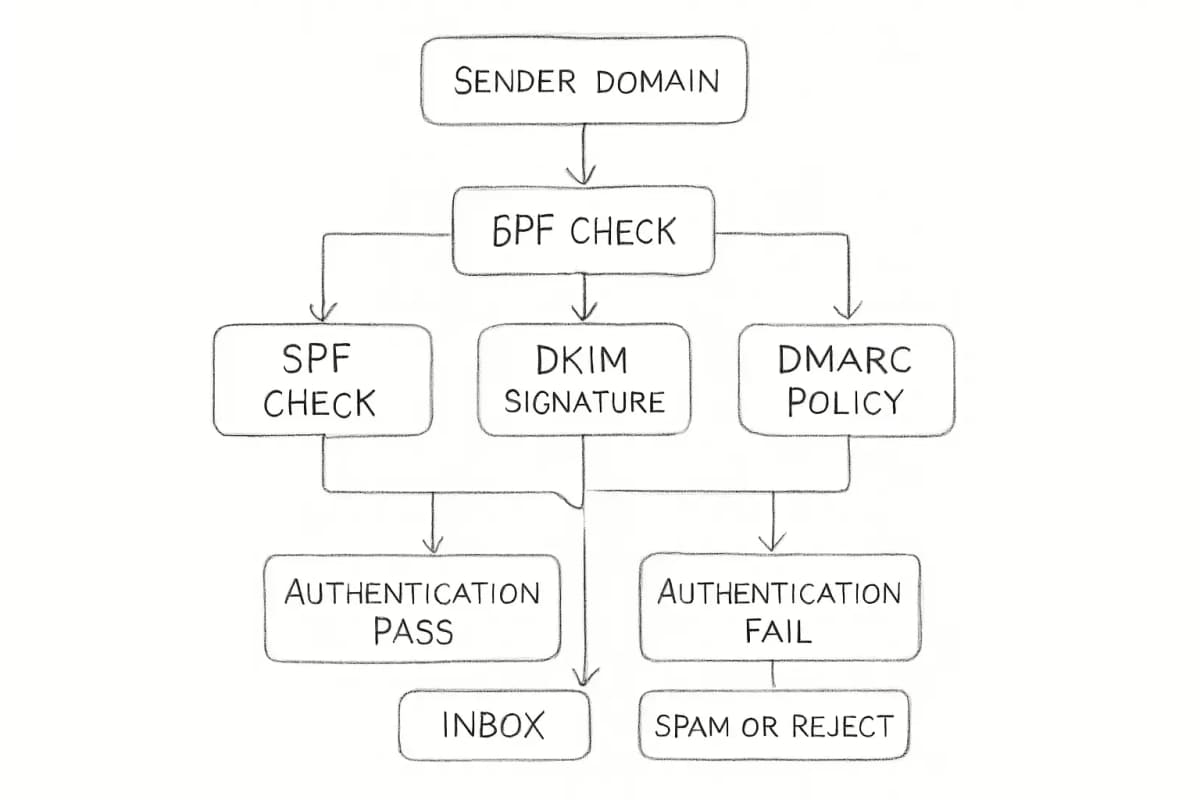
  • SPF (Sender Policy Framework): Lists the servers authorized to send email on your domain's behalf. When a receiving server gets your message, it checks whether the sending IP appears in your SPF record.
  • DKIM (DomainKeys Identified Mail): Adds a cryptographic signature to outgoing messages. The receiving server verifies this signature against a public key in your DNS records, confirming the message was not altered in transit.
  • DMARC: Bulk senders must use both SPF and DKIM, plus implement DMARC with a minimum policy of p=none.

One-click unsubscribe is equally mandatory. Gmail and Yahoo now require one-click unsubscribe functionality, and senders must process those unsubscribe requests within two days.

Non-compliance results in throttling, spam placement, or outright rejection. No fine required. Your domain simply stops reaching inboxes. Technical email authentication flow diagram showing three parallel authentication protocols (SPF, DKIM, DMARC) and how they work together to verify sender identity. SPF checks the sending server IP against published DNS records. DKIM adds a cryptographic signature to the email header. DMARC sits above both, setting policy for how receivers should handle authentication failures. Show arrows flowing from sender through each protocol to the receiving mail server, with pass/fail outcomes leading to inbox or spam folder placement.

What Every Marketing Email Must Include

Regardless of which regulation applies to your recipients, every commercial email needs to contain certain elements. This is your baseline checklist.

Required in every email:

  • Your legal business name and a valid physical mailing address
  • A clear, honest subject line that reflects the content of the email
  • A visible and working unsubscribe link
  • Identification of the message as commercial where required by local law

Unsubscribe processing requirements:

  • CAN-SPAM: Honor within 10 business days
  • CASL: Process unsubscribe requests within 10 business days.
  • Gmail and Yahoo: Follow through with unsubscribe requests within two days.

The stricter inbox provider requirement (two days) effectively sets the real operational standard. Build your suppression list workflows to process opt-outs immediately.

For a well-structured, compliance-friendly approach to the first emails you send new subscribers, see our welcome email sequence best practices.


Managing Data Privacy and Retention

Collecting consent is only part of the requirement. You also have to manage, protect, and eventually delete subscriber data responsibly.

Data breaches cost organizations an average of $4.9 million globally in 2024. A breach on top of a compliance gap is a compounding disaster.

The core principles remain consistent across global privacy laws: transparency, consent, data minimization, and accountability.

Concrete data management practices:

  1. Data minimization: Only collect the fields you actually use. A name and email address is often sufficient. Every extra field is additional liability.
  2. Retention limits: Delete or anonymize subscriber data when you no longer have a lawful reason to hold it.
  3. Access rights: Under GDPR and CCPA, subscribers can request a copy of their data or ask for deletion. Build a process to handle these requests.
  4. Breach response: Have a documented incident response plan. GDPR requires notification of a breach to the relevant authority within 72 hours.
  5. Suppression lists: Maintain a permanent suppression list of unsubscribes and use it across every send.

CCPA enforcement has intensified significantly throughout 2024 and into 2025, with the California Privacy Protection Agency issuing substantial fines, including recent actions against major platforms for sharing health-related data without proper consent mechanisms.

If your business operates in the healthcare space, note that HIPAA violations are classified into four categories, and fines range from $100 to $50,000 per violation, depending on the type.


Ongoing Compliance: Audits and Staying Current

Email marketing laws change frequently, and businesses need systematic approaches to stay current with new obligations and enforcement trends.

A compliance program that worked in 2023 may already have gaps. Here is how to maintain ongoing compliance without making it a full-time job.

Quarterly compliance audit checklist:

  • Review your signup forms: are opt-in checkboxes unchecked by default, with clear consent language?
  • Confirm your SPF, DKIM, and DMARC records are correctly configured
  • Check your spam complaint rate in Google Postmaster Tools (target below 0.1%)
  • Audit your unsubscribe processing time
  • Review consent expiry dates for Canadian contacts with implied consent
  • Confirm your physical address in email footers is current and valid
  • Verify that your suppression lists are syncing across all sending tools

GDPR requires explicit consent for EU recipients, CAN-SPAM allows implied consent in the US, and CASL demands express consent in Canada. The safest approach is obtaining explicit consent from all recipients regardless of location.

Standardizing on the strictest requirement eliminates most compliance complexity. It also produces better list quality and higher engagement rates.

For more on building a compliant and effective sending strategy from the ground up, our email marketing strategy template covers the full planning framework.


Frequently Asked Questions

Does CAN-SPAM apply to B2B emails?

Yes. B2B email is not exempt. The FTC explicitly states CAN-SPAM "makes no exception for business-to-business email." Every commercial message, regardless of whether it is sent to a business address or a consumer, must meet CAN-SPAM requirements.

What is the difference between opt-in and double opt-in for compliance purposes?

Double opt-in is the practice of sending a confirmation email when someone signs up for your mailing list. They are not officially added to the list until they click a confirmation link in the opt-in email. From a compliance perspective, securing a double opt-in is the strongest proof of consent you can collect. Single opt-in may meet the minimum bar in some jurisdictions, but it provides weaker legal protection.

How long do I have to honor an unsubscribe request?

The answer depends on which rule applies. Under CASL, unsubscribe requests must be processed within 10 business days. CAN-SPAM sets the same 10-business-day window. However, Gmail and Yahoo now require senders to follow through with unsubscribe requests within two days, making the inbox provider requirement the more operationally demanding standard.

Do the Gmail and Yahoo bulk sender requirements apply to my business?

The requirements impact those who send more than 5,000 emails per day. However, SPF and DKIM are effectively required for all senders. Without them, your email is significantly more likely to be spam-filtered regardless of volume. Even low-volume senders benefit from full authentication setup.

No comments yet. Be the first!

Leave a comment

Comments are reviewed before publishing.

HomeBlogEmail Compliance & LegalHow to Comply with Email Marketing Regulations
Email Compliance & Legal

How to Comply with Email Marketing Regulations

Master GDPR, CAN-SPAM, and CASL compliance. Learn the legal requirements that protect your list and keep your campaigns compliant.

J

James Chen

July 22, 2026

14 min read
Share:
#GDPR#CAN-SPAM#email compliance#Marketing Regulations
Illustration for how do i comply with email marketing regulations?

Stay in the loop

Get the latest posts delivered straight to your inbox. No spam, unsubscribe anytime.

Email marketing is one of the most profitable channels a business can use, with an average ROI of $42 for every dollar spent. But that return depends on a channel that works, and the channel only works when senders play by the rules. If you are asking how do I comply with email marketing regulations, this guide will walk you through every legal requirement you need to meet, from consent collection to technical authentication, so your campaigns stay in inboxes and out of legal trouble.

Key Takeaways

  • GDPR violations carry fines up to €20 million or 4% of global revenue; CAN-SPAM penalties reach up to $53,088 per email; and CASL fines reach CA$10 million for businesses.
  • CAN-SPAM allows you to send without prior consent; CASL requires consent before the first commercial message; GDPR requires a documented lawful basis for processing personal data.
  • Gmail and Yahoo require bulk senders (5,000 or more messages per day) to authenticate with SPF and DKIM, publish a DMARC record, include one-click unsubscribe, and keep spam complaint rates below 0.3%.
  • From a compliance perspective, securing a double opt-in is the strongest proof of consent you can collect.
  • Compliance is not a one-time achievement. Laws evolve, businesses change, and new technologies create fresh considerations.

Why Email Marketing Compliance Matters More Than Ever

Email was compromised in 61% of data breaches in 2025, making compliance both a legal requirement and a security necessity. Regulators have taken notice, and enforcement is no longer theoretical.

In 2023, Meta faced a €1.2 billion fine under GDPR for email marketing violations, demonstrating that email marketing regulations carry serious financial consequences. That same year, Verkada was required to pay a $2.95 million fine for violating the CAN-SPAM Act, the largest penalty the FTC has ever imposed for such violations.

Beyond financial penalties, non-compliance can get your emails blocked by major providers, damage your brand reputation, and hurt your marketing effectiveness. The risks are layered: legal fines, deliverability collapse, and audience trust loss can all happen at once.

Eight new comprehensive state privacy laws took effect in 2025 alone, each with unique requirements for email data handling, consent mechanisms, and retention policies. The landscape is expanding, not stabilizing.


The Three Major Email Marketing Laws You Must Know

CAN-SPAM, CASL, and GDPR govern commercial email across three different jurisdictions, and they are built on fundamentally different legal principles. Here is what each one requires.

CAN-SPAM (United States)

CAN-SPAM focuses primarily on truthfulness in commercial messaging and giving recipients a way to opt out. It permits sending initial unsolicited emails as long as they meet the law's requirements, such as proper identification, a valid physical address, and a working unsubscribe link.

The actual maximum civil penalty is $53,088 per email, set by the FTC's most recent inflation adjustment effective January 17, 2025. That figure applies per individual email, not per campaign. B2B email is not exempt. The FTC explicitly states CAN-SPAM "makes no exception for business-to-business email."

Core CAN-SPAM requirements:

  • Identify the sender clearly in the "From" field
  • Use subject lines that reflect the actual content
  • Include a valid physical postal address
  • Provide a clear, working unsubscribe mechanism
  • Honor unsubscribe requests within 10 business days

CASL (Canada)

CASL, effective since 2014, is considered one of the world's strictest anti-spam laws. It requires express or implied consent for commercial electronic messages sent to Canadian recipients.

Implied consent is based on existing business relationships, such as recent purchases or inquiries, with specific time limitations. This is the trap most teams miss. A Canadian customer who bought from you in January 2024 hit their two-year implied consent expiry in January 2026, unless they purchased again in the meantime. Most ESPs do not flag this. Building a workflow to track expiring consent windows is one of the most overlooked compliance tasks in email marketing.

CASL fines reach CA$1 million for individuals and CA$10 million per violation for organizations, and subscribers can sue directly without a regulator getting involved first.

GDPR (European Union)

GDPR is a law covering all EU member states. Its purpose is to put control back into the hands of consumers when it comes to protecting and processing personal data.

Under Article 83 of the GDPR, the most serious breaches carry fines of up to €20 million or 4% of an organization's global annual turnover, whichever is higher.

GDPR penalties have exceeded 7.1 billion euros in total since 2018, demonstrating that enforcement actions carry real financial consequences.

Organizations handling email marketing across borders must comply with regulations in every jurisdiction where recipients are located, whether operating from the US, EU, Canada, or elsewhere.


How to Collect Consent the Right Way

Consent is the foundation of every compliant email program. Get this wrong and nothing else you do will protect you.

Double opt-in is a two-step email subscription process where subscribers must confirm their interest by clicking a verification link before joining your mailing list. The confirmation click provides documented proof of subscriber consent, offering legal protection while filtering out invalid addresses and spam traps that could harm your sender reputation.

Organizations must design databases that capture not just email addresses but comprehensive consent metadata. This includes timestamps showing exactly when consent was obtained, records of what information was displayed to users during the consent process, IP addresses from which consent originated, and documentation of the specific communications users agreed to receive.

Practical steps for compliant consent collection:

  1. Use an unchecked opt-in checkbox on signup forms. Pre-checked boxes are illegal under CASL and GDPR.
  2. Send a confirmation email immediately after signup, requiring one click to activate the subscription.
  3. Log the timestamp, IP address, and exact consent language for every subscriber.
  4. Separate consent for different communication types (newsletters, promotions, product updates).
  5. Never import purchased lists. Clean email lists perform better than purchased lists, and permission-based marketing generates higher engagement than cold outreach.

To build a high-quality, compliant subscriber base from the start, see our guide to email list segmentation strategies that boost ROI by 760%.


Technical Authentication: SPF, DKIM, and DMARC

Legal compliance and inbox placement now overlap more than ever. Since February 2024, inbox providers have made authentication a hard requirement.

Gmail and Yahoo require bulk senders (5,000 or more messages per day) to authenticate with SPF and DKIM, publish a DMARC record at minimum p=none, include one-click unsubscribe via the List-Unsubscribe header, keep spam complaint rates below 0.3%, and use a From domain that aligns with SPF or DKIM.

Microsoft has joined Gmail, Yahoo, and Apple Mail in requiring DMARC for large senders. Beginning May 5, 2025, Microsoft rejects emails that do not meet their bulk sender requirements.

Here is what each protocol does:

  • SPF (Sender Policy Framework): Lists the servers authorized to send email on your domain's behalf. When a receiving server gets your message, it checks whether the sending IP appears in your SPF record.
  • DKIM (DomainKeys Identified Mail): Adds a cryptographic signature to outgoing messages. The receiving server verifies this signature against a public key in your DNS records, confirming the message was not altered in transit.
  • DMARC: Bulk senders must use both SPF and DKIM, plus implement DMARC with a minimum policy of p=none.

One-click unsubscribe is equally mandatory. Gmail and Yahoo now require one-click unsubscribe functionality, and senders must process those unsubscribe requests within two days.

Non-compliance results in throttling, spam placement, or outright rejection. No fine required. Your domain simply stops reaching inboxes. Technical email authentication flow diagram showing three parallel authentication protocols (SPF, DKIM, DMARC) and how they work together to verify sender identity. SPF checks the sending server IP against published DNS records. DKIM adds a cryptographic signature to the email header. DMARC sits above both, setting policy for how receivers should handle authentication failures. Show arrows flowing from sender through each protocol to the receiving mail server, with pass/fail outcomes leading to inbox or spam folder placement.


What Every Marketing Email Must Include

Regardless of which regulation applies to your recipients, every commercial email needs to contain certain elements. This is your baseline checklist.

Required in every email:

  • Your legal business name and a valid physical mailing address
  • A clear, honest subject line that reflects the content of the email
  • A visible and working unsubscribe link
  • Identification of the message as commercial where required by local law

Unsubscribe processing requirements:

  • CAN-SPAM: Honor within 10 business days
  • CASL: Process unsubscribe requests within 10 business days.
  • Gmail and Yahoo: Follow through with unsubscribe requests within two days.

The stricter inbox provider requirement (two days) effectively sets the real operational standard. Build your suppression list workflows to process opt-outs immediately.

For a well-structured, compliance-friendly approach to the first emails you send new subscribers, see our welcome email sequence best practices.


Managing Data Privacy and Retention

Collecting consent is only part of the requirement. You also have to manage, protect, and eventually delete subscriber data responsibly.

Data breaches cost organizations an average of $4.9 million globally in 2024. A breach on top of a compliance gap is a compounding disaster.

The core principles remain consistent across global privacy laws: transparency, consent, data minimization, and accountability.

Concrete data management practices:

  1. Data minimization: Only collect the fields you actually use. A name and email address is often sufficient. Every extra field is additional liability.
  2. Retention limits: Delete or anonymize subscriber data when you no longer have a lawful reason to hold it.
  3. Access rights: Under GDPR and CCPA, subscribers can request a copy of their data or ask for deletion. Build a process to handle these requests.
  4. Breach response: Have a documented incident response plan. GDPR requires notification of a breach to the relevant authority within 72 hours.
  5. Suppression lists: Maintain a permanent suppression list of unsubscribes and use it across every send.

CCPA enforcement has intensified significantly throughout 2024 and into 2025, with the California Privacy Protection Agency issuing substantial fines, including recent actions against major platforms for sharing health-related data without proper consent mechanisms.

If your business operates in the healthcare space, note that HIPAA violations are classified into four categories, and fines range from $100 to $50,000 per violation, depending on the type.


Ongoing Compliance: Audits and Staying Current

Email marketing laws change frequently, and businesses need systematic approaches to stay current with new obligations and enforcement trends.

A compliance program that worked in 2023 may already have gaps. Here is how to maintain ongoing compliance without making it a full-time job.

Quarterly compliance audit checklist:

  • Review your signup forms: are opt-in checkboxes unchecked by default, with clear consent language?
  • Confirm your SPF, DKIM, and DMARC records are correctly configured
  • Check your spam complaint rate in Google Postmaster Tools (target below 0.1%)
  • Audit your unsubscribe processing time
  • Review consent expiry dates for Canadian contacts with implied consent
  • Confirm your physical address in email footers is current and valid
  • Verify that your suppression lists are syncing across all sending tools

GDPR requires explicit consent for EU recipients, CAN-SPAM allows implied consent in the US, and CASL demands express consent in Canada. The safest approach is obtaining explicit consent from all recipients regardless of location.

Standardizing on the strictest requirement eliminates most compliance complexity. It also produces better list quality and higher engagement rates.

For more on building a compliant and effective sending strategy from the ground up, our email marketing strategy template covers the full planning framework.


Frequently Asked Questions

Does CAN-SPAM apply to B2B emails?

Yes. B2B email is not exempt. The FTC explicitly states CAN-SPAM "makes no exception for business-to-business email." Every commercial message, regardless of whether it is sent to a business address or a consumer, must meet CAN-SPAM requirements.

What is the difference between opt-in and double opt-in for compliance purposes?

Double opt-in is the practice of sending a confirmation email when someone signs up for your mailing list. They are not officially added to the list until they click a confirmation link in the opt-in email. From a compliance perspective, securing a double opt-in is the strongest proof of consent you can collect. Single opt-in may meet the minimum bar in some jurisdictions, but it provides weaker legal protection.

How long do I have to honor an unsubscribe request?

The answer depends on which rule applies. Under CASL, unsubscribe requests must be processed within 10 business days. CAN-SPAM sets the same 10-business-day window. However, Gmail and Yahoo now require senders to follow through with unsubscribe requests within two days, making the inbox provider requirement the more operationally demanding standard.

Do the Gmail and Yahoo bulk sender requirements apply to my business?

The requirements impact those who send more than 5,000 emails per day. However, SPF and DKIM are effectively required for all senders. Without them, your email is significantly more likely to be spam-filtered regardless of volume. Even low-volume senders benefit from full authentication setup.

No comments yet. Be the first!

Leave a comment

Comments are reviewed before publishing.