
AI email marketing is no longer an experiment reserved for enterprise teams with data science departments. 63% of marketers now use AI tools in their email marketing efforts. The gap between teams using AI and those still running manual campaigns is measurable in revenue, not just efficiency. If you want to know how to leverage AI in your email marketing and where the real gains are hiding, this guide covers exactly that.
Key Takeaways
- Marketers implementing AI-powered personalization report revenue increasing by 41% and click-through rates rising 13.44% compared to non-personalized campaigns.
- Despite representing only 2% of total email volume, automated emails drive 37 to 41% of all email-generated sales, yielding 320% higher revenue per message than broadcast campaigns.
- Marketers using AI for email creation save up to 30% of total time, with some reporting 90% reductions in newsletter production.
- AI-powered subject line tools can increase conversion rates by around 15 to 30%, while personalized subject lines can lift open rates by 41%.
- Nearly 72% of consumers prefer personalized emails with AI-driven recommendations over generic ones.
Why AI Changes the Economics of Email Marketing
Email marketing already delivers an average return of $36 for every dollar spent. AI does not replace that foundation. It raises the ceiling on what is possible within it.
The core problem with traditional email marketing is scale. A well-segmented, personalized campaign requires time, data analysis, and constant testing. Most teams do not have the capacity to do that at the individual subscriber level. AI removes that constraint.
These gains stem from AI's ability to analyze individual user behavior patterns and dynamically adjust content, timing, and offers to match each recipient's preferences and likelihood to engage, enabling hyper-personalization at scale that would be impossible through manual segmentation alone.
The result is a compounding advantage. The more data your platform collects, the better the predictions become, and the better the predictions, the higher the engagement and revenue per send.
1. AI-Powered Personalization Beyond First Names
Most marketers have tried surface-level personalization: inserting a subscriber's first name, referencing their last purchase. That is not what drives the 41% revenue lift. What drives it is behavioral personalization, where the content, product recommendations, and even the email layout adapt to what each subscriber has done.
AI-powered content blocks can refresh in real time, meaning the email displayed on Monday afternoon may show different products than the same email opened Friday morning, based on what the subscriber has done in the interim. Mailchimp data shows that personalized product recommendation blocks increase sales conversions by 30% and click-through rates by 35%.
Through advanced algorithms, AI can analyze vast amounts of data, such as customer behavior, preferences, and purchase history, to create highly personalized email content.
The practical starting point for most teams is connecting your email platform to your CRM and web analytics. AI automation performs best with multi-channel data. Connect your email platform to web analytics, CRM, and product usage data. The richer the behavioral profile, the more accurate the predictions.
For a deeper look at specific tactics, see our guide on email personalization techniques that boost conversions 47%.
2. Subject Line Optimization with AI
Subject lines are where AI delivers one of the fastest, most measurable wins. The model is straightforward: train on your historical engagement data, generate variants, and let the algorithm identify which patterns perform best for your specific audience.
Machine learning models trained on your historical email data generate subject lines that consistently outperform manually written alternatives. The key is training on your audience's specific response patterns, not generic best practices.
Personalized subject lines drive 26% higher open rates, and 36% of consumers specifically cite personalized content as the reason they open a marketing email.
Real-world deployments confirm this. eBay deployed Phrasee's AI-powered subject line system and saw a 15.8% lift in results.
For teams not yet using dedicated subject line AI tools, most major email platforms now include built-in AI subject line generators that score and optimize copy before you send. That alone is a reasonable starting point. Pair it with the principles in our email subject line best practices guide for a complete approach.
3. Predictive Segmentation and List Intelligence
Manual segmentation groups subscribers by static attributes: location, signup date, job title. Predictive segmentation groups them by predicted behavior, which is a materially different and more valuable signal.
Predictive analytics uses historical and current data to forecast which content and send times are most likely to deliver responses for specific subscriber segments.
Segmented campaigns dramatically outperform generic sends, with AI-driven hyper-personalization boosting revenue 41% and click-through rates 13.44%. And the revenue impact of segmentation compounds when AI is doing the segmenting. Email campaigns targeted to specific audience segments deliver dramatically higher revenue than undifferentiated mass sends, with properly segmented lists generating up to 760% more revenue.
AI segmentation also surfaces subscriber groups that manual analysis would miss: people showing early churn signals, subscribers in a pre-purchase research phase, or customers with high upsell probability based on purchase cadence.
Predictive segments evolve as subscriber behavior changes. Review AI-generated segments monthly to ensure they still align with your business objectives. A "high-value" segment that no longer correlates with actual revenue needs recalibration.
Our full breakdown of email list segmentation strategies covers the tactical layer in detail.
4. Send-Time Optimization at the Individual Level
Batch sending at a fixed time treats your entire list as a single unit. That does not reflect how 4.6 billion email users actually behave. AI send-time optimization solves this by learning when each subscriber is most likely to engage, then delivering to them at that window.
AI-powered Smart Sending features deliver emails to each subscriber at the times they are most likely to open them. Machine learning technology means the more emails you send, the more accurately the tool can predict the optimal send time for each subscriber.
The practical constraint to know: AI send-time optimization requires at least 1,000 subscribers with 60 or more days of engagement history to produce statistically meaningful personalization. Below that threshold, cohort-level optimization works better than individual-level prediction.
For smaller lists, start with data-driven cohort windows. According to HubSpot's 2025 survey, 27% of US marketers report Tuesday as their highest engagement day, while Brevo's analysis recommends Tuesday and Thursday as optimal sending days, with the best engagement occurring between 10 AM and 3 PM. Use these as your baseline until your AI model has enough data to personalize further.
5. AI-Driven Automation: Where the Revenue Multiplier Lives
Automated emails are the highest-leverage application of AI in email marketing. The numbers are not marginal.
Automated emails generate $2.87 per send compared to $0.18 for manual campaigns, which is 16x more revenue per email. Automated emails drove 37% of all email-generated sales in 2024, despite making up only 2% of total email volume.
AI elevates automation beyond simple rule-based triggers. Instead of "send a welcome email when someone subscribes," AI-driven automation adapts the sequence content, timing, and cadence based on real-time behavior.
AI can trigger automated email sequences based on specific user actions such as signing up for a webinar, abandoning a shopping cart, completing a purchase, or going quiet after a period of engagement. These behavior-triggered emails keep customers moving through the journey without requiring manual intervention from marketing teams for every send.
AI also handles churn prevention proactively. AI churn prediction models monitor behavioral signals that correlate with subscriber disengagement: declining open rates, longer intervals between purchases, and reduced website activity. When a subscriber's signals cross a defined risk threshold, the system automatically triggers a retention flow. Hydrant achieved 260% higher win-back conversion rates using this approach.
The best entry point for most teams is a single high-intent workflow. Start with a single workflow such as a welcome series or cart abandonment, and enable AI optimization on that flow only. Run for 30 days minimum before evaluating. AI needs sufficient interaction volume to calibrate.
6. AI for Content Generation and Testing
AI can save marketers up to 30% of their time by automating email design, content creation, and scheduling. For teams producing high-volume campaigns or running multiple sequences simultaneously, that time saving translates directly into capacity for strategy and testing.
Generative AI tools today can produce full email drafts, subject line variants, preview text, and CTA copy from a brief. The quality depends heavily on your input: specific audience context, campaign goal, and tone guidance produce far better results than generic prompts.
For 95% of marketers, the use of generative AI for email creation is deemed "effective," while 54% consider it "very effective."
Where AI testing adds particular value is multivariate testing at scale. Manual A/B testing typically compares two variants. AI-powered multivariate testing can evaluate dozens of content combinations simultaneously and route traffic to winners in real time, without waiting for a campaign to finish. 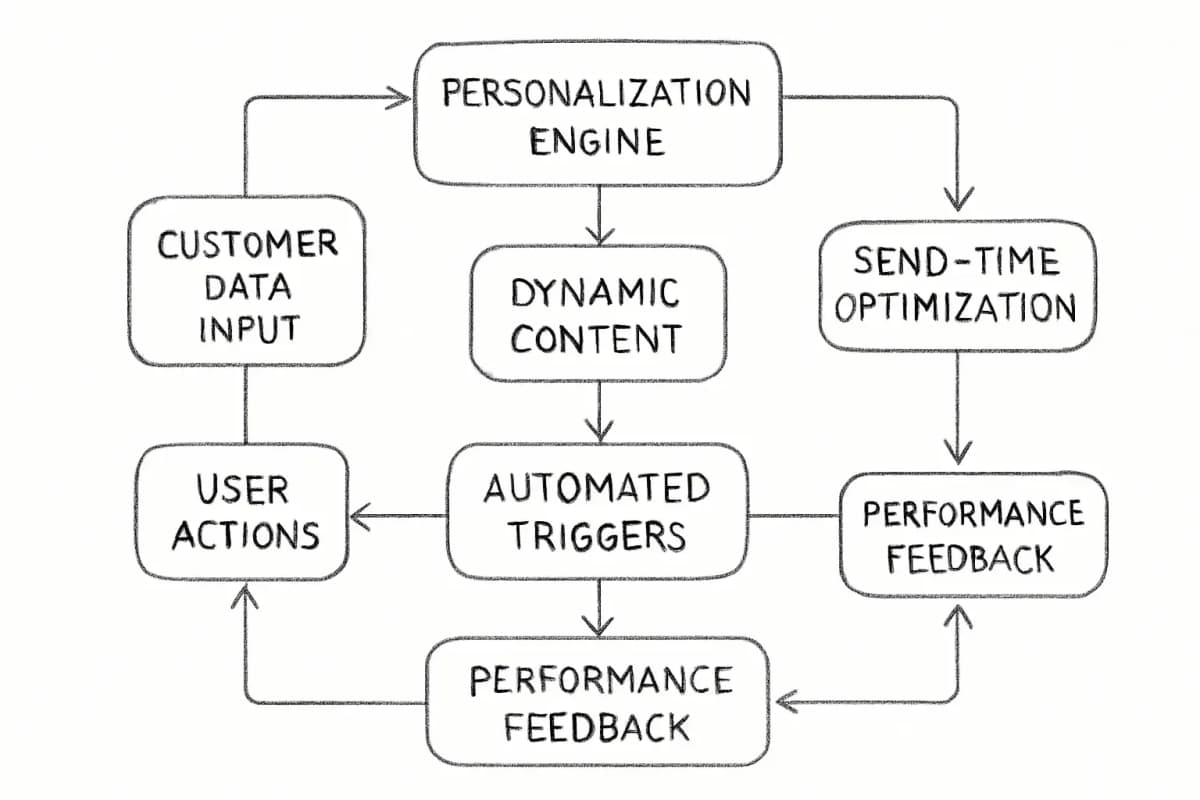
7. Measuring AI Impact: The Metrics That Matter
With Apple Mail Privacy Protection affecting 50% of email recipients, open rates are increasingly unreliable. Revenue per recipient, click-through rate, and conversion rate per send are the metrics that actually correlate with business outcomes.
When measuring AI's impact on your program specifically, use an incremental holdout approach. The gold standard for measuring AI personalization impact is incremental holdout testing. Randomly exclude 10% of your subscriber list from AI-personalized campaigns and send them the non-personalized version. Compare revenue per recipient between the two groups over 90 days. This isolates the AI personalization lift from other variables like seasonal trends, product changes, and list growth.
Primary KPIs to track across AI-enabled campaigns:
- Revenue per email sent (the clearest signal of AI personalization impact)
- Conversion rate by segment (reveals which AI-built segments are performing)
- Click-through rate by content variant (measures content optimization)
- Time saved on campaign management (quantifies operational value)
- Unsubscribe rate trend (should decline as content relevance improves with AI)
For a complete framework on tracking these metrics, see our email marketing analytics best practices guide.
Frequently Asked Questions
What is AI email marketing and how does it work?
AI email marketing uses machine learning and predictive analytics to automate and improve decisions that marketers previously made manually: which content to show each subscriber, when to send, how to segment a list, and which subject lines to use. The system learns from behavioral data, campaign history, and engagement patterns to make increasingly accurate predictions over time.
How much revenue lift can AI actually produce in email marketing?
Marketers implementing AI-powered personalization report revenue increasing by 41% and click-through rates rising 13.44% compared to non-personalized campaigns. Results vary based on list size, data quality, and how many AI features you have active. Start with a single workflow, measure against a control group, and expand from there.
Does AI email marketing work for small businesses?
Yes, though with one practical caveat. AI send-time optimization requires at least 1,000 subscribers with 60 or more days of engagement history to produce statistically meaningful personalization. Below that threshold, cohort-level optimization works better than individual-level prediction. For smaller lists, AI content generation and subject line optimization deliver value immediately, regardless of list size.
Which AI email marketing features should I prioritize first?
Start with the features that have the highest impact-to-effort ratio. Based on the data, that means: AI subject line optimization (fast to implement, measurable within one campaign), behavioral automation triggers (high revenue impact, especially welcome and cart abandonment flows), and predictive segmentation (the foundation for everything else). The biggest gains come from automation, personalization, deliverability discipline, and realistic attribution, not from sending more emails.