
Affiliate email marketers who use email consistently earn more. Affiliates using email marketing earned 66.4% more than those who did not. Yet most affiliate emails underperform not because the product is wrong, but because the writing is. A weak subject line, a buried call to action, or a missing disclosure can collapse an otherwise solid campaign. This guide breaks down exactly how to write an email for affiliate marketing that opens, clicks, and converts.
Key Takeaways
- Email marketing can deliver affiliate conversion rates as high as 5.3%, outperforming social media platforms.
- Subject line personalization and length (under 41 characters) directly affect open rates and downstream clicks.
- Button-based CTAs improve click-through rates by 127% compared to text links, according to Campaign Monitor research.
- Marketers have found a 760% increase in email revenue from segmented campaigns, according to DMA.
- FTC disclosure is legally required in every affiliate email and must appear near the affiliate link, not buried in the footer.
Why Email Outperforms Other Affiliate Channels
Before getting into structure and copy, it's worth understanding why email is worth investing in over social or paid traffic.
Email marketing is one of the highest-converting channels for affiliate marketing, with average ROI of $36 to $42 per $1 spent. Email subscribers convert at higher rates than search or social traffic because they have opted in and already trust your recommendations. The key is building a quality list of engaged subscribers rather than maximizing list size.
Email marketing typically achieves higher conversion rates around 2%, outperforming many other affiliate channels. When you compare that to the general affiliate average of 0.5% to 1% across all traffic types, email's edge is clear.
That performance edge only holds when the email itself is well-written. Here is how to do it.
Start with a Subject Line That Earns the Open
Your subject line determines whether anyone reads the rest of the email. 69% of email recipients report emails as spam based on the subject line alone. Get it wrong and nothing else matters.
Your subject line is the first thing people see, and they decide in about two seconds whether to open your email. If it works, they open it. If it doesn't, the rest of your content gets ignored.
A few rules that hold up across niches:
- Keep it short. Most email gets read on mobile, so aim for 41 characters or about 7 words. Anything longer gets cut off mid-sentence, and readers don't see the full message.
- Use the recipient's name. Using the recipient's first name in the subject line increased the chance of the email being opened by 14.68%, according to a Campaign Monitor study on power words.
- Lead with a clear benefit. The "How to" format works well because it forces you to describe the email content in very clear language. By reading these subject lines, you know exactly what you will learn from opening the email.
- Use numbers when you can. A/B tests consistently show that subject lines containing a number outperform those without. In one Campaign Monitor test, a numbered subject line achieved a 57% increase in opens over the non-numbered version.
Avoid urgency for its own sake. Fake countdown language and misleading teases damage trust and reduce future open rates.
For a deeper dive into subject line mechanics, see our guide on email subject line best practices that boost open rates by 27%.
Write an Opening That Hooks Without Hype
Once the reader opens, you have about three seconds before they scroll past or close. Your first sentence must give them a reason to keep reading.
The most effective opening for an affiliate email does one of two things:
- Names a problem the reader already has. "Your checkout page is probably losing 30% of buyers before they see the offer."
- States something surprising and specific. "Most email subscribers never click because the email gives them the answer before they reach the link."
Both of these pull the reader forward. Generic openers like "I wanted to share something exciting with you" do the opposite.
Keep your opening paragraph to two or three sentences. You are not building a case yet. You are buying enough attention to get to the next section.
Structure the Body Around Value, Not the Product
The biggest structural mistake in affiliate emails is leading with the product. Your subscriber does not care about the product. They care about their problem.
Build the body of your email in this order:
- Identify the problem or desire the reader recognizes.
- Introduce the solution as a concept, not a product pitch.
- Bridge to the affiliate offer as the specific tool, course, or service that delivers the solution.
- Add proof. A testimonial, a specific result, or a data point your subscriber can verify makes the recommendation credible.
Use social proof to show that other people like your content and the products you recommend. Adding a screenshot of a testimonial next to a call to action in the email body works particularly well.
Keep paragraphs to two or three lines. Long blocks of text in email rarely get read. Readers scan, not read, and a dense paragraph signals that the email is going to take effort.
Personalize the Message to Match the Segment
Generic emails sent to your entire list will consistently underperform compared to targeted sends. Segmented emails drive 30% more opens and 50% more clicks compared to generic campaigns.
For affiliate email specifically, segmentation works because different subscribers are at different stages of awareness. Someone who clicked on a product link last week is far more likely to convert on a direct offer than someone who has never engaged with that topic.
Segmentation is key to raising personalization for affiliates and increasing ROI. It first divides audiences according to demographics, behavior, or preferences, and then personalizes the relevant message and promotion to drive more meaningful interactions. This focused strategy drives higher engagement rates and translates into conversions since users are more prone to respond to offers that appeal to their unique needs.
Practical segments to consider for affiliate campaigns:
- Subscribers who clicked a previous related offer
- New subscribers (within the last 30 days)
- Subscribers who have purchased through your links before
- Subscribers who opened but did not click your last campaign
Our guide on email list segmentation strategies that boost ROI by 760% covers how to build and execute these segments in detail.
Personalized emails increase opening rates by 26%, with 80% of consumers more likely to convert and purchase. At scale, that lift is significant.
Place a Single, Clear Call to Action
Every affiliate email needs one primary call to action. Not two. Not three. One.
Emails with a single call to action can increase clicks by over 371% and sales by around 1,617%, according to Wordstream research.
Button-based CTAs improve click-through rates by 127%, according to Campaign Monitor research. If your email platform supports it, use a button rather than a plain hyperlink.
The copy on the button matters. Email CTAs that boost conversion rates use clear, action-oriented language to create excitement, set expectations, and demonstrate value.
Compare these:
- Weak: "Click here to learn more."
- Strong: "See the tool that cut my onboarding time in half."
The second version tells the reader what happens when they click. It removes ambiguity and connects the action to a specific outcome.
Buttons placed toward the bottom or to the right of content tend to outperform other placements, which makes sense from a messaging standpoint since you want the reader to have context before they are asked to act.
Include an FTC Disclosure (This Is Not Optional)
Every affiliate email that contains a paid or commissioned link requires a disclosure. This is a legal requirement under FTC guidelines, not a courtesy.
The Federal Trade Commission requires by law that you disclose relationships that could influence the endorsement or promotion of products. No matter how big or small the promotion, all affiliate marketers are required to do this.
In emails, integrate the disclosure clearly within the body of the email, close to the relevant recommendation or affiliate link. A disclosure buried in the footer, or missing entirely, does not satisfy FTC guidelines.
As of January 2025, the FTC can fine you up to $53,088 per violation for missing or inadequate disclosures.
A compliant disclosure is short and plain. Something like: "This email contains affiliate links. If you purchase through my link, I may earn a commission at no extra cost to you." Place it near the top of the email or directly adjacent to the affiliate link.
Most guides miss the fact that proper disclosure actually improves conversions. When readers know you are being upfront about affiliate relationships, they are more likely to click through and buy because transparency builds trust.
Measure, Test, and Improve
Writing a good affiliate email is not a one-time task. What works for one segment or one niche may not work for another. The only way to know is to test.
Track these metrics on every campaign:
- Open rate: Tells you whether your subject line is working.
- Click-through rate (CTR): Tells you whether your body copy and CTA are effective.
- Conversion rate: Tells you whether the offer and the landing page are aligned.
- Unsubscribe rate: A spike here usually means the email felt misaligned with subscriber expectations.
According to 2026 data, the average email CTR across all industries is approximately 2.09%, though this varies significantly by industry and email type. Use that as a baseline, but focus more on your own trend over time than industry averages.
Run A/B tests on one element at a time: subject line, CTA copy, email length, or personalization token. One rule applies across all platforms: test one thing at a time. If you change both the wording and the emoji, you will not know what actually improved the open rate.
For a full framework on tracking performance, see our guide to email marketing analytics best practices. 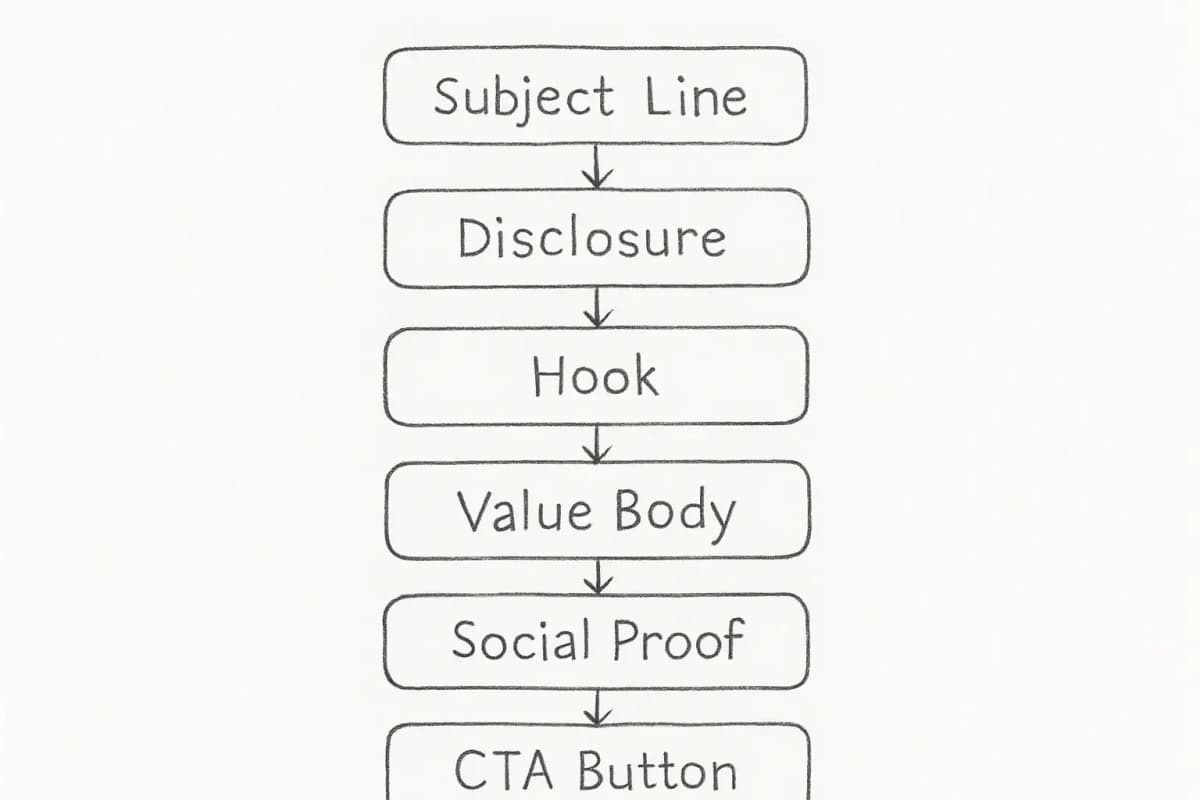
Frequently Asked Questions
How long should an affiliate marketing email be?
Most high-converting affiliate emails are between 150 and 300 words. Long enough to provide context and build a case, short enough that the reader reaches the CTA before losing interest. There is no fixed rule, but shorter emails tend to perform better with warm lists where the subscriber already trusts the sender.
How many affiliate links should I include in one email?
One primary affiliate link is the standard for promotional emails. Multiple links create competing actions and reduce the likelihood of any single click. If you need to reference secondary resources, use plain text links for those and reserve your button CTA for the affiliate offer.
Should I disclose affiliate links at the top or bottom of the email?
The FTC requires that the disclosure be clear and proximate to the affiliate link. Placing it at the top of the email, before the reader encounters the link, is the safest approach. Placing it only in the footer is not considered compliant because readers may not scroll that far.
How often should I send affiliate emails?
Frequency depends on your list and relationship with subscribers. A common benchmark is one to three promotional emails per week, balanced with value-driven content emails. Sending too many promotional emails without providing useful content increases unsubscribe rates and damages deliverability over time. Monitor your engagement data and reduce frequency if open rates begin to decline.