
Email
Email

A modern blog built with Payload CMS, Next.js, and shadcn/ui.

RSS FeedSitemap

Explore

  • Blog
  • News
  • Statistics
  • Authors

Categories

  • Hiring & Team Building
  • Email Campaign Strategy
  • Email Design & Templates
  • Email Compliance & Legal
  • Email Deliverability & Best Practices
  • Career Development
  • Email Strategy for Finance & Professional Services
  • Email Marketing Metrics

Latest articles

  • How to Hire an Email Marketing SpecialistJul 22, 2026
  • Email Marketing Campaigns Template: Ready-to-UseJul 22, 2026
  • Canva Email Marketing Templates: Design Fast, Convert MoreJul 22, 2026
  • Email Marketing Templates for FranchisesJul 22, 2026

Popular topics

  • #Specialist Skills
  • #Team Building
  • #Templates
  • #Canva
  • #Advanced Strategies
  • #multi-location businesses
  • #Marketing Regulations
  • #Lead Follow-Up
  • #iCloud Email
  • #Marketing Management
  • #Product Launch
  • #Electrician Marketing
  • #statistics
  • #Budget-Friendly
  • #Free Resources
  • #Miami businesses

Stay in the loop

Join 2,000+ readers. Unsubscribe anytime.

Subscribe
Email

© 2026 Email. All rights reserved.

SitemapRSS
HomeBlogEmail TemplatesInsurance Email Marketing Templates: 8 Proven Examples
Email Templates

Insurance Email Marketing Templates: 8 Proven Examples

Discover 8 ready-to-use insurance email marketing templates designed to boost engagement, retention, and conversions. Copy and customize today.

J

James Chen

April 25, 2026

13 min read
Share:
#Insurance Marketing#Email Templates#Email Workflows#Best Practices
Illustration for insurance email marketing templates

Stay in the loop

Get the latest posts delivered straight to your inbox. No spam, unsubscribe anytime.

Insurance email marketing is one of the highest-leverage channels available to agents, brokers, and carriers. The average email open rate across all industries typically ranges from 30% to 40%, but the insurance sector performs above that average, with a rate of 44.27%, indicating that insurance customers are genuinely engaged with email content. That engagement gap represents a real opportunity, but only if you send the right messages at the right time.

The problem most insurance marketers face is not access to the channel. It is knowing which types of emails to build, how to structure them, and how to connect each template to a business outcome. This guide covers eight proven insurance email marketing templates with practical copy frameworks, subject line guidance, and the context you need to deploy them effectively.

Key Takeaways

  • On average, businesses earn about $36 for every $1 they spend on email marketing, making it one of the strongest ROI channels available to insurance teams.
  • Marketers using advanced segmentation see a 760% increase in revenue, which is particularly relevant in insurance where policy type, lifecycle stage, and renewal date all create natural segments.
  • Personalization in email messages improves open rates by 29% and click-through rates by 41%. Personalized subject lines alone increase open rates by 26%.
  • About 55% of insurance emails are opened on mobile devices. If campaigns are not optimized for small screens, key messages and CTAs can be missed. Use concise subject lines, single-column layouts, and buttons that are easy to tap.
  • Insurance businesses must comply with data protection and privacy laws, such as GDPR, GLBA for financial institutions, or HIPAA for healthcare email marketing. Compliance is not optional, it is foundational.

Why Insurance Email Marketing Demands a Different Approach

Insurance is not an impulse buy. Nobody wakes up excited to purchase life insurance before breakfast. It is a low-frequency, high-consideration decision, which means the path from "quote requested" to "policy signed" is long and full of doubts.

That reality changes how you write, sequence, and time your emails. Insurance emails that focus solely on selling rarely perform well. Instead, successful insurance agents use email to educate clients, solve problems, and build trust, which naturally leads to more conversions.

The insurance industry does not always have a positive reputation, thanks to practices performed by ill-mannered companies. This leaves legitimate insurance companies struggling to gain the trust of the general public. Email marketing provides a solution to this issue.

Every template below reflects that context. They are built around trust first, transaction second.

For a broader foundation on structuring your campaigns, see our guide on Email Marketing Strategy Template for 2025.


Template 1: The Welcome Email

The welcome email sets the tone for every interaction that follows. Welcome emails generate 320% more revenue per email than promotional ones, and more than 8 out of 10 people open a welcome email, generating 4x as many opens and 10x as many clicks as other email types.

Goal: Introduce your agency, confirm the subscription, and give the subscriber a reason to stay engaged.

Subject line examples:

  • "Welcome to [Agency Name]: Here's what to expect"
  • "[First Name], your coverage journey starts here"

Template framework:

Hi [First Name],

Thanks for connecting with [Agency Name]. We work with [brief description of clients] to find coverage that fits their life, not a generic policy that barely does.

Over the next few weeks, you will hear from us about [specific value: tips, guides, reminders]. No daily emails. No noise.

If you have questions about your current coverage or want to explore options, reply directly to this email. You will hear back from a real person.

[Agent Name], [Agency Name]

Keep it short. State what you will send, how often, and how they can reach you. Welcome emails should be used to introduce your brand and tease some of the valuable information that will be coming to everyone who has joined your list.

For a deeper framework on onboarding sequences, read our Welcome Email Sequence Best Practices: 7 Proven Strategies.


Template 2: The Policy Renewal Reminder

Renewal reminders are one of the most effective uses of email marketing for insurance agencies. A lapsing policy is lost revenue, and it often means a client is shopping your competitors without you knowing.

Send renewal reminders early: give clients 60 to 90 days' notice before their policy expires. This gives them time to review, ask questions, and make a decision without feeling rushed.

Recommended sequence:

  1. 60 days out: soft reminder with a policy summary
  2. 30 days out: value recap and a CTA to schedule a review
  3. 7 days out: urgency-based final notice

Subject line examples:

  • "[First Name], your [policy type] renews in 60 days"
  • "Action needed: Your policy expires [date]"

Template framework (30-day reminder):

Hi [First Name],

Your [policy type] policy (# [policy number]) is set to renew on [date]. Before that happens, it is worth a quick review to make sure your coverage still reflects your situation.

A few things have changed in the past year that may affect your rate: [example: new driving record data, home improvement credits, bundling discounts].

[CTA Button: Schedule a 15-Minute Review]

If you have questions, just reply here.

[Agent Name]

Make it personal. Go beyond their name. Reference their specific policy, like "your homeowner's policy on Elm Street," to show you are paying attention. It proves they are not just another number on a list.


Template 3: The Quote Follow-Up Email

A prospect who requested a quote is at peak interest. Behavior-based emails generate roughly 3x higher engagement than scheduled campaigns, as they are triggered by specific user actions.

Send the follow-up within hours, not days.

Subject line examples:

  • "Your [policy type] quote from [Agency Name]"
  • "[First Name], here are your options"

Template framework:

Hi [First Name],

Attached is your quote for [policy type]. Here's a plain-language summary:

  • Coverage: [details]
  • Monthly premium: $[amount]
  • Deductible: $[amount]
  • What's included: [key benefits in bullet form]

A few notes:

  • [Explain any key exclusions clearly]
  • [Note if bundling saves them money]

Questions? Reply to this email or book a call: [scheduling link]

[Agent Name]

A quote delivery email is a key step in converting prospects into clients by presenting insurance options clearly and professionally. The email should include a personalized message, a concise summary of the quote details, and a clear explanation of next steps. Use a friendly tone, highlight the benefits of the coverage, and include a strong CTA. By making the email easy to understand and actionable, you can build trust and encourage timely decisions.


Template 4: The Educational Newsletter

Insurance is complex, and clients who understand their coverage are more loyal and less likely to shop elsewhere. The use of GIFs and images led to an increase in click rates in the insurance sector by 40%. Educational content that includes visuals tends to outperform text-only newsletters.

Aim to send insurance newsletters two to three times per month. Consistency matters, but avoid overwhelming subscribers. Sending too frequently without clear value can lead to increased unsubscribe rates.

Subject line examples:

  • "3 things your auto policy probably does not cover"
  • "What to do in the first 24 hours after a home claim"

Template framework:

Hi [First Name],

This month's topic: [specific, useful topic relevant to their policy type].

[Key insight or tip in one or two sentences]

Here's what most policyholders miss: [practical explanation, 2-3 sentences max].

[Optional: brief explainer visual or infographic]

If this raises questions about your own coverage, reply and we will take a look.

[Agent Name]

Focus on one topic per email. Covering three topics at once dilutes attention and reduces clicks.


Template 5: The Cross-Sell Email

Cross-selling makes it easier and less costly to connect with current clients, round out accounts, and increase revenue per client. It also increases your chances of retaining existing clients.

The first email should go out three months after clients purchase their home, auto, or umbrella policy, and then 35 days prior to renewal.

Subject line examples:

  • "You have home coverage. Is your auto protected too?"
  • "Bundling saves most clients 10-15%. Here's how"

Template framework:

Hi [First Name],

Since you joined us with your [current policy type], I wanted to flag something that could save you money: bundling with [additional policy type].

Our clients who bundle typically save [X%] annually and manage everything in one place.

Would you like a quick quote? It takes about 5 minutes and there is no obligation.

[CTA: Get a Bundle Quote]

[Agent Name]

Use a benefit-driven subject line, like "Bundling insurance saves money (and time)," and highlight the advantages of bundling, such as saving time and money and not having to juggle multiple carriers and policies.

Pair this with proper segmentation. A life insurance client receives different cross-sell messaging than an auto-only policyholder. For a practical breakdown of how to build segments that generate results, see our guide on Email List Segmentation Strategies That Boost ROI by 760%.


Template 6: The Claims Status Update Email

Claims are the moment of truth for policyholders. How you communicate during a claim directly affects retention and referrals. Email reduces anxiety during stressful claim events by delivering transparent, real-time updates.

Subject line examples:

  • "Update on your claim #[number]"
  • "[First Name], here is where your claim stands"

Template framework:

Hi [First Name],

Here is a quick update on your claim (# [claim number]):

Status: [In Review / Approved / Pending Documentation]

What happens next: [2-3 clear sentences explaining the next step in plain language]

What we need from you (if anything): [Specific action, or "Nothing at this time"]

Estimated timeline: [Date or range]

If you have questions or something has changed, contact your agent directly: [name, phone, email].

[Agency Name]

Proactive claims communication reduces inbound call volume and shows clients you are working on their behalf. Do not wait for them to follow up.


Template 7: The Re-Engagement Email (Lapsed Clients)

Email list hygiene directly impacts deliverability. When your emails consistently go to inactive subscribers, email providers may start sending your messages to spam folders, even for engaged subscribers. For insurance agents, this means potential leads and renewal reminders might never reach their intended recipients.

Before removing lapsed clients from your list, run a re-engagement sequence.

Subject line examples:

  • "It's been a while, [First Name]. Still covered?"
  • "[First Name], has anything changed since we last spoke?"

Template framework:

Hi [First Name],

We have not heard from you in a while, and wanted to check in.

A lot changes in a year: new vehicles, home renovations, life events. Any of these can affect your coverage needs, and often your rate.

If now is a good time to take a look, I am happy to do a quick review. No pressure, just a check-in.

[CTA: Book a 10-Minute Review Call]

If you would rather not hear from us, you can unsubscribe below. No hard feelings.

[Agent Name]

This approach respects the recipient's time and signals that your agency is people-first. The honesty about the unsubscribe option often improves response rates from those who are genuinely interested.


Template 8: The Referral Request Email

Email is 40 times more effective than social media for customer acquisition. Your happiest clients are your best acquisition channel. The referral request email formalizes that.

Send it 30 to 60 days after a successful claim or positive interaction, not at the point of sale.

Subject line examples:

  • "Know someone who could use better coverage?"
  • "[First Name], could you do us a favor?"

Template framework:

Hi [First Name],

Working with clients like you is the best part of this business.

If you know anyone who could benefit from a coverage review, a quick introduction means a lot to us. We will treat them with the same care we have given you.

[CTA: Refer a Friend]

As a thank-you, [optional: describe any referral incentive here].

Thanks for trusting us with something as important as your coverage.

[Agent Name]

Keep it brief. A long email about referrals reads as corporate and transactional. A short, personal note reads as genuine.
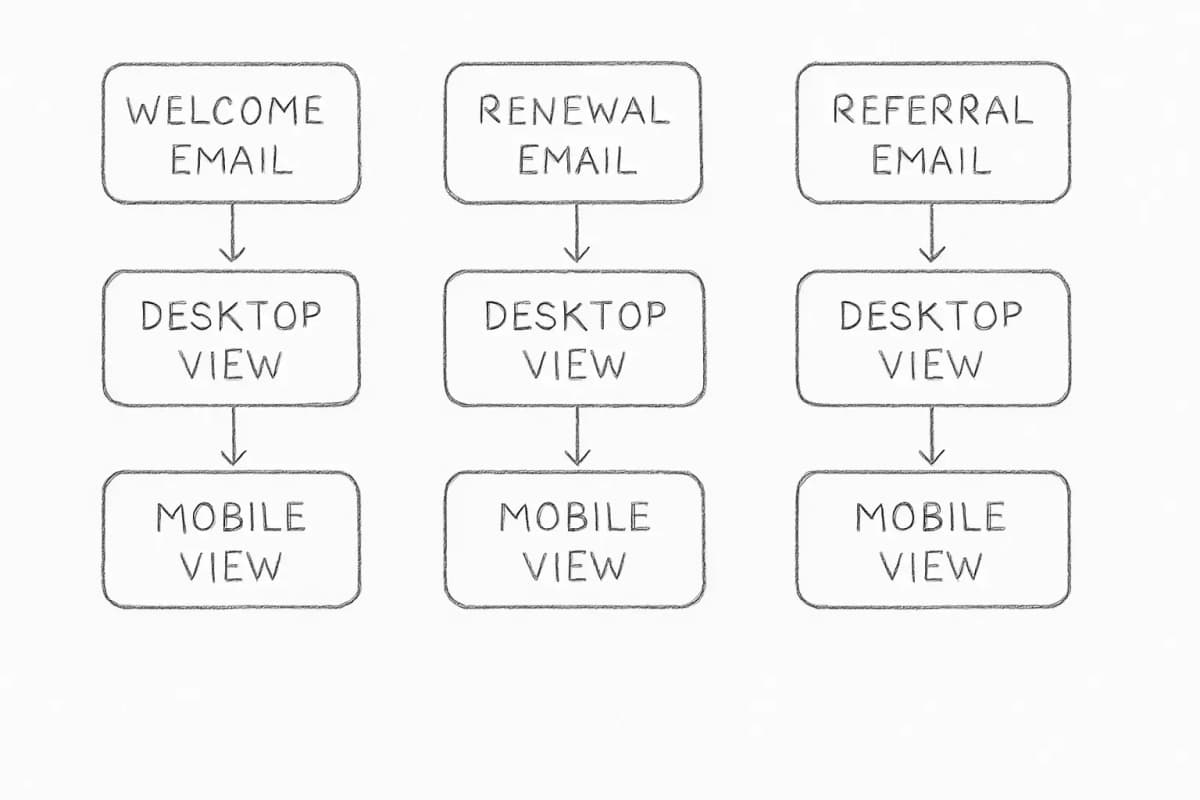

Three insurance email template layouts displayed side-by-side showing welcome, renewal, and referral email designs. Each template shows both desktop and mobile versions with realistic email content including headers, body text, call-to-action buttons, and footer information. The designs should appear professional yet approachable, using insurance industry color schemes (blues, grays, greens). Include visual distinction between the three email types while maintaining consistent branding across all templates.


What Makes These Insurance Email Marketing Templates Perform

Beyond copy, three mechanics separate high-performing insurance email campaigns from average ones.

Segmentation by policy type and lifecycle stage

Segment by insurance type (auto, home, life, health), customer lifecycle stage, policy renewal dates, demographic information, and past interactions. A renewal reminder sent to someone who just renewed two weeks ago destroys trust. Precision in segmentation prevents this.

Subject lines that earn the open

Your subject line determines whether your carefully crafted email gets opened or ignored. For insurance agents, effective subject lines balance urgency and value without triggering spam filters. For a full breakdown of what works in 2025, see our post on Email Subject Line Best Practices That Boost Open Rates by 27%.

Compliance as a design constraint, not an afterthought

Insurance is a highly regulated industry, and email marketing adds another layer of compliance requirements. Failing to follow regulations can result in significant fines and damage to your reputation. Every template above should include a physical address, a clear unsubscribe option, and any required disclosures for your jurisdiction.

Tracking metrics that connect to revenue

Insurance email marketing is still a winning outreach tool. However, making it work requires tracking the right metrics and making the necessary adjustments. Breaking down your email marketing into measurable parts helps you identify mistakes and guides your strategy with data.


Frequently Asked Questions

How often should insurance agencies send marketing emails?

Aim to send insurance newsletters two to three times per month. Consistency is key, but avoid overwhelming your subscribers. Automated triggers like renewal reminders and claims updates operate independently of this cadence and should fire based on policyholder events, not a fixed schedule.

What is a good open rate for insurance emails?

The average email open rate across all industries typically ranges from 30% to 40%. The insurance sector performs above average, with a rate of 44.27%. Use this as your baseline benchmark. If your open rates fall significantly below this, audit your subject lines, sending frequency, and list hygiene first.

How do I personalize insurance emails without crossing privacy lines?

Email marketing provides insurance companies the opportunity to personalize messages in several ways. Personalization goes beyond adding a policyholder's name to the beginning of an email. Thanks to list segmentation, email marketers can break their list into smaller groups to send more personalized, relevant material. Use only data your clients have explicitly provided or that governs their existing policy relationship. Reference policy type, renewal date, and agent name. Avoid referencing sensitive health or financial data unless you have documented consent and compliant infrastructure.

Should insurance agents use automation for these templates?

Yes. In insurance email marketing, renewal reminders are especially crucial. You can schedule automated emails to go out 30, 15, and 5 days before a policy expires. Automation ensures no renewal slips through without a touchpoint and removes the manual burden of managing reminder cadences across a large book of business. If you capture leads via multiple channels, you can set up automated emails to instantly engage the lead once they submit their details. This cuts down waiting time for the customer and creates a strong first impression. At the same time, personalization of engagement makes the customer feel they are talking to an agent rather than a system.


No comments yet. Be the first!

Leave a comment

Comments are reviewed before publishing.

More from

Related posts

Illustration for email marketing templates for franchises
Email TemplatesJul 22, 2026 13 min

Email Marketing Templates for Franchises

Ready-to-use email templates designed for franchise businesses. Boost engagement, consistency, and sales across all locations with proven templates.

MMarcus Webb
Illustration for email marketing templates for contractors
Email TemplatesJul 22, 2026 12 min

Email Marketing Templates for Contractors

Ready-to-use email templates designed for contractors. Save time, boost responses, and close more jobs with proven templates for estimates, follow-ups, and more.

PPriya Kapoor
Illustration for email template for product marketing
Email TemplatesJul 22, 2026 13 min

Email Template for Product Marketing: 7 High-Converting Examples

Learn 7 proven email templates for product marketing that drive engagement and sales. Download templates, customize them for your audience, and boost ROI today.

MMarcus Webb
HomeBlogEmail TemplatesInsurance Email Marketing Templates: 8 Proven Examples
Email Templates

Insurance Email Marketing Templates: 8 Proven Examples

Discover 8 ready-to-use insurance email marketing templates designed to boost engagement, retention, and conversions. Copy and customize today.

J

James Chen

April 25, 2026

13 min read
Share:
#Insurance Marketing#Email Templates#Email Workflows#Best Practices
Illustration for insurance email marketing templates

Stay in the loop

Get the latest posts delivered straight to your inbox. No spam, unsubscribe anytime.

Insurance email marketing is one of the highest-leverage channels available to agents, brokers, and carriers. The average email open rate across all industries typically ranges from 30% to 40%, but the insurance sector performs above that average, with a rate of 44.27%, indicating that insurance customers are genuinely engaged with email content. That engagement gap represents a real opportunity, but only if you send the right messages at the right time.

The problem most insurance marketers face is not access to the channel. It is knowing which types of emails to build, how to structure them, and how to connect each template to a business outcome. This guide covers eight proven insurance email marketing templates with practical copy frameworks, subject line guidance, and the context you need to deploy them effectively.

Key Takeaways

  • On average, businesses earn about $36 for every $1 they spend on email marketing, making it one of the strongest ROI channels available to insurance teams.
  • Marketers using advanced segmentation see a 760% increase in revenue, which is particularly relevant in insurance where policy type, lifecycle stage, and renewal date all create natural segments.
  • Personalization in email messages improves open rates by 29% and click-through rates by 41%. Personalized subject lines alone increase open rates by 26%.
  • About 55% of insurance emails are opened on mobile devices. If campaigns are not optimized for small screens, key messages and CTAs can be missed. Use concise subject lines, single-column layouts, and buttons that are easy to tap.
  • Insurance businesses must comply with data protection and privacy laws, such as GDPR, GLBA for financial institutions, or HIPAA for healthcare email marketing. Compliance is not optional, it is foundational.

Why Insurance Email Marketing Demands a Different Approach

Insurance is not an impulse buy. Nobody wakes up excited to purchase life insurance before breakfast. It is a low-frequency, high-consideration decision, which means the path from "quote requested" to "policy signed" is long and full of doubts.

That reality changes how you write, sequence, and time your emails. Insurance emails that focus solely on selling rarely perform well. Instead, successful insurance agents use email to educate clients, solve problems, and build trust, which naturally leads to more conversions.

The insurance industry does not always have a positive reputation, thanks to practices performed by ill-mannered companies. This leaves legitimate insurance companies struggling to gain the trust of the general public. Email marketing provides a solution to this issue.

Every template below reflects that context. They are built around trust first, transaction second.

For a broader foundation on structuring your campaigns, see our guide on Email Marketing Strategy Template for 2025.


Template 1: The Welcome Email

The welcome email sets the tone for every interaction that follows. Welcome emails generate 320% more revenue per email than promotional ones, and more than 8 out of 10 people open a welcome email, generating 4x as many opens and 10x as many clicks as other email types.

Goal: Introduce your agency, confirm the subscription, and give the subscriber a reason to stay engaged.

Subject line examples:

  • "Welcome to [Agency Name]: Here's what to expect"
  • "[First Name], your coverage journey starts here"

Template framework:

Hi [First Name],

Thanks for connecting with [Agency Name]. We work with [brief description of clients] to find coverage that fits their life, not a generic policy that barely does.

Over the next few weeks, you will hear from us about [specific value: tips, guides, reminders]. No daily emails. No noise.

If you have questions about your current coverage or want to explore options, reply directly to this email. You will hear back from a real person.

[Agent Name], [Agency Name]

Keep it short. State what you will send, how often, and how they can reach you. Welcome emails should be used to introduce your brand and tease some of the valuable information that will be coming to everyone who has joined your list.

For a deeper framework on onboarding sequences, read our Welcome Email Sequence Best Practices: 7 Proven Strategies.


Template 2: The Policy Renewal Reminder

Renewal reminders are one of the most effective uses of email marketing for insurance agencies. A lapsing policy is lost revenue, and it often means a client is shopping your competitors without you knowing.

Send renewal reminders early: give clients 60 to 90 days' notice before their policy expires. This gives them time to review, ask questions, and make a decision without feeling rushed.

Recommended sequence:

  1. 60 days out: soft reminder with a policy summary
  2. 30 days out: value recap and a CTA to schedule a review
  3. 7 days out: urgency-based final notice

Subject line examples:

  • "[First Name], your [policy type] renews in 60 days"
  • "Action needed: Your policy expires [date]"

Template framework (30-day reminder):

Hi [First Name],

Your [policy type] policy (# [policy number]) is set to renew on [date]. Before that happens, it is worth a quick review to make sure your coverage still reflects your situation.

A few things have changed in the past year that may affect your rate: [example: new driving record data, home improvement credits, bundling discounts].

[CTA Button: Schedule a 15-Minute Review]

If you have questions, just reply here.

[Agent Name]

Make it personal. Go beyond their name. Reference their specific policy, like "your homeowner's policy on Elm Street," to show you are paying attention. It proves they are not just another number on a list.


Template 3: The Quote Follow-Up Email

A prospect who requested a quote is at peak interest. Behavior-based emails generate roughly 3x higher engagement than scheduled campaigns, as they are triggered by specific user actions.

Send the follow-up within hours, not days.

Subject line examples:

  • "Your [policy type] quote from [Agency Name]"
  • "[First Name], here are your options"

Template framework:

Hi [First Name],

Attached is your quote for [policy type]. Here's a plain-language summary:

  • Coverage: [details]
  • Monthly premium: $[amount]
  • Deductible: $[amount]
  • What's included: [key benefits in bullet form]

A few notes:

  • [Explain any key exclusions clearly]
  • [Note if bundling saves them money]

Questions? Reply to this email or book a call: [scheduling link]

[Agent Name]

A quote delivery email is a key step in converting prospects into clients by presenting insurance options clearly and professionally. The email should include a personalized message, a concise summary of the quote details, and a clear explanation of next steps. Use a friendly tone, highlight the benefits of the coverage, and include a strong CTA. By making the email easy to understand and actionable, you can build trust and encourage timely decisions.


Template 4: The Educational Newsletter

Insurance is complex, and clients who understand their coverage are more loyal and less likely to shop elsewhere. The use of GIFs and images led to an increase in click rates in the insurance sector by 40%. Educational content that includes visuals tends to outperform text-only newsletters.

Aim to send insurance newsletters two to three times per month. Consistency matters, but avoid overwhelming subscribers. Sending too frequently without clear value can lead to increased unsubscribe rates.

Subject line examples:

  • "3 things your auto policy probably does not cover"
  • "What to do in the first 24 hours after a home claim"

Template framework:

Hi [First Name],

This month's topic: [specific, useful topic relevant to their policy type].

[Key insight or tip in one or two sentences]

Here's what most policyholders miss: [practical explanation, 2-3 sentences max].

[Optional: brief explainer visual or infographic]

If this raises questions about your own coverage, reply and we will take a look.

[Agent Name]

Focus on one topic per email. Covering three topics at once dilutes attention and reduces clicks.


Template 5: The Cross-Sell Email

Cross-selling makes it easier and less costly to connect with current clients, round out accounts, and increase revenue per client. It also increases your chances of retaining existing clients.

The first email should go out three months after clients purchase their home, auto, or umbrella policy, and then 35 days prior to renewal.

Subject line examples:

  • "You have home coverage. Is your auto protected too?"
  • "Bundling saves most clients 10-15%. Here's how"

Template framework:

Hi [First Name],

Since you joined us with your [current policy type], I wanted to flag something that could save you money: bundling with [additional policy type].

Our clients who bundle typically save [X%] annually and manage everything in one place.

Would you like a quick quote? It takes about 5 minutes and there is no obligation.

[CTA: Get a Bundle Quote]

[Agent Name]

Use a benefit-driven subject line, like "Bundling insurance saves money (and time)," and highlight the advantages of bundling, such as saving time and money and not having to juggle multiple carriers and policies.

Pair this with proper segmentation. A life insurance client receives different cross-sell messaging than an auto-only policyholder. For a practical breakdown of how to build segments that generate results, see our guide on Email List Segmentation Strategies That Boost ROI by 760%.


Template 6: The Claims Status Update Email

Claims are the moment of truth for policyholders. How you communicate during a claim directly affects retention and referrals. Email reduces anxiety during stressful claim events by delivering transparent, real-time updates.

Subject line examples:

  • "Update on your claim #[number]"
  • "[First Name], here is where your claim stands"

Template framework:

Hi [First Name],

Here is a quick update on your claim (# [claim number]):

Status: [In Review / Approved / Pending Documentation]

What happens next: [2-3 clear sentences explaining the next step in plain language]

What we need from you (if anything): [Specific action, or "Nothing at this time"]

Estimated timeline: [Date or range]

If you have questions or something has changed, contact your agent directly: [name, phone, email].

[Agency Name]

Proactive claims communication reduces inbound call volume and shows clients you are working on their behalf. Do not wait for them to follow up.


Template 7: The Re-Engagement Email (Lapsed Clients)

Email list hygiene directly impacts deliverability. When your emails consistently go to inactive subscribers, email providers may start sending your messages to spam folders, even for engaged subscribers. For insurance agents, this means potential leads and renewal reminders might never reach their intended recipients.

Before removing lapsed clients from your list, run a re-engagement sequence.

Subject line examples:

  • "It's been a while, [First Name]. Still covered?"
  • "[First Name], has anything changed since we last spoke?"

Template framework:

Hi [First Name],

We have not heard from you in a while, and wanted to check in.

A lot changes in a year: new vehicles, home renovations, life events. Any of these can affect your coverage needs, and often your rate.

If now is a good time to take a look, I am happy to do a quick review. No pressure, just a check-in.

[CTA: Book a 10-Minute Review Call]

If you would rather not hear from us, you can unsubscribe below. No hard feelings.

[Agent Name]

This approach respects the recipient's time and signals that your agency is people-first. The honesty about the unsubscribe option often improves response rates from those who are genuinely interested.


Template 8: The Referral Request Email

Email is 40 times more effective than social media for customer acquisition. Your happiest clients are your best acquisition channel. The referral request email formalizes that.

Send it 30 to 60 days after a successful claim or positive interaction, not at the point of sale.

Subject line examples:

  • "Know someone who could use better coverage?"
  • "[First Name], could you do us a favor?"

Template framework:

Hi [First Name],

Working with clients like you is the best part of this business.

If you know anyone who could benefit from a coverage review, a quick introduction means a lot to us. We will treat them with the same care we have given you.

[CTA: Refer a Friend]

As a thank-you, [optional: describe any referral incentive here].

Thanks for trusting us with something as important as your coverage.

[Agent Name]

Keep it brief. A long email about referrals reads as corporate and transactional. A short, personal note reads as genuine.


Three insurance email template layouts displayed side-by-side showing welcome, renewal, and referral email designs. Each template shows both desktop and mobile versions with realistic email content including headers, body text, call-to-action buttons, and footer information. The designs should appear professional yet approachable, using insurance industry color schemes (blues, grays, greens). Include visual distinction between the three email types while maintaining consistent branding across all templates.


What Makes These Insurance Email Marketing Templates Perform

Beyond copy, three mechanics separate high-performing insurance email campaigns from average ones.

Segmentation by policy type and lifecycle stage

Segment by insurance type (auto, home, life, health), customer lifecycle stage, policy renewal dates, demographic information, and past interactions. A renewal reminder sent to someone who just renewed two weeks ago destroys trust. Precision in segmentation prevents this.

Subject lines that earn the open

Your subject line determines whether your carefully crafted email gets opened or ignored. For insurance agents, effective subject lines balance urgency and value without triggering spam filters. For a full breakdown of what works in 2025, see our post on Email Subject Line Best Practices That Boost Open Rates by 27%.

Compliance as a design constraint, not an afterthought

Insurance is a highly regulated industry, and email marketing adds another layer of compliance requirements. Failing to follow regulations can result in significant fines and damage to your reputation. Every template above should include a physical address, a clear unsubscribe option, and any required disclosures for your jurisdiction.

Tracking metrics that connect to revenue

Insurance email marketing is still a winning outreach tool. However, making it work requires tracking the right metrics and making the necessary adjustments. Breaking down your email marketing into measurable parts helps you identify mistakes and guides your strategy with data.


Frequently Asked Questions

How often should insurance agencies send marketing emails?

Aim to send insurance newsletters two to three times per month. Consistency is key, but avoid overwhelming your subscribers. Automated triggers like renewal reminders and claims updates operate independently of this cadence and should fire based on policyholder events, not a fixed schedule.

What is a good open rate for insurance emails?

The average email open rate across all industries typically ranges from 30% to 40%. The insurance sector performs above average, with a rate of 44.27%. Use this as your baseline benchmark. If your open rates fall significantly below this, audit your subject lines, sending frequency, and list hygiene first.

How do I personalize insurance emails without crossing privacy lines?

Email marketing provides insurance companies the opportunity to personalize messages in several ways. Personalization goes beyond adding a policyholder's name to the beginning of an email. Thanks to list segmentation, email marketers can break their list into smaller groups to send more personalized, relevant material. Use only data your clients have explicitly provided or that governs their existing policy relationship. Reference policy type, renewal date, and agent name. Avoid referencing sensitive health or financial data unless you have documented consent and compliant infrastructure.

Should insurance agents use automation for these templates?

Yes. In insurance email marketing, renewal reminders are especially crucial. You can schedule automated emails to go out 30, 15, and 5 days before a policy expires. Automation ensures no renewal slips through without a touchpoint and removes the manual burden of managing reminder cadences across a large book of business. If you capture leads via multiple channels, you can set up automated emails to instantly engage the lead once they submit their details. This cuts down waiting time for the customer and creates a strong first impression. At the same time, personalization of engagement makes the customer feel they are talking to an agent rather than a system.

No comments yet. Be the first!

Leave a comment

Comments are reviewed before publishing.

More from

Related posts

Illustration for email marketing templates for franchises
Email TemplatesJul 22, 2026 13 min

Email Marketing Templates for Franchises

Ready-to-use email templates designed for franchise businesses. Boost engagement, consistency, and sales across all locations with proven templates.

MMarcus Webb
Illustration for email marketing templates for contractors
Email TemplatesJul 22, 2026 12 min

Email Marketing Templates for Contractors

Ready-to-use email templates designed for contractors. Save time, boost responses, and close more jobs with proven templates for estimates, follow-ups, and more.

PPriya Kapoor
Illustration for email template for product marketing
Email TemplatesJul 22, 2026 13 min

Email Template for Product Marketing: 7 High-Converting Examples

Learn 7 proven email templates for product marketing that drive engagement and sales. Download templates, customize them for your audience, and boost ROI today.

MMarcus Webb