
Email
Email

A modern blog built with Payload CMS, Next.js, and shadcn/ui.

RSS FeedSitemap

Explore

  • Blog
  • News
  • Statistics
  • Authors

Categories

  • CRM & Email Marketing Tools
  • Email Analytics & Reporting
  • Email Security & Compliance
  • Email Automation
  • Email List Building
  • Seasonal & Holiday Email Marketing
  • Email Marketing Benchmarks & Statistics
  • Email Design & Personalization

Latest articles

  • Email Marketing Automation Platforms: 2024 ComparisonJul 20, 2026
  • Email Marketing with the Best Automation ToolsJul 20, 2026
  • Email Marketing Automation Course: Build SkillsJul 20, 2026
  • AI Email Marketing Processes: Automate StrategyJul 20, 2026

Popular topics

  • #deliverability and segmentation
  • #beauty brand email strategy
  • #skincare email marketing
  • #Marketing
  • #email engagement metrics
  • #Content Generation
  • #Sales Efficiency
  • #Cyber Monday Trends
  • #Email Campaign Benchmarks
  • #Holiday Marketing Statistics
  • #BFCM Email Strategy
  • #Enterprise Email
  • #credit card marketing
  • #Business Software
  • #CRM Software
  • #MarTech

Stay in the loop

Join 2,000+ readers. Unsubscribe anytime.

Subscribe
Email

© 2026 Email. All rights reserved.

SitemapRSS
HomeBlogEmail Segmentation & TargetingMarketing Directors Email List: Build & Buy the Right Data
Email Segmentation & Targeting

Marketing Directors Email List: Build & Buy the Right Data

Find verified marketing directors email addresses for B2B outreach. Learn how to build, buy, or validate lists for higher deliverability and ROI.

J

James Chen

April 21, 2026

13 min read
Share:
#B2B Email Lists#Lead Generation#Email Deliverability#Email List Building
Illustration for marketing directors email list

Stay in the loop

Get the latest posts delivered straight to your inbox. No spam, unsubscribe anytime.

Reaching marketing directors with email is one of the highest-leverage moves in B2B outreach. These are the people who control marketing budgets, sign off on agency contracts, and evaluate new tools. Getting your message in front of them requires more than a bulk list and a generic pitch. It requires the right data, the right approach, and the discipline to maintain both.

This guide covers everything you need to know about building and buying a marketing directors email list that actually performs: where the data comes from, how to evaluate vendors, what the regulations require, and how to turn a contact record into a real conversation.

Key Takeaways

  • B2B contact data decays between 22.5% and 70.3% annually, with email decay accelerating to 3.6% monthly as of November 2024, meaning nearly three-quarters of prospect databases become outdated within 12 months. Buying a list once and sitting on it is not a strategy.
  • 94% of B2B marketers face issues with unreliable data, and outdated or poorly targeted leads result in low engagement, unnecessary expenses, and missed opportunities.
  • 1 in 6 marketing emails never reaches the inbox, getting filtered to spam or blocked outright. List quality directly drives deliverability.
  • Regulatory exposure is real. GDPR violations can result in fines up to €20 million or 4% of global annual revenue, whichever is higher. The FTC's maximum civil penalty amount for CAN-SPAM violations increased to $53,088 effective January 17, 2025.
  • B2B click-through rates are 47% higher than B2C email campaigns, and the average ROI for B2B email marketing is $46 for every $1 spent. The channel works when the list is right.

Why a Marketing Directors Email List Is Worth the Effort

Marketing directors sit at the intersection of budget and execution. They buy software, commission agencies, approve content strategies, and influence purchase decisions across their organizations. 73% of B2B marketers consider email marketing the most effective method for reaching out to prospects. Reaching marketing directors through email is often faster and more direct than social selling or paid advertising, particularly for B2B sales cycles where multiple touchpoints are required.

The average B2B email open rate sits between 15.1% and 35.63% depending on the source and industry, while B2B email marketing delivers an ROI of $36 to $46 for every $1 spent. When you combine those economics with the seniority level of a marketing director audience, the math supports investment in a properly built list.

But "properly built" is doing a lot of work in that sentence. A marketing directors email list is only valuable if the contacts are current, the emails are deliverable, and the outreach is relevant.


Build vs. Buy: What the Data Says

There is no universal answer here. Both approaches have legitimate use cases, and the better question is which method fits your timeline, team capacity, and target account profile.

Building an organic list

Organic list building takes longer but produces contacts who have shown genuine interest in your content or brand. Obtaining a list with 500 eligible, accurate, and engaged contacts will outperform an email list with 50,000 uninterested, generic recipients any time.

Common organic methods for reaching marketing directors include:

  • Gated research reports and benchmark studies (high perceived value for a senior audience)
  • Webinars with industry-relevant topics
  • Newsletter subscriptions with original insight
  • Event registrations and conference follow-ups
  • LinkedIn connection requests followed by an opt-in offer

The tradeoff is time. Building a high-quality organic list of marketing directors can take months, which is a constraint that matters if you have a product launch or sales target with a near-term deadline.

Buying or licensing list data

There are legitimate scenarios where working with B2B email list providers can be valuable. If you are conducting market research, running highly targeted account-based marketing campaigns, or need to quickly identify potential prospects for your sales team, these providers can offer useful data. The key is using B2B data lists as a research tool rather than a direct marketing channel.

The difference between brands that generate revenue from email and those that don't comes down to how email lists are built, not how large they are. This applies equally to purchased data. A smaller, more precisely filtered list of verified marketing director contacts at companies that match your ideal customer profile will outperform a massive unfiltered export every time.

The hybrid approach, using a data vendor to identify accounts and individuals, then building organic touchpoints before or alongside cold outreach, tends to deliver the best results in practice.

For guidance on structuring what you send once the list is in place, see our email marketing strategy template for a campaign framework you can adapt.


How to Evaluate B2B Email List Vendors

Not all data vendors are equal. The gap between the best and worst providers on real-world email accuracy is significant.

ZoomInfo is the 800-pound gorilla of B2B data. They have the largest and most accurate database in the market, with over 600 million professional profiles and 135 million verified phone numbers. But that comes at a steep price. In real-world testing, ZoomInfo's email accuracy is the best in the market at 90 to 93% on verified addresses.

Pricing for ZoomInfo starts at approximately $15,000 per year for the SalesOS Professional plan, and most teams end up paying $25,000 to $40,000 per year once they add the features they actually need.

Apollo is better for SMBs and teams that want an all-in-one platform at a transparent price point. ZoomInfo is better for enterprise organizations that need deeper data, advanced intent signals, and direct dial accuracy for senior decision-makers. Apollo claims 91% accuracy, but real-world bounce rates of 20 to 30% are frequently reported on G2, Reddit, and Trustpilot. Applying Apollo's own "Verified Emails" filter drops the database from 275 million to 96 million contacts, and G2 reviewers report accuracy hovering at 65 to 70% rather than the advertised 91%.

UpLead is a B2B prospecting tool with a 95% email accuracy guarantee, emphasizing clean, verified contact data with powerful filters.

When evaluating any vendor for a marketing directors email list, ask these questions before committing:

  1. How often is the data refreshed? Is it continuous or batch-updated?
  2. What is the verified email accuracy rate, with evidence from third-party tests?
  3. Can you filter specifically by job title, seniority level, industry, and company size?
  4. What is the compliance posture for GDPR and CAN-SPAM?
  5. Do they offer a sample set you can verify before purchasing?

The most critical selection factor is whether a provider actually has your ideal customers in their database. Before comparing features or pricing, document your ICP in detail: target industries, job titles, seniority levels, company size ranges, revenue thresholds, and geography.


The Data Decay Problem You Cannot Ignore

Even a verified marketing directors email list starts losing accuracy the moment you download it.

B2B contact data decays at approximately 2.1% per month, which compounds to roughly 22.5% annually. Nearly a quarter of your database could be outdated within a year, even if you started with verified information.

Marketing directors are a particularly volatile segment. They change companies, get promoted, move to consulting, or take internal transfers. Rate data shows that 15 to 20% of professionals change jobs annually, with average tenure at a company dropping to 4.1 years according to the Bureau of Labor Statistics.

Poor data quality costs companies an average of $12.9 million annually and leads to wasted outreach efforts, missed opportunities, and compliance risks.

The practical implication: a one-time list purchase is not an asset, it is a depreciating liability. You need to either work with a provider that offers real-time enrichment or commit to a regular data hygiene process.

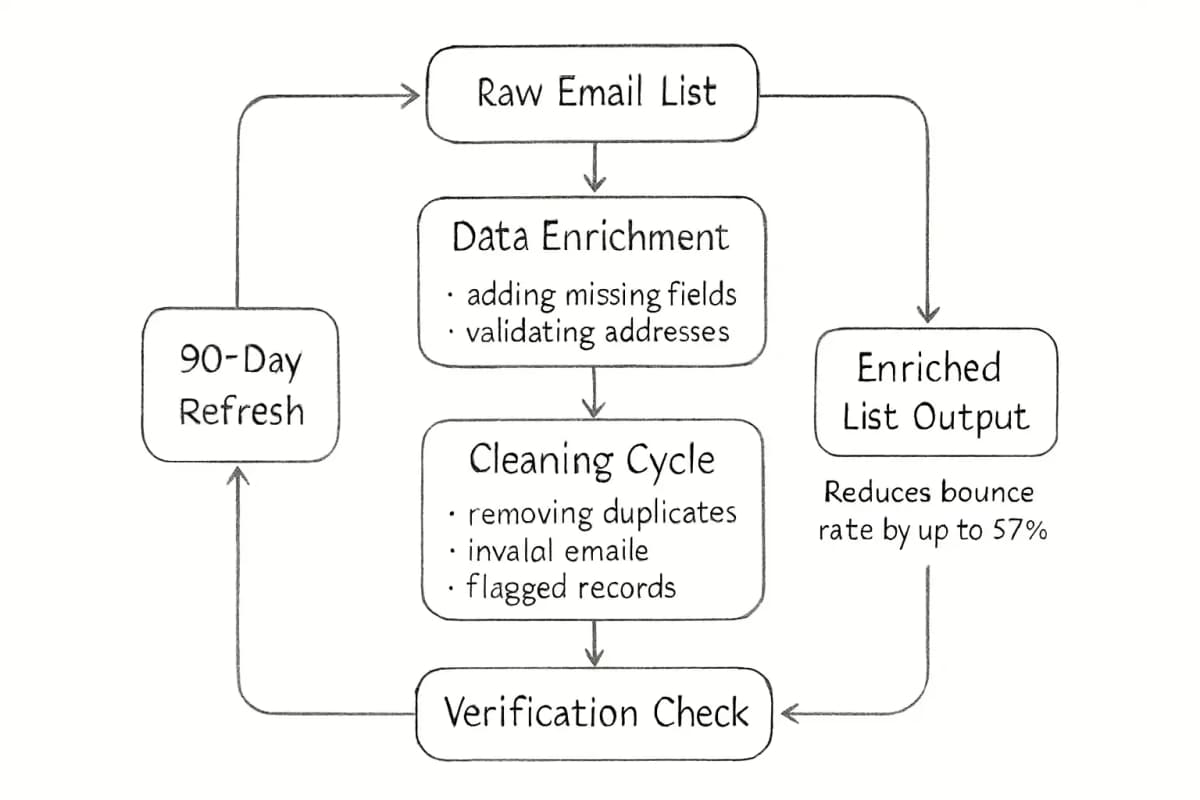
Regular list cleaning every 90 days reduces bounce rate by up to 37%. Build that into your operations calendar rather than treating it as an optional task. Email list verification and data hygiene workflow diagram showing a cyclical process. Start with raw email list, flows to data enrichment step (adding missing fields and validating addresses), then to cleaning cycle (removing duplicates, invalid emails, and flagged records), then to verification check (bounce detection and compliance validation), then back to enriched list output. Include a 90-day timer or refresh cycle indicator to emphasize the regular maintenance cadence mentioned in the article. Use arrows to show the continuous loop, with a note indicating 'Reduces bounce rate by up to 37%' at the output stage.

Compliance: What You Actually Need to Know

Using a marketing directors email list without understanding the legal framework is a risk most teams underestimate.

In the US under CAN-SPAM: Businesses do not need prior consent to send commercial emails to US recipients, which applies to B2C and B2B communications. However, all such emails must strictly adhere to the specific requirements detailed in the law. Marketers must include accurate header information, avoid deceptive subject lines, and clearly state that the message is an advertisement. They must also provide a valid physical postal address, a precise opt-out mechanism, and honor unsubscribe requests within 10 business days.

In Europe under GDPR: GDPR fully applies to B2B cold email campaigns. Under GDPR, personal data includes any information identifying an individual. When you send a cold email to john.smith@company.com, you're processing personal data because that email address identifies a specific person. You can legally send cold emails under "legitimate interest" without explicit consent if the outreach is relevant to the recipient's professional role, but transparency about data collection and easy opt-out options are mandatory in every cold email.

EU GDPR fines in 2024 totaled €4.48 billion. The regulatory environment is not theoretical. A mid-size digital services firm was hit with a compliance order just for buying a contact list from a vendor without checking if the vendor had collected the data legally in the first place. They didn't send a single deceptive email. The data sourcing alone was the violation.

The safest approach for a marketing directors email list used in outreach:

  • Use vendors that document their data sourcing and compliance posture
  • Ensure every email includes an unsubscribe mechanism and your company's physical address
  • Suppress unsubscribes immediately and propagate them across all your sending systems
  • Keep spam complaint rates below 0.3%, the threshold Gmail enforces before filtering your messages

What Makes Outreach to Marketing Directors Actually Work

Getting the email address right is the prerequisite. Getting the message right is what produces results.

Marketing directors receive a high volume of vendor outreach. Decision-makers in B2B get bombarded with unsolicited pitches, often 10 or more cold emails a week, most of which are irrelevant to them. Generic templates, vague value propositions, and obvious mass-send formatting get deleted immediately.

What breaks through:

  • Specificity. Reference something real about their company, role, or industry situation. A message that could have been sent to 10,000 people will be treated as spam by a marketing director who reviews campaigns for a living.
  • Relevance. Your offer should connect to something within the scope of a marketing director's actual job function. Budget, team tools, performance metrics, or reporting are all on the table.
  • Short copy. Emails with less than 200 words perform best in B2B, as professionals prefer concise, actionable messages.
  • A clear, single ask. Do not ask for a demo, a call, and a case study review in the same email.

Segmenting by industry vertical, company size, and marketing tech stack will significantly improve your results. B2B campaigns using advanced segmentation by role, stage, and behavior have a 78% higher click rate, and segmented emails in 2025 generate 64% more conversions compared to non-segmented sends. Our guide on email list segmentation strategies covers how to structure that in practice.

For the cold outreach subject line specifically, emails sent from named individuals, rather than generic company names, see a 27% higher open rate. Sending from a real person with a clear name and title increases perceived relevance before the email is even opened.

See our article on email subject line best practices for additional tactics that apply directly to outreach targeting senior B2B contacts.


Maintaining Your Marketing Directors Email List Over Time

A list is not a one-time asset. The teams that generate consistent pipeline from their marketing directors email list treat it as an ongoing program, not a project.

A practical maintenance framework:

  1. Verify before every send. Run your segment through an email verification tool before activating any campaign. Invalid addresses, catch-all domains, and spam traps all carry risk.
  2. Enrich quarterly. With 25 to 30% of B2B data going stale each year, enrichment should be continuous and automated to maintain CRM accuracy and sales effectiveness.
  3. Monitor deliverability metrics. The average B2B email bounce rate is 0.96%, with excellent performance falling below 0.35%. Anything above 1.62% signals list quality issues that could damage your sender reputation.
  4. Suppress disengaged contacts. Contacts who have not opened or clicked anything in 90 to 180 days should be moved to a re-engagement segment or suppressed from active sends to protect your domain reputation.
  5. Authenticate your domain. Fully authenticated domains with SPF, DKIM, and DMARC achieve 2.7 times higher likelihood of inbox placement compared to unauthenticated emails.

For deeper analysis of how your campaigns are performing against these benchmarks, see our email marketing analytics best practices guide.


Frequently Asked Questions

What filters should I use to build a targeted marketing directors email list?

Start with job title (Marketing Director, Director of Marketing, VP of Marketing, Head of Marketing), then layer in company size by employee count or revenue, industry vertical, and geography. If your product serves a specific tech stack, technographic filters available in tools like Apollo or ZoomInfo can narrow the list to contacts already using complementary or competing software. The more specific your filters, the higher your relevance and the better your response rates will be.

Is it legal to email a purchased marketing directors email list?

It depends on where the recipients are located and how the data was collected. Under the CAN-SPAM Act, businesses do not need prior consent to send commercial emails to US recipients, as long as all CAN-SPAM requirements are met. For EU-based marketing directors, GDPR applies, and you need either consent or a documented legitimate interest basis. Always verify that your data vendor collected contacts legally and can demonstrate their compliance posture. Do not assume any purchased list is automatically compliant.

How do I know if the email data I'm buying is accurate?

Request a sample before committing. Run the sample through a third-party email verification tool such as ZeroBounce, NeverBounce, or Kickbox, and check the deliverability rate of the verified addresses. Reputable vendors will have no objection to this. Ask how often records get refreshed and whether updates happen continuously or in batches. The answer matters more than database size.

How often should I clean my marketing directors email list?

At least once per quarter. High-volume senders should validate monthly. B2B contact data decays 25 to 30% annually due to job changes and company shifts, so regular cleaning is essential to keep bounce rates below 2%. In fast-moving verticals like technology, clean more frequently. A single campaign to a stale list can damage your sender domain reputation and reduce the deliverability of all future sends, including to your best contacts.


No comments yet. Be the first!

Leave a comment

Comments are reviewed before publishing.

More from

Related posts

Illustration for how to exclude segments in email marketing
Email Segmentation & TargetingMay 13, 2026 13 min

How to Exclude Segments in Email Marketing

Learn to exclude segments from campaigns to improve deliverability and engagement. Step-by-step guide for targeting the right subscribers.

MMarcus Webb
Illustration for physician email marketing list
Email Segmentation & TargetingApr 21, 2026 13 min

Physician Email Marketing List: Build & Use It

Access quality physician email lists to reach doctors directly. Learn how to build, buy, and use physician emails for compliant healthcare marketing.

MMarcus Webb
Illustration for direct email marketing lists
Email Segmentation & TargetingApr 19, 2026 11 min

Direct Email Marketing Lists: Build and Buy Quality Lists

Learn how to build, buy, and manage direct email marketing lists that drive conversions. Expert strategies for list quality, compliance, and ROI.

SSarah Mitchell
HomeBlogEmail Segmentation & TargetingMarketing Directors Email List: Build & Buy the Right Data
Email Segmentation & Targeting

Marketing Directors Email List: Build & Buy the Right Data

Find verified marketing directors email addresses for B2B outreach. Learn how to build, buy, or validate lists for higher deliverability and ROI.

J

James Chen

April 21, 2026

13 min read
Share:
#B2B Email Lists#Lead Generation#Email Deliverability#Email List Building
Illustration for marketing directors email list

Stay in the loop

Get the latest posts delivered straight to your inbox. No spam, unsubscribe anytime.

Reaching marketing directors with email is one of the highest-leverage moves in B2B outreach. These are the people who control marketing budgets, sign off on agency contracts, and evaluate new tools. Getting your message in front of them requires more than a bulk list and a generic pitch. It requires the right data, the right approach, and the discipline to maintain both.

This guide covers everything you need to know about building and buying a marketing directors email list that actually performs: where the data comes from, how to evaluate vendors, what the regulations require, and how to turn a contact record into a real conversation.

Key Takeaways

  • B2B contact data decays between 22.5% and 70.3% annually, with email decay accelerating to 3.6% monthly as of November 2024, meaning nearly three-quarters of prospect databases become outdated within 12 months. Buying a list once and sitting on it is not a strategy.
  • 94% of B2B marketers face issues with unreliable data, and outdated or poorly targeted leads result in low engagement, unnecessary expenses, and missed opportunities.
  • 1 in 6 marketing emails never reaches the inbox, getting filtered to spam or blocked outright. List quality directly drives deliverability.
  • Regulatory exposure is real. GDPR violations can result in fines up to €20 million or 4% of global annual revenue, whichever is higher. The FTC's maximum civil penalty amount for CAN-SPAM violations increased to $53,088 effective January 17, 2025.
  • B2B click-through rates are 47% higher than B2C email campaigns, and the average ROI for B2B email marketing is $46 for every $1 spent. The channel works when the list is right.

Why a Marketing Directors Email List Is Worth the Effort

Marketing directors sit at the intersection of budget and execution. They buy software, commission agencies, approve content strategies, and influence purchase decisions across their organizations. 73% of B2B marketers consider email marketing the most effective method for reaching out to prospects. Reaching marketing directors through email is often faster and more direct than social selling or paid advertising, particularly for B2B sales cycles where multiple touchpoints are required.

The average B2B email open rate sits between 15.1% and 35.63% depending on the source and industry, while B2B email marketing delivers an ROI of $36 to $46 for every $1 spent. When you combine those economics with the seniority level of a marketing director audience, the math supports investment in a properly built list.

But "properly built" is doing a lot of work in that sentence. A marketing directors email list is only valuable if the contacts are current, the emails are deliverable, and the outreach is relevant.


Build vs. Buy: What the Data Says

There is no universal answer here. Both approaches have legitimate use cases, and the better question is which method fits your timeline, team capacity, and target account profile.

Building an organic list

Organic list building takes longer but produces contacts who have shown genuine interest in your content or brand. Obtaining a list with 500 eligible, accurate, and engaged contacts will outperform an email list with 50,000 uninterested, generic recipients any time.

Common organic methods for reaching marketing directors include:

  • Gated research reports and benchmark studies (high perceived value for a senior audience)
  • Webinars with industry-relevant topics
  • Newsletter subscriptions with original insight
  • Event registrations and conference follow-ups
  • LinkedIn connection requests followed by an opt-in offer

The tradeoff is time. Building a high-quality organic list of marketing directors can take months, which is a constraint that matters if you have a product launch or sales target with a near-term deadline.

Buying or licensing list data

There are legitimate scenarios where working with B2B email list providers can be valuable. If you are conducting market research, running highly targeted account-based marketing campaigns, or need to quickly identify potential prospects for your sales team, these providers can offer useful data. The key is using B2B data lists as a research tool rather than a direct marketing channel.

The difference between brands that generate revenue from email and those that don't comes down to how email lists are built, not how large they are. This applies equally to purchased data. A smaller, more precisely filtered list of verified marketing director contacts at companies that match your ideal customer profile will outperform a massive unfiltered export every time.

The hybrid approach, using a data vendor to identify accounts and individuals, then building organic touchpoints before or alongside cold outreach, tends to deliver the best results in practice.

For guidance on structuring what you send once the list is in place, see our email marketing strategy template for a campaign framework you can adapt.


How to Evaluate B2B Email List Vendors

Not all data vendors are equal. The gap between the best and worst providers on real-world email accuracy is significant.

ZoomInfo is the 800-pound gorilla of B2B data. They have the largest and most accurate database in the market, with over 600 million professional profiles and 135 million verified phone numbers. But that comes at a steep price. In real-world testing, ZoomInfo's email accuracy is the best in the market at 90 to 93% on verified addresses.

Pricing for ZoomInfo starts at approximately $15,000 per year for the SalesOS Professional plan, and most teams end up paying $25,000 to $40,000 per year once they add the features they actually need.

Apollo is better for SMBs and teams that want an all-in-one platform at a transparent price point. ZoomInfo is better for enterprise organizations that need deeper data, advanced intent signals, and direct dial accuracy for senior decision-makers. Apollo claims 91% accuracy, but real-world bounce rates of 20 to 30% are frequently reported on G2, Reddit, and Trustpilot. Applying Apollo's own "Verified Emails" filter drops the database from 275 million to 96 million contacts, and G2 reviewers report accuracy hovering at 65 to 70% rather than the advertised 91%.

UpLead is a B2B prospecting tool with a 95% email accuracy guarantee, emphasizing clean, verified contact data with powerful filters.

When evaluating any vendor for a marketing directors email list, ask these questions before committing:

  1. How often is the data refreshed? Is it continuous or batch-updated?
  2. What is the verified email accuracy rate, with evidence from third-party tests?
  3. Can you filter specifically by job title, seniority level, industry, and company size?
  4. What is the compliance posture for GDPR and CAN-SPAM?
  5. Do they offer a sample set you can verify before purchasing?

The most critical selection factor is whether a provider actually has your ideal customers in their database. Before comparing features or pricing, document your ICP in detail: target industries, job titles, seniority levels, company size ranges, revenue thresholds, and geography.


The Data Decay Problem You Cannot Ignore

Even a verified marketing directors email list starts losing accuracy the moment you download it.

B2B contact data decays at approximately 2.1% per month, which compounds to roughly 22.5% annually. Nearly a quarter of your database could be outdated within a year, even if you started with verified information.

Marketing directors are a particularly volatile segment. They change companies, get promoted, move to consulting, or take internal transfers. Rate data shows that 15 to 20% of professionals change jobs annually, with average tenure at a company dropping to 4.1 years according to the Bureau of Labor Statistics.

Poor data quality costs companies an average of $12.9 million annually and leads to wasted outreach efforts, missed opportunities, and compliance risks.

The practical implication: a one-time list purchase is not an asset, it is a depreciating liability. You need to either work with a provider that offers real-time enrichment or commit to a regular data hygiene process.

Regular list cleaning every 90 days reduces bounce rate by up to 37%. Build that into your operations calendar rather than treating it as an optional task. Email list verification and data hygiene workflow diagram showing a cyclical process. Start with raw email list, flows to data enrichment step (adding missing fields and validating addresses), then to cleaning cycle (removing duplicates, invalid emails, and flagged records), then to verification check (bounce detection and compliance validation), then back to enriched list output. Include a 90-day timer or refresh cycle indicator to emphasize the regular maintenance cadence mentioned in the article. Use arrows to show the continuous loop, with a note indicating 'Reduces bounce rate by up to 37%' at the output stage.


Compliance: What You Actually Need to Know

Using a marketing directors email list without understanding the legal framework is a risk most teams underestimate.

In the US under CAN-SPAM: Businesses do not need prior consent to send commercial emails to US recipients, which applies to B2C and B2B communications. However, all such emails must strictly adhere to the specific requirements detailed in the law. Marketers must include accurate header information, avoid deceptive subject lines, and clearly state that the message is an advertisement. They must also provide a valid physical postal address, a precise opt-out mechanism, and honor unsubscribe requests within 10 business days.

In Europe under GDPR: GDPR fully applies to B2B cold email campaigns. Under GDPR, personal data includes any information identifying an individual. When you send a cold email to john.smith@company.com, you're processing personal data because that email address identifies a specific person. You can legally send cold emails under "legitimate interest" without explicit consent if the outreach is relevant to the recipient's professional role, but transparency about data collection and easy opt-out options are mandatory in every cold email.

EU GDPR fines in 2024 totaled €4.48 billion. The regulatory environment is not theoretical. A mid-size digital services firm was hit with a compliance order just for buying a contact list from a vendor without checking if the vendor had collected the data legally in the first place. They didn't send a single deceptive email. The data sourcing alone was the violation.

The safest approach for a marketing directors email list used in outreach:

  • Use vendors that document their data sourcing and compliance posture
  • Ensure every email includes an unsubscribe mechanism and your company's physical address
  • Suppress unsubscribes immediately and propagate them across all your sending systems
  • Keep spam complaint rates below 0.3%, the threshold Gmail enforces before filtering your messages

What Makes Outreach to Marketing Directors Actually Work

Getting the email address right is the prerequisite. Getting the message right is what produces results.

Marketing directors receive a high volume of vendor outreach. Decision-makers in B2B get bombarded with unsolicited pitches, often 10 or more cold emails a week, most of which are irrelevant to them. Generic templates, vague value propositions, and obvious mass-send formatting get deleted immediately.

What breaks through:

  • Specificity. Reference something real about their company, role, or industry situation. A message that could have been sent to 10,000 people will be treated as spam by a marketing director who reviews campaigns for a living.
  • Relevance. Your offer should connect to something within the scope of a marketing director's actual job function. Budget, team tools, performance metrics, or reporting are all on the table.
  • Short copy. Emails with less than 200 words perform best in B2B, as professionals prefer concise, actionable messages.
  • A clear, single ask. Do not ask for a demo, a call, and a case study review in the same email.

Segmenting by industry vertical, company size, and marketing tech stack will significantly improve your results. B2B campaigns using advanced segmentation by role, stage, and behavior have a 78% higher click rate, and segmented emails in 2025 generate 64% more conversions compared to non-segmented sends. Our guide on email list segmentation strategies covers how to structure that in practice.

For the cold outreach subject line specifically, emails sent from named individuals, rather than generic company names, see a 27% higher open rate. Sending from a real person with a clear name and title increases perceived relevance before the email is even opened.

See our article on email subject line best practices for additional tactics that apply directly to outreach targeting senior B2B contacts.


Maintaining Your Marketing Directors Email List Over Time

A list is not a one-time asset. The teams that generate consistent pipeline from their marketing directors email list treat it as an ongoing program, not a project.

A practical maintenance framework:

  1. Verify before every send. Run your segment through an email verification tool before activating any campaign. Invalid addresses, catch-all domains, and spam traps all carry risk.
  2. Enrich quarterly. With 25 to 30% of B2B data going stale each year, enrichment should be continuous and automated to maintain CRM accuracy and sales effectiveness.
  3. Monitor deliverability metrics. The average B2B email bounce rate is 0.96%, with excellent performance falling below 0.35%. Anything above 1.62% signals list quality issues that could damage your sender reputation.
  4. Suppress disengaged contacts. Contacts who have not opened or clicked anything in 90 to 180 days should be moved to a re-engagement segment or suppressed from active sends to protect your domain reputation.
  5. Authenticate your domain. Fully authenticated domains with SPF, DKIM, and DMARC achieve 2.7 times higher likelihood of inbox placement compared to unauthenticated emails.

For deeper analysis of how your campaigns are performing against these benchmarks, see our email marketing analytics best practices guide.


Frequently Asked Questions

What filters should I use to build a targeted marketing directors email list?

Start with job title (Marketing Director, Director of Marketing, VP of Marketing, Head of Marketing), then layer in company size by employee count or revenue, industry vertical, and geography. If your product serves a specific tech stack, technographic filters available in tools like Apollo or ZoomInfo can narrow the list to contacts already using complementary or competing software. The more specific your filters, the higher your relevance and the better your response rates will be.

Is it legal to email a purchased marketing directors email list?

It depends on where the recipients are located and how the data was collected. Under the CAN-SPAM Act, businesses do not need prior consent to send commercial emails to US recipients, as long as all CAN-SPAM requirements are met. For EU-based marketing directors, GDPR applies, and you need either consent or a documented legitimate interest basis. Always verify that your data vendor collected contacts legally and can demonstrate their compliance posture. Do not assume any purchased list is automatically compliant.

How do I know if the email data I'm buying is accurate?

Request a sample before committing. Run the sample through a third-party email verification tool such as ZeroBounce, NeverBounce, or Kickbox, and check the deliverability rate of the verified addresses. Reputable vendors will have no objection to this. Ask how often records get refreshed and whether updates happen continuously or in batches. The answer matters more than database size.

How often should I clean my marketing directors email list?

At least once per quarter. High-volume senders should validate monthly. B2B contact data decays 25 to 30% annually due to job changes and company shifts, so regular cleaning is essential to keep bounce rates below 2%. In fast-moving verticals like technology, clean more frequently. A single campaign to a stale list can damage your sender domain reputation and reduce the deliverability of all future sends, including to your best contacts.

No comments yet. Be the first!

Leave a comment

Comments are reviewed before publishing.

More from

Related posts

Illustration for how to exclude segments in email marketing
Email Segmentation & TargetingMay 13, 2026 13 min

How to Exclude Segments in Email Marketing

Learn to exclude segments from campaigns to improve deliverability and engagement. Step-by-step guide for targeting the right subscribers.

MMarcus Webb
Illustration for physician email marketing list
Email Segmentation & TargetingApr 21, 2026 13 min

Physician Email Marketing List: Build & Use It

Access quality physician email lists to reach doctors directly. Learn how to build, buy, and use physician emails for compliant healthcare marketing.

MMarcus Webb
Illustration for direct email marketing lists
Email Segmentation & TargetingApr 19, 2026 11 min

Direct Email Marketing Lists: Build and Buy Quality Lists

Learn how to build, buy, and manage direct email marketing lists that drive conversions. Expert strategies for list quality, compliance, and ROI.

SSarah Mitchell