
HomeBlogCompliance & Best PracticesPrivacy Concerns in AI Email Marketing: What You Need to Know
Compliance & Best Practices

Privacy Concerns in AI Email Marketing: What You Need to Know

Explore key privacy risks in AI-powered email marketing, GDPR compliance challenges, and practical steps to protect customer data while scaling campaigns.

P

Priya Kapoor

July 17, 2026

HomeBlogCompliance & Best PracticesPrivacy Concerns in AI Email Marketing: What You Need to Know
Compliance & Best Practices

Privacy Concerns in AI Email Marketing: What You Need to Know

Explore key privacy risks in AI-powered email marketing, GDPR compliance challenges, and practical steps to protect customer data while scaling campaigns.

P

Priya Kapoor

July 17, 2026

11 min read
11 min read
Share:
Share:
#AI Email Marketing#Data Privacy#GDPR Compliance#Email Security
Illustration for privacy concerns ai email marketing

Stay in the loop

Get the latest posts delivered straight to your inbox. No spam, unsubscribe anytime.

AI-powered email marketing tools can dramatically improve campaign performance, but they come with real privacy risks that most marketing teams underestimate. A 2023 Deloitte report found that 64% of consumers are more likely to engage with brands that provide personalized experiences, yet 75% are concerned about data misuse. That tension sits at the heart of every privacy concern in AI email marketing today. If you use AI to personalize, segment, or automate your email campaigns, here is what you need to understand before your next send.

Key Takeaways

  • According to Gartner, 40% of organizations have reported AI-related breaches, and IBM highlights that 46% of these breaches involve personally identifiable information (PII), with the global average data breach cost reaching $4.88 million in 2024.
  • According to the Cisco 2025 Data Privacy Benchmark Study, 94% of organizations say customers will not buy from them if data is not properly protected.
  • The GDPR has led to fines totaling over €1.7 billion since its inception, underscoring the financial risks of non-compliance.
  • Organizations that invest in privacy infrastructure see 1.6x higher revenue compared to those that treat privacy as an afterthought.
  • The intersection of AI and privacy is no longer a mere regulatory requirement; it has evolved into an organization's strategic imperative.

Why Privacy Concerns in AI Email Marketing Are Growing Fast

AI email marketing tools rely on something most marketers take for granted: access to subscriber data. Behavioral tracking, purchase history, browsing patterns, and engagement signals all feed the personalization engines that make AI-powered campaigns effective. The more data flows in, the sharper the targeting gets. But that same data flow is exactly what privacy regulators and consumers are scrutinizing.

One reason AI poses a greater data privacy risk than earlier technologies is the sheer volume of information in play. Terabytes of text, images, and other data are routinely included in AI training sets, and inevitably some of that data is sensitive. With more sensitive data being collected, stored, and transmitted than ever before, the odds are greater that some of it will be exposed in ways that infringe on privacy rights.

The explosive growth of AI necessitates careful navigation of the evolving legal and privacy landscape. 2024 marked a pivotal moment in global regulation as transformative legislation concerning privacy, artificial intelligence, and cybersecurity commenced a significant overhaul of the compliance landscape.

Stay in the loop

Get the latest posts delivered straight to your inbox. No spam, unsubscribe anytime.

AI-powered email marketing tools can dramatically improve campaign performance, but they come with real privacy risks that most marketing teams underestimate. A 2023 Deloitte report found that 64% of consumers are more likely to engage with brands that provide personalized experiences, yet 75% are concerned about data misuse. That tension sits at the heart of every privacy concern in AI email marketing today. If you use AI to personalize, segment, or automate your email campaigns, here is what you need to understand before your next send.

Key Takeaways

  • According to Gartner, 40% of organizations have reported AI-related breaches, and IBM highlights that 46% of these breaches involve personally identifiable information (PII), with the global average data breach cost reaching $4.88 million in 2024.
  • According to the Cisco 2025 Data Privacy Benchmark Study, 94% of organizations say customers will not buy from them if data is not properly protected.
  • The GDPR has led to fines totaling over €1.7 billion since its inception, underscoring the financial risks of non-compliance.
  • Organizations that invest in privacy infrastructure see 1.6x higher revenue compared to those that treat privacy as an afterthought.
  • The intersection of AI and privacy is no longer a mere regulatory requirement; it has evolved into an organization's strategic imperative.

Why Privacy Concerns in AI Email Marketing Are Growing Fast

AI email marketing tools rely on something most marketers take for granted: access to subscriber data. Behavioral tracking, purchase history, browsing patterns, and engagement signals all feed the personalization engines that make AI-powered campaigns effective. The more data flows in, the sharper the targeting gets. But that same data flow is exactly what privacy regulators and consumers are scrutinizing.

One reason AI poses a greater data privacy risk than earlier technologies is the sheer volume of information in play. Terabytes of text, images, and other data are routinely included in AI training sets, and inevitably some of that data is sensitive. With more sensitive data being collected, stored, and transmitted than ever before, the odds are greater that some of it will be exposed in ways that infringe on privacy rights.

The explosive growth of AI necessitates careful navigation of the evolving legal and privacy landscape. 2024 marked a pivotal moment in global regulation as transformative legislation concerning privacy, artificial intelligence, and cybersecurity commenced a significant overhaul of the compliance landscape.

For marketers, this is not an abstract concern. It translates directly into fines, deliverability problems, and subscriber trust erosion.


The Specific Privacy Risks AI Introduces to Email Marketing

Not all privacy risks are equal. AI creates a distinct category of exposure that standard email compliance programs were not designed to catch.

Third-Party Data Transfers

When you integrate AI services from external providers, you are typically sharing customer data in ways that constitute transfers, which require explicit consent under many privacy laws. Many businesses do not realize this until it is too late. For example, when a marketing team implements an AI-powered email personalization tool, customer names, purchase histories, and behavioral data flow to the provider's servers for processing. Unknowingly, the team may have just created a cross-border data transfer that increases GDPR compliance risk due to classification as high-risk processing.

Over-Personalization and Profiling

AI tools often rely on large datasets to generate personalized email content. If these datasets include personal information without explicit consent, marketers may inadvertently violate GDPR, CASL, or CCPA. While improved engagement is the goal, over-personalization may cross into unauthorized profiling, triggering legal concerns under GDPR's strict rules on automated decision-making and data usage.

AI-Generated Content and Hallucinations

AI hallucinations heighten privacy concerns when incorrect outputs reference personal data or sensitive information, underscoring the growing need for stronger data privacy and AI oversight in automated decision-making. An AI drafting personalized email copy can inadvertently surface details subscribers never provided, creating serious exposure if those details are incorrect or sensitive.

Consent Gaps in AI Training Data

AI tools often rely on large datasets to generate personalized email content. If these datasets include personal information without explicit consent, marketers may inadvertently violate GDPR, CASL, or CCPA. Using a third-party AI tool does not transfer liability to the vendor. Your organization remains responsible for how subscriber data is processed.


The Regulatory Framework You Need to Know

Privacy concerns in AI email marketing are not just ethical questions. They carry concrete legal consequences. The laws that cover most global email marketing are CAN-SPAM (US), GDPR (EU/EEA), CASL (Canada), and CCPA/CPRA (California).

Which laws apply to you comes down entirely to where your subscribers live, not where your business is registered. A US company emailing EU subscribers must comply with GDPR for those contacts.

GDPR is the most demanding. GDPR demands explicit, freely given consent before sending marketing emails to EU residents, and subscribers have the right to request complete data erasure at any time. Maximum GDPR fines can reach €20 million or 4% of global annual turnover, whichever is higher.

For marketers, this is not an abstract concern. It translates directly into fines, deliverability problems, and subscriber trust erosion.


The Specific Privacy Risks AI Introduces to Email Marketing

Not all privacy risks are equal. AI creates a distinct category of exposure that standard email compliance programs were not designed to catch.

Third-Party Data Transfers

When you integrate AI services from external providers, you are typically sharing customer data in ways that constitute transfers, which require explicit consent under many privacy laws. Many businesses do not realize this until it is too late. For example, when a marketing team implements an AI-powered email personalization tool, customer names, purchase histories, and behavioral data flow to the provider's servers for processing. Unknowingly, the team may have just created a cross-border data transfer that increases GDPR compliance risk due to classification as high-risk processing.

Over-Personalization and Profiling

AI tools often rely on large datasets to generate personalized email content. If these datasets include personal information without explicit consent, marketers may inadvertently violate GDPR, CASL, or CCPA. While improved engagement is the goal, over-personalization may cross into unauthorized profiling, triggering legal concerns under GDPR's strict rules on automated decision-making and data usage.

AI-Generated Content and Hallucinations

AI hallucinations heighten privacy concerns when incorrect outputs reference personal data or sensitive information, underscoring the growing need for stronger data privacy and AI oversight in automated decision-making. An AI drafting personalized email copy can inadvertently surface details subscribers never provided, creating serious exposure if those details are incorrect or sensitive.

Consent Gaps in AI Training Data

AI tools often rely on large datasets to generate personalized email content. If these datasets include personal information without explicit consent, marketers may inadvertently violate GDPR, CASL, or CCPA. Using a third-party AI tool does not transfer liability to the vendor. Your organization remains responsible for how subscriber data is processed.


The Regulatory Framework You Need to Know

Privacy concerns in AI email marketing are not just ethical questions. They carry concrete legal consequences. The laws that cover most global email marketing are CAN-SPAM (US), GDPR (EU/EEA), CASL (Canada), and CCPA/CPRA (California).

Which laws apply to you comes down entirely to where your subscribers live, not where your business is registered. A US company emailing EU subscribers must comply with GDPR for those contacts.

GDPR is the most demanding. GDPR demands explicit, freely given consent before sending marketing emails to EU residents, and subscribers have the right to request complete data erasure at any time. Maximum GDPR fines can reach €20 million or 4% of global annual turnover, whichever is higher.

CCPA/CPRA takes a different approach. GDPR requires affirmative opt-in consent before sending marketing emails to EU residents. CCPA, in contrast, allows opt-out mechanisms: you can send marketing emails to California residents but must provide clear ways for them to opt out and honor those requests promptly.

The EU AI Act adds a new layer specifically targeting AI applications. For outbound campaigns, the EU AI Act may require disclosure that the content is AI-generated, depending on how the final rules are interpreted for B2B communications. The EU AI Act is the world's first comprehensive AI regulation. It was adopted in 2024, and enforcement begins in phases. Fines under the EU AI Act can reach €35 million or 7% of global annual revenue for prohibited AI uses.

The FTC has warned businesses that merely updating privacy policies is insufficient: organizations must actively notify and gain consent before using personal data for AI.

For a deeper look at how AI tools interact with email strategy more broadly, see our guide on AI email marketing personalization techniques.


The Most Common Compliance Mistakes AI-Powered Teams Make

Most AI data privacy violations in outbound email marketing are not malicious. They come from teams that scaled faster than their compliance processes could keep up.

The most common AI marketing compliance violations include: missing consent capture on EU prospects in AI-personalized outreach, missing CCPA opt-out for California prospects, AI-generated content without disclosure under the EU AI Act, missing unsubscribe links in AI-drafted email sequences, and personalization referencing sensitive data without proper lawful basis.

Under GDPR and CCPA, failing to respond to a consumer's request for their data within the mandated timeframe (30 days for GDPR, 45 days for CCPA) is itself a violation, separate from any underlying data handling issues.

One particularly overlooked risk: tracking pixels. The IP address is the key legal trigger in email tracking. Because it identifies a specific individual or organization, it meets the GDPR and CCPA definitions of personally identifiable information. Any system that collects IP addresses from email opens is processing personal data and requires a lawful basis.

If your AI-powered campaign relies on open-rate data for segmentation or behavioral triggers, you likely have a documented legal basis requirement you have not met.


How to Build a Privacy-First AI Email Marketing Program

Compliance does not have to mean worse campaigns. According to McKinsey, businesses that adopt advanced AI-based data anonymization see a 30% improvement in personalization accuracy while maintaining privacy. The following steps give you a practical foundation.

CCPA/CPRA takes a different approach. GDPR requires affirmative opt-in consent before sending marketing emails to EU residents. CCPA, in contrast, allows opt-out mechanisms: you can send marketing emails to California residents but must provide clear ways for them to opt out and honor those requests promptly.

The EU AI Act adds a new layer specifically targeting AI applications. For outbound campaigns, the EU AI Act may require disclosure that the content is AI-generated, depending on how the final rules are interpreted for B2B communications. The EU AI Act is the world's first comprehensive AI regulation. It was adopted in 2024, and enforcement begins in phases. Fines under the EU AI Act can reach €35 million or 7% of global annual revenue for prohibited AI uses.

The FTC has warned businesses that merely updating privacy policies is insufficient: organizations must actively notify and gain consent before using personal data for AI.

For a deeper look at how AI tools interact with email strategy more broadly, see our guide on AI email marketing personalization techniques.


The Most Common Compliance Mistakes AI-Powered Teams Make

Most AI data privacy violations in outbound email marketing are not malicious. They come from teams that scaled faster than their compliance processes could keep up.

The most common AI marketing compliance violations include: missing consent capture on EU prospects in AI-personalized outreach, missing CCPA opt-out for California prospects, AI-generated content without disclosure under the EU AI Act, missing unsubscribe links in AI-drafted email sequences, and personalization referencing sensitive data without proper lawful basis.

Under GDPR and CCPA, failing to respond to a consumer's request for their data within the mandated timeframe (30 days for GDPR, 45 days for CCPA) is itself a violation, separate from any underlying data handling issues.

One particularly overlooked risk: tracking pixels. The IP address is the key legal trigger in email tracking. Because it identifies a specific individual or organization, it meets the GDPR and CCPA definitions of personally identifiable information. Any system that collects IP addresses from email opens is processing personal data and requires a lawful basis.

If your AI-powered campaign relies on open-rate data for segmentation or behavioral triggers, you likely have a documented legal basis requirement you have not met.


How to Build a Privacy-First AI Email Marketing Program

Compliance does not have to mean worse campaigns. According to McKinsey, businesses that adopt advanced AI-based data anonymization see a 30% improvement in personalization accuracy while maintaining privacy. The following steps give you a practical foundation.

  1. Audit your data inputs. Before deploying any AI personalization tool, map exactly what subscriber data flows to external servers. GDPR and CCPA both demand that you collect only what you need and document where every record came from. Data minimization protects you in two ways: it reduces compliance exposure when a contact requests deletion, and it improves deliverability by keeping your database lean and verifiable.
  2. Use double opt-in as your default. Collect data responsibly. Use clear, documented consent methods like double opt-in to ensure you have verifiable proof of permission.
  3. Sign Data Processing Agreements with every AI vendor. Tools that process your contact data on your behalf and under your instructions are data processors under GDPR, which means you need a signed Data Processing Agreement with each vendor before uploading any contact data.
  4. Disclose AI use where required. Industry guidance on the EU AI Act is still being finalized, but the safe approach is to ensure AI-generated emails are reviewed by a human before sending.
  5. Build consent expiry tracking. Most ESPs do not flag this. Building a workflow to track expiring consent windows is one of the most overlooked compliance tasks in email marketing.
  6. Automate suppression and deletion workflows. If you are holding years of inactive customer data without a stated purpose, you are likely non-compliant. Document your retention policies and automate deletion.
  1. Audit your data inputs. Before deploying any AI personalization tool, map exactly what subscriber data flows to external servers. GDPR and CCPA both demand that you collect only what you need and document where every record came from. Data minimization protects you in two ways: it reduces compliance exposure when a contact requests deletion, and it improves deliverability by keeping your database lean and verifiable.
  2. Use double opt-in as your default. Collect data responsibly. Use clear, documented consent methods like double opt-in to ensure you have verifiable proof of permission.
  3. Sign Data Processing Agreements with every AI vendor. Tools that process your contact data on your behalf and under your instructions are data processors under GDPR, which means you need a signed Data Processing Agreement with each vendor before uploading any contact data.
  4. Disclose AI use where required. Industry guidance on the EU AI Act is still being finalized, but the safe approach is to ensure AI-generated emails are reviewed by a human before sending.
  5. Build consent expiry tracking. Most ESPs do not flag this. Building a workflow to track expiring consent windows is one of the most overlooked compliance tasks in email marketing.
  6. Automate suppression and deletion workflows. If you are holding years of inactive customer data without a stated purpose, you are likely non-compliant. Document your retention policies and automate deletion.

The Trust Dividend: Why Privacy Compliance Is Good Marketing

There is a measurable business case for privacy-first AI email marketing that goes beyond avoiding fines.

According to Salesforce, 92% of consumers are more likely to trust brands that clearly explain how their data is used. Trust translates directly into open rates, click rates, and conversions. A subscriber who understands exactly how their data is used is more likely to engage, less likely to mark your email as spam, and more likely to stay subscribed.

The combined effect of privacy challenges on economic growth is significant, since they reduce customer trust, discourage investment in AI technology, and require governmental actions to protect data privacy. The inverse is also true: brands that get privacy right earn a durable competitive advantage.

Beyond 2025, organizational success will increasingly belong to enterprises that perceive governance not as a barrier but as a catalyst for growth. By transforming regulatory challenges into opportunities, they will invest in sustainable innovation by building trust, credibility, and resilience.

This connects directly to email list segmentation strategies, where consent-verified, well-documented subscriber data produces significantly better targeting precision than scraped or loosely acquired lists.


What to Watch: The Regulatory Developments Shaping 2025 and 2026

The regulatory environment is moving quickly. Four states in the US implemented new privacy laws effective January 1, 2025. In 2025, California, Colorado, and Texas worked to implement new laws expressly addressing AI systems.

AI regulations are tightening in 2026, with the EU AI Act and the Colorado AI Act leading the way. These regulations demand detailed disclosures about how AI models work, why systems make certain marketing decisions, and which consumer data is collected or processed. Breaches of these guidelines can result in heavy fines, reputational damage, or the loss of customer trust.

For teams already using AI to build and send campaigns, our guide on how to leverage AI in your email marketing covers the strategic side, while this post covers the compliance boundaries you must stay within.

The core principle across all jurisdictions is the same: collect the minimum data you need, document your legal basis clearly, give subscribers real control, and keep humans in the review loop when AI generates the content.


The Trust Dividend: Why Privacy Compliance Is Good Marketing

There is a measurable business case for privacy-first AI email marketing that goes beyond avoiding fines.

According to Salesforce, 92% of consumers are more likely to trust brands that clearly explain how their data is used. Trust translates directly into open rates, click rates, and conversions. A subscriber who understands exactly how their data is used is more likely to engage, less likely to mark your email as spam, and more likely to stay subscribed.

The combined effect of privacy challenges on economic growth is significant, since they reduce customer trust, discourage investment in AI technology, and require governmental actions to protect data privacy. The inverse is also true: brands that get privacy right earn a durable competitive advantage.

Beyond 2025, organizational success will increasingly belong to enterprises that perceive governance not as a barrier but as a catalyst for growth. By transforming regulatory challenges into opportunities, they will invest in sustainable innovation by building trust, credibility, and resilience.

This connects directly to email list segmentation strategies, where consent-verified, well-documented subscriber data produces significantly better targeting precision than scraped or loosely acquired lists.


What to Watch: The Regulatory Developments Shaping 2025 and 2026

The regulatory environment is moving quickly. Four states in the US implemented new privacy laws effective January 1, 2025. In 2025, California, Colorado, and Texas worked to implement new laws expressly addressing AI systems.

AI regulations are tightening in 2026, with the EU AI Act and the Colorado AI Act leading the way. These regulations demand detailed disclosures about how AI models work, why systems make certain marketing decisions, and which consumer data is collected or processed. Breaches of these guidelines can result in heavy fines, reputational damage, or the loss of customer trust.

For teams already using AI to build and send campaigns, our guide on how to leverage AI in your email marketing covers the strategic side, while this post covers the compliance boundaries you must stay within.

The core principle across all jurisdictions is the same: collect the minimum data you need, document your legal basis clearly, give subscribers real control, and keep humans in the review loop when AI generates the content.


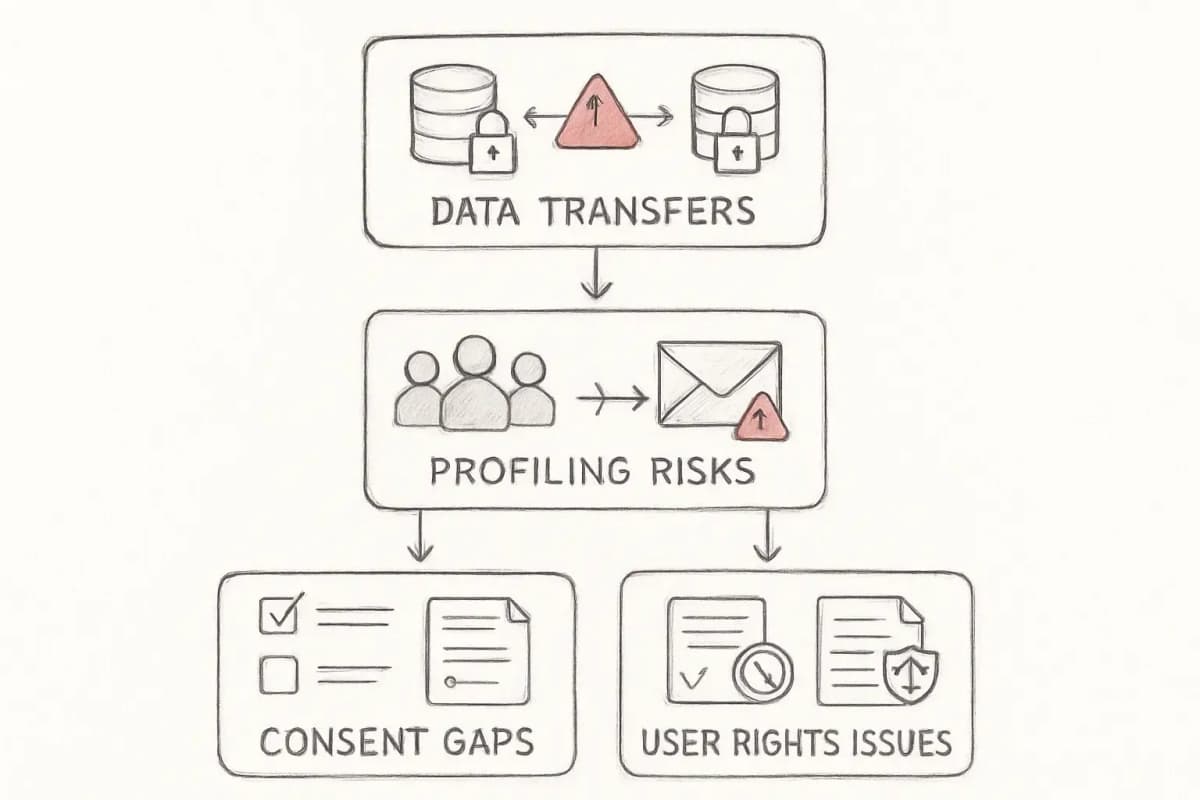
A visual hierarchy diagram showing three main privacy risks in AI email marketing. Top box: 'Data Transfers and Storage' showing data flowing between systems with lock icons and warning signs. Middle box: 'Profiling and Automated Decision-Making' depicting subscriber segments being created and decisions being made without human review. Bottom box: 'Consent and User Rights Gaps' showing checkboxes, consent forms, and blockers representing lack of meaningful consent and difficulty enforcing data subject rights. Each risk area connects downward with arrows to show escalation of concern. Include icons for data, people, and legal documents. Use red accent colors for warning elements.


Frequently Asked Questions

What are the main privacy concerns in AI email marketing?

AI data privacy concerns in email marketing include lack of meaningful consent, excessive data collection, automated decision-making without transparency, and difficulty enforcing user rights like data deletion in AI systems. Third-party data transfers to AI vendors and over-personalization that crosses into unauthorized profiling are two of the most common issues marketing teams overlook.

Does using AI to write marketing emails create legal risk?

AI-written emails are legal. The compliance risk lies in how subscriber data powers the personalization. Under the EU AI Act, if you use AI to write emails, disclosure that the content is AI-generated may be required, depending on how final rules are interpreted. The regulation targets content that could be "mistaken for human-generated."

How do GDPR and CCPA differ for AI-powered email campaigns?

GDPR and CCPA take fundamentally different approaches. GDPR requires affirmative opt-in consent before sending marketing emails to EU residents. CCPA allows opt-out mechanisms: you can send marketing emails to California residents but must provide clear ways for them to opt out and honor those requests promptly. Both laws apply based on where your subscribers are located, not where your business operates.

What happens if an AI vendor I use has a data breach involving my subscriber data?

If a third-party model is trained on customer data without clear consent or strong contracts, the organization, not just the vendor, could be liable for the breach. This is why signed Data Processing Agreements and thorough vendor audits are mandatory, not optional, before connecting any AI tool to your email subscriber database.


A visual hierarchy diagram showing three main privacy risks in AI email marketing. Top box: 'Data Transfers and Storage' showing data flowing between systems with lock icons and warning signs. Middle box: 'Profiling and Automated Decision-Making' depicting subscriber segments being created and decisions being made without human review. Bottom box: 'Consent and User Rights Gaps' showing checkboxes, consent forms, and blockers representing lack of meaningful consent and difficulty enforcing data subject rights. Each risk area connects downward with arrows to show escalation of concern. Include icons for data, people, and legal documents. Use red accent colors for warning elements.


Frequently Asked Questions

What are the main privacy concerns in AI email marketing?

AI data privacy concerns in email marketing include lack of meaningful consent, excessive data collection, automated decision-making without transparency, and difficulty enforcing user rights like data deletion in AI systems. Third-party data transfers to AI vendors and over-personalization that crosses into unauthorized profiling are two of the most common issues marketing teams overlook.

Does using AI to write marketing emails create legal risk?

AI-written emails are legal. The compliance risk lies in how subscriber data powers the personalization. Under the EU AI Act, if you use AI to write emails, disclosure that the content is AI-generated may be required, depending on how final rules are interpreted. The regulation targets content that could be "mistaken for human-generated."

How do GDPR and CCPA differ for AI-powered email campaigns?

GDPR and CCPA take fundamentally different approaches. GDPR requires affirmative opt-in consent before sending marketing emails to EU residents. CCPA allows opt-out mechanisms: you can send marketing emails to California residents but must provide clear ways for them to opt out and honor those requests promptly. Both laws apply based on where your subscribers are located, not where your business operates.

What happens if an AI vendor I use has a data breach involving my subscriber data?

If a third-party model is trained on customer data without clear consent or strong contracts, the organization, not just the vendor, could be liable for the breach. This is why signed Data Processing Agreements and thorough vendor audits are mandatory, not optional, before connecting any AI tool to your email subscriber database.

No comments yet. Be the first!

Leave a comment

Comments are reviewed before publishing.

No comments yet. Be the first!

Leave a comment

Comments are reviewed before publishing.