
If your growth team has been piecing together email workflows with manual processes, spreadsheets, and point-and-click platforms, a python SDK for email marketing automation is likely the most direct path to campaigns that scale without scaling your headcount. Python gives you programmatic control over every layer of your email stack: list management, template rendering, send logic, behavioral triggers, and campaign analytics. This article explains what that looks like in practice, which SDKs to use, and what results you can realistically expect.
Key Takeaways
- Automated emails make up just 2% of email sends but drove 37% of all email-generated sales in 2024, revealing why automation is the highest-leverage investment in your email program.
- Email marketing ROI typically ranges from 10:1 to 36:1 for most organizations, with top-performing programs exceeding 50:1.
- The best email APIs for Python developers include Mailtrap, Mailgun, SendGrid, Amazon SES, and Postmark, each serving different technical and business needs.
- Python's built-in
smtplibandemail.mimelibraries handle basic automation without any extra packages, while third-party SDKs likesendgrid-pythonandmailchimp-marketingunlock deliverability infrastructure, subscriber management, and analytics at scale. - Marketing automation saves companies 6 or more hours per week on routine tasks, which compounds into hundreds of recovered hours annually per team member.
Why Python for Email Marketing Automation
Python can help simplify and automate many aspects of email marketing. Its rich library ecosystem and straightforward syntax make it a great language to automate repetitive tasks, making your email marketing more efficient and effective.
That is the core case. Beyond syntax simplicity, Python integrates directly with data sources. You can pull subscriber data from a CRM, a CSV file, or a database, apply segmentation logic in code, render personalized HTML templates, and send through any major email service provider, all inside one script.
About 62% of businesses saw improved ROI after implementing AI-driven marketing tools. Many of these solutions are built with Python. The language sits at the intersection of data science, automation, and web development, which is exactly where modern email marketing lives.
Today, 63% of companies automate email marketing, and in B2B that figure rises to 71%. Triggered emails now drive 75% of all email revenue. If you are not building triggered, automated flows, you are leaving the majority of email revenue potential untouched.
Python's Built-in Email Libraries: The Starting Point
Before reaching for a third-party SDK, understand what Python ships with natively.
The email and smtplib modules belong to Python's standard library, so no installation is required. These two modules handle the majority of foundational email sending tasks:
smtplib: Manages SMTP connections and message deliveryemail.mime: Constructs multipart messages with HTML, plain text, and attachments
Here is a minimal working example:
import smtplib
from email.mime.multipart import MIMEMultipart
from email.mime.text import MIMEText

def send_email(to_address, subject, html_body, sender, password):
    msg = MIMEMultipart("alternative")
    msg["Subject"] = subject
    msg["From"] = sender
    msg["To"] = to_address
    msg.attach(MIMEText(html_body, "html"))

with smtplib.SMTP("smtp.gmail.com", 587) as server:
        server.starttls()
        server.login(sender, password)
        server.send_message(msg)
To send emails at scale with dynamic content, you can combine smtplib with Jinja2. This protocol determines how to format, send, and encrypt your emails between the source and destination mail servers.
Jinja2 templates let you inject subscriber-specific variables into HTML before sending. A Python script using Jinja2 creates personalized emails by merging data from a template with recipient details. It establishes a connection to an SMTP server, iterates over a list of recipients, generates customized emails, and sends them.
The limitation of native smtplib is deliverability. Sending from your own SMTP credentials at volume damages sender reputation, triggers spam filters, and lacks bounce handling, unsubscribe processing, and analytics. That is where purpose-built SDKs take over.
Top Python SDKs for Email Marketing Automation
SendGrid Python SDK
SendGrid provides official SDKs for multiple languages including Java, Python, Node.js, PHP, Ruby, C#, and Go, along with ready-to-use integrations with third-party plugins and CRM systems.
Install it with pip install sendgrid. The SDK wraps SendGrid's Web API v3 and gives you programmatic access to transactional sends, marketing campaigns, list management, and event webhooks.
SendGrid has evolved into a full marketing platform with campaigns, automation, and visual editors. For teams that need both developer API access and a marketing-facing campaign builder, this dual-mode architecture is a practical fit.
SendGrid delivers more than 80 billion emails monthly to users including Uber, Spotify, and Airbnb.
Mailgun Python SDK
Mailgun is a set of powerful APIs that enables you to send, receive, and track emails. It uses SMTP to handle transactional emails, and its flexible pricing model makes it more appealing for developer use.
Mailgun excels in bulk validation, list health checks, and send time optimization. It also provides customizable suppression rules and bounce classification using machine learning to improve deliverability insights.
Install with pip install mailgun. Mailgun provides email services to 225,000 businesses worldwide, including Wikipedia and DHL, and delivers more than 400 billion emails every year.
Mailchimp Marketing Python Client
The official Python client library for the Mailchimp Marketing API is maintained by Mailchimp directly. Install it with:
pip install mailchimp-marketing
The Mailchimp Marketing API provides programmatic access to Mailchimp data and functionality, allowing developers to build custom features to sync email activity and campaign analytics with their database, manage audiences and campaigns, and more.
The Python client supports subscriber management, segmentation, campaign creation, and reporting. For teams that already use Mailchimp's platform and want to extend it with custom logic, this SDK is the natural choice.
Amazon SES via boto3
Amazon SES is best for software engineers looking for a cloud-based email sending service to send transactional and bulk emails. The boto3 SDK provides access to SES alongside the full AWS ecosystem.
Amazon SES is the clear winner on raw cost at high volumes, roughly 80 to 90% cheaper than alternatives. The trade-off is setup complexity and limited built-in analytics, but for high-volume senders with engineering resources, SES is hard to beat on cost efficiency.
MailerLite SDK
The MailerLite API is full-featured and well-documented, with SDKs for PHP, Go, Python, Node.js, and Ruby. You will find a wide range of endpoints for programmatically managing all aspects of email marketing, from subscribers, groups, and segments to forms, automations, and campaigns.
Building Behavioral Triggers with Python
The real power of using a python SDK for email marketing automation is behavioral triggering: sending the right email based on what a subscriber does, not just what time of day it is.
Once you grasp the basics, you can build more complex workflows. Behavioral triggers include sending an email when a user clicks a specific link or notifying a user who abandoned their shopping cart.
A basic trigger workflow in Python looks like this:
- Subscribe to webhook events from your ESP (opens, clicks, purchases, cart abandonment)
- Parse the incoming event payload with a Flask or FastAPI endpoint
- Apply conditional logic to determine which email sequence to trigger
- Call your SDK's campaign send or template send endpoint
- Log the event and response for analytics
You can also use libraries like pandas to analyze open rates, click rates, and bounce rates from logs or APIs. This means your Python automation layer can both send emails and evaluate their performance in the same environment.
For teams building drip campaigns and welcome sequences, this kind of triggered architecture consistently outperforms broadcast campaigns. If you want to understand how these sequences should be structured before automating them, the welcome email sequence best practices guide covers the logic in depth.
Personalization and Segmentation at Scale
Personalization is where Python SDKs pull clearly ahead of manual ESP workflows. Using pandas to segment your list and Jinja2 to render personalized templates, you can send genuinely individualized emails to lists of any size.
Python can help automate the list building process. For instance, you can use Python to extract data from various sources like a website, a CRM system, or a database, and consolidate this into a clean, usable email list.
The mailchimp-marketing SDK takes this further by giving you programmatic access to segment APIs. A segment is a section of your list that includes only those subscribers who share specific common field information. You can create, update, and target segments entirely through Python, without touching the Mailchimp dashboard.
For a deeper look at how segmentation logic affects campaign ROI, see our guide on email list segmentation strategies. The same behavioral data your Python automation captures can feed directly into those segmentation models.
Personalization pairs with segmentation for maximum impact. The top 10% of email workflows generate $16.96 in revenue per recipient, while average email flows generate $1.94, revealing massive upside for teams that invest in optimization and testing. The difference between average and top-performing workflows is almost always personalization depth and send-time accuracy, both of which Python automation can handle programmatically. 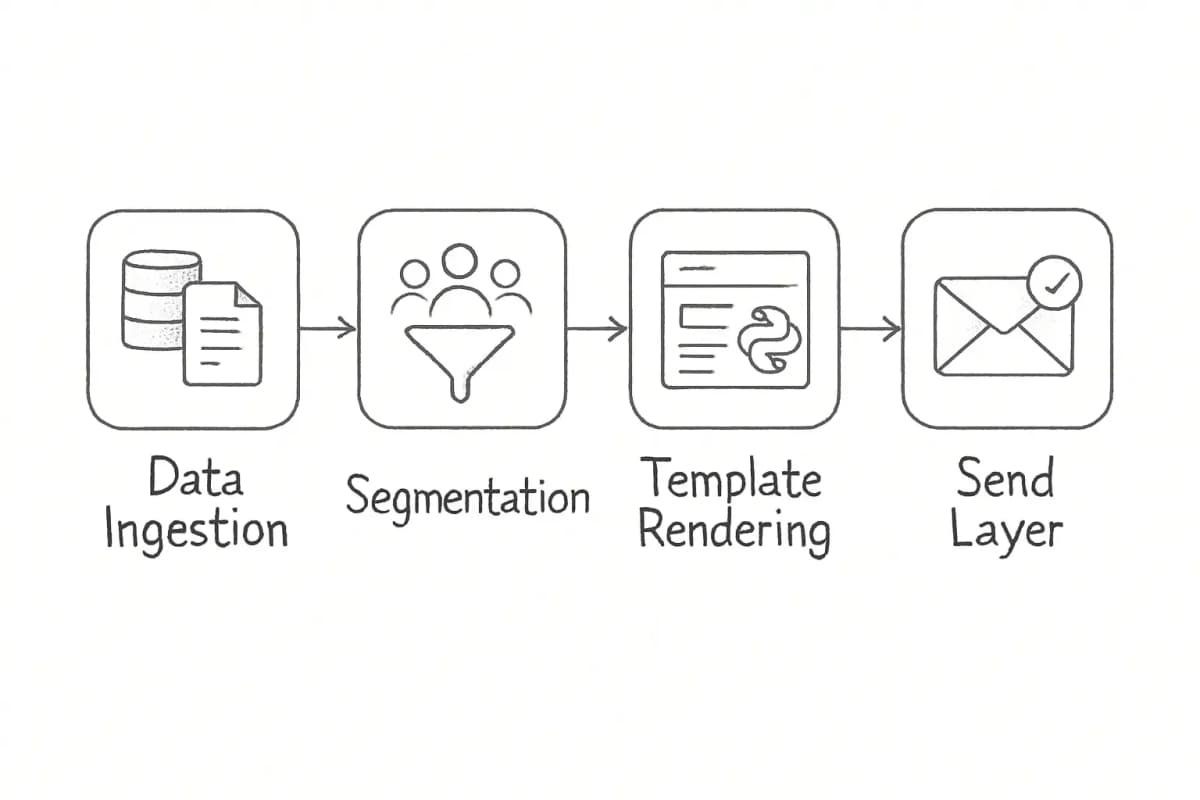
Analytics and Reporting with Python
Sending emails is only half the automation loop. Closing the loop means pulling performance data back into Python for analysis and iteration.
Email marketing platforms usually provide analytics like open rates, click rates, bounces, and more. Python can help automate the process of gathering and analyzing this data, enabling you to easily monitor the performance of your campaigns and gain insights for future improvements.
Every major SDK exposes reporting endpoints. With SendGrid, you pull event data via the Activity Feed API or webhooks. Mailchimp exposes campaign-level stats including open rate, click rate, bounce rate, and revenue attribution directly through the Python client.
Combine SDK-pulled data with pandas for analysis and matplotlib for visualization, and you have a full in-house reporting pipeline. This kind of setup lets you run A/B tests programmatically, identify underperforming segments, and adjust send logic without manual intervention.
You can use Python to test different email subject lines and analyze which one performs better. Pair this with our resource on email marketing analytics best practices to build measurement frameworks that inform both your Python automation and your broader campaign strategy.
Deliverability Considerations When Using Python SDKs
A Python SDK is not a deliverability shortcut. The SDK handles the API layer; deliverability still depends on your sender reputation, authentication setup, and list hygiene.
Key deliverability steps when building Python-based automation:
- Authenticate your domain: Set up SPF, DKIM, and DMARC records before your first campaign send. Mailgun provides a RESTful API and SMTP relay setup with full support for SPF, DKIM, and DMARC authentication.
- Warm up IPs gradually: Sending high volumes from a cold IP directly damages deliverability.
- Handle bounces and unsubscribes in code: Automate unsubscribe functionality alongside your sending logic. Every major SDK provides webhook events for bounces and unsubscribes that you can process programmatically.
- Validate emails before sending: Mailgun excels in bulk validation and list health checks. Running validation through the API before a send protects your sender score.
- Monitor everything: Keep track of sent emails, failures, and retries. Build structured logging into every send function.
Automated emails average a 70.5% higher open rate and 152% higher click-through rate than standard marketing messages. That advantage is only realized when deliverability infrastructure is in place.
Choosing the Right SDK for Your Stack
The right SDK depends on your volume, technical resources, and what features you need beyond raw sending.
| Use Case | Recommended SDK |
|---|---|
| High-volume transactional at low cost | Amazon SES via boto3 |
| Transactional with strong deliverability tooling | Mailgun |
| Marketing campaigns plus transactional | SendGrid |
| Full audience and campaign management | Mailchimp Marketing Python client |
| SMB with full-featured automation | MailerLite Python SDK |
For teams running campaigns across multiple channels, a Python SDK also integrates cleanly with CRM data pipelines. See the email marketing automation CRM setup guide for specifics on connecting your subscriber data layer to your sending infrastructure.
Frequently Asked Questions
What is a Python SDK for email marketing automation?
A Python SDK (software development kit) is a pre-built library that wraps an email service provider's API, letting you send emails, manage subscribers, trigger campaigns, and pull analytics using Python code rather than manually operating a dashboard. Examples include sendgrid-python, mailchimp-marketing, and boto3 for Amazon SES.
Do I need coding experience to use a Python email SDK?
Yes, a working knowledge of Python is required. Python is known for being beginner-friendly with a clear and readable syntax. While some coding experience can be helpful, many resources are available specifically for marketers who want to learn Python for practical applications. Most SDKs have quickstart guides that get you to your first send within 15 to 30 minutes.
Which Python email SDK has the best deliverability?
Mailtrap is considered the best for Python developers and product teams with high deliverability rates, excellent analytics, developer-friendly experience, and reliability. For transactional email specifically, Postmark leads at 83.3% inbox placement according to Mailtrap's March 2025 study, followed by Mailgun at 71.4%. Deliverability ultimately depends on domain authentication, IP warmup, and list hygiene as much as the SDK choice.
Can Python handle email list segmentation and personalization automatically?
Yes. You can use pandas to load and clean customer data from a CSV or database, then use Python to customize emails to individual recipients using data from your email list. Combined with Jinja2 for template rendering and SDK segment APIs like Mailchimp's, Python can handle the full personalization and segmentation pipeline without manual intervention.
How do triggered emails differ from broadcast emails in Python automation?
Broadcast emails go to a defined list at a scheduled time. Triggered emails fire in response to specific subscriber actions such as a purchase, a cart abandonment, or a link click. Automated emails generate 320% more revenue than non-automated emails, a gap that reflects the power of behavioral triggers, personalization at scale, and precisely timed delivery sequences. Python SDKs handle both modes, but the highest ROI consistently comes from trigger-based workflows.