
HomeBlogAI and AutomationRole of AI in Email Marketing: Benefits and Strategies
AI and Automation

Role of AI in Email Marketing: Benefits and Strategies

Discover how AI transforms email marketing with personalization, automation, and predictive analytics. Learn strategies to boost ROI and engagement.

R

Rachel Torres

July 17, 2026

13 min read
HomeBlogAI and AutomationRole of AI in Email Marketing: Benefits and Strategies
AI and Automation

Role of AI in Email Marketing: Benefits and Strategies

Discover how AI transforms email marketing with personalization, automation, and predictive analytics. Learn strategies to boost ROI and engagement.

R

Rachel Torres

July 17, 2026

13 min read
Share:
Share:
#Artificial Intelligence#Email Automation#Personalization#Marketing Technology
Illustration for role of ai in email marketing

Stay in the loop

Get the latest posts delivered straight to your inbox. No spam, unsubscribe anytime.

AI already handles a meaningful share of email marketing decisions. In 2025, 63% of marketers use AI tools for email campaigns, generating 13% higher click-through rates and 41% more revenue. Those numbers reflect a shift that has been building for several years, but is now compounding fast. If you are responsible for email performance, understanding the role of AI in email marketing is no longer optional. It is the difference between running a program that scales and one that stagnates.

Key Takeaways

  • Marketers who use AI to personalize emails see a 41% increase in revenue and a 13.44% increase in click-through rates.
  • 70% of marketers predict up to half of their email operations will be AI-driven by 2026, while 18% expect AI to handle 50-75% of their email marketing tasks.
  • Automated emails generate 320% more revenue than non-automated alternatives, and AI-optimized campaigns see a 13% improvement in click-through rates.
  • Marketers implementing AI report saving up to 30% of their total working time, with some companies reducing newsletter production time by 90%.
  • McKinsey reports that AI-driven marketing strategies can lead to a 20-30% increase in marketing ROI, while also reducing customer acquisition costs by up to 50%.

Why AI Has Become Central to Email Marketing

Email has always been the highest-ROI digital channel. Email marketing already delivers the highest ROI of any digital marketing channel, returning $36 to $42 for every dollar spent. The issue is that most teams only capture a fraction of that potential because manual execution creates too many bottlenecks: slow list segmentation, static content, arbitrary send times, and inconsistent testing.

AI solves these bottlenecks systematically.

Traditional email marketing relies on manual processes and scheduled sends to broad audience lists. In contrast, AI-powered campaigns run on continuous optimization, individual-level personalization, and decisions backed by data.

In 2025, approximately 75-80% of marketers utilize AI in some capacity, ranging from email personalization to automated SMS campaigns, across both enterprise and small-to-medium businesses. The technology has matured past experimentation. It now integrates directly into platforms like Klaviyo, HubSpot, Mailchimp, and Iterable, which means adoption is accessible to teams of every size.

Stay in the loop

Get the latest posts delivered straight to your inbox. No spam, unsubscribe anytime.

AI already handles a meaningful share of email marketing decisions. In 2025, 63% of marketers use AI tools for email campaigns, generating 13% higher click-through rates and 41% more revenue. Those numbers reflect a shift that has been building for several years, but is now compounding fast. If you are responsible for email performance, understanding the role of AI in email marketing is no longer optional. It is the difference between running a program that scales and one that stagnates.

Key Takeaways

  • Marketers who use AI to personalize emails see a 41% increase in revenue and a 13.44% increase in click-through rates.
  • 70% of marketers predict up to half of their email operations will be AI-driven by 2026, while 18% expect AI to handle 50-75% of their email marketing tasks.
  • Automated emails generate 320% more revenue than non-automated alternatives, and AI-optimized campaigns see a 13% improvement in click-through rates.
  • Marketers implementing AI report saving up to 30% of their total working time, with some companies reducing newsletter production time by 90%.
  • McKinsey reports that AI-driven marketing strategies can lead to a 20-30% increase in marketing ROI, while also reducing customer acquisition costs by up to 50%.

Why AI Has Become Central to Email Marketing

Email has always been the highest-ROI digital channel. Email marketing already delivers the highest ROI of any digital marketing channel, returning $36 to $42 for every dollar spent. The issue is that most teams only capture a fraction of that potential because manual execution creates too many bottlenecks: slow list segmentation, static content, arbitrary send times, and inconsistent testing.

AI solves these bottlenecks systematically.

Traditional email marketing relies on manual processes and scheduled sends to broad audience lists. In contrast, AI-powered campaigns run on continuous optimization, individual-level personalization, and decisions backed by data.

In 2025, approximately 75-80% of marketers utilize AI in some capacity, ranging from email personalization to automated SMS campaigns, across both enterprise and small-to-medium businesses. The technology has matured past experimentation. It now integrates directly into platforms like Klaviyo, HubSpot, Mailchimp, and Iterable, which means adoption is accessible to teams of every size.


The Core Benefits of AI in Email Marketing

Higher Revenue and Engagement

The performance gap between AI-assisted and non-AI email programs is significant and documented.

Programs integrating AI across the full email workflow, including dynamic content, send-time optimization, and predictive segmentation, achieve 41% higher revenue than manual campaigns. AI-optimized campaigns average a 13.44% click-through rate compared to 3% for non-AI campaigns.

Senders who use AI have an average order value of $145.08, compared to $138.00 for those who do not use AI. That gap grows with volume.

Faster Content Production

In 2025, just 6% of teams take longer than two weeks to produce an email, down from 62% in 2024. That is a direct result of AI entering the content workflow.

In 2025, 49% of marketers use generative AI for static copy creation, and the number of marketers using AI-powered image generation has increased by 340% in the last year.

This speed matters for campaign agility. Teams that can ideate, draft, test, and send in hours rather than weeks respond faster to market conditions, customer behaviors, and seasonal opportunities.

Smarter Segmentation at Scale

Modern email platforms with AI built in can create and update segments dynamically based on behavior, intent signals, lifecycle stage, and predicted likelihood to convert. Someone who downloads a pricing page moves into a higher-intent nurture track. Someone who goes cold for 60 days shifts to a re-engagement sequence automatically.

This matters because segmentation is where most of the revenue difference lives. For a deeper look at how structured segmentation improves returns, see our guide to email list segmentation strategies that boost ROI.

Nearly three-quarters of marketing professionals identify time savings as automation's primary benefit, ranking it above even revenue generation and lead acquisition. The elimination of repetitive tasks such as list uploads, manual segmentation, scheduled sends, and performance reporting allows marketers to focus on strategy, creative development, and optimization rather than campaign execution.


Key AI Strategies That Drive Email Performance

1. Send Time Optimization

Most email teams send at whatever time feels reasonable for the list average. AI does something fundamentally different.

AI send-time optimization learns each recipient's actual behavior and delivers your email when they are most likely to open it, not the list average but the individual.

Machine learning determines individual subscriber preferences for email delivery timing. Personalized send times increase open rates by 35-50% compared to batch sending.

This is often the lowest-friction entry point for teams starting with AI. Many platforms already include it, and the lift is consistent.

2. AI-Generated Subject Lines and Copy

Emails with AI-generated subject lines see an open rate increase of 5% to 10%. AI tools create compelling subject lines by understanding what language and tone resonate with specific audiences, making the email stand out in a crowded inbox.


The Core Benefits of AI in Email Marketing

Higher Revenue and Engagement

The performance gap between AI-assisted and non-AI email programs is significant and documented.

Programs integrating AI across the full email workflow, including dynamic content, send-time optimization, and predictive segmentation, achieve 41% higher revenue than manual campaigns. AI-optimized campaigns average a 13.44% click-through rate compared to 3% for non-AI campaigns.

Senders who use AI have an average order value of $145.08, compared to $138.00 for those who do not use AI. That gap grows with volume.

Faster Content Production

In 2025, just 6% of teams take longer than two weeks to produce an email, down from 62% in 2024. That is a direct result of AI entering the content workflow.

In 2025, 49% of marketers use generative AI for static copy creation, and the number of marketers using AI-powered image generation has increased by 340% in the last year.

This speed matters for campaign agility. Teams that can ideate, draft, test, and send in hours rather than weeks respond faster to market conditions, customer behaviors, and seasonal opportunities.

Smarter Segmentation at Scale

Modern email platforms with AI built in can create and update segments dynamically based on behavior, intent signals, lifecycle stage, and predicted likelihood to convert. Someone who downloads a pricing page moves into a higher-intent nurture track. Someone who goes cold for 60 days shifts to a re-engagement sequence automatically.

This matters because segmentation is where most of the revenue difference lives. For a deeper look at how structured segmentation improves returns, see our guide to email list segmentation strategies that boost ROI.

Nearly three-quarters of marketing professionals identify time savings as automation's primary benefit, ranking it above even revenue generation and lead acquisition. The elimination of repetitive tasks such as list uploads, manual segmentation, scheduled sends, and performance reporting allows marketers to focus on strategy, creative development, and optimization rather than campaign execution.


Key AI Strategies That Drive Email Performance

1. Send Time Optimization

Most email teams send at whatever time feels reasonable for the list average. AI does something fundamentally different.

AI send-time optimization learns each recipient's actual behavior and delivers your email when they are most likely to open it, not the list average but the individual.

Machine learning determines individual subscriber preferences for email delivery timing. Personalized send times increase open rates by 35-50% compared to batch sending.

This is often the lowest-friction entry point for teams starting with AI. Many platforms already include it, and the lift is consistent.

2. AI-Generated Subject Lines and Copy

Emails with AI-generated subject lines see an open rate increase of 5% to 10%. AI tools create compelling subject lines by understanding what language and tone resonate with specific audiences, making the email stand out in a crowded inbox.

The key is treating AI as a drafting and iteration tool rather than a publishing tool. The old approach was to write one version of an email and send it to everyone. The new approach is to write the core message and let AI generate subject line variants, preview text options, and body content tailored to different segments.

For proven tactics on subject line craft that complements AI testing, see our resource on email subject line best practices that boost open rates.

3. Predictive Analytics and Behavioral Triggers

Predictive analytics is one of the most powerful applications of AI in email marketing. By leveraging historical data and sophisticated algorithms, it allows marketers to forecast future customer behaviors and preferences with remarkable accuracy, enabling businesses to anticipate future actions and optimize email content, timing, and targeting for maximum impact.

Marketing emails sent in response to behavioral triggers generate 10 times greater revenue than other email types.

For cart recovery specifically, AI assesses whether a discount, a scarcity-based push, or a social proof element will increase a shopper's likelihood of responding, and even optimizes the voice tone and send time based on past exchanges.

4. AI-Powered Personalization

Nearly 72% of consumers prefer personalized emails with AI-driven recommendations over generic ones.

Brands using AI-driven email personalization report up to 41% more revenue than those using traditional batch sends. Lifestyle segmentation boosts email ROI by 29%, localized emails increase engagement by 23%, and flash sales with individual preference matching see 3.4 times more conversions than generic promotional sends.

For tactics that go beyond basic name personalization, see our full breakdown of email personalization techniques that boost conversions.

5. Automated A/B Testing

Manual A/B testing is slow, often underpowered statistically, and easy to deprioritize when teams are stretched thin. AI removes that friction entirely.

Automated A/B testing systems increase email marketing ROI by 37% compared to organizations deploying campaigns without testing protocols.

AI analyzes past open rates to predict the optimal send time for each individual subscriber, generates subject line variations, tests them automatically, and shifts volume toward winners in real time.


How AI Affects Email Deliverability

The role of AI in email marketing extends beyond content creation and optimization. It is also reshaping deliverability, and not always in the direction marketers expect.

One in six marketing emails never reaches the inbox. That is the global average in 2025, according to Validity's Deliverability Benchmark report, and for high-volume senders it is even worse.

Unlike traditional rule-based spam filters that relied on keyword blacklists, modern AI systems use machine learning to continuously adapt and learn. These filters analyze hundreds of factors simultaneously, from sender reputation to content patterns to recipient behavior.

Generic, template-based emails are increasingly flagged by AI filters. Personalized emails are 6 times more likely to drive conversions because they appear more human and relevant.

The key is treating AI as a drafting and iteration tool rather than a publishing tool. The old approach was to write one version of an email and send it to everyone. The new approach is to write the core message and let AI generate subject line variants, preview text options, and body content tailored to different segments.

For proven tactics on subject line craft that complements AI testing, see our resource on email subject line best practices that boost open rates.

3. Predictive Analytics and Behavioral Triggers

Predictive analytics is one of the most powerful applications of AI in email marketing. By leveraging historical data and sophisticated algorithms, it allows marketers to forecast future customer behaviors and preferences with remarkable accuracy, enabling businesses to anticipate future actions and optimize email content, timing, and targeting for maximum impact.

Marketing emails sent in response to behavioral triggers generate 10 times greater revenue than other email types.

For cart recovery specifically, AI assesses whether a discount, a scarcity-based push, or a social proof element will increase a shopper's likelihood of responding, and even optimizes the voice tone and send time based on past exchanges.

4. AI-Powered Personalization

Nearly 72% of consumers prefer personalized emails with AI-driven recommendations over generic ones.

Brands using AI-driven email personalization report up to 41% more revenue than those using traditional batch sends. Lifestyle segmentation boosts email ROI by 29%, localized emails increase engagement by 23%, and flash sales with individual preference matching see 3.4 times more conversions than generic promotional sends.

For tactics that go beyond basic name personalization, see our full breakdown of email personalization techniques that boost conversions.

5. Automated A/B Testing

Manual A/B testing is slow, often underpowered statistically, and easy to deprioritize when teams are stretched thin. AI removes that friction entirely.

Automated A/B testing systems increase email marketing ROI by 37% compared to organizations deploying campaigns without testing protocols.

AI analyzes past open rates to predict the optimal send time for each individual subscriber, generates subject line variations, tests them automatically, and shifts volume toward winners in real time.


How AI Affects Email Deliverability

The role of AI in email marketing extends beyond content creation and optimization. It is also reshaping deliverability, and not always in the direction marketers expect.

One in six marketing emails never reaches the inbox. That is the global average in 2025, according to Validity's Deliverability Benchmark report, and for high-volume senders it is even worse.

Unlike traditional rule-based spam filters that relied on keyword blacklists, modern AI systems use machine learning to continuously adapt and learn. These filters analyze hundreds of factors simultaneously, from sender reputation to content patterns to recipient behavior.

Generic, template-based emails are increasingly flagged by AI filters. Personalized emails are 6 times more likely to drive conversions because they appear more human and relevant.

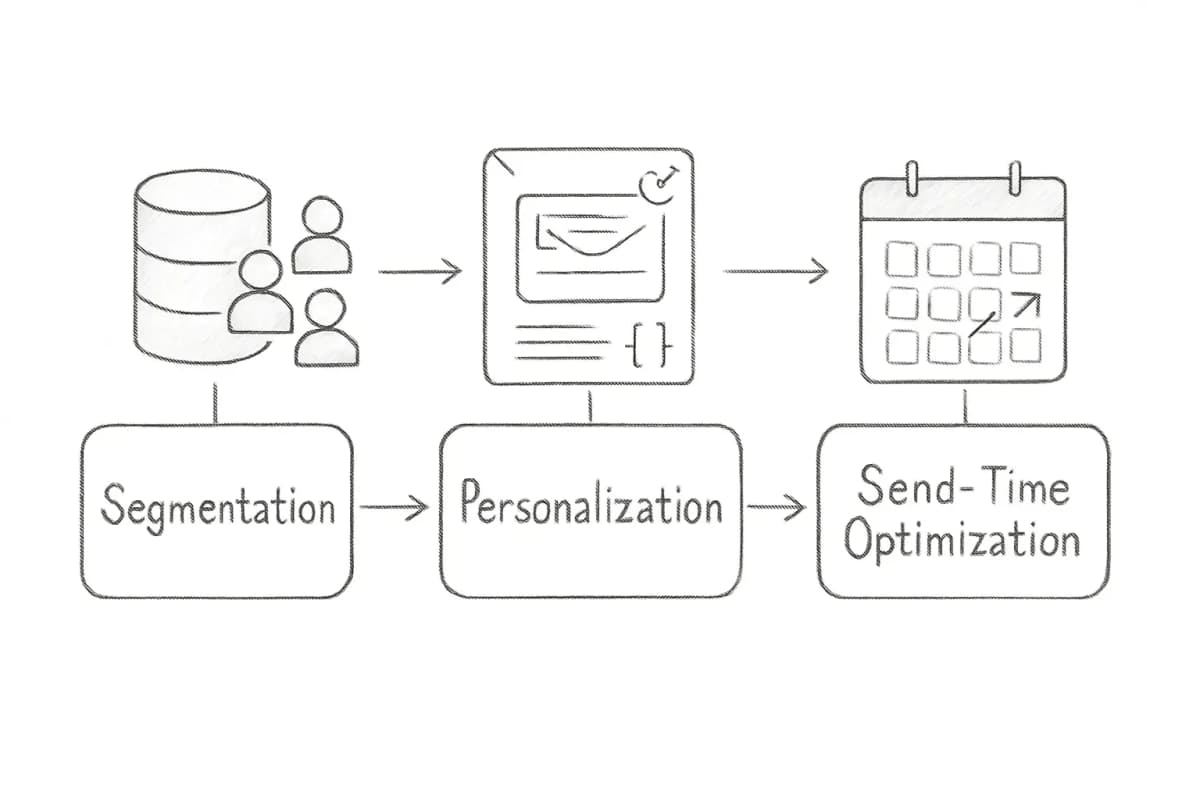
The practical implication: AI-generated content that looks formulaic can hurt deliverability even when it follows every technical rule. Use AI to draft and vary, but keep your voice, specificity, and original judgment intact. AI email marketing workflow diagram showing three connected stages: segmentation (database of subscriber groups), personalization (customized content and dynamic fields), and send-time optimization (calendar with timing indicators). Arrows flow left to right connecting each stage, with small icons representing data input, content variation, and delivery scheduling.

Where Most Teams Should Start

The temptation is to implement everything at once. That usually leads to half-configured tools and no clear attribution. A phased approach works better.

  1. Subject line testing. Enable AI subject line generation in your current email platform. Run head-to-head tests against your manually written lines for at least four to six sends before drawing conclusions.
  2. Send time optimization. Turn it on for your most-engaged segments first. Measure open rate lift over four weeks before expanding.
  3. Behavioral triggers. Identify two to three high-value trigger points: welcome sequences, cart abandonment, post-purchase follow-ups. These alone justify AI adoption for most teams.
  4. Predictive segmentation. Once your behavioral data is clean and flowing, move into dynamic segments that update based on real-time signals rather than static list filters.
  5. Content personalization at scale. After the infrastructure is in place, layer in AI-generated content variants that adapt to each segment's preferences and lifecycle stage.

AI cannot personalize effectively without good data. If subscriber records are incomplete, inconsistent, or siloed across tools, AI-driven personalization will automate inaccurate or irrelevant content at scale. Data hygiene is foundational. Clean your subscriber data before layering in AI personalization, and invest in connecting your email platform to your CRM, ecommerce, and website behavior data so the AI has genuine signals to work from.

For a structured approach to building out your full email automation infrastructure, see our email marketing automation CRM setup guide.


Common Challenges and How to Address Them

AI in email marketing is not without real friction points.

Despite rapid growth in AI usage, 34% of marketers cite budget constraints as a barrier to adoption, 67% say a lack of education and training is a top barrier, and data privacy and security concerns also rank among the top hesitation factors.

Even as AI handles more operations, 22% of marketers still struggle to prove or measure ROI effectively.

The practical implication: AI-generated content that looks formulaic can hurt deliverability even when it follows every technical rule. Use AI to draft and vary, but keep your voice, specificity, and original judgment intact. AI email marketing workflow diagram showing three connected stages: segmentation (database of subscriber groups), personalization (customized content and dynamic fields), and send-time optimization (calendar with timing indicators). Arrows flow left to right connecting each stage, with small icons representing data input, content variation, and delivery scheduling.


Where Most Teams Should Start

The temptation is to implement everything at once. That usually leads to half-configured tools and no clear attribution. A phased approach works better.

  1. Subject line testing. Enable AI subject line generation in your current email platform. Run head-to-head tests against your manually written lines for at least four to six sends before drawing conclusions.
  2. Send time optimization. Turn it on for your most-engaged segments first. Measure open rate lift over four weeks before expanding.
  3. Behavioral triggers. Identify two to three high-value trigger points: welcome sequences, cart abandonment, post-purchase follow-ups. These alone justify AI adoption for most teams.
  4. Predictive segmentation. Once your behavioral data is clean and flowing, move into dynamic segments that update based on real-time signals rather than static list filters.
  5. Content personalization at scale. After the infrastructure is in place, layer in AI-generated content variants that adapt to each segment's preferences and lifecycle stage.

AI cannot personalize effectively without good data. If subscriber records are incomplete, inconsistent, or siloed across tools, AI-driven personalization will automate inaccurate or irrelevant content at scale. Data hygiene is foundational. Clean your subscriber data before layering in AI personalization, and invest in connecting your email platform to your CRM, ecommerce, and website behavior data so the AI has genuine signals to work from.

For a structured approach to building out your full email automation infrastructure, see our email marketing automation CRM setup guide.


Common Challenges and How to Address Them

AI in email marketing is not without real friction points.

Despite rapid growth in AI usage, 34% of marketers cite budget constraints as a barrier to adoption, 67% say a lack of education and training is a top barrier, and data privacy and security concerns also rank among the top hesitation factors.

Even as AI handles more operations, 22% of marketers still struggle to prove or measure ROI effectively.

The measurement problem is worth taking seriously. If your reporting only tracks open rates, you will undercount AI's contribution because Apple's Mail Privacy Protection artificially inflates opens for a portion of your list. Focus on click-through rates, conversions, and revenue per recipient as your primary performance signals.

As businesses adopt AI, customers increasingly expect transparency and security in data usage. According to a recent Salesforce report, 68% of consumers believe that companies must prioritize trust in the context of AI adoption.

Be transparent about how you collect and use behavioral data. Solid preference centers and clear unsubscribe flows build the kind of list quality that AI tools need to perform well.


Frequently Asked Questions

What is the role of AI in email marketing?

AI automates and improves the most data-intensive parts of email marketing: audience segmentation, content personalization, send time optimization, A/B testing, and deliverability monitoring. AI now drives personalization, automation, and predictive analytics in ways that were unthinkable just a few years ago. It reduces manual effort while improving the precision and relevance of every campaign.

How much can AI improve email marketing ROI?

AI-driven email marketing leads to a 13% increase in click-through rates and a 41% rise in revenue. McKinsey reports that AI-driven marketing strategies can lead to a 20-30% increase in overall marketing ROI. Results vary by team, platform, and data quality, but the directional evidence is consistent across multiple large-scale studies.

Does AI in email marketing work for small businesses?

AI tools for email marketing automation are scalable and accessible to small businesses. They handle tasks like segmentation, behavioral analytics, and content personalization, helping small businesses increase their email marketing ROI and save time. Most major platforms now include AI features at entry-level price points, so the barrier is less about budget and more about data readiness.

What is the biggest risk of using AI for email content?

The key risk with AI content generation is producing generic, interchangeable emails that feel automated rather than personal. The solution is to treat AI as a drafting and iteration tool rather than a publishing tool. Human review, brand-specific details, and genuine editorial judgment are still the difference between an email that converts and one that gets ignored or flagged.


No comments yet. Be the first!

Leave a comment

Comments are reviewed before publishing.

The measurement problem is worth taking seriously. If your reporting only tracks open rates, you will undercount AI's contribution because Apple's Mail Privacy Protection artificially inflates opens for a portion of your list. Focus on click-through rates, conversions, and revenue per recipient as your primary performance signals.

As businesses adopt AI, customers increasingly expect transparency and security in data usage. According to a recent Salesforce report, 68% of consumers believe that companies must prioritize trust in the context of AI adoption.

Be transparent about how you collect and use behavioral data. Solid preference centers and clear unsubscribe flows build the kind of list quality that AI tools need to perform well.


Frequently Asked Questions

What is the role of AI in email marketing?

AI automates and improves the most data-intensive parts of email marketing: audience segmentation, content personalization, send time optimization, A/B testing, and deliverability monitoring. AI now drives personalization, automation, and predictive analytics in ways that were unthinkable just a few years ago. It reduces manual effort while improving the precision and relevance of every campaign.

How much can AI improve email marketing ROI?

AI-driven email marketing leads to a 13% increase in click-through rates and a 41% rise in revenue. McKinsey reports that AI-driven marketing strategies can lead to a 20-30% increase in overall marketing ROI. Results vary by team, platform, and data quality, but the directional evidence is consistent across multiple large-scale studies.

Does AI in email marketing work for small businesses?

AI tools for email marketing automation are scalable and accessible to small businesses. They handle tasks like segmentation, behavioral analytics, and content personalization, helping small businesses increase their email marketing ROI and save time. Most major platforms now include AI features at entry-level price points, so the barrier is less about budget and more about data readiness.

What is the biggest risk of using AI for email content?

The key risk with AI content generation is producing generic, interchangeable emails that feel automated rather than personal. The solution is to treat AI as a drafting and iteration tool rather than a publishing tool. Human review, brand-specific details, and genuine editorial judgment are still the difference between an email that converts and one that gets ignored or flagged.

No comments yet. Be the first!

Leave a comment

Comments are reviewed before publishing.

More from

Related posts

Illustration for ai impact on email marketing
AI and AutomationJul 17, 2026 13 min

AI Impact on Email Marketing: ROI and Strategy

Discover how AI transforms email marketing through personalization, automation, and deliverability. Learn actionable strategies to boost campaign ROI.

More from

Related posts

Illustration for ai impact on email marketing
AI and AutomationJul 17, 2026 13 min

AI Impact on Email Marketing: ROI and Strategy

Discover how AI transforms email marketing through personalization, automation, and deliverability. Learn actionable strategies to boost campaign ROI.

P
Priya Kapoor
P
Priya Kapoor