
HomeBlogEmail Templates & ExamplesSEO Email Marketing Template for Better Rankings
Email Templates & Examples

SEO Email Marketing Template for Better Rankings

Get a proven SEO email marketing template to boost visibility, engagement, and conversions. Step-by-step guide with examples inside.

R

Rachel Torres

May 9, 2026

12 min read
HomeBlogEmail Templates & ExamplesSEO Email Marketing Template for Better Rankings
Email Templates & Examples

SEO Email Marketing Template for Better Rankings

Get a proven SEO email marketing template to boost visibility, engagement, and conversions. Step-by-step guide with examples inside.

R

Rachel Torres

May 9, 2026

12 min read
Share:
Share:
#Email Templates#SEO#Email Marketing Strategy#template
Illustration for seo email marketing template

Stay in the loop

Get the latest posts delivered straight to your inbox. No spam, unsubscribe anytime.

Most marketers treat email marketing and SEO as two separate disciplines. They shouldn't. When you build an SEO email marketing template the right way, you create a system where each channel amplifies the other: email drives qualified traffic to your content, and that traffic sends positive signals back to search engines. Using email marketing and SEO together can significantly boost brand awareness, organic traffic, and search rankings. This guide shows you exactly how to build a template that does both.

Key Takeaways

  • Email marketing ROI remains unmatched, averaging 36:1 in 2025, making it one of the most cost-effective marketing channels.
  • Email marketing for SEO helps drive traffic, increase engagement, build backlinks, and amplify content reach.
  • Content is foundational to both SEO and email, and you can integrate them by driving email sign-ups via web pages, using email as a keyword research tool, and repurposing top-performing content.
  • Email traffic is naturally "pre-warmed," meaning subscribers spend more time on your site than cold search visitors, which improves dwell time signals.
  • Segmented email campaigns generate 30% more opens and 50% more click-throughs than non-segmented campaigns.

What an SEO Email Marketing Template Actually Is

An SEO email marketing template is a pre-designed email format that aids marketers in reaching out to prospects for different search engine optimization initiatives, including cold email outreach, high-quality backlink acquisition, lead generation, SEO proposals, collaboration requests, and more.

But the definition has expanded. Today, a strong SEO email marketing template isn't only a link-building outreach tool. It's also a content distribution framework that turns your email list into an SEO asset. The two use cases share a common goal: getting the right content in front of the right people, at the right time, in a way that earns attention and authority.

SEO is often seen as acquisition-focused while email leans more toward retention, but at the end of the day, they both share the same goal: introducing products and services to the right people, at the right time, and in the right context.


Why SEO and Email Marketing Are Stronger Together

Stay in the loop

Get the latest posts delivered straight to your inbox. No spam, unsubscribe anytime.

Most marketers treat email marketing and SEO as two separate disciplines. They shouldn't. When you build an SEO email marketing template the right way, you create a system where each channel amplifies the other: email drives qualified traffic to your content, and that traffic sends positive signals back to search engines. Using email marketing and SEO together can significantly boost brand awareness, organic traffic, and search rankings. This guide shows you exactly how to build a template that does both.

Key Takeaways

  • Email marketing ROI remains unmatched, averaging 36:1 in 2025, making it one of the most cost-effective marketing channels.
  • Email marketing for SEO helps drive traffic, increase engagement, build backlinks, and amplify content reach.
  • Content is foundational to both SEO and email, and you can integrate them by driving email sign-ups via web pages, using email as a keyword research tool, and repurposing top-performing content.
  • Email traffic is naturally "pre-warmed," meaning subscribers spend more time on your site than cold search visitors, which improves dwell time signals.
  • Segmented email campaigns generate 30% more opens and 50% more click-throughs than non-segmented campaigns.

What an SEO Email Marketing Template Actually Is

An SEO email marketing template is a pre-designed email format that aids marketers in reaching out to prospects for different search engine optimization initiatives, including cold email outreach, high-quality backlink acquisition, lead generation, SEO proposals, collaboration requests, and more.

But the definition has expanded. Today, a strong SEO email marketing template isn't only a link-building outreach tool. It's also a content distribution framework that turns your email list into an SEO asset. The two use cases share a common goal: getting the right content in front of the right people, at the right time, in a way that earns attention and authority.

SEO is often seen as acquisition-focused while email leans more toward retention, but at the end of the day, they both share the same goal: introducing products and services to the right people, at the right time, and in the right context.


Why SEO and Email Marketing Are Stronger Together

The case for integrating these two channels is backed by hard data. In 2024, the top marketing channels driving ROI for B2B brands were their website, blog, and SEO efforts; for B2C brands, the channels with the best ROI were email marketing, paid social media content, and content marketing. Put simply, both channels are already at the top. The teams combining them pull further ahead.

Here is the core mechanism at work:

When you send an email, you drive intentional traffic to your site. That traffic spends time reading your content, clicking links, and signaling to Google that your site is a trusted authority. Return visitors show significantly higher session durations and are far more likely to share content, link to it, or mention your brand organically. Think of email as the mechanism that converts a one-time organic visitor into a repeat reader, and repeat readers are the behavioral signal that tells Google your content deserves to keep ranking high.

There is also a backlink dimension that most teams overlook. Top-ranking pages on Google have about 3.8x more backlinks than pages ranking lower, so consistent backlink acquisition directly impacts your ability to generate organic pipeline. Email outreach, when done with a well-built SEO email marketing template, is one of the most cost-efficient ways to earn those links.


The Anatomy of a High-Performing SEO Email Marketing Template

Whether you're distributing content or pitching a backlink, every effective SEO email marketing template shares the same core structure.

1. Subject Line That Reflects Search Intent

Title tags are similar to subject lines, while meta descriptions for web pages are a little like preview text. SEOs work to craft page titles and descriptions that encourage clicks when they show up in search results, so evaluating the titles and descriptions that get the most clicks from Google can help email marketers get creative with subject lines and preview text.

Use subject line data as a keyword research shortcut. Study the subject lines that generate the highest open rates. The words and phrases used will give you a good indication of the topics your target audience finds most relevant. Keep subject lines under 50 characters so they display fully across devices.

2. A Clear, Relevant Opening

Your cold email campaign for SEO purposes should include all the essentials: a subject line, a brief introduction with your company name and details, a call to action, and a closing part. But you need unique elements to make your SEO outreach template remarkable and impression-driven.

Lead with specificity. Reference the recipient's recent work, a gap in their content, or a direct reason you're reaching out. Generic openers kill response rates.

3. Value Before the Ask

Offer something valuable, like free SEO reviews, market insights, or case studies that showcase your expertise. For content distribution templates, this means the email itself should deliver a useful insight, not just tease the article. The click should feel like getting more, not like being sent away.

4. One Clear CTA

The case for integrating these two channels is backed by hard data. In 2024, the top marketing channels driving ROI for B2B brands were their website, blog, and SEO efforts; for B2C brands, the channels with the best ROI were email marketing, paid social media content, and content marketing. Put simply, both channels are already at the top. The teams combining them pull further ahead.

Here is the core mechanism at work:

When you send an email, you drive intentional traffic to your site. That traffic spends time reading your content, clicking links, and signaling to Google that your site is a trusted authority. Return visitors show significantly higher session durations and are far more likely to share content, link to it, or mention your brand organically. Think of email as the mechanism that converts a one-time organic visitor into a repeat reader, and repeat readers are the behavioral signal that tells Google your content deserves to keep ranking high.

There is also a backlink dimension that most teams overlook. Top-ranking pages on Google have about 3.8x more backlinks than pages ranking lower, so consistent backlink acquisition directly impacts your ability to generate organic pipeline. Email outreach, when done with a well-built SEO email marketing template, is one of the most cost-efficient ways to earn those links.


The Anatomy of a High-Performing SEO Email Marketing Template

Whether you're distributing content or pitching a backlink, every effective SEO email marketing template shares the same core structure.

1. Subject Line That Reflects Search Intent

Title tags are similar to subject lines, while meta descriptions for web pages are a little like preview text. SEOs work to craft page titles and descriptions that encourage clicks when they show up in search results, so evaluating the titles and descriptions that get the most clicks from Google can help email marketers get creative with subject lines and preview text.

Use subject line data as a keyword research shortcut. Study the subject lines that generate the highest open rates. The words and phrases used will give you a good indication of the topics your target audience finds most relevant. Keep subject lines under 50 characters so they display fully across devices.

2. A Clear, Relevant Opening

Your cold email campaign for SEO purposes should include all the essentials: a subject line, a brief introduction with your company name and details, a call to action, and a closing part. But you need unique elements to make your SEO outreach template remarkable and impression-driven.

Lead with specificity. Reference the recipient's recent work, a gap in their content, or a direct reason you're reaching out. Generic openers kill response rates.

3. Value Before the Ask

Offer something valuable, like free SEO reviews, market insights, or case studies that showcase your expertise. For content distribution templates, this means the email itself should deliver a useful insight, not just tease the article. The click should feel like getting more, not like being sent away.

4. One Clear CTA

Avoid overloading emails with too many CTAs. Stick to one primary CTA supported by secondary links if necessary. For outreach emails, the CTA is typically a low-friction ask: a reply, a quick review, or a specific meeting time. For content-driven emails, it's one link to the relevant page.

5. Mobile-Optimized Layout

Over 41 to 62% of cold emails are opened on mobile phones. If your email looks wrong on mobile, it's game over. Use a single-column layout, 16px minimum body text, and buttons that are at least 44px tall so they're easy to tap.


Template Type 1: The SEO Content Distribution Template

This template format promotes your new or updated content to your subscriber list, sending qualified traffic directly to the page you want to rank.

When to use it: New blog post launch, refreshed evergreen content, or a page you want to rank faster.

Structure:

  1. Subject line: Mirror the post's title tag or a high-click meta variation
  2. Opening: One sentence on why this matters right now
  3. Body: 2 to 3 key takeaways from the content, written as original insights (not a paste of the intro)
  4. CTA: Single link to the full article with keyword-relevant anchor text
  5. P.S. line: Optional social sharing prompt or reply question to boost engagement

You can summarize the key takeaways of a recent blog post or the results of a case study in a newsletter, then include a link to the full article to drive traffic back to your website.

Why it works for SEO: Consistent traffic from emails to your content pages can also enhance their authority and relevance, leading to improved organic search rankings over time.

For deeper guidance on building a complete content distribution strategy, see our email marketing strategy template.


Template Type 2: The Backlink Outreach Template

This is the classic SEO email marketing template use case: reaching out to relevant sites to earn a backlink.

When to use it: New linkable asset (original research, data, tools), broken link replacement, or guest post pitch.

Structure:

  1. Subject line: Specific, personal, no more than 8 words
  2. Icebreaker: One genuine reference to their recent content
  3. Value proof: What you've created and why it helps their audience
  4. The ask: One clear, low-friction request
  5. Follow-up: Planned 3 to 4 days after the initial send

Only 8.5% of outreach emails get a response on average, meaning backlink email outreach needs to be more targeted and personalized than a typical blast to stand out. Personalization here is not inserting a first name. It's showing you've read their work and understood where your content fits.

Avoid overloading emails with too many CTAs. Stick to one primary CTA supported by secondary links if necessary. For outreach emails, the CTA is typically a low-friction ask: a reply, a quick review, or a specific meeting time. For content-driven emails, it's one link to the relevant page.

5. Mobile-Optimized Layout

Over 41 to 62% of cold emails are opened on mobile phones. If your email looks wrong on mobile, it's game over. Use a single-column layout, 16px minimum body text, and buttons that are at least 44px tall so they're easy to tap.


Template Type 1: The SEO Content Distribution Template

This template format promotes your new or updated content to your subscriber list, sending qualified traffic directly to the page you want to rank.

When to use it: New blog post launch, refreshed evergreen content, or a page you want to rank faster.

Structure:

  1. Subject line: Mirror the post's title tag or a high-click meta variation
  2. Opening: One sentence on why this matters right now
  3. Body: 2 to 3 key takeaways from the content, written as original insights (not a paste of the intro)
  4. CTA: Single link to the full article with keyword-relevant anchor text
  5. P.S. line: Optional social sharing prompt or reply question to boost engagement

You can summarize the key takeaways of a recent blog post or the results of a case study in a newsletter, then include a link to the full article to drive traffic back to your website.

Why it works for SEO: Consistent traffic from emails to your content pages can also enhance their authority and relevance, leading to improved organic search rankings over time.

For deeper guidance on building a complete content distribution strategy, see our email marketing strategy template.


Template Type 2: The Backlink Outreach Template

This is the classic SEO email marketing template use case: reaching out to relevant sites to earn a backlink.

When to use it: New linkable asset (original research, data, tools), broken link replacement, or guest post pitch.

Structure:

  1. Subject line: Specific, personal, no more than 8 words
  2. Icebreaker: One genuine reference to their recent content
  3. Value proof: What you've created and why it helps their audience
  4. The ask: One clear, low-friction request
  5. Follow-up: Planned 3 to 4 days after the initial send

Only 8.5% of outreach emails get a response on average, meaning backlink email outreach needs to be more targeted and personalized than a typical blast to stand out. Personalization here is not inserting a first name. It's showing you've read their work and understood where your content fits.

For best results, send your first follow-up 3 to 4 business days after your initial email, aim for between 9:00 AM and 11:00 AM local time, and prioritize Tuesday, Wednesday, or Thursday.


Template Type 3: The Keyword Research Feedback Template

Most teams do keyword research in tools. Smart teams also do it in their inbox.

You can take a direct approach and ask subscribers via a poll which topics they want to learn more about. Polls are also great for engagement, making it a double win.

This template sends a short, reply-based question to a segment of your list. The responses reveal content gaps your competitors are missing, in the words your audience actually uses.

Structure:

  1. Subject: A direct, curiosity-driven question related to your content focus
  2. Body: 3 to 5 sentences of context, then one open question asking what they want to learn
  3. CTA: Reply with one word, one phrase, or a link to a 2-question poll
  4. Use responses to brief new content and validate keyword hypotheses

Customers often include the same search terms that other potential customers will use, turning a response from a trust signal into a keyword-rich insight.


How to Use Email Data to Improve Your SEO Content

The data flowing through your email campaigns is often more actionable than what you get from Google Search Console. Here is how to close the loop:

  • High open rates on a subject line: That phrase likely signals strong audience intent. Test it as a blog post title or meta title.
  • High CTRs on a link: That page is resonating. Prioritize updating it, building links to it, and adding contextual internal links toward it.
  • Low clicks despite high opens: The content inside the email doesn't deliver on the subject line's promise. Apply the same diagnosis to your meta descriptions.

High-performing subject lines are ideal for ads and social captions. Paid spend can be better distributed by focusing on which blog posts get the most email clicks. Click heatmap analysis can be used to help optimize web UX and CTA placement.

Use UTM parameters on every link in your email. UTM parameters serve as digital breadcrumbs, revealing how subscribers interact with your SEO content through email campaigns, which Google Analytics uses to track the performance of your email campaigns and their impact on your SEO efforts.

To build systematic reporting around this, our email marketing analytics best practices guide covers the exact metrics worth tracking.


Segmentation: The Missing Link Between Email and SEO

For best results, send your first follow-up 3 to 4 business days after your initial email, aim for between 9:00 AM and 11:00 AM local time, and prioritize Tuesday, Wednesday, or Thursday.


Template Type 3: The Keyword Research Feedback Template

Most teams do keyword research in tools. Smart teams also do it in their inbox.

You can take a direct approach and ask subscribers via a poll which topics they want to learn more about. Polls are also great for engagement, making it a double win.

This template sends a short, reply-based question to a segment of your list. The responses reveal content gaps your competitors are missing, in the words your audience actually uses.

Structure:

  1. Subject: A direct, curiosity-driven question related to your content focus
  2. Body: 3 to 5 sentences of context, then one open question asking what they want to learn
  3. CTA: Reply with one word, one phrase, or a link to a 2-question poll
  4. Use responses to brief new content and validate keyword hypotheses

Customers often include the same search terms that other potential customers will use, turning a response from a trust signal into a keyword-rich insight.


How to Use Email Data to Improve Your SEO Content

The data flowing through your email campaigns is often more actionable than what you get from Google Search Console. Here is how to close the loop:

  • High open rates on a subject line: That phrase likely signals strong audience intent. Test it as a blog post title or meta title.
  • High CTRs on a link: That page is resonating. Prioritize updating it, building links to it, and adding contextual internal links toward it.
  • Low clicks despite high opens: The content inside the email doesn't deliver on the subject line's promise. Apply the same diagnosis to your meta descriptions.

High-performing subject lines are ideal for ads and social captions. Paid spend can be better distributed by focusing on which blog posts get the most email clicks. Click heatmap analysis can be used to help optimize web UX and CTA placement.

Use UTM parameters on every link in your email. UTM parameters serve as digital breadcrumbs, revealing how subscribers interact with your SEO content through email campaigns, which Google Analytics uses to track the performance of your email campaigns and their impact on your SEO efforts.

To build systematic reporting around this, our email marketing analytics best practices guide covers the exact metrics worth tracking.


Segmentation: The Missing Link Between Email and SEO

You can have the best SEO email marketing template on paper, but send it to the wrong segment and it will fall flat. Campaigns targeting fewer than 50 recipients average a 5.8% reply rate, compared to 2.1% for campaigns with over 1,000 recipients, highlighting the effectiveness of smaller, highly segmented lists.

Even though email marketing doesn't directly impact search algorithms, it offers downstream benefits that can improve your website rankings. Segmented personalization often delivers higher CTRs and more traffic, which is great for SEO.

Segment your list by:

  • Content consumed: Subscribers who clicked on a specific topic category get emails relevant to that topic.
  • Signup source: A visitor who opted in from a product page gets product-related content, not a generic newsletter.
  • Engagement tier: High-engagement subscribers are the right audience for a backlink ask or a new research piece launch.

For a complete segmentation playbook, see our guide to email list segmentation strategies that boost ROI by 760%.


Repurposing Email Content for SEO Gains

Every high-performing email is a draft blog post waiting to be published. When you reformat an email for your blog, you may add additional long-tail keywords, internal links, or additional contextual information to enhance its impact.

Content repurposing is one of the most powerful methods, especially when you repurpose a well-performing piece of content. By repurposing newsletters as articles, you can earn backlinks, which increase your domain authority and page authority, and your website gains more market share within search engines as a result.

To protect rankings, rewrite repurposed email content enough to avoid duplicate content issues. Expand it, add new data, and optimize for a target keyword before publishing.

Well-crafted email campaigns help establish your brand as a trusted source of information. Trust and authority are critical components for SEO success, considering Google prioritizes content from sources with expertise, authority, and trustworthiness.

You can have the best SEO email marketing template on paper, but send it to the wrong segment and it will fall flat. Campaigns targeting fewer than 50 recipients average a 5.8% reply rate, compared to 2.1% for campaigns with over 1,000 recipients, highlighting the effectiveness of smaller, highly segmented lists.

Even though email marketing doesn't directly impact search algorithms, it offers downstream benefits that can improve your website rankings. Segmented personalization often delivers higher CTRs and more traffic, which is great for SEO.

Segment your list by:

  • Content consumed: Subscribers who clicked on a specific topic category get emails relevant to that topic.
  • Signup source: A visitor who opted in from a product page gets product-related content, not a generic newsletter.
  • Engagement tier: High-engagement subscribers are the right audience for a backlink ask or a new research piece launch.

For a complete segmentation playbook, see our guide to email list segmentation strategies that boost ROI by 760%.


Repurposing Email Content for SEO Gains

Every high-performing email is a draft blog post waiting to be published. When you reformat an email for your blog, you may add additional long-tail keywords, internal links, or additional contextual information to enhance its impact.

Content repurposing is one of the most powerful methods, especially when you repurpose a well-performing piece of content. By repurposing newsletters as articles, you can earn backlinks, which increase your domain authority and page authority, and your website gains more market share within search engines as a result.

To protect rankings, rewrite repurposed email content enough to avoid duplicate content issues. Expand it, add new data, and optimize for a target keyword before publishing.

Well-crafted email campaigns help establish your brand as a trusted source of information. Trust and authority are critical components for SEO success, considering Google prioritizes content from sources with expertise, authority, and trustworthiness.


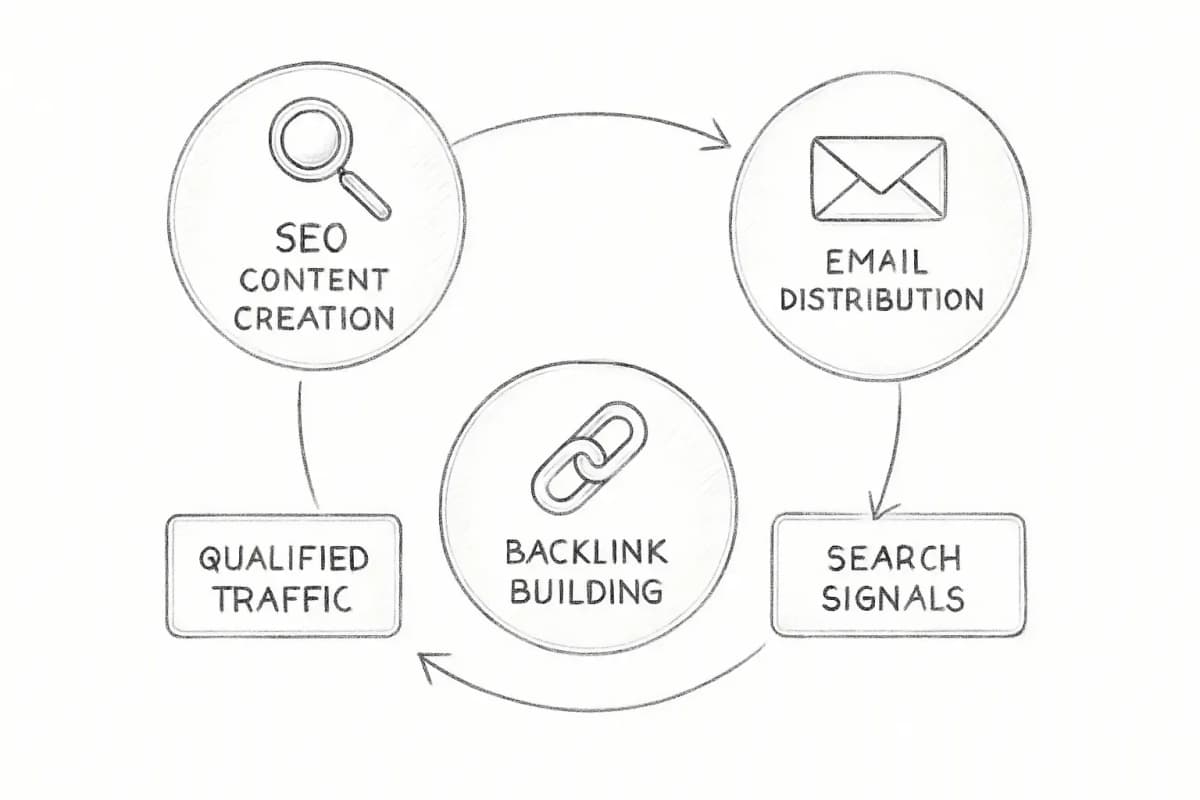
Email marketing and SEO integration workflow diagram showing three connected circular nodes. Left node represents SEO content creation with keyword research and optimization. Center node shows email distribution to subscriber list. Right node displays backlink building and brand authority signals. Arrows flow clockwise between nodes showing how email drives traffic to content, traffic generates backlinks and branded searches, which improve search rankings, which creates more SEO opportunities for email promotion. Include icons or visual indicators for each element (magnifying glass for SEO, envelope for email, link chain for backlinks). Color scheme uses blues and greens to represent the amplification cycle.


Frequently Asked Questions

Does email marketing directly affect Google search rankings?

Email marketing does not directly help Google rankings. Google does not crawl your emails. However, it helps indirectly by driving high-quality traffic, increasing branded searches, and improving user engagement signals like dwell time and lower bounce rates.

What should an SEO email marketing template include?

An SEO email marketing template should include a subject line, a brief introduction with your company name and details, a call to action, and a closing section. Beyond the basics, it should feature a personalized opening, a specific value proposition, keyword-aligned copy, and a single clear CTA pointing to an SEO-optimized page.

How do I use email marketing to build backlinks?

Start with a linkable asset, such as original data, a free tool, or a comprehensive guide. Then use a targeted outreach template that personalizes each email to the recipient's existing content. A 2025 survey put the average acceptable cost of one high-quality backlink at roughly $508.95, which makes systematic email outreach compelling economics. About 93.8% of SEOs say link quality beats volume, so target fewer, higher-fit domains instead of sending mass blasts.

How often should I send SEO-driven email campaigns?

Frequency depends on your list size and content output, but consistency matters more than volume. About 93% of people use email every day, and 58% say email is the first thing they check online in the morning, so a well-timed email can be the first message they see all day. A weekly or bi-weekly newsletter that links to your latest SEO content is typically enough to generate consistent traffic signals without fatiguing subscribers.

Can I repurpose email content into blog posts for SEO?

Yes, and it's one of the highest-leverage moves available to content teams. When you reformat an email for your blog, you may add additional long-tail keywords, internal links, or additional contextual information to enhance its impact. Updated statistics, data, and quotes can transform a personalized email into a general-interest piece that appeals to a wider audience. Always rewrite enough to avoid duplicate content penalties, and optimize the published version for a specific target keyword.


No comments yet. Be the first!

Leave a comment

Comments are reviewed before publishing.

Email marketing and SEO integration workflow diagram showing three connected circular nodes. Left node represents SEO content creation with keyword research and optimization. Center node shows email distribution to subscriber list. Right node displays backlink building and brand authority signals. Arrows flow clockwise between nodes showing how email drives traffic to content, traffic generates backlinks and branded searches, which improve search rankings, which creates more SEO opportunities for email promotion. Include icons or visual indicators for each element (magnifying glass for SEO, envelope for email, link chain for backlinks). Color scheme uses blues and greens to represent the amplification cycle.


Frequently Asked Questions

Does email marketing directly affect Google search rankings?

Email marketing does not directly help Google rankings. Google does not crawl your emails. However, it helps indirectly by driving high-quality traffic, increasing branded searches, and improving user engagement signals like dwell time and lower bounce rates.

What should an SEO email marketing template include?

An SEO email marketing template should include a subject line, a brief introduction with your company name and details, a call to action, and a closing section. Beyond the basics, it should feature a personalized opening, a specific value proposition, keyword-aligned copy, and a single clear CTA pointing to an SEO-optimized page.

How do I use email marketing to build backlinks?

Start with a linkable asset, such as original data, a free tool, or a comprehensive guide. Then use a targeted outreach template that personalizes each email to the recipient's existing content. A 2025 survey put the average acceptable cost of one high-quality backlink at roughly $508.95, which makes systematic email outreach compelling economics. About 93.8% of SEOs say link quality beats volume, so target fewer, higher-fit domains instead of sending mass blasts.

How often should I send SEO-driven email campaigns?

Frequency depends on your list size and content output, but consistency matters more than volume. About 93% of people use email every day, and 58% say email is the first thing they check online in the morning, so a well-timed email can be the first message they see all day. A weekly or bi-weekly newsletter that links to your latest SEO content is typically enough to generate consistent traffic signals without fatiguing subscribers.

Can I repurpose email content into blog posts for SEO?

Yes, and it's one of the highest-leverage moves available to content teams. When you reformat an email for your blog, you may add additional long-tail keywords, internal links, or additional contextual information to enhance its impact. Updated statistics, data, and quotes can transform a personalized email into a general-interest piece that appeals to a wider audience. Always rewrite enough to avoid duplicate content penalties, and optimize the published version for a specific target keyword.

No comments yet. Be the first!

Leave a comment

Comments are reviewed before publishing.

More from

Related posts

Illustration for home services email marketing templates
Email Templates & ExamplesMay 17, 2026 13 min

Home Services Email Marketing Templates

Ready-to-use email templates designed for home service businesses. Increase bookings and customer retention with proven layouts.

More from

Related posts

Illustration for home services email marketing templates
Email Templates & ExamplesMay 17, 2026 13 min

Home Services Email Marketing Templates

Ready-to-use email templates designed for home service businesses. Increase bookings and customer retention with proven layouts.

S
Sarah Mitchell
S
Sarah Mitchell
Illustration for marketing email template design
Email Templates & ExamplesMay 17, 2026 10 min

Email Template Design: Build Effective Templates

Learn proven email template design principles that boost engagement and conversions. Discover layouts, mobile optimization, and best practices for better results.

PPriya Kapoor
Illustration for marketing email template design
Email Templates & ExamplesMay 17, 2026 10 min

Email Template Design: Build Effective Templates

Learn proven email template design principles that boost engagement and conversions. Discover layouts, mobile optimization, and best practices for better results.

PPriya Kapoor
Illustration for contractor email marketing templates
Email Templates & ExamplesMay 17, 2026 12 min

Contractor Email Marketing Templates That Convert

Ready-to-use contractor email marketing templates for service businesses. Customize them to boost client engagement and close more jobs.

RRachel Torres
Illustration for contractor email marketing templates
Email Templates & ExamplesMay 17, 2026 12 min

Contractor Email Marketing Templates That Convert

Ready-to-use contractor email marketing templates for service businesses. Customize them to boost client engagement and close more jobs.

RRachel Torres