
Nearly 63% of marketers now use AI tools in their email marketing efforts, and the results are hard to ignore. Companies using AI-driven email strategies see up to 41% more revenue than those using traditional batch-and-blast sends, and 76% of marketing teams can now produce and send a marketing email within three days, a dramatic shift from the weeks-long production cycles that were standard before AI. If you are trying to figure out what AI services excel at email marketing, the answer depends on which part of your email workflow you need to improve: content creation, segmentation, automation, send-time optimization, or all of the above. This guide breaks down the leading AI services by what they actually do well, so you can pick the right tools for your specific goals.
Key Takeaways
- The market for AI in email marketing is projected to grow at a CAGR of 26.3%, reaching $2.7 billion by 2025 according to Statista, signaling how central AI has become to the channel.
- Omnisend's 2025 data shows automated emails pulling 52% higher open rates than scheduled campaigns, with automated emails driving far more revenue relative to their send volume.
- AI email personalization has led to a 13.44% increase in click-through rates for marketers, with behavior-based approaches delivering even larger gains.
- Klaviyo's 2025 State of Email report found that brands using AI-driven segments saw revenue per recipient increase by 18 to 45% compared to traditional demographic segmentation.
- Marketers implementing AI report saving up to 30% of their total working time previously consumed by email production activities.
What Makes an AI Email Marketing Service Actually Good?
Not every tool that claims to use AI delivers meaningful performance gains. The services worth using share a few concrete traits: they analyze real behavioral data rather than surface-level demographics, they integrate deeply with your existing tech stack, and they improve outcomes across multiple email metrics simultaneously, not just one vanity figure.
AI email marketing tools are software platforms that apply machine learning, predictive analytics, and generative AI to execute email campaigns. These tools analyze customer data and campaign performance to automate decisions that traditionally required manual effort, like writing copy or choosing send times.
The strongest platforms do not treat AI as a separate feature bolted onto a legacy system. They build intelligence into the core workflow, from audience segmentation to send-time decisions to copy generation.
There are essentially two categories to consider:
- Platform AI: Full email service providers like Klaviyo, ActiveCampaign, and HubSpot that have embedded AI across the entire campaign lifecycle.
- Specialist AI: Tools like Jasper and Lavender that solve one specific problem extremely well, such as copywriting or subject line coaching.
The tools on the market represent a spectrum from full AI autonomy to AI-assisted human writing. The industry is moving from batch-and-blast to per-recipient intelligence. Traditional email marketing sends one campaign to a segment. AI email marketing researches each recipient individually and adapts content, timing, and channel accordingly.
Klaviyo: Best for Ecommerce and B2C Lifecycle Email
Klaviyo is the autonomous B2C CRM and AI marketing platform that unifies customer data and automates email, SMS, RCS, WhatsApp, and mobile push to drive personalized, revenue-generating campaigns.
For ecommerce teams, Klaviyo is the clearest answer to the question of what AI services excel at email marketing. Its AI capabilities span three functional areas:
Klaviyo's AI functionalities are strategically organized into prediction (enabling you to anticipate customer behavior, such as next purchase date and potential lifetime value), personalization (facilitating dynamic adjustments to timing, content, and offers tailored to individual subscribers), and automation (streamlining your workflow by assisting with content creation, email A/B testing, and continuous optimization).
The practical results are measurable. On average, Klaviyo users earn a 63x ROI on their email marketing. Massachusetts seafood retailer Svenfish now attributes 82% of their year-to-date Klaviyo-attributed revenue to using one or more of Klaviyo's AI features. Garrett Popcorn used Klaviyo AI to segment their messages and saw 4x higher revenue per recipient.
Instead of adding AI as an external add-on, Klaviyo integrates it directly into existing workflows, allowing brands to automate 1:1 experiences faster, build advanced campaigns without IT support, and save time by consolidating marketing and service stacks. The result is an average ROI increase of 228% for businesses that fully leverage these capabilities.
Klaviyo's Composer agent is particularly useful for growth teams: a marketer describes a goal, such as "launch a summer re-engagement campaign for customers who haven't purchased in 90 days," and Composer identifies the right audience, drafts email and SMS content, sequences the timing, and queues everything for review, in minutes.
The main limitation: Klaviyo excels at ecommerce email marketing with deep Shopify integration, predictive analytics, and revenue tracking, but these features add limited value for non-ecommerce businesses.
For deeper guidance on segmentation strategy, see our guide to email list segmentation strategies that boost ROI by 760%.
ActiveCampaign: Best for B2B and Marketing Automation
Independent review site EmailToolTester named ActiveCampaign the Best Email Marketing Tool of 2025, praising its simple yet powerful platform, specifically highlighting deliverability, AI features, and responsive support.
ActiveCampaign's AI engine, Active Intelligence, sets it apart in the mid-market B2B space. In May 2025, ActiveCampaign introduced Active Intelligence, described not just as another AI feature, but as a complete reimagining of how marketing automation works, evolving it into autonomous marketing. Active Intelligence is a system-wide intelligence engine powered by billions of data points and dozens of specialized AI agents working together.
The AI Campaign Builder generates complete campaigns from a single natural language prompt, including subject lines, body copy, CTAs, and automation flows. Teams create campaigns 3x faster than building manually.
ActiveCampaign's AI-powered marketing software boosts campaign performance by automating key tasks like content creation, audience segmentation, and send-time optimization. The platform's AI agents analyze billions of data points to recommend the best strategies, personalize messages for each contact, and ensure emails land at the optimal time for engagement.
From a pricing standpoint, ActiveCampaign is the best value for AI-enhanced email among mid-market platforms. You get predictive sending and engagement scoring on the Plus plan ($49 per month), while comparable features on HubSpot require Professional ($800 or more per month). For small-to-midsize B2B, it is the right choice.
HubSpot: Best for CRM-First Teams
HubSpot's strength is the integration between email and the full CRM data layer. For teams already using HubSpot across sales and service, its email AI is a natural extension rather than a separate workflow.
HubSpot's AI Email feature is a core component of its marketing automation workflows. You can set triggers based on customer behavior, and the AI will automatically generate and send hyper-personalized email content based on deep CRM data, all without direct human intervention for each send. This integration moves campaigns beyond simple, pre-written templates into a new era of intelligent, context-aware communication. Instead of just automating the sending of an email, you are now automating the creation and personalization of it.
The performance data from HubSpot's own team is notable. HubSpot's demand generation team used AI to transform their email nurturing strategy, analyzing user behavior and website data to deliver hyper-personalized content recommendations. By using GPT-4 to understand intent and match users with relevant courses, they achieved an 82% higher conversion rate, 30% better open rate, and 50% lift in click-throughs.
HubSpot has moved past batch-and-blast. Its AI Email engine turns CRM context into dynamic, conversion-ready content.
Jasper: Best for AI-Powered Email Copywriting
Jasper is not an email sending platform. It is a content generation tool, and it excels at the specific task of writing compelling email copy at volume.
Jasper excels at generating email copy. If your bottleneck is writing compelling subject lines, body copy, and CTAs rather than automation or deliverability, Jasper fills that gap better than any ESP's built-in AI.
Testing for email copy A/B testing found that Jasper can generate 10 subject line variants and 5 body copy versions for a product launch email. The Brand Voice feature maintained consistent tone across all variants, and the template library provided frameworks for welcome sequences, re-engagement, and promotional campaigns. Quality was noticeably higher than what Mailchimp or ActiveCampaign's built-in AI produced.
Jasper is best used as a complement to your email platform rather than a replacement for it, particularly for teams where content quality and brand consistency are the primary concern. Pair it with platform-level automation to get the best of both.
AI-Powered Send-Time Optimization: Where Every Platform Delivers
Regardless of which platform you choose, send-time optimization (STO) is one of the most consistent and high-return AI applications in email marketing.
Rather than relying on broad averages, AI analyzes individual recipient behavior to determine when each subscriber is most likely to engage. The impact potential is a 20 to 30% improvement compared to arbitrary send times.
Rather than setting a send time and applying it to the entire list, AI systems analyze each subscriber's historical activity patterns to determine when they are most likely to be in their inbox and engaged. If a subscriber habitually opens emails between 7:30 and 9:00 a.m. on weekdays, the system will queue their send accordingly. The impact is incremental by nature, typically lifting open rates by a few percentage points rather than tens of percentage points. But at scale, across a list of hundreds of thousands, those few percentage points translate into significant additional opens, clicks, and conversions.
Mailchimp, Klaviyo, and HubSpot all offer built-in STO features, and all three report consistent double-digit open rate improvements when enabled.
For a deeper look at subject line optimization in combination with AI, read our post on email subject line best practices that boost open rates by 27%.
AI for Segmentation and Personalization: The Revenue Driver
Of all the things AI services do well in email marketing, behavioral segmentation produces the largest revenue impact.
Email campaigns targeted to specific audience segments deliver dramatically higher revenue than undifferentiated mass sends, with properly segmented lists generating up to 760% more revenue. This extraordinary multiplier effect results from improved relevance: recipients receive offers, content, and messaging aligned with their specific interests, purchase history, and engagement level. The finding demonstrates that segmentation strategy matters more than send volume or creative execution.
AI-driven personalization of email copy results in a 13% or more increase in CTR. Behavior-based personalization using purchase history data boosts CTR by up to 39%.
The strongest platforms now support newsletter sends with AI-assisted subject lines, timing, and segmentation, alongside automatic audience grouping based on behavior instead of static lists.
This is where AI genuinely earns its place. Manual segmentation based on demographic data is slow, static, and limited. Behavioral AI segments update in real time based on purchases, browsing, email engagement, and lifecycle stage, without a marketer manually maintaining rules.
For techniques you can apply directly, see our guide on email personalization techniques that boost conversions 47%.
How to Choose the Right AI Email Service for Your Business
The right choice depends on your primary bottleneck and the type of email program you run:
- Ecommerce or DTC brand with Shopify: Klaviyo is the clearest fit, with deep integration, predictive analytics, and revenue attribution built in.
- B2B or SaaS with complex nurture sequences: ActiveCampaign's AI automation builder and predictive sending give you enterprise-grade intelligence at mid-market pricing.
- CRM-first teams already on HubSpot: HubSpot's AI Email engine is the path of least resistance, with full CRM context informing every campaign.
- Teams where copy quality is the constraint: Jasper delivers higher-quality content than most platform-native AI writers, and it integrates with your existing ESP.
In 2025, 49% of marketers use generative AI for static copy creation, and the number of marketers using AI-powered image generation has increased by 340% in the last year. The point is not to pick one AI tool. Most high-performing email programs layer platform AI (for automation, segmentation, and send-time optimization) with specialist AI (for copy and creative) to get results in every area. 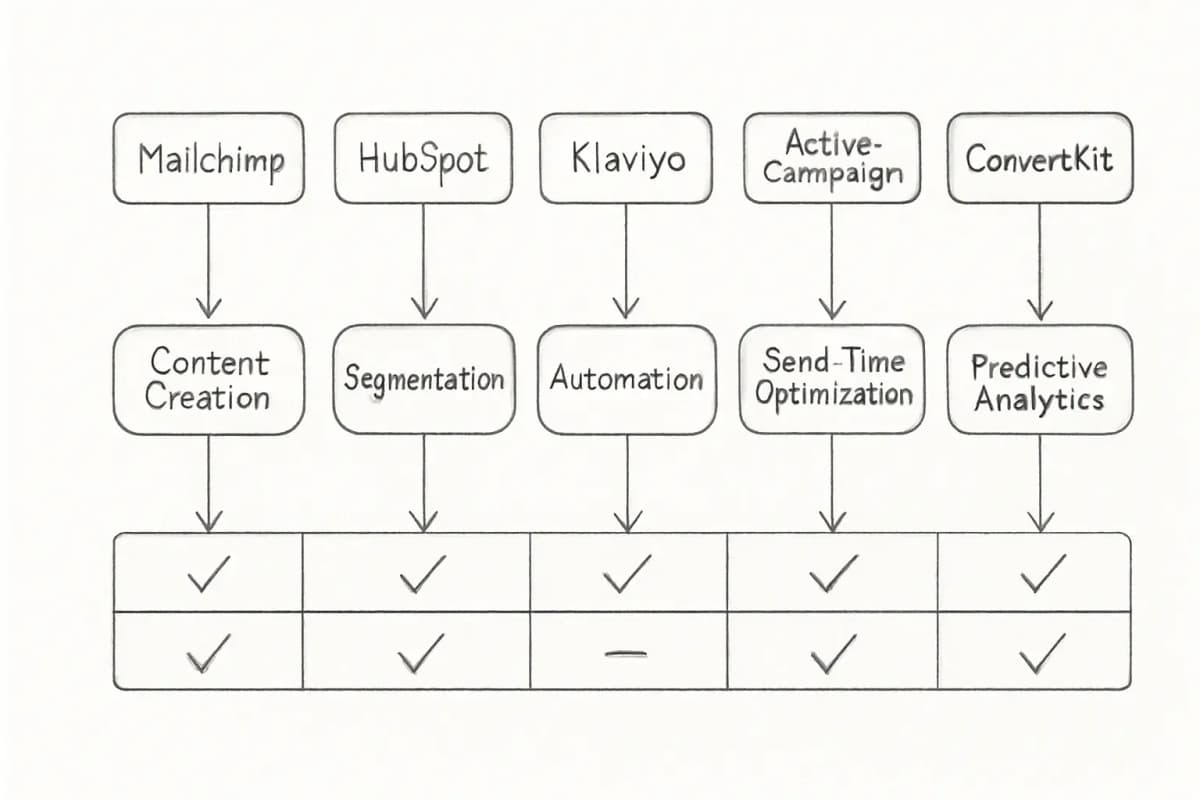
Frequently Asked Questions
What AI services excel at email marketing for small businesses?
Mailchimp remains the most widely used platform globally and has steadily added AI features including predictive demographics, send-time optimization, and an AI marketing assistant. It is best suited for small and mid-sized businesses. ActiveCampaign is also a strong option for small businesses that need behavior-based automation, with AI features available on plans starting at $49 per month.
How much of a revenue lift can AI actually produce in email marketing?
The data is specific. Companies using AI-driven email strategies see up to 41% more revenue than those using traditional batch-and-blast sends. Predictive recommendations increase revenue per email by an average of 41%. Results vary by data quality, list size, and how deeply the AI features are implemented, but the directional impact is consistently positive across platforms.
Is AI-generated email copy as effective as copy written by humans?
Nearly half of all email marketers now leverage AI for analytical support and content creation, indicating growing trust in AI's ability to produce engaging and relevant messaging. This shift saves significant time and resources while maintaining quality, as AI tools can generate subject lines, body copy, and calls-to-action based on historical performance data. The trend accelerates as marketers discover AI-generated content often outperforms manually written alternatives when properly trained on brand voice and audience preferences. That said, human review remains important, particularly for brand tone and factual accuracy.
What is the future of AI in email marketing?
AI adoption in email marketing is projected to reach 97% by 2030. The trajectory points toward agentic AI systems that manage entire email channels with minimal human intervention, true 1:1 personalization where every element of every email is generated uniquely for each subscriber, and deeper integration with real-time behavioral data sources that make email a continuous conversation rather than a scheduled broadcast.