
Millions of Outlook.com users lost access to their email on Monday, April 27, 2026, after a widespread Microsoft service disruption left many unable to log in across the web, desktop, and mobile. According to CyberMaterial, the incident caused intermittent inbox loading failures, delayed email delivery, and a complete inability to reach the webmail interface for users across multiple regions.
Microsoft officially confirmed "service degradation" for the email service, acknowledging that users were experiencing sign-in issues and unexpected sign-outs. The company's official Microsoft 365 Status account on X posted its last status update at 10:15 AM UTC on April 27.
What Broke and Who Was Affected
The outage triggered a surge in user reports beginning around 4:50 AM ET, causing intermittent sign-in failures and preventing users from sending or receiving emails. The disruption hit the platform's web version, desktop client, and mobile applications simultaneously, making it one of the more far-reaching email outages the service has seen in recent memory.
According to data from Downdetector, nearly 900 reports of service failures were recorded globally, with more than 800 users flagging issues in the UK and over 400 reports originating from the United States. Technical metrics indicate the primary obstacle was account authentication, with 64% of affected users experiencing login failures, 24% reporting mobile app problems, and 10% citing message delivery failures.
Microsoft indicated the root issue may involve authentication key failures, though engineers were still working to determine the precise cause. The nature of the failure created confusion for IT departments, as repeated password prompts can resemble signs of compromised accounts, prompting many organizations to initiate internal security checks.
The Broader Pattern of Microsoft 365 Instability
Monday's outage did not happen in isolation. It is part of a broader pattern of Microsoft 365 service instability that has dogged the platform throughout early 2026, following a significant multi-service disruption in January that affected Outlook, Microsoft Teams, Defender, and SharePoint.
In April 2026, an earlier outage had already taken down Microsoft 365, Teams, Outlook, and Azure simultaneously, with Microsoft attributing the disruption to an external service dependency affecting multiple platform components.
The deliverability pressure on the platform runs deeper than single-day outages. As Engagor documented, Microsoft deployed aggressive rate limiting in February 2026 that swept across the industry, catching enterprise email security platforms, dedicated hosting providers, SaaS transactional senders, and small mail operators in the same net. Microsoft's consumer mail filtering has become meaningfully less predictable, with error codes that do not reliably indicate the nature of the problem and self-service tools that do not reliably reflect the actual state of sending reputation.
What This Means for Email Marketers and Growth Teams
For marketers whose campaigns reach Outlook.com and Hotmail inboxes, platform-level outages carry consequences that outlast the downtime itself. Previous outages have clogged Exchange Online queues, causing SMTP handoffs from providers like Mailchimp to register as hard bounces, triggering list purges and halted campaigns. Those false positives can suppress lists and distort deliverability metrics for weeks.
Small and medium-sized businesses are particularly exposed, especially those without alternative communication channels, given that Outlook is the primary platform for client interaction for many of them, making even short outages costly.
The instability also intersects with Microsoft's own tightening enforcement posture. As Egen Consulting noted, Microsoft has begun enforcing stricter email authentication and sender-reputation standards across Outlook, Hotmail, and Microsoft 365 in 2026. Unauthenticated email is increasingly blocked or throttled, and domains without alignment between SPF, DKIM, and DMARC are treated as risky. An outage that disrupts authentication infrastructure compounds this risk for senders who are not already fully compliant. 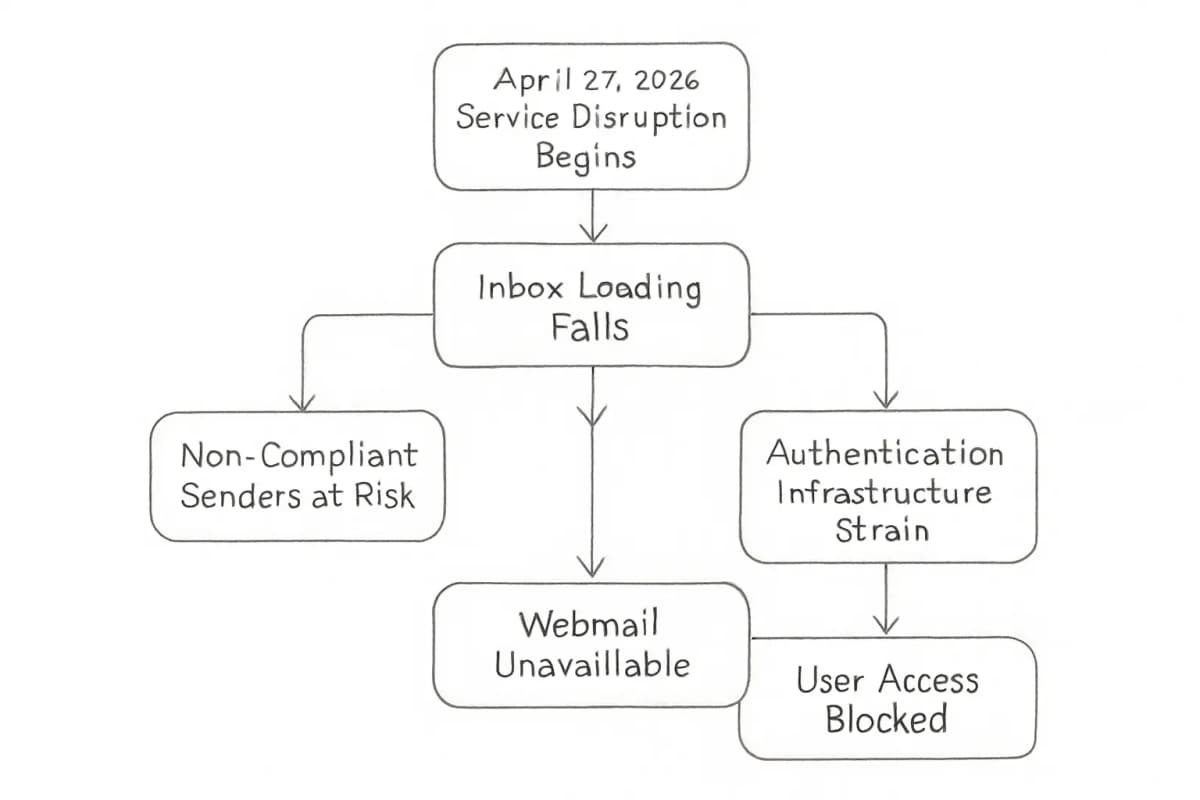
What to Do Right Now
If your team sends campaigns to Outlook or Hotmail addresses, here are practical steps to protect deliverability during and after a provider-side outage:
- Pause time-sensitive sends while the incident is active. Emails queued against a degraded infrastructure accumulate soft bounces and retry noise that distorts your sender reputation data.
- Check your ESP bounce reports carefully. Email operations professionals have described Mailchimp SMTP relays timing out against Microsoft's recovering servers, generating false positives that look like genuine hard bounces.
- Do not suppress or unsubscribe bounced addresses immediately. Wait 48 to 72 hours and cross-reference against your normal bounce rate baseline before making list decisions.
- Verify SPF, DKIM, and DMARC alignment. Research shows that only 16% of domains have implemented DMARC, which leaves the majority of senders more exposed when Microsoft's authentication infrastructure behaves unpredictably.
- Monitor Microsoft's Service Health Dashboard for real-time incident updates rather than relying on third-party trackers alone.
Microsoft confirmed on April 27 at 08:58 AM UTC that its fix deployment was progressing and was scheduled for completion by Tuesday, April 28, 2026. Full restoration timelines for platform-level incidents, however, rarely account for the downstream deliverability effects that linger after the servers come back online. For email teams, recovery planning starts now, not after the status page turns green.