
PowerDMARC, an email authentication platform serving more than 10,000 organizations across 130 countries, will exhibit at Stockholm Tech Show 2026 on May 26 and 27 at Kistamässan, Stockholm. The appearance puts one of the DMARC market's most recognized vendors directly in front of the Nordic region's cybersecurity and digital transformation decision-makers at a moment when email authentication has become a business-critical discipline, not just a security checkbox.
The company will demonstrate its AI-powered DMARC platform at booth E-20 during an event that has grown into a significant gathering for European technology leaders.
Why Stockholm, Why Now
Stockholm Tech Show brings together over 5,000 decision-makers, 250 or more exhibitors, and leading European voices in AI, cybersecurity, cloud, DevOps, and data infrastructure. For PowerDMARC, the timing is deliberate. The Nordic market sits at the intersection of high digital adoption and growing regulatory pressure on email security, making it a natural expansion target for a platform that spans compliance, deliverability, and threat detection.
The company arrives with fresh momentum. PowerDMARC was recognized as a Leader in G2's Spring 2026 Reports for DMARC Software and was also named a Regional Leader across EMEA, Asia, Asia Pacific, and Europe. The platform holds SOC 2 Type 2, ISO 27001, and GDPR compliance certifications, credentials that carry particular weight with European enterprise buyers.
What Attendees Will See at Booth E-20
Visitors to the PowerDMARC stand will get access to an all-in-one email authentication suite covering hosted DMARC, SPF, DKIM, BIMI, MTA-STS, and TLS-RPT from a single dashboard, alongside DMARC AI: real-time, AI-driven threat detection and autonomous policy guidance that reduces incident response time from days to minutes.
That AI layer is central to PowerDMARC's current product story. PowerDMARC's DMARC AI assistant is an integrated tool within the platform that provides real-time, AI-driven guidance on SPF, DKIM, and DMARC configurations, offering instant insights into threat intelligence, identifying malicious IPs, and enabling autonomous enforcement of DMARC policies.
The platform is also MSP/MSSP-ready with multi-tenancy and white-label capabilities built for partners managing hundreds of client domains, and live demonstrations will cover the domain health checker, one-click DNS publishing, and human-readable DMARC reporting.
The company serves more than 10,000 customers in over 130 countries and partners with 2,000 or more MSPs and MSSPs worldwide.
The Authentication Gap That Makes This Matter
The Stockholm appearance reflects a genuine market problem, not just a product launch moment. DMARC adoption has reached 937,931 domains (52.1%) in 2026, up from 47.7% in 2025, according to EasyDMARC's 2026 DMARC Adoption Report. But adoption and protection are not the same thing.
Of those domains with valid DMARC records in early 2026, more than 525,996 remain at p=none, the monitoring-only policy that does nothing to stop spoofed emails from reaching inboxes, meaning more than half of all DMARC-enabled domains offer zero active protection.
The threat environment pressing organizations to close that gap is accelerating. Industry analysis shows that 82.6% of phishing emails now contain AI-generated content, and manually crafted phishing emails that once took attackers 16 hours to produce can now be generated in as little as five minutes. For marketing and growth teams, this matters beyond security: authenticated emails are more likely to land in the primary inbox rather than spam or quarantine folders, leading to higher open rates, better engagement, and more conversions.
The average cost of a phishing-related breach reached approximately $4.88 million in 2025, according to PowerDMARC's own phishing statistics research. That figure gives finance and operations leaders a concrete basis for investing in enforcement, not just monitoring. 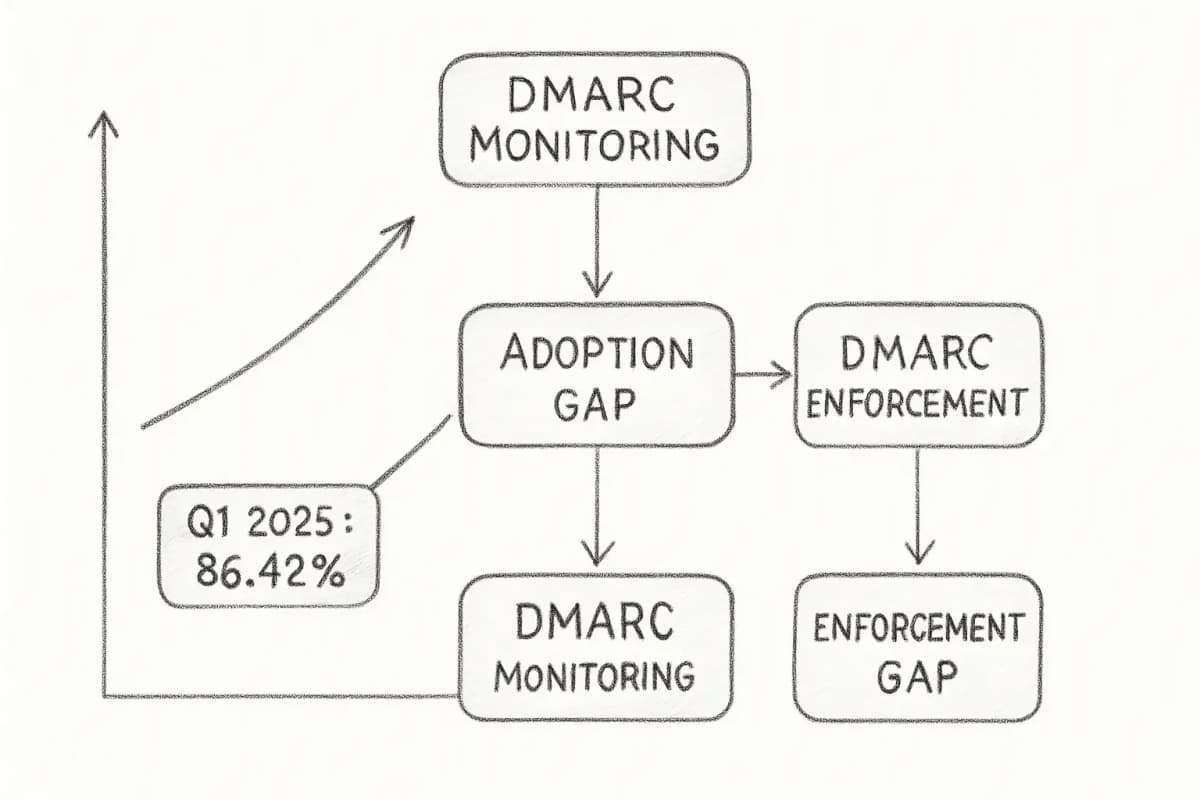
What This Means for Email Marketers and Growth Teams
For business owners and marketing teams, the Stockholm event is a useful prompt to audit where their own domains sit on the enforcement spectrum. The global DMARC pass rate hit 88.99% in Q1 2026, up from 86.42% in Q1 2025, according to TechnologyChecker.io's Q1 2026 analysis. That progress is real, but the gap between having a record and enforcing it remains wide.
Between 2023 and 2025, adoption surged as companies rushed to meet new sender requirements from major mailbox providers. In 2026, the industry is entering a new stage of maturity, where organizations are increasingly using DMARC reporting data to transition from monitoring policies to enforcement policies that actively prevent domain abuse.
Platforms like PowerDMARC are positioning AI as the practical bridge between those two stages: organizations that have set up a p=none record but never moved toward p=reject now have tools that analyze their traffic automatically and guide the transition without requiring manual XML report parsing.
PowerDMARC CEO Maitham Al Lawati has framed the company's mission around accessibility: "Stockholm Tech Show is one of Europe's most exciting forums for innovation, and we're thrilled to bring PowerDMARC's email authentication expertise to the Nordic community. With phishing and impersonation attacks evolving rapidly, our mission is to make robust DMARC enforcement accessible to every organization, from growing SMBs to global enterprises."
Teams attending Stockholm Tech Show can meet the PowerDMARC team at booth E-20, or book a demo in advance to learn more about the platform at powerdmarc.com.