
Email
Email

A modern blog built with Payload CMS, Next.js, and shadcn/ui.

RSS FeedSitemap

Explore

  • Blog
  • News
  • Statistics
  • Authors

Categories

  • CRM & Email Marketing Tools
  • Email Analytics & Reporting
  • Email Security & Compliance
  • Email Automation
  • Email List Building
  • Seasonal & Holiday Email Marketing
  • Email Marketing Benchmarks & Statistics
  • Email Design & Personalization

Latest articles

  • Best Free AI Email Marketing Tools in 2024Jul 20, 2026
  • Email Marketing Automation by ConversionJul 20, 2026
  • Email Marketing Automation Comparison: 2024Jul 20, 2026
  • Email and Marketing Automation Meaning: A GuideJul 20, 2026

Popular topics

  • #deliverability and segmentation
  • #beauty brand email strategy
  • #skincare email marketing
  • #Marketing
  • #email engagement metrics
  • #Content Generation
  • #Sales Efficiency
  • #Cyber Monday Trends
  • #Email Campaign Benchmarks
  • #Holiday Marketing Statistics
  • #BFCM Email Strategy
  • #Enterprise Email
  • #credit card marketing
  • #Business Software
  • #CRM Software
  • #MarTech

Stay in the loop

Join 2,000+ readers. Unsubscribe anytime.

Subscribe
Email

© 2026 Email. All rights reserved.

SitemapRSS
HomeNewsAI Integration Boosts Email ROI 75 Percent, Validity Research Finds
Email Automation

AI Integration Boosts Email ROI 75 Percent, Validity Research Finds

New research shows marketing teams with deep AI integration are 75% more likely to achieve 45:1 ROI. Only 12% of organizations have achieved this depth yet.

P

Priya Kapoor

April 15, 2026

4 min read
Share:
#Email Personalization#Email Automation#Email Analytics#ROI
Illustration for report: AI Integration Boosts Email ROI 75 Percent, Validity Research Finds

Stay in the loop

Get the latest posts delivered straight to your inbox. No spam, unsubscribe anytime.

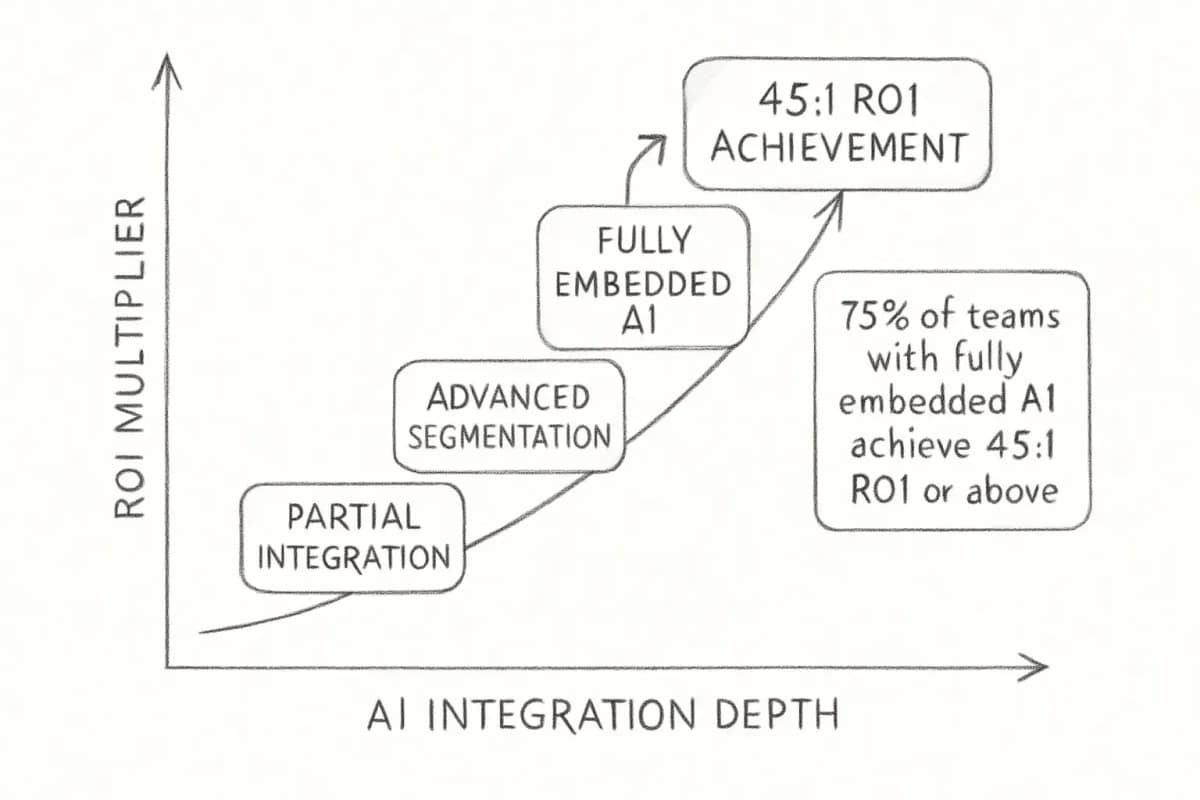
Marketing teams that have fully embedded AI into their email workflows are 75% more likely to hit an ROI above 45:1, according to new research published April 14, 2026 by Validity. The findings, drawn from the State of Email 2026 report, mark a clear dividing line in email performance: organizations treating AI as a surface-level tool are falling behind those that have woven it into their core decision-making.

Produced by Litmus from Validity, the report is based on responses from more than 500 marketing professionals across the U.S., U.K., Australia, and New Zealand, and focuses specifically on how the depth of AI integration affects campaign performance and ROI efficiency.

The AI Integration Gap Is Widening

The research shows that advanced AI adopters, meaning marketing teams that have embedded AI into their workflows and decision-making processes, are seeing stronger email ROI. These teams are 75% more likely to achieve returns above 45:1 from their email campaigns.

The gap in outcomes is not just about using AI tools. It is about how deeply those tools are integrated.

Validity's recent AI Plans and Priorities report suggests many marketers are still struggling to reach full integration. Just 12% of organizations described their AI maturity as "integrated," and 17% reported either pausing AI initiatives or having no program at all.

Cynthia Price, SVP of Marketing at Validity, noted that "the data demonstrates what marketers have suspected since the start of the AI boom: that fully embedding AI across your operations significantly increases your email ROI."

She also pointed to indirect benefits, including savings from avoided compliance costs, reputational damage from poorly targeted campaigns, and unnecessary headcount additions.

For growth teams tracking channel efficiency, this is a consequential finding.

Email already ranks as the most effective channel for 41% of marketing professionals, far outpacing social media and paid search, which tied for second at just 16% each.

AI integration appears to be the mechanism that separates strong performers from the rest within that channel.

Smaller Lists, Higher Frequency

One of the more counterintuitive findings in the report concerns list size and sending volume.

Validity's 2026 Deliverability Benchmark Report shows that year-over-year sending volume decreased for the first time in 2025.

Yet the teams generating the best results are actually sending more often, not less.

Companies with the highest click-through rates (above 5%) are 30% more likely to send daily emails. This points to high performers leaning into tight lists of highly engaged recipients rather than blasting at scale.

This shift reflects a broader industry realignment.

Engagement quality, not volume, has become the defining performance factor in email marketing.

The data also aligns with what deliverability research consistently shows:

email marketing performance has entered a new era defined by engagement depth over volume, with brands relying on batch-and-blast campaigns seeing diminishing returns, while those embracing predictive automation, advanced segmentation, and behavioral targeting are experiencing significant growth. A chart or graph showing email ROI correlation with AI integration depth. The visualization should display a clear upward trend line or progression showing how deeper AI integration (from surface-level tool use to fully embedded in core workflows) directly correlates with higher ROI outcomes. Include specific data points: 75% of teams with fully embedded AI achieve 45:1 ROI or above, contrasted against teams using AI as surface-level tool with lower ROI. Use a gradient or color coding to show the progression from shallow to deep AI integration on the x-axis, and ROI multiplier on the y-axis.
Privacy Compliance Drives ROI in APAC

The research also surfaced a regional finding with wider strategic implications.

Marketers in Australia and New Zealand are 63% more likely than U.S. and U.K. teams to achieve an ROI above 45:1. Validity's experts attribute this gap to strict privacy protections and data-handling obligations in the Asia-Pacific region, which discourage low-quality or non-consensual messaging and, in turn, increase subscriber trust in the emails reaching their inboxes.

This is a meaningful signal for any marketing team still treating consent and list hygiene as compliance boxes rather than performance levers. Cleaner lists built on genuine consent produce engaged subscribers, and engaged subscribers convert.

What This Means for Your Email Strategy

The Validity data, taken together, points to three actionable shifts:

  1. Deepen AI integration across workflows, not just content creation. Teams using AI only for copy generation are not capturing the ROI benefit. The 75% lift belongs to those embedding AI in segmentation, testing, scheduling, and analytics.
  2. Prioritize list quality over list size.

Segmented email campaigns generate 30% more opens and 50% more click-throughs, and 78% of marketers say segmentation is their most effective tactic.

If your volume is high but your click-through rate is below 5%, the research suggests consolidating to a more engaged core audience. 3. Treat consent as a performance strategy. The APAC finding is not a regional curiosity. It is a preview of where email marketing is heading globally as mailbox providers continue to weight engagement signals more heavily in inbox placement decisions.

As Price put it: "Marketers are not short on ambition when it comes to AI, but ambition without the right foundational efforts and infrastructure is just noise."

The 2026 data makes clear that infrastructure, meaning integrated AI, engaged lists, and genuine consent, is precisely where the returns are being earned.

The full State of Email 2026 report is available at litmus.com.

No comments yet. Be the first!

Leave a comment

Comments are reviewed before publishing.

Breaking

Related news

Illustration for product_launch: Google Ads Connector Just Launched for Active Intelligence
Email AutomationJul 11, 2026 5 min

Google Ads Connector Just Launched for Active Intelligence

ActiveCampaign launches Google Ads connector for Active Intelligence, enabling marketers to create Performance Max campaigns directly in the platform with AI guidance and conversational prompts.

PPriya Kapoor
Illustration for expansion: Reachly Launches US Services After $3M+ APAC Success
Email AutomationMay 5, 2026 4 min

Reachly Launches US Services After $3M+ APAC Success

APAC lead generation agency Reachly expands to US market after generating $3M+ pipeline. Multi-channel cold email strategy hits 2,500+ booked meetings.

SSarah Mitchell
Illustration for product_launch: Salesforce Summer '26: AI Agents Drive Email Marketing Forward
Email AutomationApr 26, 2026 5 min

Salesforce Summer '26: AI Agents Drive Email Marketing Forward

Salesforce's Summer '26 release prioritizes Agentforce-powered automation for email and multi-channel marketing. Learn what changes for Marketing Cloud users.

JJames Chen
HomeNewsAI Integration Boosts Email ROI 75 Percent, Validity Research Finds
Email Automation

AI Integration Boosts Email ROI 75 Percent, Validity Research Finds

New research shows marketing teams with deep AI integration are 75% more likely to achieve 45:1 ROI. Only 12% of organizations have achieved this depth yet.

P

Priya Kapoor

April 15, 2026

4 min read
Share:
#Email Personalization#Email Automation#Email Analytics#ROI
Illustration for report: AI Integration Boosts Email ROI 75 Percent, Validity Research Finds

Stay in the loop

Get the latest posts delivered straight to your inbox. No spam, unsubscribe anytime.

Marketing teams that have fully embedded AI into their email workflows are 75% more likely to hit an ROI above 45:1, according to new research published April 14, 2026 by Validity. The findings, drawn from the State of Email 2026 report, mark a clear dividing line in email performance: organizations treating AI as a surface-level tool are falling behind those that have woven it into their core decision-making.

Produced by Litmus from Validity, the report is based on responses from more than 500 marketing professionals across the U.S., U.K., Australia, and New Zealand, and focuses specifically on how the depth of AI integration affects campaign performance and ROI efficiency.

The AI Integration Gap Is Widening

The research shows that advanced AI adopters, meaning marketing teams that have embedded AI into their workflows and decision-making processes, are seeing stronger email ROI. These teams are 75% more likely to achieve returns above 45:1 from their email campaigns.

The gap in outcomes is not just about using AI tools. It is about how deeply those tools are integrated.

Validity's recent AI Plans and Priorities report suggests many marketers are still struggling to reach full integration. Just 12% of organizations described their AI maturity as "integrated," and 17% reported either pausing AI initiatives or having no program at all.

Cynthia Price, SVP of Marketing at Validity, noted that "the data demonstrates what marketers have suspected since the start of the AI boom: that fully embedding AI across your operations significantly increases your email ROI."

She also pointed to indirect benefits, including savings from avoided compliance costs, reputational damage from poorly targeted campaigns, and unnecessary headcount additions.

For growth teams tracking channel efficiency, this is a consequential finding.

Email already ranks as the most effective channel for 41% of marketing professionals, far outpacing social media and paid search, which tied for second at just 16% each.

AI integration appears to be the mechanism that separates strong performers from the rest within that channel.

Smaller Lists, Higher Frequency

One of the more counterintuitive findings in the report concerns list size and sending volume.

Validity's 2026 Deliverability Benchmark Report shows that year-over-year sending volume decreased for the first time in 2025.

Yet the teams generating the best results are actually sending more often, not less.

Companies with the highest click-through rates (above 5%) are 30% more likely to send daily emails. This points to high performers leaning into tight lists of highly engaged recipients rather than blasting at scale.

This shift reflects a broader industry realignment.

Engagement quality, not volume, has become the defining performance factor in email marketing.

The data also aligns with what deliverability research consistently shows:

email marketing performance has entered a new era defined by engagement depth over volume, with brands relying on batch-and-blast campaigns seeing diminishing returns, while those embracing predictive automation, advanced segmentation, and behavioral targeting are experiencing significant growth. A chart or graph showing email ROI correlation with AI integration depth. The visualization should display a clear upward trend line or progression showing how deeper AI integration (from surface-level tool use to fully embedded in core workflows) directly correlates with higher ROI outcomes. Include specific data points: 75% of teams with fully embedded AI achieve 45:1 ROI or above, contrasted against teams using AI as surface-level tool with lower ROI. Use a gradient or color coding to show the progression from shallow to deep AI integration on the x-axis, and ROI multiplier on the y-axis.

Privacy Compliance Drives ROI in APAC

The research also surfaced a regional finding with wider strategic implications.

Marketers in Australia and New Zealand are 63% more likely than U.S. and U.K. teams to achieve an ROI above 45:1. Validity's experts attribute this gap to strict privacy protections and data-handling obligations in the Asia-Pacific region, which discourage low-quality or non-consensual messaging and, in turn, increase subscriber trust in the emails reaching their inboxes.

This is a meaningful signal for any marketing team still treating consent and list hygiene as compliance boxes rather than performance levers. Cleaner lists built on genuine consent produce engaged subscribers, and engaged subscribers convert.

What This Means for Your Email Strategy

The Validity data, taken together, points to three actionable shifts:

  1. Deepen AI integration across workflows, not just content creation. Teams using AI only for copy generation are not capturing the ROI benefit. The 75% lift belongs to those embedding AI in segmentation, testing, scheduling, and analytics.
  2. Prioritize list quality over list size.

Segmented email campaigns generate 30% more opens and 50% more click-throughs, and 78% of marketers say segmentation is their most effective tactic.

If your volume is high but your click-through rate is below 5%, the research suggests consolidating to a more engaged core audience. 3. Treat consent as a performance strategy. The APAC finding is not a regional curiosity. It is a preview of where email marketing is heading globally as mailbox providers continue to weight engagement signals more heavily in inbox placement decisions.

As Price put it: "Marketers are not short on ambition when it comes to AI, but ambition without the right foundational efforts and infrastructure is just noise."

The 2026 data makes clear that infrastructure, meaning integrated AI, engaged lists, and genuine consent, is precisely where the returns are being earned.

The full State of Email 2026 report is available at litmus.com.

No comments yet. Be the first!

Leave a comment

Comments are reviewed before publishing.

Breaking

Related news

Illustration for product_launch: Google Ads Connector Just Launched for Active Intelligence
Email AutomationJul 11, 2026 5 min

Google Ads Connector Just Launched for Active Intelligence

ActiveCampaign launches Google Ads connector for Active Intelligence, enabling marketers to create Performance Max campaigns directly in the platform with AI guidance and conversational prompts.

PPriya Kapoor
Illustration for expansion: Reachly Launches US Services After $3M+ APAC Success
Email AutomationMay 5, 2026 4 min

Reachly Launches US Services After $3M+ APAC Success

APAC lead generation agency Reachly expands to US market after generating $3M+ pipeline. Multi-channel cold email strategy hits 2,500+ booked meetings.

SSarah Mitchell
Illustration for product_launch: Salesforce Summer '26: AI Agents Drive Email Marketing Forward
Email AutomationApr 26, 2026 5 min

Salesforce Summer '26: AI Agents Drive Email Marketing Forward

Salesforce's Summer '26 release prioritizes Agentforce-powered automation for email and multi-channel marketing. Learn what changes for Marketing Cloud users.

JJames Chen