
HomeBlogEmail Marketing StrategyAI for Personalized Email Marketing: Strategy Guide
Email Marketing Strategy

AI for Personalized Email Marketing: Strategy Guide

Learn how AI personalizes emails to boost open rates and revenue. Discover segment strategies, tools, and implementation steps for your campaigns.

R

Rachel Torres

July 13, 2026

15 min read
HomeBlogEmail Marketing StrategyAI for Personalized Email Marketing: Strategy Guide
Email Marketing Strategy

AI for Personalized Email Marketing: Strategy Guide

Learn how AI personalizes emails to boost open rates and revenue. Discover segment strategies, tools, and implementation steps for your campaigns.

R

Rachel Torres

July 13, 2026

15 min read
Share:
Share:
#AI and Automation#Email Personalization#Email Workflows
Illustration for ai for personalized email marketing

Stay in the loop

Get the latest posts delivered straight to your inbox. No spam, unsubscribe anytime.

63% of marketers now use AI tools in their email marketing efforts, and the gap between those who do and those who don't is widening fast. Marketers who use AI to personalize emails see a 41% increase in revenue and a 13.44% increase in CTR, numbers that are impossible to replicate with manual batch-and-blast campaigns. If you're responsible for email performance, this guide covers exactly how AI for personalized email marketing works, where to apply it first, and what measurable results to expect.

Key Takeaways

  • Marketers who use AI to personalize emails see a 41% increase in revenue and a 13.44% increase in CTR, and AI senders also achieve a higher average order value of $145.08 vs. $138.00 for non-AI senders.
  • Personalized emails have a 29% higher open rate and a 41% higher click-through rate compared to non-personalized emails.
  • AI-generated subject lines outperform human-written ones by 26%, and the advantage compounds with dynamic send-time optimization, which adds another 14% lift when combined with AI subject lines.
  • Segmented email campaigns generate 760% more revenue than non-segmented broadcasts, with the most effective segmentation combining behavioral data with AI-predicted intent scores.
  • 88% of companies plan to adopt AI/ML tools to deliver smarter recommendations in real time and improve customer journeys.

What AI Actually Does in Email Marketing

The phrase "AI email marketing" gets used loosely. Before building a strategy around it, it helps to know what the technology actually does at each stage of a campaign.

AI-powered content personalization goes beyond inserting a first name into the subject line. Modern email platforms use machine learning to dynamically select subject lines, images, product recommendations, and entire content blocks based on each subscriber's predicted preferences and behavior patterns, resulting in an email that feels individually crafted even when it is generated at scale.

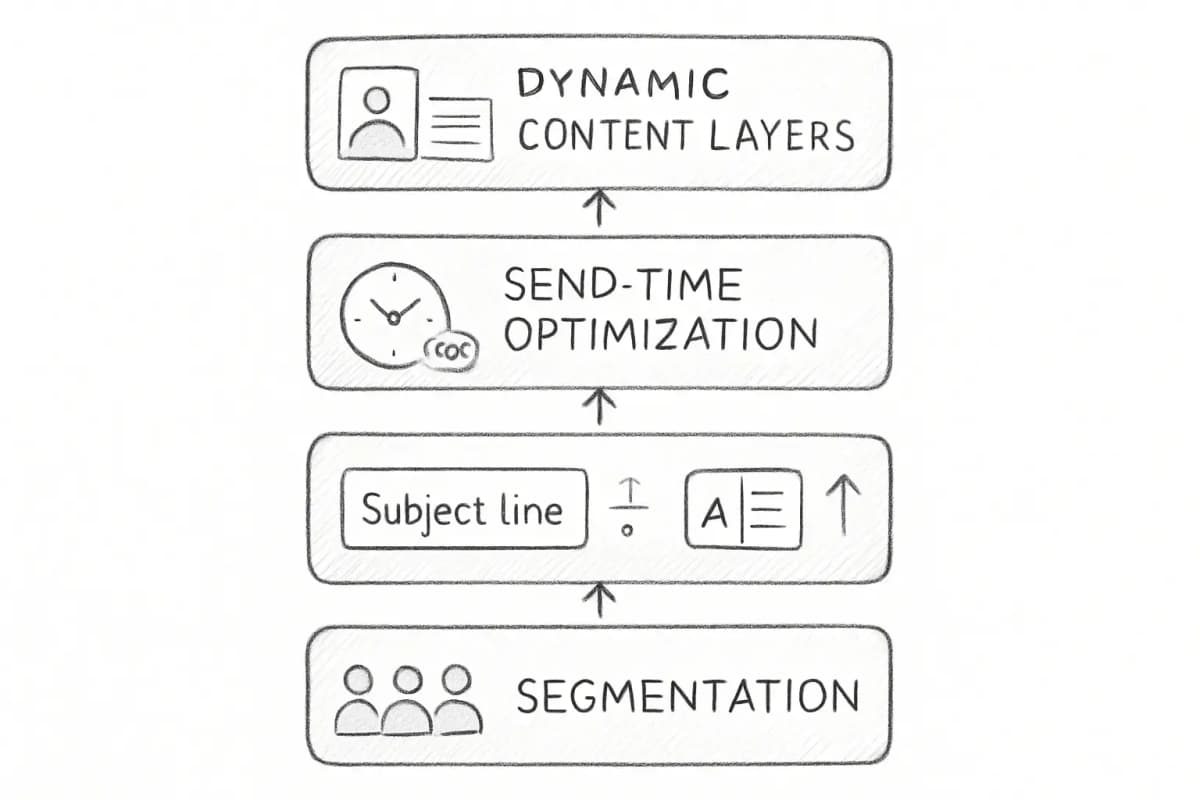
The core capabilities that power AI for personalized email marketing break down into four areas:

  1. Predictive segmentation: Machine learning models cluster subscribers by purchase propensity, churn risk, lifetime value potential, and content affinity, with segments updating in real time as subscriber behavior changes rather than relying on static demographic groups.

Stay in the loop

Get the latest posts delivered straight to your inbox. No spam, unsubscribe anytime.

63% of marketers now use AI tools in their email marketing efforts, and the gap between those who do and those who don't is widening fast. Marketers who use AI to personalize emails see a 41% increase in revenue and a 13.44% increase in CTR, numbers that are impossible to replicate with manual batch-and-blast campaigns. If you're responsible for email performance, this guide covers exactly how AI for personalized email marketing works, where to apply it first, and what measurable results to expect.

Key Takeaways

  • Marketers who use AI to personalize emails see a 41% increase in revenue and a 13.44% increase in CTR, and AI senders also achieve a higher average order value of $145.08 vs. $138.00 for non-AI senders.
  • Personalized emails have a 29% higher open rate and a 41% higher click-through rate compared to non-personalized emails.
  • AI-generated subject lines outperform human-written ones by 26%, and the advantage compounds with dynamic send-time optimization, which adds another 14% lift when combined with AI subject lines.
  • Segmented email campaigns generate 760% more revenue than non-segmented broadcasts, with the most effective segmentation combining behavioral data with AI-predicted intent scores.
  • 88% of companies plan to adopt AI/ML tools to deliver smarter recommendations in real time and improve customer journeys.

What AI Actually Does in Email Marketing

The phrase "AI email marketing" gets used loosely. Before building a strategy around it, it helps to know what the technology actually does at each stage of a campaign.

AI-powered content personalization goes beyond inserting a first name into the subject line. Modern email platforms use machine learning to dynamically select subject lines, images, product recommendations, and entire content blocks based on each subscriber's predicted preferences and behavior patterns, resulting in an email that feels individually crafted even when it is generated at scale.

The core capabilities that power AI for personalized email marketing break down into four areas:

  1. Predictive segmentation: Machine learning models cluster subscribers by purchase propensity, churn risk, lifetime value potential, and content affinity, with segments updating in real time as subscriber behavior changes rather than relying on static demographic groups.
  • Subject line optimization: AI analyzes historical data to generate compelling subject lines that can increase open rates. AI-optimized subject lines produce 50% higher open rates than manually written ones, and this optimization works by training a model on your historical email performance data to learn which word patterns, lengths, emotional tones, and structural formats correlate with higher engagement for your specific audience.
  • Send-time optimization (STO): AI send-time optimization analyzes individual subscriber engagement patterns and delivers emails at each person's personal optimal moment. Compared to batch-sending at a fixed time, AI-optimized send times lift open rates by 15-23% because emails arrive at the top of the inbox precisely when each subscriber is most likely to check their email.
  • Predictive analytics: Predictive analytics is one of the most powerful applications of AI in email marketing. By leveraging historical data and sophisticated algorithms, it allows marketers to forecast future customer behaviors and preferences with remarkable accuracy, enabling businesses to not only understand what their customers have done in the past but also to anticipate their future actions.

  • The Business Case: Why the Numbers Matter

    Email marketing delivers an average return of $36-42 per dollar spent in 2026, outperforming paid search ($2), social advertising ($2.80), and display ads ($1.35). When you layer AI personalization on top of that already-strong base, the returns accelerate further.

    Email marketing delivers an average ROI of $36 for every $1 spent, with top-performing organizations reaching $68 per $1 invested. Personalization significantly amplifies returns: brands that use personalization increase email ROI by nearly 260% compared to those that don't.

    The revenue mechanics are straightforward. Segmented and personalized emails generate 58% of all revenue. Personalized emails deliver six times higher transaction rates than non-personalized ones. That is not a marginal gain. It reflects a structural difference in how recipients respond to relevant versus generic content.

    For teams tracking conversion metrics specifically: AI-driven personalization has become the standard across email marketing, powering more than 70% of campaigns globally in 2026. AI-optimized campaigns currently average a 13.44% click-through rate compared to 3% for non-AI campaigns.

    If you want to see how personalized email marketing examples translate these statistics into real campaign executions, that reference covers specific formats and results across industries.


    AI-Powered Segmentation: Moving Beyond Demographics

    Most email lists are still segmented by demographics: age, location, job title. AI makes that approach look coarse.

    Using machine learning to analyze large datasets, AI can identify patterns in behavior and interactions. It uses these to divide your target audience into segments based on attributes such as demographics, purchase history, preferences, needs, and pain points. This enables narrow targeting, allowing you to create email content that's customized for each segment.

  • Subject line optimization: AI analyzes historical data to generate compelling subject lines that can increase open rates. AI-optimized subject lines produce 50% higher open rates than manually written ones, and this optimization works by training a model on your historical email performance data to learn which word patterns, lengths, emotional tones, and structural formats correlate with higher engagement for your specific audience.
  • Send-time optimization (STO): AI send-time optimization analyzes individual subscriber engagement patterns and delivers emails at each person's personal optimal moment. Compared to batch-sending at a fixed time, AI-optimized send times lift open rates by 15-23% because emails arrive at the top of the inbox precisely when each subscriber is most likely to check their email.
  • Predictive analytics: Predictive analytics is one of the most powerful applications of AI in email marketing. By leveraging historical data and sophisticated algorithms, it allows marketers to forecast future customer behaviors and preferences with remarkable accuracy, enabling businesses to not only understand what their customers have done in the past but also to anticipate their future actions.

  • The Business Case: Why the Numbers Matter

    Email marketing delivers an average return of $36-42 per dollar spent in 2026, outperforming paid search ($2), social advertising ($2.80), and display ads ($1.35). When you layer AI personalization on top of that already-strong base, the returns accelerate further.

    Email marketing delivers an average ROI of $36 for every $1 spent, with top-performing organizations reaching $68 per $1 invested. Personalization significantly amplifies returns: brands that use personalization increase email ROI by nearly 260% compared to those that don't.

    The revenue mechanics are straightforward. Segmented and personalized emails generate 58% of all revenue. Personalized emails deliver six times higher transaction rates than non-personalized ones. That is not a marginal gain. It reflects a structural difference in how recipients respond to relevant versus generic content.

    For teams tracking conversion metrics specifically: AI-driven personalization has become the standard across email marketing, powering more than 70% of campaigns globally in 2026. AI-optimized campaigns currently average a 13.44% click-through rate compared to 3% for non-AI campaigns.

    If you want to see how personalized email marketing examples translate these statistics into real campaign executions, that reference covers specific formats and results across industries.


    AI-Powered Segmentation: Moving Beyond Demographics

    Most email lists are still segmented by demographics: age, location, job title. AI makes that approach look coarse.

    Using machine learning to analyze large datasets, AI can identify patterns in behavior and interactions. It uses these to divide your target audience into segments based on attributes such as demographics, purchase history, preferences, needs, and pain points. This enables narrow targeting, allowing you to create email content that's customized for each segment.

    AI-driven behavioral segments based on purchase propensity, churn risk, and lifetime value produce 18-45% higher revenue per recipient compared to traditional demographic segmentation. The segments update in real time as subscriber behavior changes.

    Churn prediction is a particularly high-value application. Predictive analytics can identify customers who are at risk of churning. By analyzing patterns in customer behavior such as a decrease in engagement or purchase frequency, AI models can flag these customers and trigger re-engagement campaigns aimed at retaining them.

    The practical implication: instead of one segment called "inactive subscribers," AI builds separate micro-segments for subscribers who opened but didn't click, subscribers who clicked but didn't convert, and subscribers who haven't opened in 60, 90, or 120+ days. Each group gets a different re-engagement message calibrated to their specific behavior.

    For a deeper look at how segmentation strategy connects to revenue, the guide on email list segmentation strategies that boost ROI by 760% covers the mechanics in detail.


    Subject Lines and Dynamic Content at Scale

    The subject line is the single most influential variable in email marketing performance. Research from Mailchimp's 2026 Email Marketing Benchmark Report shows that 47% of email recipients decide to open an email based solely on the subject line, while 69% report email as spam based on the subject line alone.

    AI addresses this in two ways. First, it generates and tests multiple subject line variants faster than any human team can. Traditional A/B testing requires time and manual effort. AI automates the process by testing multiple subject lines simultaneously and analyzing real-time data. It quickly identifies the best-performing option, ensuring optimal open rates and engagement.

    Second, it personalizes beyond the first name. First-name personalization is table stakes and lifts open rates by 10-14% on average. But AI-powered dynamic personalization using behavioral data such as past purchase, browse history, location, and loyalty tier drives a 26% lift over unpersonalized subject lines. The key is relevance specificity: "Your running shoes are restocked" outperforms "Sarah, check out our new arrivals" because it signals the email contains information the recipient already cares about.

    For body content, dynamic blocks allow a single email template to render different product recommendations, offers, or copy sections for each recipient. AI-driven contextual personalization matches the right customer to the optimal message, leveraging each customer's context including clicks, purchases, opened emails, and session data to select the variant most likely to lead to a conversion.

    Pair this with our resource on email subject line best practices that boost open rates by 27% to understand the human-side principles that make AI-generated subject lines more effective.


    Behavioral Triggers and Automated Flows

    Five automated flows generate 80% of email revenue: welcome series, cart recovery, post-purchase, re-engagement, and browse abandonment sequences drive the vast majority of automated email revenue when properly configured with behavioral triggers.

    AI makes each of these flows smarter. Instead of a fixed sequence that sends the same three emails to every new subscriber, an AI-powered welcome series adapts based on what the subscriber clicks, ignores, or converts on. A contact who engages with a pricing email gets a different path than one who skips it entirely.

    AI-driven behavioral segments based on purchase propensity, churn risk, and lifetime value produce 18-45% higher revenue per recipient compared to traditional demographic segmentation. The segments update in real time as subscriber behavior changes.

    Churn prediction is a particularly high-value application. Predictive analytics can identify customers who are at risk of churning. By analyzing patterns in customer behavior such as a decrease in engagement or purchase frequency, AI models can flag these customers and trigger re-engagement campaigns aimed at retaining them.

    The practical implication: instead of one segment called "inactive subscribers," AI builds separate micro-segments for subscribers who opened but didn't click, subscribers who clicked but didn't convert, and subscribers who haven't opened in 60, 90, or 120+ days. Each group gets a different re-engagement message calibrated to their specific behavior.

    For a deeper look at how segmentation strategy connects to revenue, the guide on email list segmentation strategies that boost ROI by 760% covers the mechanics in detail.


    Subject Lines and Dynamic Content at Scale

    The subject line is the single most influential variable in email marketing performance. Research from Mailchimp's 2026 Email Marketing Benchmark Report shows that 47% of email recipients decide to open an email based solely on the subject line, while 69% report email as spam based on the subject line alone.

    AI addresses this in two ways. First, it generates and tests multiple subject line variants faster than any human team can. Traditional A/B testing requires time and manual effort. AI automates the process by testing multiple subject lines simultaneously and analyzing real-time data. It quickly identifies the best-performing option, ensuring optimal open rates and engagement.

    Second, it personalizes beyond the first name. First-name personalization is table stakes and lifts open rates by 10-14% on average. But AI-powered dynamic personalization using behavioral data such as past purchase, browse history, location, and loyalty tier drives a 26% lift over unpersonalized subject lines. The key is relevance specificity: "Your running shoes are restocked" outperforms "Sarah, check out our new arrivals" because it signals the email contains information the recipient already cares about.

    For body content, dynamic blocks allow a single email template to render different product recommendations, offers, or copy sections for each recipient. AI-driven contextual personalization matches the right customer to the optimal message, leveraging each customer's context including clicks, purchases, opened emails, and session data to select the variant most likely to lead to a conversion.

    Pair this with our resource on email subject line best practices that boost open rates by 27% to understand the human-side principles that make AI-generated subject lines more effective.


    Behavioral Triggers and Automated Flows

    Five automated flows generate 80% of email revenue: welcome series, cart recovery, post-purchase, re-engagement, and browse abandonment sequences drive the vast majority of automated email revenue when properly configured with behavioral triggers.

    AI makes each of these flows smarter. Instead of a fixed sequence that sends the same three emails to every new subscriber, an AI-powered welcome series adapts based on what the subscriber clicks, ignores, or converts on. A contact who engages with a pricing email gets a different path than one who skips it entirely.

    Instead of sending the same number of emails to everyone, AI analyzes individual engagement patterns to optimize frequency: high-engagement customers may receive more frequent communications, low-engagement subscribers get reduced frequency to prevent unsubscribes, and re-engagement campaigns trigger automatically for inactive segments.

    The data on automated email performance is compelling. Automated emails significantly outperform campaign emails, generating 22 times more revenue per email and converting nearly 19 times higher.

    Around 64% of abandoned cart emails leverage AI to tailor recommendations, leading to a 15% higher recovery rate. That recovery rate improvement, applied across thousands of cart abandonment events monthly, compounds into meaningful revenue.


    Measuring AI Email Performance: Metrics That Actually Matter

    Click rates matter more than open rates. Apple Mail Privacy Protection has made open rates unreliable. Focus on click-through rates, click-to-open rates, and conversion rates as your primary engagement metrics.

    The metrics worth tracking for AI-personalized programs:

    • Revenue per email (RPE): The clearest indicator of whether personalization is working at the individual level.
    • Click-to-open rate (CTOR): Measures content relevance independently of deliverability or subject line performance.
    • Conversion rate by segment: Tracks whether behavioral segmentation is reaching the right people with the right offer.
    • Churn score trends: Shows whether predictive re-engagement flows are retaining at-risk subscribers.

    AI will monitor your key metrics such as click-through and response rates, unsubscribes, and eventual conversions to check how an email campaign is performing. It will make the necessary adjustments in real time, and can see which subject lines lead to higher open rates and optimize future emails accordingly.

    This continuous feedback loop is what separates AI-powered programs from traditional email marketing: each campaign makes the next one smarter. For a full framework on what to track and how to read campaign data, the guide on email marketing analytics best practices covers the measurement layer in depth.


    How to Implement AI for Personalized Email Marketing: A Practical Approach

    Start narrow. Most teams that struggle with AI adoption try to implement everything at once. The teams that see fast results pick one high-leverage application and prove the ROI before expanding.

    Start small, optimize subject lines or send times first, then scale AI across your email marketing strategy.

    A practical implementation sequence:

    Instead of sending the same number of emails to everyone, AI analyzes individual engagement patterns to optimize frequency: high-engagement customers may receive more frequent communications, low-engagement subscribers get reduced frequency to prevent unsubscribes, and re-engagement campaigns trigger automatically for inactive segments.

    The data on automated email performance is compelling. Automated emails significantly outperform campaign emails, generating 22 times more revenue per email and converting nearly 19 times higher.

    Around 64% of abandoned cart emails leverage AI to tailor recommendations, leading to a 15% higher recovery rate. That recovery rate improvement, applied across thousands of cart abandonment events monthly, compounds into meaningful revenue.


    Measuring AI Email Performance: Metrics That Actually Matter

    Click rates matter more than open rates. Apple Mail Privacy Protection has made open rates unreliable. Focus on click-through rates, click-to-open rates, and conversion rates as your primary engagement metrics.

    The metrics worth tracking for AI-personalized programs:

    • Revenue per email (RPE): The clearest indicator of whether personalization is working at the individual level.
    • Click-to-open rate (CTOR): Measures content relevance independently of deliverability or subject line performance.
    • Conversion rate by segment: Tracks whether behavioral segmentation is reaching the right people with the right offer.
    • Churn score trends: Shows whether predictive re-engagement flows are retaining at-risk subscribers.

    AI will monitor your key metrics such as click-through and response rates, unsubscribes, and eventual conversions to check how an email campaign is performing. It will make the necessary adjustments in real time, and can see which subject lines lead to higher open rates and optimize future emails accordingly.

    This continuous feedback loop is what separates AI-powered programs from traditional email marketing: each campaign makes the next one smarter. For a full framework on what to track and how to read campaign data, the guide on email marketing analytics best practices covers the measurement layer in depth.


    How to Implement AI for Personalized Email Marketing: A Practical Approach

    Start narrow. Most teams that struggle with AI adoption try to implement everything at once. The teams that see fast results pick one high-leverage application and prove the ROI before expanding.

    Start small, optimize subject lines or send times first, then scale AI across your email marketing strategy.

    A practical implementation sequence:

    1. Audit your current data infrastructure. Select AI technology that serves your specific use cases: subject line optimization, segmentation, personalized content creation, or deliverability improvement. Ensure compatibility with your email marketing tools, CRM, or email API to maintain a seamless cross-platform workflow.
    2. Enable send-time optimization. This requires no new content and produces measurable open rate improvement within two to three send cycles. Machine learning models that predict when each subscriber is most likely to open and engage can boost open rates by 26% and click-through rates by 41% compared to fixed-schedule sends.
    3. Deploy AI subject line testing. Run AI-generated subject lines against your manually written ones using statistical significance as the decision threshold, not just which variant "looks better."
    4. Introduce behavioral segmentation. Replace static demographic segments with behavioral clusters built from purchase history, browse behavior, and engagement patterns.
    5. Layer in predictive content. Once segmentation is producing clean clusters, use AI to generate content variants matched to each segment's behavioral profile.
    6. Maintain human review. Content will still need a human edit since you can't rely on AI 100% to bring the copy close to your recipients, despite its capacity for data analysis.
    1. Audit your current data infrastructure. Select AI technology that serves your specific use cases: subject line optimization, segmentation, personalized content creation, or deliverability improvement. Ensure compatibility with your email marketing tools, CRM, or email API to maintain a seamless cross-platform workflow.
    2. Enable send-time optimization. This requires no new content and produces measurable open rate improvement within two to three send cycles. Machine learning models that predict when each subscriber is most likely to open and engage can boost open rates by 26% and click-through rates by 41% compared to fixed-schedule sends.
    3. Deploy AI subject line testing. Run AI-generated subject lines against your manually written ones using statistical significance as the decision threshold, not just which variant "looks better."
    4. Introduce behavioral segmentation. Replace static demographic segments with behavioral clusters built from purchase history, browse behavior, and engagement patterns.
    5. Layer in predictive content. Once segmentation is producing clean clusters, use AI to generate content variants matched to each segment's behavioral profile.
    6. Maintain human review. Content will still need a human edit since you can't rely on AI 100% to bring the copy close to your recipients, despite its capacity for data analysis.

    Data privacy runs alongside every step. Ensure compliance with regulations like GDPR and CCPA, be transparent about how customer data is collected and used, provide clear opt-out mechanisms for personalized communications, and implement proper data security measures to protect customer information. Vertical stack diagram showing four layers of AI email personalization: Layer 1 (bottom) shows 'Segmentation' with audience icons splitting into different groups; Layer 2 shows 'Subject Line AI' with a text preview and optimization arrows; Layer 3 shows 'Send-Time Optimization' with a clock and multiple time zones; Layer 4 (top) shows 'Dynamic Content Layers' with content blocks customizing based on user data. Each layer connects upward with arrows. Use a modern tech color palette with blues and purples. Include subtle icons for each concept.

    Frequently Asked Questions

    What is AI for personalized email marketing?

    AI for personalized email marketing refers to the use of machine learning, natural language processing, and predictive analytics to tailor email content, subject lines, send times, and audience segments to individual subscribers. AI integration helps analyze customer behavior, automate content creation, and optimize send times, which enhances overall engagement and conversion rates. Unlike rule-based automation, AI systems learn from engagement data and continuously refine their outputs.

    How much can AI improve email open rates?

    The improvement depends on which AI capability you apply. Brands using AI-powered subject line optimization see open rate improvements of 35-95% compared to untested subject lines. The range depends on the baseline: brands with already-optimized subject lines see 35% lifts, while brands sending generic subject lines see up to 95% improvement when AI testing is introduced. AI send-time optimization lifts open rates by 15-23% by delivering at each subscriber's personal optimal moment.

    Do small businesses benefit from AI email personalization?

    Yes. AI email personalization is making sophisticated, data-driven customization accessible to businesses of all sizes. Platforms like Mailchimp, Klaviyo, and ActiveCampaign embed AI features directly into their standard tools. Start small, optimize subject lines or send times first, then scale AI across your email marketing strategy. Even a list of a few thousand subscribers can see measurable improvements from subject line testing and behavioral segmentation.

    What data does AI need to personalize emails effectively?

    Predictive analytics in email marketing involves the use of machine learning models that analyze vast amounts of historical customer data, including past purchases, browsing history, engagement with emails, and demographic information. The more first-party behavioral data you collect, the more accurate the model becomes. The deprecation of third-party cookies makes predictive analytics more important, not less, shifting the focus to first-party data collected directly on properties you own such as your website, app, and email. Preference centers, post-purchase surveys, and CRM integration are the fastest ways to build a rich data foundation.


    Data privacy runs alongside every step. Ensure compliance with regulations like GDPR and CCPA, be transparent about how customer data is collected and used, provide clear opt-out mechanisms for personalized communications, and implement proper data security measures to protect customer information. Vertical stack diagram showing four layers of AI email personalization: Layer 1 (bottom) shows 'Segmentation' with audience icons splitting into different groups; Layer 2 shows 'Subject Line AI' with a text preview and optimization arrows; Layer 3 shows 'Send-Time Optimization' with a clock and multiple time zones; Layer 4 (top) shows 'Dynamic Content Layers' with content blocks customizing based on user data. Each layer connects upward with arrows. Use a modern tech color palette with blues and purples. Include subtle icons for each concept.


    Frequently Asked Questions

    What is AI for personalized email marketing?

    AI for personalized email marketing refers to the use of machine learning, natural language processing, and predictive analytics to tailor email content, subject lines, send times, and audience segments to individual subscribers. AI integration helps analyze customer behavior, automate content creation, and optimize send times, which enhances overall engagement and conversion rates. Unlike rule-based automation, AI systems learn from engagement data and continuously refine their outputs.

    How much can AI improve email open rates?

    The improvement depends on which AI capability you apply. Brands using AI-powered subject line optimization see open rate improvements of 35-95% compared to untested subject lines. The range depends on the baseline: brands with already-optimized subject lines see 35% lifts, while brands sending generic subject lines see up to 95% improvement when AI testing is introduced. AI send-time optimization lifts open rates by 15-23% by delivering at each subscriber's personal optimal moment.

    Do small businesses benefit from AI email personalization?

    Yes. AI email personalization is making sophisticated, data-driven customization accessible to businesses of all sizes. Platforms like Mailchimp, Klaviyo, and ActiveCampaign embed AI features directly into their standard tools. Start small, optimize subject lines or send times first, then scale AI across your email marketing strategy. Even a list of a few thousand subscribers can see measurable improvements from subject line testing and behavioral segmentation.

    What data does AI need to personalize emails effectively?

    Predictive analytics in email marketing involves the use of machine learning models that analyze vast amounts of historical customer data, including past purchases, browsing history, engagement with emails, and demographic information. The more first-party behavioral data you collect, the more accurate the model becomes. The deprecation of third-party cookies makes predictive analytics more important, not less, shifting the focus to first-party data collected directly on properties you own such as your website, app, and email. Preference centers, post-purchase surveys, and CRM integration are the fastest ways to build a rich data foundation.

    No comments yet. Be the first!

    Leave a comment

    Comments are reviewed before publishing.

    No comments yet. Be the first!

    Leave a comment

    Comments are reviewed before publishing.

    More from

    Related posts

    Illustration for ai-based email marketing
    Email Marketing StrategyJul 14, 2026 12 min

    AI-Based Email Marketing: Strategy and ROI

    Learn how AI transforms email marketing with smarter segmentation, personalization, and automation. Boost open rates and conversions with data-driven tactics.

    More from

    Related posts

    Illustration for ai-based email marketing
    Email Marketing StrategyJul 14, 2026 12 min

    AI-Based Email Marketing: Strategy and ROI

    Learn how AI transforms email marketing with smarter segmentation, personalization, and automation. Boost open rates and conversions with data-driven tactics.

    M
    Marcus Webb
    M
    Marcus Webb
    Illustration for email marketing automation benefits
    Email Marketing StrategyJul 14, 2026 12 min

    Email Marketing Automation Benefits: ROI & Efficiency Gains

    Discover how email automation boosts conversions, saves time, and improves customer engagement. Learn the key benefits and ROI metrics that matter.

    JJames Chen
    Illustration for email marketing automation benefits
    Email Marketing StrategyJul 14, 2026 12 min

    Email Marketing Automation Benefits: ROI & Efficiency Gains

    Discover how email automation boosts conversions, saves time, and improves customer engagement. Learn the key benefits and ROI metrics that matter.

    JJames Chen
    Illustration for "crm email marketing automation
    Email Marketing StrategyJul 14, 2026 14 min

    CRM Email Marketing Automation: Setup & Best Practices

    Learn how to automate email campaigns through your CRM to save time, improve deliverability, and increase ROI. Step-by-step guide inside.

    PPriya Kapoor
    Illustration for "crm email marketing automation
    Email Marketing StrategyJul 14, 2026 14 min

    CRM Email Marketing Automation: Setup & Best Practices

    Learn how to automate email campaigns through your CRM to save time, improve deliverability, and increase ROI. Step-by-step guide inside.

    PPriya Kapoor