
AI in email marketing optimization has crossed from early adopter territory into mainstream practice, with 63% of marketers now using AI tools in their email campaigns. The results back up the adoption: programs that integrate AI across their full email workflow, including dynamic content, send-time optimization, and predictive segmentation, achieve 41% higher revenue than manual campaigns, and AI-optimized campaigns average a 13.44% click-through rate compared to 3% for non-AI campaigns.
This guide covers every major application of AI in email marketing, from subject line generation to deliverability, with the data you need to make the case internally and the practical steps to act on it.
Key Takeaways
- AI-optimized email campaigns average a 13.44% click-through rate, compared to 3% for non-AI campaigns.
- AI-generated subject lines outperform human-written ones by 26% on average, and the advantage compounds with dynamic send-time optimization, which adds another 14% lift when both are combined.
- In 2024, 62% of teams needed two weeks or more to create an email. By 2025, that figure dropped to around 6%, with AI assistance largely responsible for the reduction. AI tools deliver a 72% time savings on campaign creation across the creation, testing, and iteration cycle.
- AI spam filters use machine learning models that detect patterns across millions of emails, analyzing tone, link trustworthiness, historical engagement, complaint rates, and sender behavior, not just keywords. Marketers need to understand this to protect deliverability.
- 70% of marketers predict that up to half of their email operations will be AI-driven by 2026. Teams that start building AI into their workflows now will compound that advantage.
Why AI in Email Marketing Optimization Now
Email marketing already delivers the highest return of any digital channel. Email marketing delivers an average return of $36 to $42 per dollar spent in 2026, outperforming paid search ($2), social advertising ($2.80), and display ads ($1.35). AI amplifies that structural advantage by applying precision where human capacity runs out.
The volume problem makes this urgent. Daily emails sent worldwide are projected to reach 392.5 billion in 2026 and 408.2 billion by 2027. Competing for attention in an inbox that crowded requires relevance at a scale that manual processes cannot achieve. AI closes that gap by processing behavioral signals, predicting intent, and personalizing content faster than any human team.
According to the 2025 CMO Survey, 1 in 6 marketing activities are currently automated or enhanced by AI, with up to half expected to be automated within three years. The shift is already underway. What follows are the specific areas where it produces measurable results.
AI-Powered Subject Line Optimization
Subject lines are the single point of leverage with the highest ceiling for improvement. Nothing inside the email matters if the subscriber never opens it.
AI has made subject line optimization more accessible and more effective than any A/B testing approach available before. AI-generated subject lines outperform human-written ones by 26% on average, and the advantage compounds with dynamic send-time optimization, which adds another 14% lift when the two are combined.
AI subject line tools work by analyzing large datasets of subject line performance across industries, learning which words, lengths, question formats, numbers, and emotional triggers drive opens for specific audience segments. The best implementations go further, generating multiple variants and running real-time tests across small audience cohorts before selecting the best-performing version to send to the remainder of the list.
For practical guidance on what makes subject lines work, see our guide to email subject line best practices that boost open rates by 27%. The AI layer adds scale and speed to the principles that guide already apply.
Key actions:
- Use AI tools to generate 5 to 10 subject line variants per campaign, not just 2.
- Set up automatic winner selection after a statistically valid test cohort (typically 20% of your list).
- Combine AI recommendations with brand voice guidelines rather than replacing human judgment entirely.
Predictive Send-Time Optimization
Most teams still choose a fixed send time for the entire list. That approach ignores the reality that subscribers have distinct engagement windows.
Predictive send-time optimization uses AI to determine the best time to send an email to each recipient based on past engagement behavior. Instead of a fixed send time, emails are delivered when individuals are most likely to open or click.
Sending to each subscriber at their personal optimal time, rather than a fixed batch time, consistently produces 20 to 30 percent open rate improvements across industries. In practice, real-world results show 8 to 15% improvement in open rates for most users, and the approach works best for large lists (50K or more) with significant engagement history.
Start with send-time optimization since it has the lowest implementation complexity, fastest time-to-value, and clearest measurement methodology. Add predictive segmentation once you have 6 months of stable send-time data. Layer generative AI for subject line testing next. Scale to full body copy personalization only after the foundational layers are producing stable, measured results.
AI-Driven Segmentation and Personalization
Segmented email campaigns generate 760% more revenue than non-segmented broadcasts. The most effective segmentation combines behavioral data (purchase history and browse patterns) with AI-predicted intent scores.
Traditional segmentation groups subscribers by demographic or purchase recency. AI-driven segmentation goes further. 41% of marketers are already leveraging AI for tasks like advanced segmentation, behavioral prediction, churn modeling, and customer journey optimization.
The personalization layer compounds the segmentation benefit. Consumers increasingly expect personalized experiences. Nearly 80% will only engage with emails tailored to their previous interactions with the brand.
93% of marketers say personalization improves conversions, and data proves this: around 80% of users are more likely to buy from personalized emails.
For a full breakdown of how to build segments that perform, see our article on email list segmentation strategies that boost ROI by 760%. For the personalization layer on top of that, our AI email marketing personalization techniques guide covers the implementation specifics.
What AI segmentation does that rules-based systems cannot:
- Identifies micro-segments based on predicted purchase intent, not just past behavior.
- Hyper-segmented campaigns targeting micro-audiences of 500 to 2,000 contacts outperform broad segments by 3.4x on conversion rate.
- Adjusts segment membership in real time as subscriber behavior changes.
- Predicts churn risk and triggers re-engagement sequences before subscribers go cold.
AI for Email Content Generation
49% of marketers use generative AI for static copy creation, and the number of marketers using AI-powered image generation has increased by 340% in the last year.
The production efficiency gains are real and significant. Teams that once spent weeks on a single campaign now iterate in hours. Just 6% of teams now take longer than two weeks to produce an email, down from 62% in 2024.
The risk, however, is equally real. The key risk with AI content generation is producing generic, interchangeable emails that feel automated rather than personal. The solution is to treat AI as a drafting and iteration tool rather than a publishing tool.
AI-generated subject lines and copy require human review gates, since AI-generated content performs well on average but occasionally produces off-brand, misleading, or tone-inappropriate outputs. Every production deployment of generative email content must include a human review step before send, particularly for high-stakes campaigns to large segments.
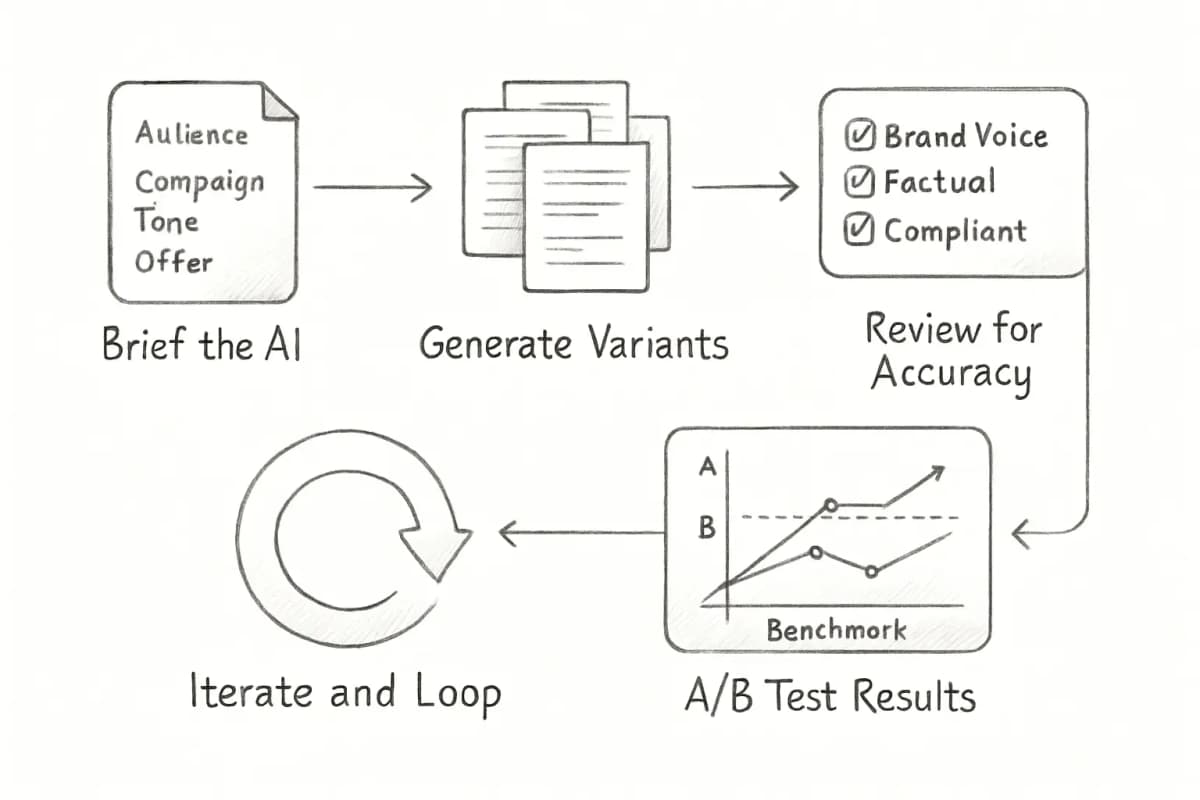
A practical content generation workflow:
- Brief the AI with audience context, campaign goal, tone guidelines, and offer details.
- Generate 3 to 5 body copy variants.
- Review for brand voice, factual accuracy, and compliance.
- A/B test the top 2 variants against your historical benchmark.
- Feed results back into your next briefing.
AI and Email Deliverability
Deliverability is where many marketers have a blind spot. One in six marketing emails never reaches the inbox. That is the global average in 2025, according to Validity's Deliverability Benchmark report.
AI is operating on both sides of the deliverability equation. On the filtering side, AI spam filters use machine learning models to detect patterns across millions of emails, analyzing tone, link trustworthiness, historical engagement, complaint rates, and sender behavior to identify unwanted or risky messages.
In early 2026, Google launched Gemini AI for Gmail. It now summarizes email threads, prioritizes messages it thinks are important, and evaluates every incoming email for relevance before a human ever sees it. That is a fundamental shift in what determines inbox placement.
On the marketer side, AI spam checkers offer a proactive solution by analyzing email content before you hit send, identifying trigger words, suspicious formatting, and authentication issues that harm deliverability. These tools use machine learning algorithms to simulate how spam filters evaluate your messages, providing actionable recommendations to fix problems before they impact your send.
Deliverability signals AI filters now evaluate:
- Sender reputation and domain history.
- Authentication protocol compliance (SPF, DKIM, DMARC).
- Historical engagement rates from your list.
- Content quality and tone.
- Complaint and unsubscribe rates.
- Personalized inbox placement based on each user's past engagement and preferences: if a subscriber interacts with your brand frequently, their inbox may prioritize your message, while inactive users may see it lower or in a different tab.
The practical implication: sending relevant, well-timed email to an engaged list is no longer just good strategy, it is the primary deliverability factor. AI makes that possible at scale.
AI Analytics: Measuring What Actually Matters
There is a critical measurement shift underway. Apple's Mail Privacy Protection has inflated industry open rates by pre-loading pixels for roughly half of all email opens. Open rates are no longer a reliable primary metric.
The metric that matters is what happens after the click, not before it. AI analytics tools help identify which segments, send times, content types, and offer structures drive the highest downstream revenue, not just the highest open rate.
The metrics to focus on now are click-to-open rate (CTOR), conversion rate (CVR), and revenue per email (RPE). These reveal true engagement and financial impact, unlike open rates.
Click-to-conversion rates jumped 53% year over year, rising from 5.9% to 9%. That is where AI-driven personalization is having its clearest effect: subscribers who receive relevant content are more intent-driven when they click.
For a complete framework on building a measurement system around these metrics, see our email marketing analytics best practices guide.
Where AI analytics adds value that manual reporting misses:
- Cohort-level revenue attribution, connecting email clicks to downstream purchases.
- Predictive lifetime value scoring by segment.
- Churn probability scoring to trigger retention sequences before subscribers disengage.
- Automated anomaly detection, surfacing deliverability or engagement drops before they become serious problems.
How to Get Started with AI in Email Marketing Optimization
The most common mistake is trying to implement everything simultaneously. Start with the highest-leverage, lowest-complexity intervention and build from there.
A sequenced implementation plan:
- Audit your current metrics. Establish baseline CTR, CTOR, conversion rate, and revenue per email before changing anything. You cannot measure improvement without a clear starting point.
- Enable send-time optimization. Most major ESPs (Klaviyo, Mailchimp, HubSpot, ActiveCampaign) include this natively. Turn it on and run it against a control group for 60 days.
- Add AI subject line testing. Run 3 to 5 variants per send and let the system select winners automatically.
- Build behavioral segments. Start with purchase history, browse abandonment, and engagement recency. Add AI-predicted intent scoring once data volume supports it.
- Introduce generative copy assistance. Use AI to draft and iterate body copy, but keep human review in the workflow before every send.
- Close the analytics loop. Connect email performance to downstream revenue. Retire open rate as your primary KPI and replace it with CTOR and revenue per email.
Companies using AI-driven predictive analytics are reporting a 35% increase in customer lifetime value. That is the downstream outcome of getting the fundamentals right: relevant content, precise timing, and behavioral segmentation working together.
Frequently Asked Questions
What is AI in email marketing optimization?
AI in email marketing optimization refers to using machine learning and generative AI to improve campaign performance across the full email workflow. This includes subject line generation and testing, predictive send-time optimization, behavioral segmentation, dynamic content personalization, deliverability monitoring, and revenue attribution analytics. AI integration helps analyze customer behavior, automate content creation, and optimize send times, which enhances overall engagement and conversion rates.
How much of a revenue lift can AI realistically deliver?
Email marketing programs that adopted AI in 2025 and early 2026 reported revenue increases averaging 41% compared to non-AI programs. Results depend on baseline program maturity, list quality, and which AI capabilities are implemented. Send-time optimization and subject line testing tend to produce results fastest, while full personalization at scale takes longer to build but compounds over time.
Does AI hurt email deliverability?
AI can help or hurt deliverability depending on how it is used. AI spam checkers analyze email content before you hit send, identifying trigger words, suspicious formatting, and authentication issues that harm deliverability. Used that way, it protects inbox placement. The risk is using generative AI to produce high-volume, generic content sent to poorly segmented lists. Senders who earn subscriber trust through relevance get better placement, while those who blast unengaged lists with irrelevant content get penalized because the data says they should be.
Which AI email marketing tools are best for small teams?
Most major ESPs already include AI features that small teams can use without additional budget. Most ESPs include basic send-time optimization natively: Klaviyo Smart Send Time and Mailchimp Send Time Optimization are both included in standard plans. HubSpot and ActiveCampaign offer predictive lead scoring and behavioral segmentation. Start with the AI features already inside your existing platform before evaluating standalone AI tools. The priority is consistent use of what you already have access to, not adding complexity.
How do you measure whether AI is improving email performance?
Stop using open rate as your primary success metric. Apple Mail Privacy Protection has made open rates unreliable. Focus on click-through rates, click-to-open rates, and conversion rates as your primary engagement metrics. Connect email performance to downstream revenue wherever your attribution setup allows. Run controlled experiments by keeping a portion of your list on the old workflow while testing AI features on the rest, then compare revenue per email and conversion rate between the two groups over 60 to 90 days.