
Choosing the right healthcare AI email marketing firm is one of the highest-leverage decisions a healthcare organization can make in 2025. The average open rate for healthcare-related email campaigns sits at 41%, well above most other industries, yet most healthcare teams are not extracting full value from that built-in engagement advantage. The wrong partner leaves compliance risk, wasted budget, and missed patient touchpoints on the table. The right one brings AI-powered personalization, airtight HIPAA compliance, and measurable ROI in a single system.
This guide cuts through the noise and shows you exactly what to evaluate before signing with any healthcare AI email marketing firm.
Key Takeaways
- 80% of healthcare and life science companies using AI saw improvements in marketing metrics.
- No matter how secure an email vendor is, if they are unwilling or unable to sign Business Associate Agreements (BAAs), they are not HIPAA compliant.
- Marketers who use AI for email personalization report a revenue increase of 41%, with click-through rates higher by 13.44%.
- The 2022 HHS guidance on tracking technologies clarified that standard email marketing analytics, including open tracking and click tracking, can constitute a HIPAA violation if they capture and transmit PHI to third-party analytics vendors without a Business Associate Agreement in place.
- The rise of AI-powered healthcare email marketing is particularly notable, with artificial intelligence enhancing content creation, patient segmentation, and predictive analytics.
Why Healthcare Email Marketing Is a Different Discipline
Healthcare email does not operate like standard B2B or ecommerce email. Healthcare email marketing sits at the intersection of two demanding disciplines: effective marketing and strict regulatory compliance. Done well, it generates qualified leads, nurtures complex buying relationships, and builds sustained trust. Done poorly or without proper attention to compliance, it creates serious legal and reputational risks.
The email channel itself remains powerful in healthcare. The average view rate for marketing emails in healthcare is 36.23%, and Saturdays have emerged as a peak day with a view rate of 49% and CTR of 5%. Healthcare marketing emails also have a remarkably low unsubscribe rate of just 0.06%, indicating patients find this communication valuable.
The challenge is that most general-purpose email marketing firms are not built to operate inside these constraints. When healthcare organizations want to use email marketing, out-of-the-box solutions are not a good fit. Healthcare organizations must use email marketing platforms specifically designed to meet HIPAA's unique privacy and security requirements.
That is where a specialized healthcare AI email marketing firm earns its value, or fails to.
1. Non-Negotiable: HIPAA Compliance and a Signed BAA
Before evaluating any firm's AI capabilities, verify their compliance posture. This is not a checkbox item.
The rules for HIPAA compliant email marketing are complex, subject to multiple exceptions, and can be interpreted in a number of ways depending on the purpose of the marketing email, its content, and whether it even qualifies as a marketing email under HIPAA. Regardless of how the rules are interpreted, the platform used to send HIPAA compliant marketing emails must meet specific security requirements.
No matter how secure an email vendor is, if they are unwilling or unable to sign a BAA, they are not HIPAA compliant. An email provider is considered a business associate under the HIPAA regulation as they receive, transmit, and store data on behalf of their healthcare clients. All HIPAA business associates are required to sign BAAs before working with healthcare clients.
Key compliance requirements to confirm with any prospective firm:
- HIPAA-compliant email must include encryption, secure storage for 6 years, business associate agreements, and proper access controls for protected health information.
- Explicit opt-in is not just a best practice; it is increasingly a legal requirement, particularly when email communications include health-related content.
- Breaches come with significant fines, ranging from $10,000 to $50,000. Atop this, your organization's reputation is jeopardized, and patients will likely look elsewhere for a trusted healthcare provider.
Also watch for firms that claim HIPAA compliance loosely. Many organizations claim HIPAA eligibility, but only because they are willing to sign a BAA. However, no single third party verifies HIPAA compliance. When a company self-identifies as HIPAA eligible, it means you must take their word for it.
Ask for third-party certifications. Look for HITRUST CSF certification, which is considered the gold standard in healthcare information security, and confirm the platform undergoes regular risk analysis and HIPAA audits.
2. AI Personalization That Goes Beyond Name Tags
Personalization in healthcare email is where AI creates a measurable lift, but only when it is implemented properly. Generic "first name" personalization is a baseline, not a differentiator.
Artificial intelligence enables healthcare marketers to go beyond generic messaging by analyzing individual patient data, including demographics, search behavior, and past interactions. This insight allows for the creation of hyper-personalized content such as customized email newsletters, targeted social media ads, and dynamic website content that adapts in real time to user preferences.
AI automation tools create email messages that are personalized to each patient without including unnecessary personal details. You can segment messages by appointment type, last visit window, or patient status rather than sensitive conditions such as medical history.
This distinction matters for compliance and trust. A healthcare AI email marketing firm should demonstrate exactly how their personalization engine works, and what patient data it does and does not touch.
Look for firms that offer:
- Behavioral triggers based on patient lifecycle stage (new patient, post-visit, lapsed)
- Condition-agnostic segmentation that avoids direct PHI in personalization logic
- Dynamic content blocks that adapt to patient preferences without exposing sensitive data
- Predictive send-time optimization based on individual engagement history
For more on how to structure personalized campaigns correctly, see our guide on AI email marketing personalization techniques.
3. EHR and Tech Stack Integration
A healthcare AI email marketing firm that cannot connect to your existing systems will create more manual work, not less.
Your email marketing platform should work seamlessly with your existing Electronic Health Records (EHR) or Electronic Medical Records (EMR) system. Integrations with systems like AthenaHealth, AdvancedMD, and Epic allow you to segment patients by care status, automate relevant outreach, and keep communication data connected to clinical records.
Integration with patient portals and telemedicine platforms is increasing, enabling seamless appointment scheduling and virtual consultations while maintaining regulatory compliance.
Ask any prospective firm to walk you through their integration architecture. Confirm:
- Which EHR and EMR systems they integrate with natively
- How patient data flows between your clinical systems and the email platform
- Whether integrations are real-time or batch-synced (real-time is better for appointment-based triggers)
- How they handle integration security and data mapping under HIPAA
4. Automation Capabilities for the Full Patient Journey
AI-based marketing tools send the right messages at the right times to the right patients, customizing messaging based on specific points in the patient lifecycle. You might start by automating appointment reminder and confirmation emails that prevent missed appointments and no-shows, then use the AI tool to send personalized onboarding instructions to new patients.
Healthcare automation can help set important but repetitive tasks like appointment reminders, post-visit follow-ups, prescription refill notices, and patient onboarding emails on autopilot. By setting up trigger-based sequences, practices ensure patients get timely, relevant communication without manual effort. This is crucial for reducing patient no-shows and keeps patients consistently engaged.
The automation depth a healthcare AI email marketing firm provides should map to your actual patient journey. Ask for a demonstration of multi-step automation workflows, not just single-send triggers.
Strong automation should cover:
- New patient onboarding sequences
- Appointment reminders and confirmations
- Post-visit follow-up and review requests
- Patient reactivation campaigns for lapsed patients
- Preventive care and seasonal health campaigns
- Prescription refill and care compliance reminders
Automated emails can generate 320% more revenue than non-automated emails. In healthcare, that lift translates directly to appointments booked and patients retained.
For a broader look at structuring automated workflows, see our email marketing automation tips guide.
5. Segmentation That Handles Healthcare's Complexity
Healthcare lists are not monolithic. A hospital system may need to reach prospective patients, active patients, HCPs, and referring physicians, all with different messages. A quality healthcare AI email marketing firm treats each of these as distinct audiences requiring distinct strategies.
Beyond compliance, role-based segmentation dramatically improves healthcare email marketing performance. A clinical department head has entirely different concerns from a hospital CFO or a procurement director. Segmenting by role and organizational level allows you to tailor messaging to what each audience cares about, reducing unsubscribes, improving engagement, and delivering content that moves the right buyers through the right journey.
Different patients have different needs. A good platform allows you to group recipients into segments and track how those groups interact with your messages.
AI-driven segmentation should go beyond demographics. Look for predictive segmentation that identifies which patients are likely to need specific services based on behavioral patterns, and which lapsed patients are most likely to re-engage. This kind of predictive logic is where AI creates an edge over traditional rules-based segmentation. Our deep-dive on email list segmentation strategies explains how proper segmentation can boost ROI by 760%.
6. Analytics, Reporting, and Attribution You Can Act On
AI-driven predictive analytics use historical data and machine learning models to anticipate future behaviors and trends. In healthcare marketing, this means identifying individuals who are likely to need specific services based on patterns such as search queries, health history, or lifestyle factors.
Any healthcare AI email marketing firm worth evaluating should give you clear reporting on:
- Open rates, click rates, and conversion rates by segment and campaign type
- Patient appointment bookings directly attributed to email campaigns
- Revenue or appointment value attributed to specific email sequences
- Deliverability metrics including inbox placement rate, spam complaint rate, and bounce rate
- A/B test results with statistical significance, not just directional trends
Most public comparisons score AI tools on output quality, speed, and feature surface. Those metrics matter, but they miss what kills deployments inside healthcare. What kills deployments is poor attribution, so the analytics layer matters as much as the sending layer. 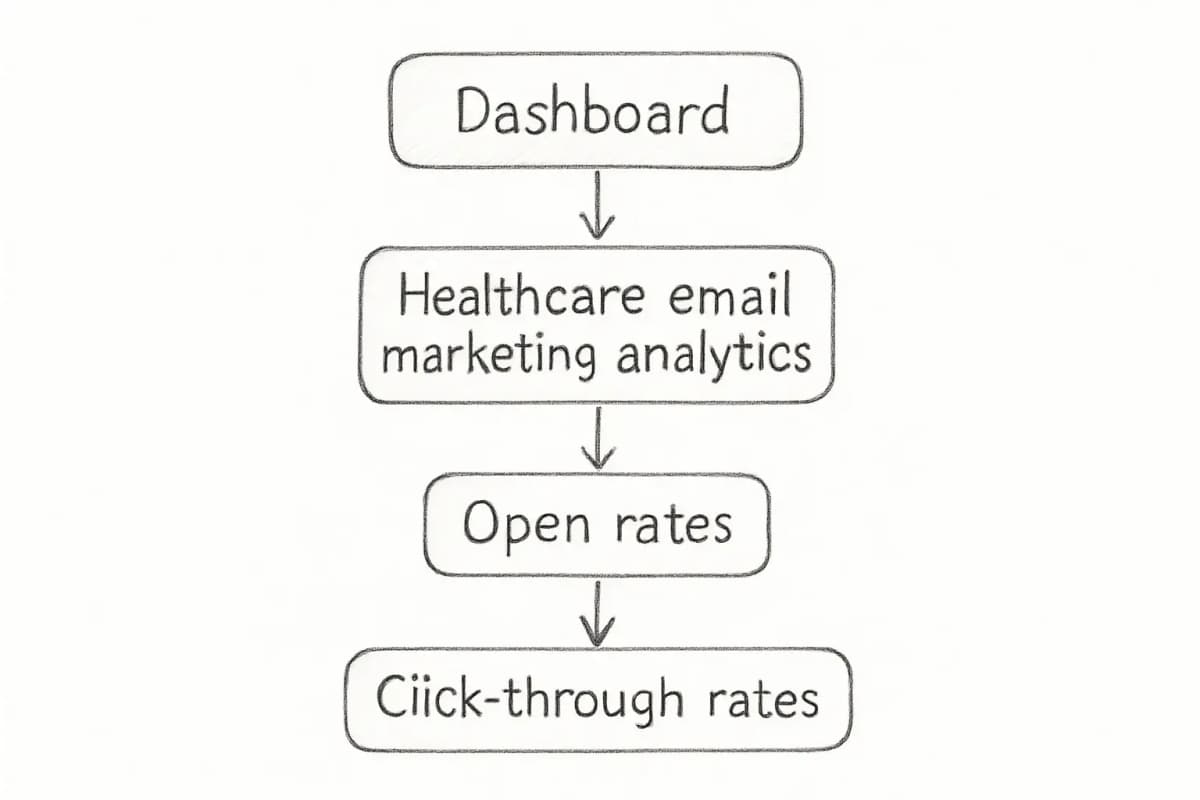
7. Healthcare Domain Expertise, Not Just Email Expertise
The best AI healthcare marketing tools in 2025 to 2026 are the ones that survive your regulatory review process, not the ones with the most impressive demos.
A firm with deep healthcare experience will understand:
- The difference between clinical communications, treatment-related communications, and marketing under HIPAA
- How to write email copy that is clear and compliant without being cold or generic
- Seasonal healthcare campaigns tied to preventive care calendars
- How to navigate FDA guidance when emails touch on specific conditions or products
- The trust dynamics specific to patient-provider relationships
As more businesses become comfortable with AI content, there is a growing demand for blending AI with human insight. The focus should be on humanizing your brand and connecting with your target audience in more meaningful ways to deliver a better, more unique, and compelling brand experience.
Ask any prospective firm to show you healthcare-specific campaign examples, reference clients in your segment (hospital system, specialty practice, health tech, pharma, etc.), and demonstrate familiarity with the compliance frameworks governing your specific organization.
For reference on what strong AI-driven campaign work looks like in practice, our roundup of successful AI-driven email marketing examples is a useful benchmark.
8. Pricing Transparency and Scalability
The global healthcare email marketing software market is growing steadily, driven by digitalization and patient engagement needs. Healthcare-specific platforms typically range from $140 to $350 per month for around 8,000 contacts. Full-service agency relationships or enterprise AI platforms carry higher costs.
Plan to spend $1,500 to $4,000 per month on AI tools at growth stage; $8,000 to $25,000 at scaled medtech.
Before committing, clarify:
- Whether pricing is per-contact, per-email sent, or platform-flat
- What is included at each tier (compliance features, integrations, dedicated support)
- How pricing scales as your contact list grows
- Contract length and exit terms
The right healthcare AI email marketing firm should provide a clear ROI model that connects their fees to measurable outcomes, whether that is appointments booked, patient retention rates, or patient lifetime value.
Frequently Asked Questions
What makes a healthcare AI email marketing firm different from a standard email marketing agency?
Healthcare AI email marketing firms specialize in the regulatory constraints, patient communication dynamics, and clinical data integrations specific to healthcare. When healthcare organizations want to use email marketing, out-of-the-box solutions are not a good fit. Healthcare organizations must use email marketing platforms specifically designed to meet HIPAA's unique privacy and security requirements. Standard email agencies typically cannot sign BAAs, do not offer end-to-end encryption, and lack the healthcare-specific segmentation and compliance tooling that covered entities need.
Do I need a signed BAA with every email marketing vendor I use?
Yes. An email provider is considered a business associate under the HIPAA regulation as they receive, transmit, and store data on behalf of their healthcare clients. All HIPAA business associates are required to sign BAAs before working with healthcare clients. A BAA dictates the security measures a business associate is required to have in place to safeguard PHI.
How does AI actually improve healthcare email marketing performance?
AI integration helps analyze customer behavior, automate content creation, and optimize send times, which enhances overall engagement and conversion rates. In healthcare specifically, marketing content can now adapt based on clinical workflows, prescribing behaviors, and individual preferences. This is not just about personalizing email greetings; it is about delivering information that actually helps people make better decisions. The performance impact is measurable: marketers who use AI for email personalization report a revenue increase of 41% and a click-through rate increase of 13.44%.
What compliance regulations govern healthcare email marketing in the US?
Healthcare organizations must comply with HIPAA, applicable state laws requiring affirmative opt-ins, the FTC's CAN-SPAM Act, and the INFORM Consumers Act where applicable. HIPAA's requirements regarding consent for healthcare communications are layered on top of existing email marketing regulations such as CAN-SPAM and CASL. Organizations touching FDA-regulated products must also account for FDA marketing guidance. Working with a healthcare AI email marketing firm that has legal and compliance resources embedded in their team reduces your exposure across all of these frameworks.