
AI-driven email marketing is no longer a competitive advantage reserved for enterprise teams. It is now the baseline for programs that want to stay relevant, and the performance gap between AI-adopters and manual senders is widening fast.
Email marketing already delivers an average return of $36 for every dollar spent, making it the highest-ROI digital channel in existence. Add AI to the mix and those numbers shift further. Brands using AI-driven personalization report up to 42% higher revenue, with click-through rates exceeding 13%. The question is no longer whether to use AI in your email program. It is which capabilities to prioritize and how to implement them without sacrificing quality or brand voice.
This guide covers exactly that.
Key Takeaways
- 63% of marketers now use AI tools in their email marketing efforts, signaling mainstream adoption.
- Using AI for email personalization leads to a 41% increase in revenue.
- AI-generated subject lines outperform manually written ones by 26% on open rates.
- Automated emails produce 320% more revenue than non-automated messages.
- By 2026, 89% of marketing experts expect up to 75% of email strategy operations to be AI-driven.
What AI-Driven Email Marketing Actually Means
AI in email marketing is not a single feature. It is a set of technologies applied across your entire send pipeline.
AI in email marketing refers to the use of machine learning models, predictive analytics, and generative AI systems to automate decisions and personalize content at the individual subscriber level. Predictive AI uses historical data, including past purchases, browsing behavior, email engagement, and time-on-site, to forecast future behavior.
Generative AI creates content. It can draft subject lines, preview text, body copy, and product descriptions from prompts, and can produce dozens of subject line variants for A/B testing in the time it would traditionally take a copywriter to write three.
The meaningful shift in 2025 and 2026 is that these two types are increasingly working together inside email platforms.
The practical result: fewer manual decisions, more relevant messages, and measurable revenue improvements at every stage of the customer lifecycle.
1. AI Personalization: The Biggest Revenue Driver
Generic batch-and-blast campaigns are losing ground fast. The gap between teams using AI personalization and those still running batch-and-blast campaigns is widening. AI-powered email programs generate 41% more revenue than manual campaigns according to Salesforce benchmarks, and teams implementing the full AI stack see 3.2x higher revenue per recipient.
What makes AI personalization different from basic mail merge is depth. Modern platforms analyze subscriber data to customize entire email content blocks based on preferences, purchase history, and predicted interests, not just first name tokens.
65% of marketers identify dynamic content blocks as their most effective personalization tactic. These blocks allow a single email template to render differently for each subscriber, pulling in product recommendations, offers, and messaging that match their individual behavior.
The engagement and conversion data backs this up clearly:
- Personalized emails achieve 29% higher open rates and 41% higher click-through rates than generic messages.
- Emails with personalized elements can boost conversion rates by up to 60%.
- Nearly 72% of consumers prefer personalized emails with AI-driven recommendations over generic ones.
For a deeper look at how to execute this at the campaign level, see AI Email Marketing Personalization Techniques.
2. Smarter Segmentation Through Predictive AI
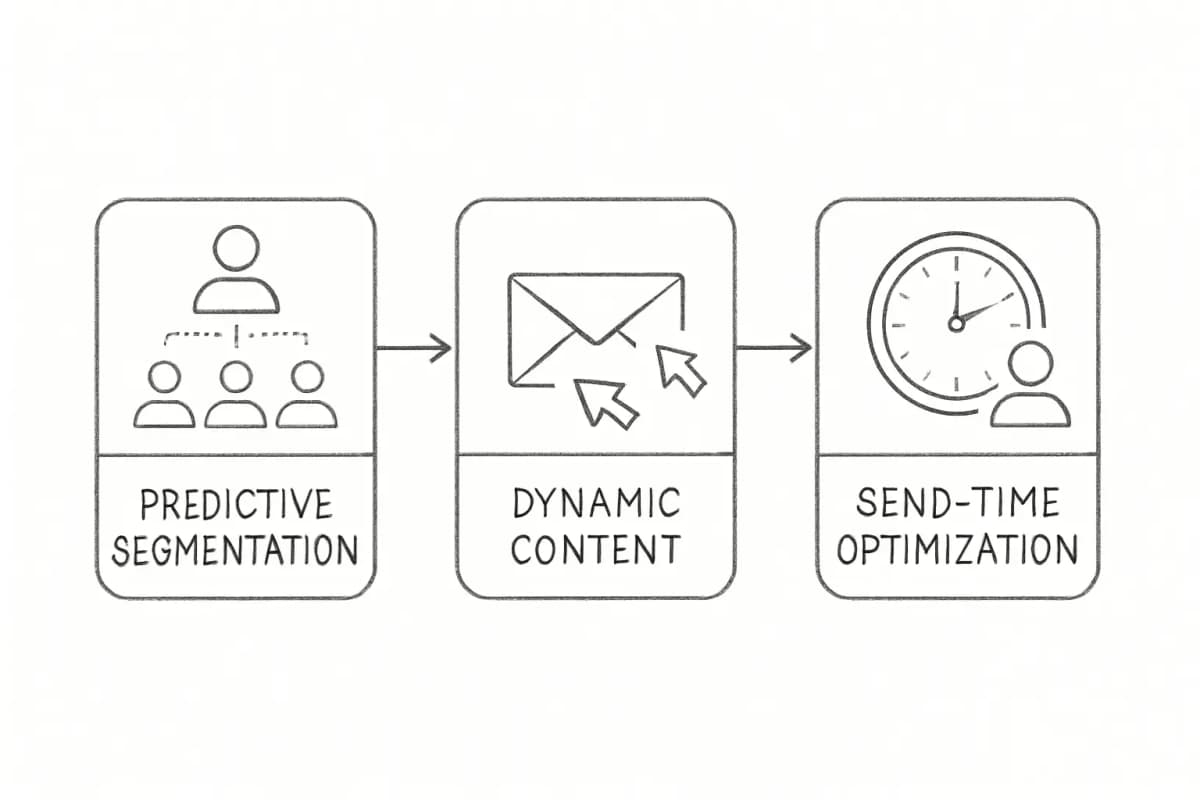
Traditional segmentation puts subscribers into static buckets. AI-driven segmentation is dynamic. Models continuously score each subscriber on behavioral signals including conversion likelihood, predicted lifetime value, purchase frequency, content preference, and churn probability, and update those scores as new data comes in.
Standard behavioral segmentation groups contacts by what they have already done. Predictive segmentation scores contacts based on what they are more likely to do next.
That shift from backward-looking to forward-looking targeting is where the revenue gains concentrate. Segmented email campaigns generate 30% more opens and 50% more click-throughs, according to HubSpot's 2025 State of Marketing Report.
AI segmentation clusters subscribers by purchase recency, browse behavior, email engagement velocity, and predicted lifetime value, giving you the precision to suppress low-intent contacts, prioritize high-value ones, and trigger the right message at the right lifecycle stage.
For a complete playbook on segmentation strategy, read Email List Segmentation Strategies That Boost ROI by 760%.
3. Subject Line Optimization with AI
Your subject line is the single highest-leverage asset in each send. Before any copy, design, or offer lands in front of a subscriber, the subject line determines whether the email gets opened.
Organizations using AI to generate and optimize subject lines see a 26% increase in open rates compared to manually written alternatives. The advantage compounds with dynamic send-time optimization, which adds another 14% lift when combined with AI subject lines.
The mechanism behind this improvement is testing volume. AI subject line generators produce 10 to 50 variants, test them against historical performance data, and pick the winner before the full send rolls out. A human copywriter testing two variants manually cannot compete with that throughput.
Multivariate testing outperforms simple A/B testing by 22%. AI-powered multivariate testing evaluates 5 to 10 variants simultaneously, analyzing emotional tone, word choice, length, personalization tokens, and emoji usage.
For subject line best practices grounded in real data, see Email Subject Line Best Practices That Boost Open Rates by 27%.
4. Send-Time Optimization: Individual-Level Timing
Most teams pick a send time based on industry benchmarks, typically Tuesday or Thursday morning, and apply it to their entire list. AI replaces that blunt approach with per-recipient delivery.
Send-time optimization (STO) is one of the highest-leverage AI features in email marketing. Instead of sending your entire campaign at 10 AM Tuesday to everyone, STO delivers each email when each individual subscriber is most likely to engage. The result is a 15 to 25% improvement in meaningful engagement metrics.
There is an important caveat for 2026. Apple Mail Privacy Protection, adopted by roughly 50% of email recipients, pre-loads tracking pixels and breaks traditional open-rate-based timing models. Modern AI STO systems have evolved to analyze click behavior, conversion timing, and reply patterns instead of relying on open signals.
If your platform still relies on open timestamps, it is using corrupted data. Klaviyo, Braze, and Salesforce Marketing Cloud have updated to click-based models.
Check your platform's STO documentation before assuming it is working correctly.
5. Automated Flows: Where AI Multiplies Revenue
AI-driven automation is not just a time-saver. It is a revenue engine. Automated emails accounted for just 2% of all sends but drove 30% of total email revenue in 2025.
Omnisend's 2025 data shows automated emails pulling 52% higher open rates than scheduled campaigns. GetResponse analyzed 4.4 billion messages and found triggered automations hitting 45.38% open rates versus 40.08% for manual newsletters. The gap grows wider on clicks, with automated emails driving 332% higher click rates and 2,361% better conversion rates.
The highest-ROI flows to build first:
- Abandoned cart recovery: Abandoned cart emails convert at 10.7% on average, meaning more than one in ten recipients completes their purchase after receiving a reminder.
- Welcome sequences: Welcome emails outperform every other automated flow at a 35% open rate.
- Win-back campaigns: Win-back campaigns are among the most predictable starting points for AI personalization, triggered by clear behavioral signals with well-defined conversion goals.
AI can save marketers up to 30% of their time by automating email design, content creation, and scheduling, which frees the team to focus on strategy and creative direction rather than execution.
6. AI and Deliverability: The Foundation Underneath Everything
No amount of personalization or subject line optimization matters if your emails never reach the inbox. Only 84% of marketing emails currently reach the inbox. The remaining 16.9% either land in spam or are never delivered. This means roughly one in six emails fails before engagement is even possible, making deliverability management a primary revenue constraint, not a secondary technical concern.
AI helps address this in two ways.
First, it improves list quality. List quality influences both engagement and complaint risk. AI identifies inactive clusters, risky acquisition sources, and segments with declining click-through rates. Behavior-based suppression helps maintain healthier engagement ratios and reduces unnecessary exposure.
Second, it monitors and protects sender reputation before problems escalate. AI-powered email deliverability optimization uses machine learning to increase the likelihood that emails reach the inbox. It works by analyzing the same signals mailbox providers evaluate: content structure, sender reputation, engagement behavior, and list quality.
Stricter inbox rules from Google, Yahoo, and other major providers have pushed email authentication from best practice to bare minimum. SPF, DKIM, and DMARC now form the essential identity layer that proves a sender is legitimate. AI cannot compensate for failed authentication. Get that infrastructure in place first.
7. Measuring AI-Driven Email Marketing ROI
The metrics you track need to evolve alongside your AI stack.
With Apple Mail Privacy Protection affecting 50% of email recipients, open rates are increasingly unreliable. Revenue per recipient, click-through rate, and conversion rate per send are the metrics that actually correlate with business outcomes.
A practical measurement framework:
- Revenue per recipient (RPR): The most reliable indicator of campaign effectiveness in the post-MPP era.
- Click-through rate (CTR): Unlike open rates, CTR cannot be inflated by privacy features. It requires genuine user action.
- Conversion rate per send: Connects email activity directly to business outcomes.
- Incremental lift: The gold standard for measuring AI personalization impact is holdout testing. Randomly exclude 10% of your subscriber list from AI-personalized campaigns and send them the non-personalized version. Compare revenue per recipient between the two groups over 90 days. This isolates the AI personalization lift from other variables like seasonal trends and list growth.
For a full breakdown of which analytics to prioritize at each stage, visit Email Marketing Analytics Best Practices.
Practical Starting Points for AI Adoption
Not every team needs to overhaul their entire stack at once. The most reliable sequence for teams getting started with AI-driven email marketing:
- Audit your data quality first. Invalid addresses, spam traps, and dormant contacts degrade model performance and damage deliverability. AI models trained on dirty data produce skewed outputs.
- Start with high-signal flows. Abandoned cart, post-purchase follow-up, and win-back campaigns have clear behavioral triggers and measurable goals.
- Layer in subject line testing. This is low-cost, high-impact, and delivers fast results.
- Verify your STO platform uses click signals, not open data. Platforms that use click and conversion rates instead of open-rate data are the ones to prioritize. Klaviyo made this shift. If your platform has not, it is still optimizing based on unreliable inputs.
- Maintain human oversight. Keep human judgment in charge of strategy, creative direction, design, deliverability decisions, and anything that requires knowing the brand. The most common mistake is treating AI as a replacement for any process. Brands that automate everything and review nothing end up with faster, more generic emails that do not convert.
Frequently Asked Questions
What is AI-driven email marketing?
AI in email marketing refers to the use of machine learning, predictive analytics, and generative AI to automate and personalize email campaigns at scale. It enables decisions about who receives which message, when, with what content, and what the next action should be, made at an individual subscriber level based on behavioral data.
How much does AI improve email marketing ROI?
Businesses using AI in email campaigns report an average ROI increase of 21%. At the higher end, Omnisend reports that its U.S. clients generate an average of $79 in revenue for every $1 spent, reflecting the combined ROI of AI-powered automation and real-time personalization across email and SMS.
Does AI help with email deliverability?
Yes, but within limits. AI-powered email deliverability optimization is an operational layer that aligns sender behavior with machine-learning-driven filtering systems. When content, reputation, engagement, and list quality are analyzed together and sending behavior is adjusted in response, inbox placement becomes more consistent. However, AI cannot override failed authentication. SPF, DKIM, and DMARC setup remains a prerequisite.
What email marketing tasks should AI handle versus humans?
The key distinction is between AI that generates content and AI that optimizes delivery. Both matter, but they solve different problems. Generative AI speeds up content creation workflow. Predictive AI, the kind that analyzes subscriber behavior to determine optimal send times or re-engagement triggers, directly impacts your core metrics. Human judgment should govern strategy, brand voice, creative direction, and any decision that requires contextual understanding of your audience.