
Artificial Intelligence in Email Marketing: A Complete Guide
Learn how AI transforms email marketing with personalization, automation, and better ROI. Explore practical strategies to boost deliverability and engagement today.
Artificial Intelligence in Email Marketing: A Complete Guide
Learn how AI transforms email marketing with personalization, automation, and better ROI. Explore practical strategies to boost deliverability and engagement today.
Artificial intelligence in email marketing has moved from a competitive edge to a baseline expectation. In 2025, 63% of marketers are using AI for campaigns, generating 13% higher click-through rates and 41% more revenue. The gap between teams using AI-driven campaigns and those still running batch-and-blast sends is widening every quarter, and the data makes the case clearly: AI is not an optional upgrade. It is the infrastructure modern email programs run on.
This guide covers what artificial intelligence actually does in email marketing, where it delivers the strongest results, and how to implement it without losing the human judgment that makes campaigns work.
Key Takeaways
By the end of 2026, 70% of marketers anticipate that up to half of their email marketing operations will be AI-driven.
AI-powered email programs generate 41% more revenue than manual campaigns according to Salesforce benchmarks, and teams implementing the full AI stack see 3.2x higher revenue per recipient.
82% of marketers use automation for triggered emails, which generate 8x more opens than batch sends. Automated emails produce 320% more revenue than non-automated messages.
76% of marketers now produce and send emails within three days, a dramatic shift from 2024 when 62% of teams needed two weeks or more to produce a single email.
AI adoption in email is projected to reach 97% by 2030, effectively making it standard infrastructure rather than a competitive differentiator.
What Artificial Intelligence Actually Does in Email Marketing
AI in email marketing refers to using artificial intelligence and machine learning to automate, optimize, and personalize email campaigns. This includes everything from content generation and audience segmentation to send time optimization and predictive analytics.
Two distinct types of AI power most email programs today:
Predictive AI handles the analytical side. It learns from behavior and purchase data to segment audiences, time sends per recipient, and forecast outcomes like expected next order or predicted customer lifetime value.
Generative AI handles the creative side. It creates subject line variants, preview text, body copy drafts, and personalized product recommendation copy from audience context and brand guidelines.
Artificial intelligence in email marketing has moved from a competitive edge to a baseline expectation. In 2025, 63% of marketers are using AI for campaigns, generating 13% higher click-through rates and 41% more revenue. The gap between teams using AI-driven campaigns and those still running batch-and-blast sends is widening every quarter, and the data makes the case clearly: AI is not an optional upgrade. It is the infrastructure modern email programs run on.
This guide covers what artificial intelligence actually does in email marketing, where it delivers the strongest results, and how to implement it without losing the human judgment that makes campaigns work.
Key Takeaways
By the end of 2026, 70% of marketers anticipate that up to half of their email marketing operations will be AI-driven.
AI-powered email programs generate 41% more revenue than manual campaigns according to Salesforce benchmarks, and teams implementing the full AI stack see 3.2x higher revenue per recipient.
82% of marketers use automation for triggered emails, which generate 8x more opens than batch sends. Automated emails produce 320% more revenue than non-automated messages.
76% of marketers now produce and send emails within three days, a dramatic shift from 2024 when 62% of teams needed two weeks or more to produce a single email.
AI adoption in email is projected to reach 97% by 2030, effectively making it standard infrastructure rather than a competitive differentiator.
What Artificial Intelligence Actually Does in Email Marketing
AI in email marketing refers to using artificial intelligence and machine learning to automate, optimize, and personalize email campaigns. This includes everything from content generation and audience segmentation to send time optimization and predictive analytics.
Two distinct types of AI power most email programs today:
Predictive AI handles the analytical side. It learns from behavior and purchase data to segment audiences, time sends per recipient, and forecast outcomes like expected next order or predicted customer lifetime value.
Generative AI handles the creative side. It creates subject line variants, preview text, body copy drafts, and personalized product recommendation copy from audience context and brand guidelines.
The performance advantage of running both together comes from a multiplicative effect: send-time optimization might lift open rates 20 to 30%, personalized subject lines might lift open rates another 15 to 20%, and personalized body copy might lift click-through rates 10 to 15%. Each layer compounds on the others.
AI-Powered Personalization: Beyond the First Name
Inserting a subscriber's first name is not personalization. It is a placeholder. AI enables something structurally different.
AI-powered content personalization goes beyond inserting a first name into the subject line. Modern email platforms use machine learning to dynamically select subject lines, images, product recommendations, and entire content blocks based on each subscriber's predicted preferences and behavior patterns. The result is an email that feels individually crafted even when it is generated at scale.
The revenue impact is measurable. Personalized emails achieve 29% higher open rates and 41% higher click-through rates than non-personalized messages. Segmented and personalized campaigns generate 58% of email revenue and can increase revenue by up to 760%.
Klaviyo's 2025 State of Email report found that brands using AI-driven segments saw revenue per recipient increase by 18 to 45% compared to traditional demographic segmentation.
Traditional segmentation groups subscribers by static attributes: location, age, purchase tier. AI segmentation works differently.
Models continuously score each subscriber on behavioral signals, including conversion likelihood, predicted lifetime value, purchase frequency, content preference, and churn probability, and update those scores as new data comes in. One documented case showed 28% higher conversions compared to legacy segment performance, with high-propensity customers identified by the model being five times more likely to buy than the rest of the list.
Segments update dynamically as behavior changes, eliminating stale static segments that misrepresent the current customer state. AI assigns each subscriber a churn probability score based on declining engagement signals, and high-risk subscribers trigger re-engagement sequences automatically.
Of the 64% of marketers now using AI in some form within their email programs, 50% use it for personalization, 41% for subject line optimization, and 29% for send-time optimization.
To understand how segmentation strategy fits into a broader email program, see our guide on email list segmentation strategies that boost ROI by 760%.
Send-Time Optimization and Automated Flows
The performance advantage of running both together comes from a multiplicative effect: send-time optimization might lift open rates 20 to 30%, personalized subject lines might lift open rates another 15 to 20%, and personalized body copy might lift click-through rates 10 to 15%. Each layer compounds on the others.
AI-Powered Personalization: Beyond the First Name
Inserting a subscriber's first name is not personalization. It is a placeholder. AI enables something structurally different.
AI-powered content personalization goes beyond inserting a first name into the subject line. Modern email platforms use machine learning to dynamically select subject lines, images, product recommendations, and entire content blocks based on each subscriber's predicted preferences and behavior patterns. The result is an email that feels individually crafted even when it is generated at scale.
The revenue impact is measurable. Personalized emails achieve 29% higher open rates and 41% higher click-through rates than non-personalized messages. Segmented and personalized campaigns generate 58% of email revenue and can increase revenue by up to 760%.
Klaviyo's 2025 State of Email report found that brands using AI-driven segments saw revenue per recipient increase by 18 to 45% compared to traditional demographic segmentation.
Traditional segmentation groups subscribers by static attributes: location, age, purchase tier. AI segmentation works differently.
Models continuously score each subscriber on behavioral signals, including conversion likelihood, predicted lifetime value, purchase frequency, content preference, and churn probability, and update those scores as new data comes in. One documented case showed 28% higher conversions compared to legacy segment performance, with high-propensity customers identified by the model being five times more likely to buy than the rest of the list.
Segments update dynamically as behavior changes, eliminating stale static segments that misrepresent the current customer state. AI assigns each subscriber a churn probability score based on declining engagement signals, and high-risk subscribers trigger re-engagement sequences automatically.
Of the 64% of marketers now using AI in some form within their email programs, 50% use it for personalization, 41% for subject line optimization, and 29% for send-time optimization.
To understand how segmentation strategy fits into a broader email program, see our guide on email list segmentation strategies that boost ROI by 760%.
Send-Time Optimization and Automated Flows
When to send an email is almost as consequential as what the email says. Send-time optimization uses machine learning to predict when each individual subscriber is most likely to open and engage with an email. Rather than sending to your entire list at 10 AM on Tuesday, the AI staggers delivery so each subscriber receives the email during their personal engagement window.
Businesses using send-time optimization see an average 26% lift in open rates and a 41% improvement in click-through rates.
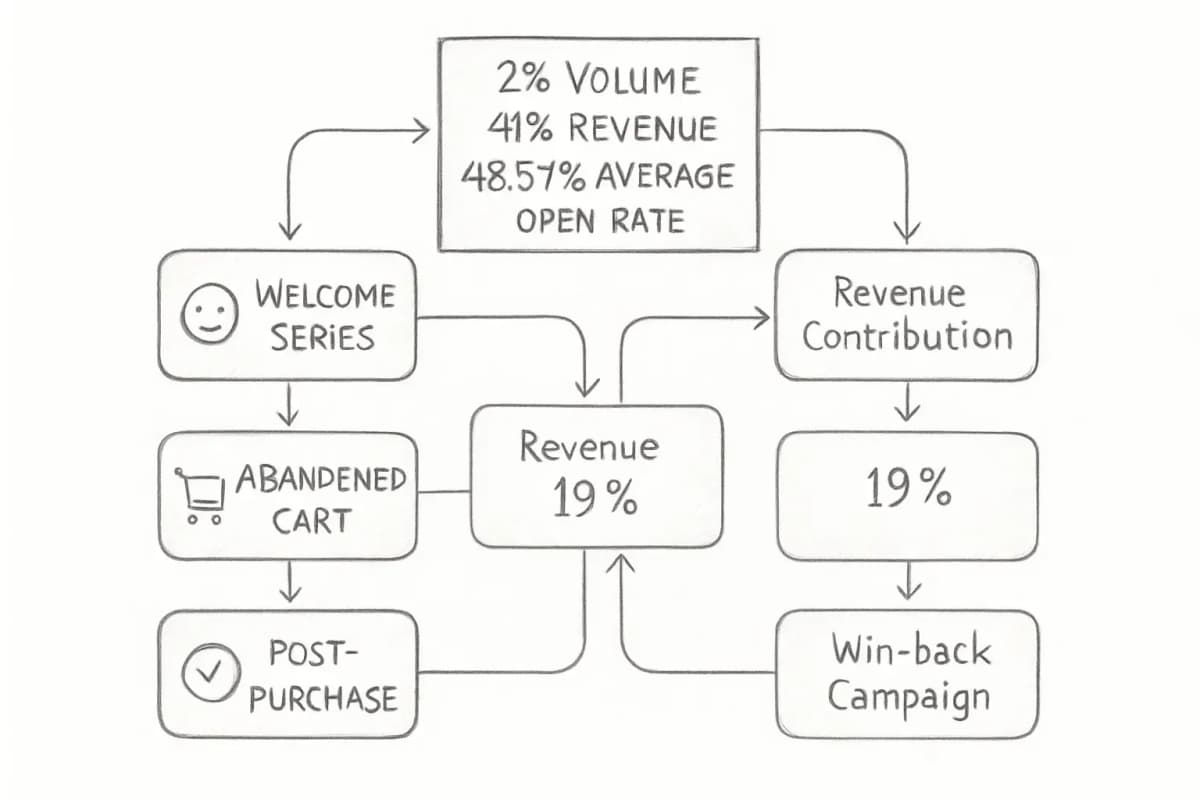
Beyond timing, AI-powered automation handles the flows that generate the most email revenue. Five automated flows generate 80% of email revenue: welcome series, cart recovery, post-purchase, re-engagement, and browse abandonment sequences drive the vast majority of automated email revenue when properly configured with behavioral triggers.
Triggered and automated emails represent only 2% of total email send volume, yet they account for 41% of total email revenue. Automated emails achieve an average open rate of 48.57%, compared to 25.2% for manual campaign sends.
AI Subject Line Optimization
Subject lines determine whether an email gets opened or ignored. In 2026, with the average professional receiving 121 emails per day and mobile open rates accounting for 68% of all email engagement, subject line optimization is not a nice-to-have. It is the highest-leverage activity in your entire email marketing operation.
AI changes subject line testing from a manual, intuition-driven process into something faster and more precise. A human copywriter might draft three to five subject line variants for an A/B test. A generative AI system can produce 50 variants in the same time, all of which can then be tested across audience segments simultaneously rather than sequentially.
eBay deployed Phrasee's AI-powered subject line system and saw a 15.8% lift in open rates and a 31% increase in clicks. Across the industry, AI-optimized subject lines produce 50% higher open rates than manually written ones.
For more on what makes subject lines perform, read our breakdown of email subject line best practices that boost open rates by 27%.
AI in Email Marketing: Key Tools
The right platform depends on your business type, data infrastructure, and growth stage. These are the most widely used options in 2026:
When to send an email is almost as consequential as what the email says. Send-time optimization uses machine learning to predict when each individual subscriber is most likely to open and engage with an email. Rather than sending to your entire list at 10 AM on Tuesday, the AI staggers delivery so each subscriber receives the email during their personal engagement window.
Businesses using send-time optimization see an average 26% lift in open rates and a 41% improvement in click-through rates.
Beyond timing, AI-powered automation handles the flows that generate the most email revenue. Five automated flows generate 80% of email revenue: welcome series, cart recovery, post-purchase, re-engagement, and browse abandonment sequences drive the vast majority of automated email revenue when properly configured with behavioral triggers.
Triggered and automated emails represent only 2% of total email send volume, yet they account for 41% of total email revenue. Automated emails achieve an average open rate of 48.57%, compared to 25.2% for manual campaign sends.
AI Subject Line Optimization
Subject lines determine whether an email gets opened or ignored. In 2026, with the average professional receiving 121 emails per day and mobile open rates accounting for 68% of all email engagement, subject line optimization is not a nice-to-have. It is the highest-leverage activity in your entire email marketing operation.
AI changes subject line testing from a manual, intuition-driven process into something faster and more precise. A human copywriter might draft three to five subject line variants for an A/B test. A generative AI system can produce 50 variants in the same time, all of which can then be tested across audience segments simultaneously rather than sequentially.
eBay deployed Phrasee's AI-powered subject line system and saw a 15.8% lift in open rates and a 31% increase in clicks. Across the industry, AI-optimized subject lines produce 50% higher open rates than manually written ones.
For more on what makes subject lines perform, read our breakdown of email subject line best practices that boost open rates by 27%.
AI in Email Marketing: Key Tools
The right platform depends on your business type, data infrastructure, and growth stage. These are the most widely used options in 2026:
Klaviyo: Built around first-party ecommerce data and deep Shopify integration. Its AI features include predictive CLV scoring, churn risk identification, send-time optimization, and AI-powered content generation. It performs best for DTC brands with rich purchase data.
Salesforce Marketing Cloud: Offers the most sophisticated AI infrastructure through Einstein AI. Its capabilities span predictive segmentation, personalized recommendations, journey optimization, and generative content. Built for enterprise complexity and integrates with the full Salesforce data cloud.
HubSpot: Integrates email deeply with its CRM, allowing customer data to flow directly into segmentation and personalization decisions. Its AI-powered content assistant and send-time optimization are solid for mid-market companies managing marketing, sales, and service from a single platform.
ActiveCampaign: Combines email marketing with CRM and supports complex behavioral automation. Strong for B2B and service businesses that need multi-channel lifecycle management.
Mailchimp: Remains the most widely used platform globally and has steadily added AI features including predictive demographics, send-time optimization, and an AI marketing assistant. Best suited for small and mid-sized businesses.
Klaviyo: Built around first-party ecommerce data and deep Shopify integration. Its AI features include predictive CLV scoring, churn risk identification, send-time optimization, and AI-powered content generation. It performs best for DTC brands with rich purchase data.
Salesforce Marketing Cloud: Offers the most sophisticated AI infrastructure through Einstein AI. Its capabilities span predictive segmentation, personalized recommendations, journey optimization, and generative content. Built for enterprise complexity and integrates with the full Salesforce data cloud.
HubSpot: Integrates email deeply with its CRM, allowing customer data to flow directly into segmentation and personalization decisions. Its AI-powered content assistant and send-time optimization are solid for mid-market companies managing marketing, sales, and service from a single platform.
ActiveCampaign: Combines email marketing with CRM and supports complex behavioral automation. Strong for B2B and service businesses that need multi-channel lifecycle management.
Mailchimp: Remains the most widely used platform globally and has steadily added AI features including predictive demographics, send-time optimization, and an AI marketing assistant. Best suited for small and mid-sized businesses.
Limitations and Risks to Manage
AI works well when managed by people who understand its failure modes.
Data quality is the binding constraint. AI email marketing models need engagement history, CRM data, intent signals, and technographic profiles to produce reliable predictions. Data quality is the limiting factor, not the AI itself; models perform only as well as the data feeding them.
Generic output is a real risk. One of the biggest risks is over-reliance on automation. AI can handle repetitive tasks, but when it becomes the default solution for everything, the human element of creativity and connection can be lost. Campaigns that rely too heavily on machine-generated text often sound generic or impersonal, which can weaken trust and reduce engagement.
Compliance is non-negotiable. Using AI in email marketing means handling sensitive customer data, which is a major risk if GDPR, CCPA, or CAN-SPAM compliance is not in place. Brands using AI email marketing tools must ensure data is secured, user consent is clear, and privacy is respected at every level.
Review generated content before sending. AI-generated subject lines perform well on average but occasionally produce off-brand, misleading, or tone-inappropriate outputs. Every production deployment of generative email content must include a human review step before send, particularly for high-stakes campaigns to large segments.
The strongest results still come from the combination of human creativity and machine intelligence. AI is a tool used by skilled marketers, not a substitute for them.
How to Start Implementing AI in Email Marketing
You do not need to overhaul your entire program at once. A staged approach produces faster and more measurable results.
Limitations and Risks to Manage
AI works well when managed by people who understand its failure modes.
Data quality is the binding constraint. AI email marketing models need engagement history, CRM data, intent signals, and technographic profiles to produce reliable predictions. Data quality is the limiting factor, not the AI itself; models perform only as well as the data feeding them.
Generic output is a real risk. One of the biggest risks is over-reliance on automation. AI can handle repetitive tasks, but when it becomes the default solution for everything, the human element of creativity and connection can be lost. Campaigns that rely too heavily on machine-generated text often sound generic or impersonal, which can weaken trust and reduce engagement.
Compliance is non-negotiable. Using AI in email marketing means handling sensitive customer data, which is a major risk if GDPR, CCPA, or CAN-SPAM compliance is not in place. Brands using AI email marketing tools must ensure data is secured, user consent is clear, and privacy is respected at every level.
Review generated content before sending. AI-generated subject lines perform well on average but occasionally produce off-brand, misleading, or tone-inappropriate outputs. Every production deployment of generative email content must include a human review step before send, particularly for high-stakes campaigns to large segments.
The strongest results still come from the combination of human creativity and machine intelligence. AI is a tool used by skilled marketers, not a substitute for them.
How to Start Implementing AI in Email Marketing
You do not need to overhaul your entire program at once. A staged approach produces faster and more measurable results.
Start with send-time optimization. It is built into most platforms, requires no extra setup, and delivers an immediate lift. Use AI send-time optimization from day one. It is free on most platforms and delivers immediate results.
Add AI subject line testing. Provide basic information about your email's content, and AI creates 10 to 20 variations optimized for different subscriber segments. Platforms like Seventh Sense and Phrasee have helped small businesses achieve subject line performance improvements of 20 to 30% within the first month of implementation.
Build behavioral segmentation before scaling your list. Ensure your email list is properly segmented with relevant subscriber data. AI tools need quality data to make intelligent decisions about personalization and timing.
Automate your highest-value flows first. Welcome series and cart recovery generate the largest share of automated revenue. Get those right before adding complexity.
Measure revenue per email, not open rates. With Apple Mail Privacy Protection affecting 50% of email recipients, open rates are increasingly unreliable. Revenue per recipient, click-through rate, and conversion rate per send are the metrics that actually correlate with business outcomes.
Start with send-time optimization. It is built into most platforms, requires no extra setup, and delivers an immediate lift. Use AI send-time optimization from day one. It is free on most platforms and delivers immediate results.
Add AI subject line testing. Provide basic information about your email's content, and AI creates 10 to 20 variations optimized for different subscriber segments. Platforms like Seventh Sense and Phrasee have helped small businesses achieve subject line performance improvements of 20 to 30% within the first month of implementation.
Build behavioral segmentation before scaling your list. Ensure your email list is properly segmented with relevant subscriber data. AI tools need quality data to make intelligent decisions about personalization and timing.
Automate your highest-value flows first. Welcome series and cart recovery generate the largest share of automated revenue. Get those right before adding complexity.
Measure revenue per email, not open rates. With Apple Mail Privacy Protection affecting 50% of email recipients, open rates are increasingly unreliable. Revenue per recipient, click-through rate, and conversion rate per send are the metrics that actually correlate with business outcomes.
For a structured approach to campaign planning, see our email marketing strategy template for 2025.
Frequently Asked Questions
Does AI in email marketing actually improve ROI, or is it just hype?
The performance data is consistent across multiple independent sources. Marketers who use AI for email personalization report a 41% revenue increase and a 13.44% higher click-through rate. 82% of marketers use automation for triggered emails, which generate 8x more opens than batch sends, and automated emails produce 320% more revenue than non-automated messages. The improvements are real, but they depend on clean data, proper setup, and human oversight.
What is the biggest mistake teams make when adopting AI for email?
Even the best AI email marketing tools require proper strategy, clean data, and human oversight to deliver meaningful results. Most AI email marketing tools rely on large volumes of clean, relevant, and current subscriber data to function effectively. If the inputs are flawed, even advanced AI will not deliver relevant insights, causing poor segmentation and mismatched messaging. Investing in AI before addressing data infrastructure consistently underperforms.
How does AI-powered segmentation differ from traditional segmentation?
Instead of grouping subscribers by those who opened in the last 30 days, predictive segments identify subscribers with a high probability of purchase in the next 14 days or subscribers showing early churn signals. These segments update dynamically as behavior changes, eliminating stale static segments that misrepresent the current customer state.
Is AI email marketing suitable for small businesses?
Yes. AI email marketing is available right now and more affordable than hiring additional marketing staff. Small businesses using AI-powered email marketing report average improvements of 40% in open rates, 35% in click-through rates, and 25% in overall email revenue. Most major platforms, including Mailchimp and Brevo, include AI features at accessible price tiers that do not require technical expertise to configure.

No comments yet. Be the first!
For a structured approach to campaign planning, see our email marketing strategy template for 2025.
Frequently Asked Questions
Does AI in email marketing actually improve ROI, or is it just hype?
The performance data is consistent across multiple independent sources. Marketers who use AI for email personalization report a 41% revenue increase and a 13.44% higher click-through rate. 82% of marketers use automation for triggered emails, which generate 8x more opens than batch sends, and automated emails produce 320% more revenue than non-automated messages. The improvements are real, but they depend on clean data, proper setup, and human oversight.
What is the biggest mistake teams make when adopting AI for email?
Even the best AI email marketing tools require proper strategy, clean data, and human oversight to deliver meaningful results. Most AI email marketing tools rely on large volumes of clean, relevant, and current subscriber data to function effectively. If the inputs are flawed, even advanced AI will not deliver relevant insights, causing poor segmentation and mismatched messaging. Investing in AI before addressing data infrastructure consistently underperforms.
How does AI-powered segmentation differ from traditional segmentation?
Instead of grouping subscribers by those who opened in the last 30 days, predictive segments identify subscribers with a high probability of purchase in the next 14 days or subscribers showing early churn signals. These segments update dynamically as behavior changes, eliminating stale static segments that misrepresent the current customer state.
Is AI email marketing suitable for small businesses?
Yes. AI email marketing is available right now and more affordable than hiring additional marketing staff. Small businesses using AI-powered email marketing report average improvements of 40% in open rates, 35% in click-through rates, and 25% in overall email revenue. Most major platforms, including Mailchimp and Brevo, include AI features at accessible price tiers that do not require technical expertise to configure.