
HomeBlogEmail Marketing StrategyEmail Marketing Automation Best Practices
Email Marketing Strategy

Email Marketing Automation Best Practices

Master email automation with proven strategies for segmentation, timing, and personalization. Boost engagement and ROI with actionable tactics.

M

Marcus Webb

July 12, 2026

11 min read
HomeBlogEmail Marketing StrategyEmail Marketing Automation Best Practices
Email Marketing Strategy

Email Marketing Automation Best Practices

Master email automation with proven strategies for segmentation, timing, and personalization. Boost engagement and ROI with actionable tactics.

M

Marcus Webb

July 12, 2026

11 min read
Share:
Share:
#Email Automation#Marketing Strategy#Deliverability#Personalization
Illustration for best practices for email marketing automation

Stay in the loop

Get the latest posts delivered straight to your inbox. No spam, unsubscribe anytime.

Most of the data I need is already gathered. Let me now compose the full blog post.

Email marketing automation is one of the highest-ROI activities available to any marketing team, yet most businesses use it at only a fraction of its potential. Automated emails generate 320% more revenue than non-automated emails, according to Campaign Monitor. The gap between marketers who follow the best practices for email marketing automation and those who send generic batch-and-blast campaigns is widening fast. This guide covers the practices that actually move the needle, backed by current data, so you can build automation workflows that run efficiently and generate real revenue.

Key Takeaways

  • Email flows massively outperform campaigns on revenue efficiency: flows generate nearly 41% of total email revenue from just 5.3% of sends, with average revenue per recipient nearly 18x higher than standard campaigns.
  • Segmented email campaigns generate 30% more opens and 50% more click-throughs, and 78% of marketers say segmentation is their most effective tactic.
  • As of February 2024, Google and Yahoo require bulk senders to authenticate with SPF and DKIM, publish a DMARC record, and maintain low spam complaint rates.
  • AI-driven personalization of email copy results in a 13%+ increase in CTR, while behavior-based personalization using purchase history data boosts CTR by up to 39%.
  • Automated emails generate 320% more revenue than non-automated campaigns, and 76% of marketers see positive ROI within one year of automation implementation.

1. Start with the Right Automated Flows

Before you optimize anything, you need the foundational automation workflows in place. These are the flows that run continuously, respond to subscriber behavior, and generate revenue without any manual effort after setup.

The core flows every business should have:

  • Welcome series: Triggered immediately when someone subscribes. Automated welcome emails dramatically outperform standard campaigns, achieving an 83.63% open rate and a 16.60% click-through rate.
  • Abandoned cart emails: Abandoned cart emails achieve an average CTR of 23.33%, the single highest-performing email type by click engagement across all automation types.

Stay in the loop

Get the latest posts delivered straight to your inbox. No spam, unsubscribe anytime.

Most of the data I need is already gathered. Let me now compose the full blog post.

Email marketing automation is one of the highest-ROI activities available to any marketing team, yet most businesses use it at only a fraction of its potential. Automated emails generate 320% more revenue than non-automated emails, according to Campaign Monitor. The gap between marketers who follow the best practices for email marketing automation and those who send generic batch-and-blast campaigns is widening fast. This guide covers the practices that actually move the needle, backed by current data, so you can build automation workflows that run efficiently and generate real revenue.

Key Takeaways

  • Email flows massively outperform campaigns on revenue efficiency: flows generate nearly 41% of total email revenue from just 5.3% of sends, with average revenue per recipient nearly 18x higher than standard campaigns.
  • Segmented email campaigns generate 30% more opens and 50% more click-throughs, and 78% of marketers say segmentation is their most effective tactic.
  • As of February 2024, Google and Yahoo require bulk senders to authenticate with SPF and DKIM, publish a DMARC record, and maintain low spam complaint rates.
  • AI-driven personalization of email copy results in a 13%+ increase in CTR, while behavior-based personalization using purchase history data boosts CTR by up to 39%.
  • Automated emails generate 320% more revenue than non-automated campaigns, and 76% of marketers see positive ROI within one year of automation implementation.

1. Start with the Right Automated Flows

Before you optimize anything, you need the foundational automation workflows in place. These are the flows that run continuously, respond to subscriber behavior, and generate revenue without any manual effort after setup.

The core flows every business should have:

  • Welcome series: Triggered immediately when someone subscribes. Automated welcome emails dramatically outperform standard campaigns, achieving an 83.63% open rate and a 16.60% click-through rate.
  • Abandoned cart emails: Abandoned cart emails achieve an average CTR of 23.33%, the single highest-performing email type by click engagement across all automation types.
  • Post-purchase sequences: These nurture buyers into repeat customers and are among the highest revenue-generating flows. Automated flows, including abandoned cart and post-purchase messages, generate up to 30 times more revenue per recipient compared to standard email campaigns, because they address specific customer behaviors at critical points in the customer journey.
  • Re-engagement campaigns: Target subscribers who have gone cold before removing them from your list.
  • Browse abandonment emails: Sent to subscribers who viewed a product or page but did not convert.
  • For a deeper look at structuring your welcome sequence specifically, see our guide on welcome email sequence best practices.


    2. Segment Your List Before You Automate

    Sending the same automated email to your entire list is almost always a mistake. Segmentation is what separates a relevant, high-performing automation from one that gets ignored or reported as spam.

    Automated email segmentation uses dynamic rules and real-time data to organize contacts into targeted groups automatically. Unlike traditional static lists that require constant manual updates, automated segmentation continuously adjusts audience membership based on changing customer behaviors, preferences, and lifecycle stages.

    The four most actionable segmentation criteria:

    1. Lifecycle stage: New subscribers need different messaging than long-term customers or lapsed buyers.
    2. Behavioral data: Email opens, link clicks, website visits, and purchase history.
    3. Demographic data: Industry, job role, location, or company size for B2B.
    4. Engagement tier: Active, at-risk, and inactive subscribers should receive different cadences and content.

    Start with two or three high-impact segments rather than trying to segment everything at once. As performance data accumulates, you can refine or expand your approach.

    Our article on email list segmentation strategies covers this in more depth, including specific segmentation models that have produced significant ROI lifts.


    3. Use Behavioral Triggers, Not Just Time-Based Sends

    Time-based emails, like "send a newsletter every Tuesday," have their place. But the best practices for email marketing automation emphasize trigger-based sending: emails that fire in response to a specific subscriber action.

    When customer behavior triggers email automation, these emails generate nearly 10 times more revenue than other emails. Over 60% of marketers now send more emails than ever before.

    Common behavioral triggers to automate:

  • Post-purchase sequences: These nurture buyers into repeat customers and are among the highest revenue-generating flows. Automated flows, including abandoned cart and post-purchase messages, generate up to 30 times more revenue per recipient compared to standard email campaigns, because they address specific customer behaviors at critical points in the customer journey.
  • Re-engagement campaigns: Target subscribers who have gone cold before removing them from your list.
  • Browse abandonment emails: Sent to subscribers who viewed a product or page but did not convert.
  • For a deeper look at structuring your welcome sequence specifically, see our guide on welcome email sequence best practices.


    2. Segment Your List Before You Automate

    Sending the same automated email to your entire list is almost always a mistake. Segmentation is what separates a relevant, high-performing automation from one that gets ignored or reported as spam.

    Automated email segmentation uses dynamic rules and real-time data to organize contacts into targeted groups automatically. Unlike traditional static lists that require constant manual updates, automated segmentation continuously adjusts audience membership based on changing customer behaviors, preferences, and lifecycle stages.

    The four most actionable segmentation criteria:

    1. Lifecycle stage: New subscribers need different messaging than long-term customers or lapsed buyers.
    2. Behavioral data: Email opens, link clicks, website visits, and purchase history.
    3. Demographic data: Industry, job role, location, or company size for B2B.
    4. Engagement tier: Active, at-risk, and inactive subscribers should receive different cadences and content.

    Start with two or three high-impact segments rather than trying to segment everything at once. As performance data accumulates, you can refine or expand your approach.

    Our article on email list segmentation strategies covers this in more depth, including specific segmentation models that have produced significant ROI lifts.


    3. Use Behavioral Triggers, Not Just Time-Based Sends

    Time-based emails, like "send a newsletter every Tuesday," have their place. But the best practices for email marketing automation emphasize trigger-based sending: emails that fire in response to a specific subscriber action.

    When customer behavior triggers email automation, these emails generate nearly 10 times more revenue than other emails. Over 60% of marketers now send more emails than ever before.

    Common behavioral triggers to automate:

    • Product page viewed (no purchase)
    • Cart created but not completed
    • First purchase completed
    • Specific link clicked in a previous email
    • Subscription renewal upcoming
    • Inactivity after a set number of days
    • Milestone reached (e.g., anniversary, loyalty tier upgrade)

    82% of marketers use automation to create triggered emails, which result in 8 times more opens and greater earnings than typical bulk emails. The best tactics for automation are mapping the customer experience (53%) and the use of personalized messages (51%).

    Behavioral triggers work because the email arrives at the moment the subscriber is most likely to engage. Timing and context are what drive conversions, not volume.


    4. Personalize Beyond First Name

    Personalization in email automation has moved well past {{first_name}} merge tags. The marketers seeing the largest performance gains are using dynamic content driven by behavioral and purchase data.

    Companies using AI-driven email strategies see up to 41% more revenue than those using traditional batch-and-blast sends, and predictive recommendations increase revenue per email by an average of 41%.

    Practical personalization tactics to build into your automation:

    • Dynamic product recommendations: Based on browsing history or past purchases.
    • Conditional content blocks: Show different sections of the same email depending on the subscriber's segment, location, or lifecycle stage.
    • Send time optimization: Use machine learning to deliver each email when the individual subscriber is most likely to open it.
    • Personalized subject lines: Use merge tags to personalize subject lines with each recipient's name or location. Personalized emails may increase open rates for most users and work well when combined with marketing automation in transactional emails, such as birthday deals, post-purchase follow-ups, or promotional emails.

    For a structured breakdown of personalization techniques, our guide on email personalization techniques that boost conversions covers methods that consistently outperform generic campaigns.


    5. Nail Your Email Deliverability

    Even the best automation workflows fail if your emails never reach the inbox. Average email deliverability in 2024 was tested at around 83%, which means roughly 17% of emails never reached their intended destination. That is a significant portion of your list, and your automation revenue, going to waste.

    Authentication is non-negotiable. As of February 2024, Google and Yahoo require bulk senders to authenticate with SPF and DKIM, publish a DMARC record (at least p=none), and maintain low spam complaint rates, with Gmail recommending complaints stay below 0.1%.

    Here is what every sender needs in place:

    • Product page viewed (no purchase)
    • Cart created but not completed
    • First purchase completed
    • Specific link clicked in a previous email
    • Subscription renewal upcoming
    • Inactivity after a set number of days
    • Milestone reached (e.g., anniversary, loyalty tier upgrade)

    82% of marketers use automation to create triggered emails, which result in 8 times more opens and greater earnings than typical bulk emails. The best tactics for automation are mapping the customer experience (53%) and the use of personalized messages (51%).

    Behavioral triggers work because the email arrives at the moment the subscriber is most likely to engage. Timing and context are what drive conversions, not volume.


    4. Personalize Beyond First Name

    Personalization in email automation has moved well past {{first_name}} merge tags. The marketers seeing the largest performance gains are using dynamic content driven by behavioral and purchase data.

    Companies using AI-driven email strategies see up to 41% more revenue than those using traditional batch-and-blast sends, and predictive recommendations increase revenue per email by an average of 41%.

    Practical personalization tactics to build into your automation:

    • Dynamic product recommendations: Based on browsing history or past purchases.
    • Conditional content blocks: Show different sections of the same email depending on the subscriber's segment, location, or lifecycle stage.
    • Send time optimization: Use machine learning to deliver each email when the individual subscriber is most likely to open it.
    • Personalized subject lines: Use merge tags to personalize subject lines with each recipient's name or location. Personalized emails may increase open rates for most users and work well when combined with marketing automation in transactional emails, such as birthday deals, post-purchase follow-ups, or promotional emails.

    For a structured breakdown of personalization techniques, our guide on email personalization techniques that boost conversions covers methods that consistently outperform generic campaigns.


    5. Nail Your Email Deliverability

    Even the best automation workflows fail if your emails never reach the inbox. Average email deliverability in 2024 was tested at around 83%, which means roughly 17% of emails never reached their intended destination. That is a significant portion of your list, and your automation revenue, going to waste.

    Authentication is non-negotiable. As of February 2024, Google and Yahoo require bulk senders to authenticate with SPF and DKIM, publish a DMARC record (at least p=none), and maintain low spam complaint rates, with Gmail recommending complaints stay below 0.1%.

    Here is what every sender needs in place:

    • SPF (Sender Policy Framework): Authorizes which servers can send on behalf of your domain.
    • DKIM (DomainKeys Identified Mail): Adds a cryptographic signature to verify messages were not tampered with in transit.
    • DMARC: Tells receiving servers how to handle mail that fails SPF or DKIM checks. Start with a monitoring policy (p=none), analyze reports, and gradually enforce stricter rules (quarantine, then reject).

    Beyond authentication, maintain list hygiene:

    • Remove hard bounces immediately.
    • Suppress subscribers who have not engaged in 90 to 180 days (or run a re-engagement flow before removing them).
    • Mailbox providers are getting more aggressive about filtering based on sender reputation, authentication, and engagement history. Gmail and Yahoo both implemented stricter requirements in 2024 around SPF, DKIM, and DMARC authentication, easy-to-find unsubscribe options, and spam complaint thresholds below 0.3%.
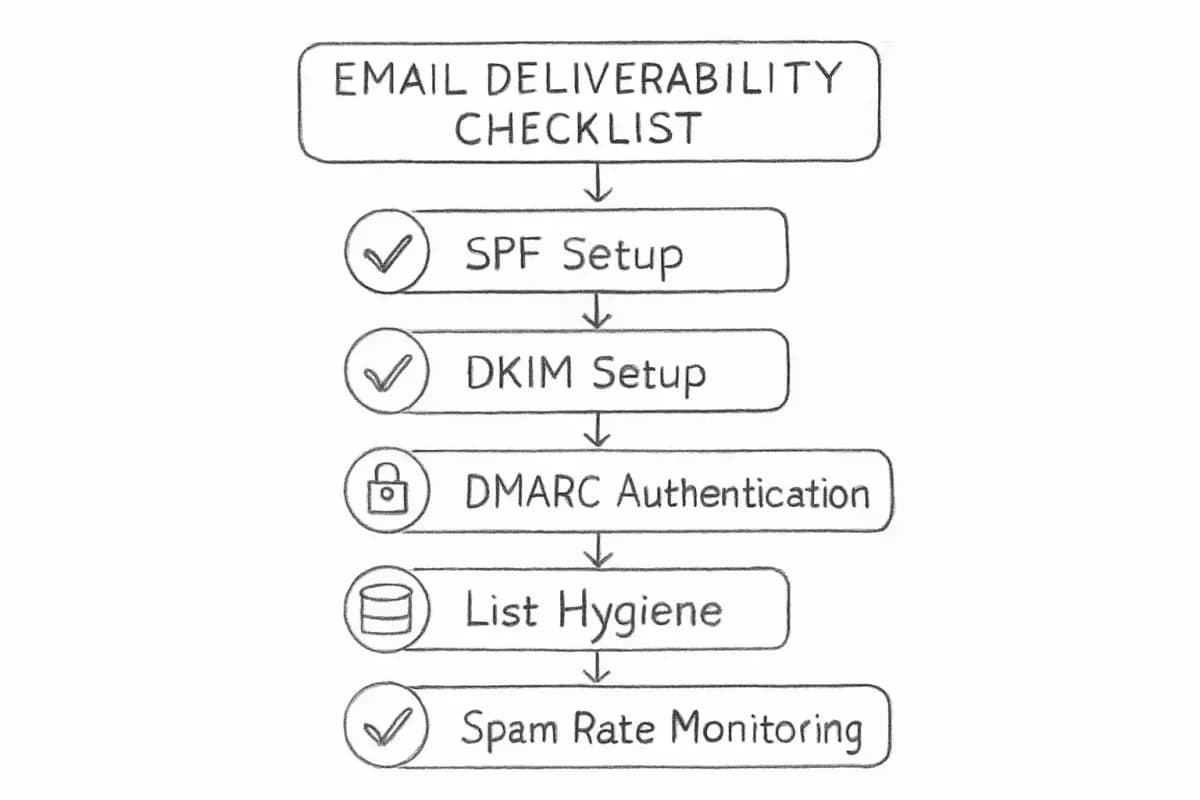
    Email deliverability checklist displayed as a vertical checklist with five key items: SPF setup (with checkmark), DKIM setup (with checkmark), DMARC authentication (with checkmark), list hygiene and subscriber validation (with checkmark), and spam rate monitoring showing percentage below threshold (with checkmark). Use a clean, professional design with green checkmarks and a subtle background. Include icons next to each item representing the concept (lock for authentication, database for list hygiene, chart for monitoring).


    6. Write Subject Lines That Work With Your Automation Logic

    Your automation can be flawlessly built, but a poor subject line means the email never gets opened. 47% of recipients decide whether to open an email based solely on its subject line, and 68% of recipients decide whether to mark an email as spam based on the subject line alone.

    For automated emails specifically, subject lines should reflect the trigger context. A cart abandonment email with "You left something behind" outperforms a generic promotional subject line because it matches exactly what the subscriber just did.

    Guidelines that apply across automated email types:

    • Keep it under 60 characters for mobile readability.
    • Avoid spam trigger words such as "FREE," "ACT NOW," and excessive punctuation.
    • Test subject line variations using A/B testing within your automation platform.
    • Use personalization tokens where they add genuine context, not just decoration.

    For more on this topic, our guide on email subject line best practices that boost open rates covers testing frameworks and proven formats in detail.


    7. Measure What Matters and Optimize Regularly

    Automation is not a set-it-and-forget-it system. The workflows you build need regular review based on actual performance data, not just open rates.

    Shifting focus from traditional metrics like open rates is no small task, yet 15% of email marketers still rely on open rates as a primary measure of success. Open rates are distorted by Apple's Mail Privacy Protection, which pre-loads images for Apple Mail users regardless of whether they actually opened the email.

    Metrics to track for automated workflows:

    • SPF (Sender Policy Framework): Authorizes which servers can send on behalf of your domain.
    • DKIM (DomainKeys Identified Mail): Adds a cryptographic signature to verify messages were not tampered with in transit.
    • DMARC: Tells receiving servers how to handle mail that fails SPF or DKIM checks. Start with a monitoring policy (p=none), analyze reports, and gradually enforce stricter rules (quarantine, then reject).

    Beyond authentication, maintain list hygiene:

    • Remove hard bounces immediately.
    • Suppress subscribers who have not engaged in 90 to 180 days (or run a re-engagement flow before removing them).
    • Mailbox providers are getting more aggressive about filtering based on sender reputation, authentication, and engagement history. Gmail and Yahoo both implemented stricter requirements in 2024 around SPF, DKIM, and DMARC authentication, easy-to-find unsubscribe options, and spam complaint thresholds below 0.3%.

    Email deliverability checklist displayed as a vertical checklist with five key items: SPF setup (with checkmark), DKIM setup (with checkmark), DMARC authentication (with checkmark), list hygiene and subscriber validation (with checkmark), and spam rate monitoring showing percentage below threshold (with checkmark). Use a clean, professional design with green checkmarks and a subtle background. Include icons next to each item representing the concept (lock for authentication, database for list hygiene, chart for monitoring).


    6. Write Subject Lines That Work With Your Automation Logic

    Your automation can be flawlessly built, but a poor subject line means the email never gets opened. 47% of recipients decide whether to open an email based solely on its subject line, and 68% of recipients decide whether to mark an email as spam based on the subject line alone.

    For automated emails specifically, subject lines should reflect the trigger context. A cart abandonment email with "You left something behind" outperforms a generic promotional subject line because it matches exactly what the subscriber just did.

    Guidelines that apply across automated email types:

    • Keep it under 60 characters for mobile readability.
    • Avoid spam trigger words such as "FREE," "ACT NOW," and excessive punctuation.
    • Test subject line variations using A/B testing within your automation platform.
    • Use personalization tokens where they add genuine context, not just decoration.

    For more on this topic, our guide on email subject line best practices that boost open rates covers testing frameworks and proven formats in detail.


    7. Measure What Matters and Optimize Regularly

    Automation is not a set-it-and-forget-it system. The workflows you build need regular review based on actual performance data, not just open rates.

    Shifting focus from traditional metrics like open rates is no small task, yet 15% of email marketers still rely on open rates as a primary measure of success. Open rates are distorted by Apple's Mail Privacy Protection, which pre-loads images for Apple Mail users regardless of whether they actually opened the email.

    Metrics to track for automated workflows:

    • Click-through rate (CTR): Signals genuine engagement. Anything above 2% is strong across most industries.
    • Revenue per recipient (RPR): The clearest measure of automation ROI, especially for e-commerce flows.
    • Conversion rate per flow: What percentage of recipients who enter a flow complete the desired action?
    • Unsubscribe rate: The average unsubscribe rate in 2025 was 0.22%. Consistent spikes in a specific flow suggest a relevance or frequency problem.
    • Spam complaint rate: Keep this below 0.1% to stay within Gmail's guidelines.

    Review each core automation flow monthly. Look at where subscribers drop off, which emails have low CTR, and which segments underperform. Small changes to copy, timing, or segmentation logic can produce meaningful lifts in revenue.

    For a complete framework on tracking and interpreting your metrics, see our post on email marketing analytics best practices.


    8. Use AI to Scale Without Losing Relevance

    AI has changed what is achievable with email automation, particularly for teams with limited bandwidth. Almost 90% of marketers expect that over three-quarters of their email marketing operations will be AI-supported by the end of 2026.

    Practical ways AI improves automation performance:

    • Send time optimization: AI analyzes each subscriber's historical engagement to deliver emails when they are most likely to open.
    • Subject line generation and testing: AI tools can generate and evaluate subject line variants at scale.
    • Predictive segmentation: Machine learning identifies patterns in subscriber behavior to build more precise segments.
    • Dynamic content generation: AI can automatically select and populate content blocks based on individual subscriber data.

    AI product recommendations lift email click rates to 3.75% on average (and 8.79% for top performers), confirming that personalization has a material improvement on email automation performance.

    The key is using AI to improve relevance, not to send more email. Volume without relevance damages your sender reputation and increases unsubscribes.


    Frequently Asked Questions

    What are the most important automated email flows to set up first?

    • Click-through rate (CTR): Signals genuine engagement. Anything above 2% is strong across most industries.
    • Revenue per recipient (RPR): The clearest measure of automation ROI, especially for e-commerce flows.
    • Conversion rate per flow: What percentage of recipients who enter a flow complete the desired action?
    • Unsubscribe rate: The average unsubscribe rate in 2025 was 0.22%. Consistent spikes in a specific flow suggest a relevance or frequency problem.
    • Spam complaint rate: Keep this below 0.1% to stay within Gmail's guidelines.

    Review each core automation flow monthly. Look at where subscribers drop off, which emails have low CTR, and which segments underperform. Small changes to copy, timing, or segmentation logic can produce meaningful lifts in revenue.

    For a complete framework on tracking and interpreting your metrics, see our post on email marketing analytics best practices.


    8. Use AI to Scale Without Losing Relevance

    AI has changed what is achievable with email automation, particularly for teams with limited bandwidth. Almost 90% of marketers expect that over three-quarters of their email marketing operations will be AI-supported by the end of 2026.

    Practical ways AI improves automation performance:

    • Send time optimization: AI analyzes each subscriber's historical engagement to deliver emails when they are most likely to open.
    • Subject line generation and testing: AI tools can generate and evaluate subject line variants at scale.
    • Predictive segmentation: Machine learning identifies patterns in subscriber behavior to build more precise segments.
    • Dynamic content generation: AI can automatically select and populate content blocks based on individual subscriber data.

    AI product recommendations lift email click rates to 3.75% on average (and 8.79% for top performers), confirming that personalization has a material improvement on email automation performance.

    The key is using AI to improve relevance, not to send more email. Volume without relevance damages your sender reputation and increases unsubscribes.


    Frequently Asked Questions

    What are the most important automated email flows to set up first?

    Start with a welcome series, abandoned cart flow, and post-purchase sequence. These three flows address the highest-intent moments in the subscriber lifecycle. In a test carried out on 17 billion emails, automated emails scored 84% higher open rates, 2,270% increase in conversion rates, and a 341% increase in click rate compared to non-automated emails. Once these core flows are performing, add browse abandonment and re-engagement campaigns.

    How often should I review and update my automation workflows?

    Review each flow at minimum once per month for the first three months after launch, then quarterly once performance stabilizes. Pay attention to conversion rate by flow step, CTR, and unsubscribe spikes within specific emails. Market conditions, seasonal patterns, and product changes all affect automation performance over time.

    How does segmentation affect email automation results?

    Segmentation determines whether your automated emails feel relevant or generic to the recipient. The key advantage of automated segmentation is that segment membership triggers automated workflows and personalized content delivery. When someone moves from prospect to customer, they are automatically enrolled in the appropriate welcome series while being removed from sales nurture campaigns. Better segmentation means higher engagement, fewer unsubscribes, and stronger sender reputation.

    What spam complaint rate should I aim for in automated campaigns?

    Gmail recommends complaints stay below 0.1%. Automated flows that send to highly engaged, recently opted-in subscribers typically produce complaint rates well below this threshold. If a specific flow generates elevated complaints, audit the trigger logic, the content relevance, and whether the segment receiving it is appropriate. High complaint rates on automated flows are almost always a segmentation or relevance problem.


    No comments yet. Be the first!

    Leave a comment

    Comments are reviewed before publishing.

    Start with a welcome series, abandoned cart flow, and post-purchase sequence. These three flows address the highest-intent moments in the subscriber lifecycle. In a test carried out on 17 billion emails, automated emails scored 84% higher open rates, 2,270% increase in conversion rates, and a 341% increase in click rate compared to non-automated emails. Once these core flows are performing, add browse abandonment and re-engagement campaigns.

    How often should I review and update my automation workflows?

    Review each flow at minimum once per month for the first three months after launch, then quarterly once performance stabilizes. Pay attention to conversion rate by flow step, CTR, and unsubscribe spikes within specific emails. Market conditions, seasonal patterns, and product changes all affect automation performance over time.

    How does segmentation affect email automation results?

    Segmentation determines whether your automated emails feel relevant or generic to the recipient. The key advantage of automated segmentation is that segment membership triggers automated workflows and personalized content delivery. When someone moves from prospect to customer, they are automatically enrolled in the appropriate welcome series while being removed from sales nurture campaigns. Better segmentation means higher engagement, fewer unsubscribes, and stronger sender reputation.

    What spam complaint rate should I aim for in automated campaigns?

    Gmail recommends complaints stay below 0.1%. Automated flows that send to highly engaged, recently opted-in subscribers typically produce complaint rates well below this threshold. If a specific flow generates elevated complaints, audit the trigger logic, the content relevance, and whether the segment receiving it is appropriate. High complaint rates on automated flows are almost always a segmentation or relevance problem.
    No comments yet. Be the first!

    Leave a comment

    Comments are reviewed before publishing.

    More from

    Related posts

    Illustration for ai-based email marketing
    Email Marketing StrategyJul 14, 2026 12 min

    AI-Based Email Marketing: Strategy and ROI

    Learn how AI transforms email marketing with smarter segmentation, personalization, and automation. Boost open rates and conversions with data-driven tactics.

    More from

    Related posts

    Illustration for ai-based email marketing
    Email Marketing StrategyJul 14, 2026 12 min

    AI-Based Email Marketing: Strategy and ROI

    Learn how AI transforms email marketing with smarter segmentation, personalization, and automation. Boost open rates and conversions with data-driven tactics.

    M
    Marcus Webb
    M
    Marcus Webb
    Illustration for email marketing automation benefits
    Email Marketing StrategyJul 14, 2026 12 min

    Email Marketing Automation Benefits: ROI & Efficiency Gains

    Discover how email automation boosts conversions, saves time, and improves customer engagement. Learn the key benefits and ROI metrics that matter.

    JJames Chen
    Illustration for email marketing automation benefits
    Email Marketing StrategyJul 14, 2026 12 min

    Email Marketing Automation Benefits: ROI & Efficiency Gains

    Discover how email automation boosts conversions, saves time, and improves customer engagement. Learn the key benefits and ROI metrics that matter.

    JJames Chen
    Illustration for "crm email marketing automation
    Email Marketing StrategyJul 14, 2026 14 min

    CRM Email Marketing Automation: Setup & Best Practices

    Learn how to automate email campaigns through your CRM to save time, improve deliverability, and increase ROI. Step-by-step guide inside.

    PPriya Kapoor
    Illustration for "crm email marketing automation
    Email Marketing StrategyJul 14, 2026 14 min

    CRM Email Marketing Automation: Setup & Best Practices

    Learn how to automate email campaigns through your CRM to save time, improve deliverability, and increase ROI. Step-by-step guide inside.

    PPriya Kapoor