
The right email template does more than make your emails look good. It shapes how subscribers experience your brand, affects click-through rates, and directly impacts your bottom line. The average ROI for email marketing is $36 for every $1 spent, equating to a 3,500% return. But getting there requires more than a list and a send button. The quality and structure of your email template determines whether subscribers read, click, or delete.
This guide breaks down the companies with the best email marketing templates in 2024, so you can choose the right platform for your team's goals and skill level.
Key Takeaways
- Poor email design is a primary reason emails fail to convert. Emails that are not engaging enough lead people to ignore them, wasting all of your campaign effort.
- The best dedicated template builders combine intuitive drag-and-drop editors, large template libraries, and AMP support to deliver exceptional value, particularly for teams without coding expertise.
- Personalization efforts improve email conversion rates by an average of 60%, and dynamic content blocks amplify that further.
- Nearly 49% of email opens happen on mobile devices, making mobile-optimized templates a non-negotiable requirement.
- Template library size matters less than template quality, flexibility, and how well the builder integrates with your existing email service provider (ESP).
Why Your Email Template Choice Matters
Professional and memorable emails captivate your audience through strong design and clear branding. A well-designed email not only looks good but also enhances engagement and conversion rates through effective calls-to-action.
Testing across email templates has shown that a simplified and visually appealing design increased click-through rates by 12%, leading to a 5% boost in conversions. That is a measurable lift from a design decision alone.
High-converting email templates use clear hierarchy, personalized content, and strong calls to action. When designed with mobile-first layouts and compelling visuals, they drive engagement and measurable ROI for ecommerce brands.
Before we look at specific platforms, understand that the companies with the best email marketing templates share three traits: they offer responsive designs that render correctly across clients, they let you customize without needing a developer, and they integrate cleanly with your sending platform.
1. Stripo: Best Dedicated Email Template Builder
For teams that want to design emails separately from sending them, Stripo is the strongest dedicated builder available in 2024.
Stripo is a versatile email template builder that simplifies the email design process with its drag-and-drop and HTML editing capabilities. It offers over 1,400 free templates, making it easy for users to create professional-looking emails.
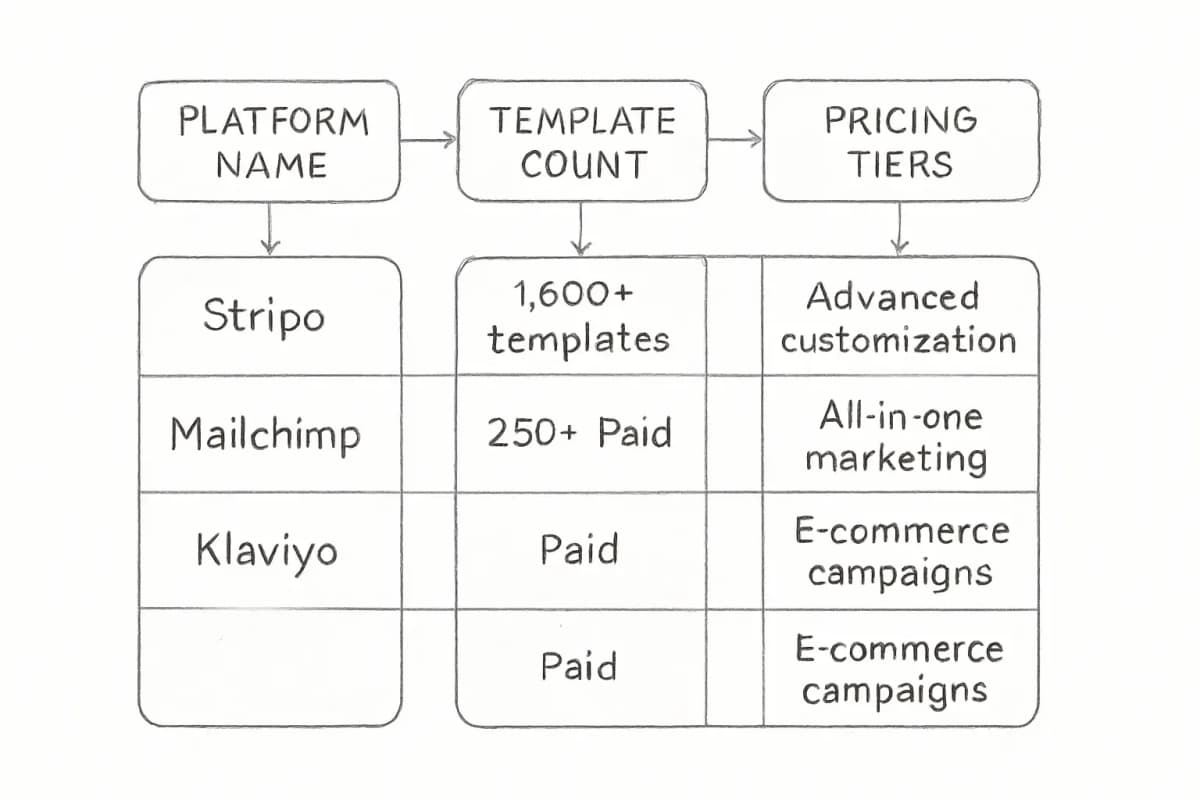
Its combination of an intuitive drag-and-drop editor, 1,600+ templates, and robust AMP support delivers exceptional value, particularly for teams without coding expertise.
The platform is known for its efficiency-enhancing features and integrations with various email service providers. The Stripo plugin extends its functionality, allowing integration into websites, CRMs, and ESPs.
The software also includes a brand guidelines kit generator, ensuring brand consistency across email campaigns. This tool is especially useful for quickly onboarding new team members.
Pricing: Stripo offers four plans: Free ($0/month, 1 user, 4 exports), Basic ($15/month, 1 user, 50 exports), Medium ($45/month, 3 users, 300 exports), and Pro ($95/month, 10 users, unlimited exports).
Best for: Marketing teams and agencies that design across multiple ESPs.
2. Mailchimp: Best for All-in-One Template Access
Mailchimp remains one of the most widely recognized companies with best email marketing templates, partly because its template library covers almost every use case out of the box.
You can get a head start on your next email with one of over 250 templates designed for your specific industry. Mailchimp's library of templates includes mobile-optimized and conversion-driving designs geared toward today's users and built by trusted experts.
The drag-and-drop email builder and professional templates help you create campaigns in minutes, and you can grow your audience by adding popup signup forms or creating unlimited landing pages using premade templates.
Mailchimp offers advanced tools like A/B testing, prebuilt and custom list segmentation options, and send time optimization. You can also personalize email content, including product recommendations using an ecommerce plugin.
Mailchimp's free plan gives you access to a variety of basic, featured, and themed email templates, while paid plans include access to the entire template library. On Standard or Premium plans, you can also purchase custom, expert-designed templates from the Mailchimp Marketplace.
Best for: Small to mid-sized businesses wanting templates and sending under one roof.
3. Klaviyo: Best for Ecommerce Email Templates
Klaviyo is a powerful ecommerce marketing platform. It combines advanced email and SMS tools with automation, segmentation, and deep store integrations to drive conversions. With 350+ email templates and 80+ prebuilt workflows, setting up effective campaigns is fast and intuitive.
Klaviyo's email and form templates look much more appealing than many competitors. Just swap out the placeholder images and text to get emails and forms that look like they were custom-created by a professional.
Klaviyo's design tools are built specifically for ecommerce, with product recommendation blocks, dynamic content based on purchase history, and sophisticated personalization.
There is a generous number of templates, and they are all modern-looking and highly usable. You can filter templates by email type, layout, and seasonal events to find the right one for your needs.
If you run a Shopify, WooCommerce, or BigCommerce store and want templates built around conversions, Klaviyo is the clear leader. For inspiration on how to structure ecommerce email campaigns, see our guide on ecommerce email marketing tips.
Best for: Ecommerce brands that need behavior-triggered, revenue-focused template designs.
4. MailerLite: Best Free Template Library
MailerLite is an affordable and user-friendly email marketing platform. It keeps things simple and focuses on email marketing functionality, making it ideal for a no-fuss way to build and automate email campaigns.
MailerLite's drag-and-drop email editor makes creating professional-looking marketing campaigns as simple as it can be. It comes with 90+ pre-designed email templates to start.
MailerLite also includes forms, a landing page builder, and a simple website creator.
While the template count is lower than Stripo or Mailchimp, the quality is consistently strong. The free plan is one of the most generous available, and the editor gives you enough flexibility to make each template fully on-brand without touching code.
Best for: Startups, bloggers, freelancers, and small business owners who need polished templates on a tight budget.
5. Brevo: Best for Transactional and Promotional Template Variety
Brevo's marketing platform comes with an intuitive email template builder. It is easy to use, relying on simple drag-and-drop to create on-brand email campaigns from scratch. It has a library of pre-built templates across various categories including newsletters, transactional emails, seasonal campaigns, and promotional emails.
Brevo offers an intuitive drag-and-drop editor for easy customization or creation of new templates. You can personalize transactional emails using variables like customer names, prices, and products. It also integrates with hundreds of third-party apps including helpdesks, CRMs, lead generation tools, and payment services.
Brevo's pricing model is based on the number of emails you send, unlike others who charge based on the size of your contact list. This makes it cost-effective for companies with large lists but lower send volumes.
Best for: Businesses that need both transactional and marketing templates in a single platform, particularly those with large contact lists.
6. Constant Contact: Best for Small Business Owners and Beginners
Constant Contact excels with its intuitive design and range of features, including email templates, social media integration, event marketing tools, and robust automation options. The platform also offers excellent customer support and educational resources.
Constant Contact offers a user-friendly email editing tool with a drag-and-drop editor. The editor allows you to add text, images, and other elements to your emails. The platform also offers a wide range of customizable templates to help you get started. The user-friendly interface ensures that even beginners can create professional-looking emails without struggle.
Constant Contact offers unlimited AI-generated email templates, giving it an edge for teams that want to produce volume without starting from scratch each time.
Best for: Small business owners, event organizers, and nonprofits looking for a gentle learning curve and strong template selection.
7. Designmodo Postcards: Best for Designers and Agencies
Postcards is an email template builder offered by Designmodo to help users create email templates faster and with no limits on design.
This email template builder supports collaboration, allowing marketers to share templates with their team and work together to refine the design. You can also incorporate your products directly into your email campaigns via XML feeds.
Pricing starts at $19/month, and the platform is designed specifically for marketers, designers, ecommerce teams, and agencies that need full creative control. It functions as a standalone builder, meaning you export templates for use in your preferred ESP.
Best for: Design-forward teams and agencies that need full creative control without HTML expertise.
What to Look for When Comparing Email Template Companies
Not every business needs the same things from a template provider. Here is a simple framework to narrow your choice:
- Template volume vs. quality. A library of 1,400 mediocre templates is less valuable than 90 polished, flexible ones. Prioritize design quality and responsiveness over raw numbers.
- Customization depth. Check whether you can edit layout, fonts, spacing, and color without touching code. Some platforms lock you into rigid blocks.
- ESP integration. If you build templates in a dedicated builder like Stripo, make sure it exports cleanly to your sending platform.
- Mobile rendering. Choose a premade template that is responsive for mobile devices and tablets. Most email platforms offer such assets for a variety of purposes and industries, including intuitive editors to customize your emails.
- Team collaboration. Agencies and larger teams should prioritize platforms with shared workspaces, commenting, and role-based permissions.
To get more out of your templates once they are built, pair them with smart personalization. Our guide on email personalization techniques covers how to layer dynamic content into any template for stronger engagement. And if you want to understand how to structure your campaigns strategically around those templates, the email marketing strategy template resource covers the full planning framework.
Frequently Asked Questions
Which email marketing platform has the most templates?
Stripo leads as a dedicated template builder with 1,600+ templates, while Mailchimp offers over 250 industry-specific templates within its all-in-one platform. Klaviyo offers 350+ templates focused specifically on ecommerce use cases. For sheer volume, Stripo is the strongest option; for quality within a sending platform, Klaviyo and Mailchimp are the most competitive.
Are free email templates good enough for professional campaigns?
Yes, with the right builder. MailerLite's free plan is one of the most generous available. Its clean, intuitive interface makes everything easy to navigate, and the drag-and-drop email editor helps create professional-looking campaigns. Stripo's free plan also gives access to a substantial portion of its template library. The key is choosing templates designed responsively and customizing them consistently with your brand.
What makes an email template high-converting?
A clear hierarchy, strong visual balance, and a single, relevant CTA tailored to your audience's intent all drive higher conversion. Beyond layout, measures such as dynamic content, embedded interactive elements, and countdown timers can result in a 20 to 25% improvement in conversion rate. Mobile optimization and fast load times are equally important since nearly 49% of email opens happen on mobile devices.
Should I use a dedicated template builder or the one built into my ESP?
It depends on your workflow. Dedicated builders like Stripo give you more template variety and design flexibility, then let you export to your ESP. To integrate Stripo with other ESPs, you need a paid plan. If you are looking for a single tool to design, manage contacts, send, and analyze emails, a complete email marketing platform offers a much wider range of features. For most growing teams, starting with the template tools inside your ESP and upgrading to a dedicated builder as volume increases is the most practical approach.