
Automated emails generate 320% more revenue than non-automated emails, and for every $1 spent on email marketing, the average return is $36. Those two numbers explain why so many businesses are investing heavily in the platforms that make automation possible. But not every platform delivers equally. The right tool for a SaaS growth team looks nothing like the right tool for a D2C ecommerce brand, and choosing the wrong one wastes both budget and time.
This guide covers the leading email marketing platforms with automation, what each one does best, and how to match the platform to your specific use case.
Key Takeaways
- Automated emails drove 37% of all email-generated sales in 2024 despite accounting for just 2% of email volume.
- Marketing automation commands the largest revenue pool in the email market, valued at USD 5.1 billion in 2025.
- Approximately 76% of businesses currently use some form of marketing automation technology as part of their strategy.
- ActiveCampaign leads on raw email automation depth; Klaviyo is the dominant choice for ecommerce.
- Agentic features, including message-level AI personalization and autonomous journey optimization, have moved from differentiators to baseline expectations on enterprise tiers in 2026.
Why Automation Is Now a Baseline Expectation
Email automation used to be a competitive edge. In 2026, it is table stakes. The automated email marketing segment dominates the global email marketing market, driven by increasing demand for personalized customer engagement, real-time communication, and AI-driven campaign management. Businesses across ecommerce, retail, BFSI, healthcare, media, and travel are rapidly adopting automated email marketing platforms to improve lead generation, customer retention, and conversion rates.
The financial case is clear. Several industry sources place the average email marketing ROI at $42 for every dollar spent, making it the highest-returning digital marketing channel across sectors. Automation amplifies that return further. Automated emails reached a 38% open rate and generated $2.87 per email, compared to $0.18 for standard campaign sends.
The key shift happening right now: legacy batch-and-blast platforms are giving way to AI-powered email personalization, where machine-learning models optimize send times, subject lines, and content blocks at the individual recipient level.
If you want to understand how email marketing automation connects with your CRM, the technical setup matters as much as the platform you choose.
The 6 Leading Email Marketing Platforms With Automation
ActiveCampaign: Best for Advanced Automation and B2B
ActiveCampaign is an AI-driven marketing platform offering email marketing with a first-in-class deliverability rate, unifying CRM and cross-channel messaging in one system. Its core advantage is depth. Where many platforms bolt automation on top of a newsletter tool, ActiveCampaign was built from the ground up to orchestrate complex customer journeys without requiring a dedicated ops team.
Its workflow builder features 135+ triggers and split-testable automations, and remains the benchmark for automation sophistication. EmailToolTester's latest deliverability tests scored ActiveCampaign at a 94.2% deliverability rate, placing it first out of 15 tools tested.
Best for: B2B companies, SaaS teams, agencies, and any business with complex, multi-step customer journeys.
Limitation: There is a steeper learning curve, and pricing jumps significantly as lists grow.
Klaviyo: Best for Ecommerce
Klaviyo is the undisputed leader in ecommerce email marketing, powering brands that have generated over $45 billion in attributed revenue through the platform. Like Omnisend, Klaviyo has become a go-to automation platform for online stores, particularly those on Shopify, standing out for its deep integration with ecommerce systems and advanced tools designed to streamline email and text marketing.
Klaviyo has enhanced its platform with AI-driven tools that predict customer behavior, simplify the way you build marketing automations, and help generate email content. It offers over 70 marketing automation templates in its Flow library, an intuitive form builder, dynamic product feeds, and integrated SMS marketing.
Best for: Ecommerce brands on Shopify or other major platforms that need behavioral segmentation and revenue attribution.
Limitation: While packed with features, costs can increase significantly as your customer list grows.
HubSpot Marketing Hub: Best for B2B and CRM-First Teams
HubSpot Marketing Hub is the strongest marketing automation choice for most B2B and SaaS teams, combining a native CRM, deep workflow automation, and AI tools in one platform, with a free tier that is actually usable.
HubSpot covers all digital marketing areas and caters to sales-oriented businesses like SaaS, offering a unified platform that combines CRM capabilities with email marketing, automation, and sales tools. The streamlined data flow makes it easier to coordinate marketing and sales efforts. HubSpot's Spring 2025 announcement included over 200 new features, including "Breeze AI" agents designed to help SMBs compete at enterprise scale.
Best for: B2B companies with a complex sales cycle that need the most complete integrated option.
Limitation: Highest cost at scale.
Mailchimp: Best for Simplicity and Small Businesses
Mailchimp remains one of the most recognized platforms in email marketing. In October 2025, Mailchimp introduced new Shopify-focused email marketing enhancements, omnichannel campaign tools, and advanced analytics features aimed at helping retailers improve customer targeting and increase marketing ROI during seasonal campaigns.
However, its automation has a ceiling. Mailchimp's Marketing Automation Flows handle basic sequences like welcome series and abandoned cart reminders, but teams needing sophisticated conditional branching, goal tracking, or multi-step behavioral workflows will find the platform restrictive compared to ActiveCampaign or Klaviyo.
Best for: SMEs with small lists and occasional campaigns who prioritize ease of use.
Limitation: Mailchimp counts contacts across all lists, meaning the same person in multiple audiences counts multiple times toward your limit, which can inflate costs.
Brevo: Best Value for High-Volume Senders
Brevo is an email marketing and CRM platform for small businesses, ecommerce brands, and marketers, offering SMS marketing, CRM, and transactional emails alongside email marketing. It suits businesses wanting to manage multiple communication channels in one place.
Brevo's strength is its integration of email and SMS marketing. You can create workflows that automatically send follow-up text messages when emails are not opened, ensuring important messages reach your audience through their preferred communication channel.
Brevo represents the strongest value proposition in the European mid-market, bundling email, SMS, WhatsApp, and conversation tools at an aggressive price.
Best for: High-volume senders that want email, SMS, and WhatsApp natively at a competitive price.
Limitation: Workflow logic is limited compared to ActiveCampaign, and analytics are relatively shallow.
MailerLite: Best Budget Option for Growing Teams
MailerLite is an affordable and user-friendly email marketing platform that keeps things simple and focused on core email functionality, making it ideal for building and automating email campaigns without complexity.
Despite its simple appearance, MailerLite supports complex automation workflows with multiple triggers and conditions, and its automation tools stand out particularly for their price point. Paid plans start at just $12 per month, including 5,000 emails and three account users.
Best for: Small to midsize businesses that want solid automation without enterprise pricing.
Limitation: Not suited for complex enterprise-level automations.
What to Look for When Evaluating Automation Depth
Not all "automation" is the same. One platform might offer simple drip sequences while another orchestrates multi-step behavioral journeys across email, SMS, and web. Feature labels say nothing about depth, so they rarely tell you which platform is actually the best fit.
When comparing the leading email marketing platforms with automation, evaluate these areas:
- Trigger variety: Can workflows start from page visits, product purchases, email engagement, or custom events?
- Conditional logic: Does the builder support if/then branching, goal tracking, and multi-path journeys?
- CRM integration: Does subscriber data flow bidirectionally with your CRM, or is it one-way?
- AI features: Does the platform use machine learning to optimize send times, content, or segmentation?
- Deliverability infrastructure: Does it offer dedicated IPs, domain warmup, bounce management, and DMARC support?
Automated solutions should enable companies to schedule campaigns, trigger behavior-based emails, segment customer databases, and analyze campaign performance with minimal manual effort.
For teams building out their full strategy, pairing strong automation with email list segmentation strategies is one of the fastest ways to improve returns.
The Role of AI in Modern Email Automation
AI is no longer a feature reserved for enterprise plans. By late 2026, 61% of enterprise email programs will use AI for at least one element of campaign creation.
The performance impact is real. AI-generated subject lines outperform human-written ones by 26% for open rates on average. Combined with dynamic send-time optimization, the total lift reaches 40%. Companies using AI-driven email strategies see up to 41% more revenue than those using traditional batch-and-blast sends.
Production speed is improving rapidly due to AI: 76% of marketing teams now produce and send a marketing email within 3 days. In 2024, 62% of teams took two weeks or more for a single email.
Platforms are responding to this shift. In June 2025, Salesforce launched Marketing Cloud Next, an AI-powered agentic marketing platform designed to automate campaign creation, customer engagement, and personalized communication. The platform integrates autonomous AI agents to improve real-time marketing interactions and customer journey management.
If you want a deeper look at how AI fits into this space, see our guide on how to leverage AI in your email marketing.
How to Choose the Right Platform for Your Business
No single platform is universally "the best." They solve different problems for different teams. Here is a practical decision framework:
- Ecommerce brands: Start with Klaviyo or Omnisend. Both are built around purchase data, behavioral flows, and revenue attribution.
- B2B and SaaS teams: HubSpot or ActiveCampaign. HubSpot if CRM alignment is critical; ActiveCampaign if automation depth and affordability matter more.
- High-volume senders on a budget: Brevo prices by email volume rather than contacts, which benefits businesses with large but infrequently-emailed lists.
- Small businesses and beginners: MailerLite offers a strong automation feature set at entry-level pricing, without a steep learning curve.
- Teams that need simplicity above all: Mailchimp is the most recognized option and works well for straightforward campaigns with basic automation.
Most platforms offer free trials. Test two or three options with real campaigns before committing. Pay attention to deliverability, ease of use, and how well the platform integrates with your existing tools.
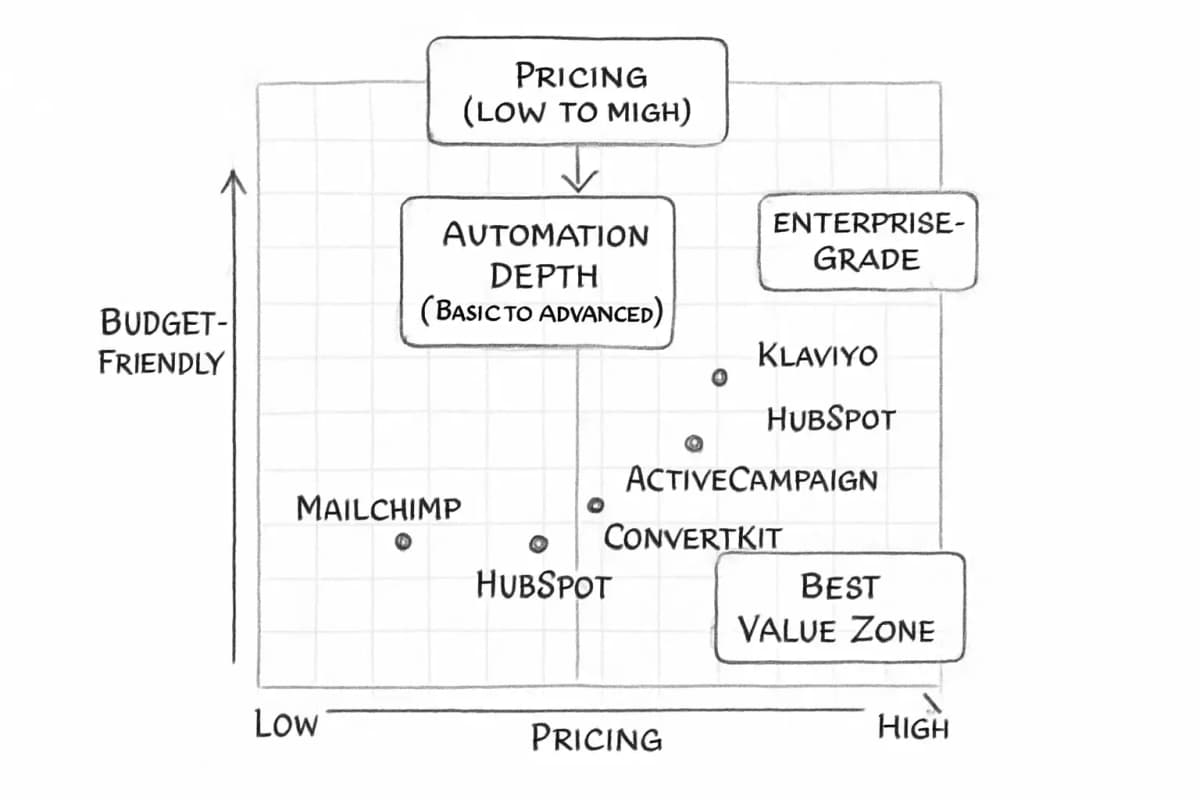
Pricing also scales differently across platforms. For smaller campaigns of around 10,000 emails per month, most platforms offer cost-effective plans between $10 and $40 per month. At 50,000 emails per month, a mid-tier range typically between $50 and $150, the more expensive options usually include advanced segmentation, A/B testing, and custom reporting.
Deliverability: The Factor Most Buyers Overlook
Automation only works if emails reach the inbox. Average email deliverability in 2024 was tested at around 83%, meaning roughly 17% of emails never reached their intended destination.
Gmail and Yahoo both implemented stricter requirements in 2024 around SPF, DKIM, and DMARC authentication, easy-to-find unsubscribe options, and spam complaint thresholds below 0.3%.
When evaluating any of the leading email marketing platforms with automation, confirm that the platform offers:
- Native SPF, DKIM, and DMARC support
- Dedicated IP options for high-volume senders
- Automated bounce management and list hygiene tools
- Spam complaint monitoring and alerts
A strong email infrastructure leverages proper authentication practices via DNS records (SPF, DKIM, DMARC), dedicated IPs, and warmup processes to maintain a high sender reputation.
Tracking deliverability alongside opens and clicks is a discipline on its own. Our guide on email marketing analytics best practices covers the metrics that matter most.
Frequently Asked Questions
Which email marketing platform has the best automation in 2026?
For most businesses, ActiveCampaign is the best general email automation platform, particularly for its AI offering and workflow depth. For ecommerce, Klaviyo leads. For B2B teams that need CRM alignment, HubSpot is the most complete option. The best platform depends on your industry, list size, and workflow complexity.
How much do leading email marketing platforms with automation cost?
Pricing varies significantly by list size, email volume, and features. For campaigns of around 10,000 emails per month, most platforms offer plans between $10 and $40 per month. Enterprise-level plans with advanced automation and dedicated IPs can exceed $300 per month at scale. Most platforms offer free tiers with limited contacts and sends.
What automation features should every email platform include?
At minimum, look for: behavior-triggered workflows, welcome email sequences, abandoned cart recovery, audience segmentation, A/B testing, and basic analytics. More capable platforms enable companies to schedule campaigns, trigger behavior-based emails, segment customer databases, and analyze campaign performance with minimal manual effort.
Is email automation worth the investment for small businesses?
Yes, consistently. 47% of companies use automation specifically for sending welcome emails alone. Small businesses find email marketing an accessible and effective way to reach customers, and the ability to personalize messages and automate campaigns helps small businesses compete with larger firms without large budgets. Even basic automation, like a three-email welcome sequence, can significantly improve subscriber conversion rates from day one.