
An email marketing AI agent is not just another automation upgrade. It is a goal-oriented system that plans, writes, segments, tests, and optimizes entire email campaigns with minimal human direction. While traditional automation follows fixed if-then rules, an AI agent interprets objectives, analyzes live data, and executes decisions on its own. For business owners and marketing teams under pressure to do more with less, that distinction changes what is possible.
Nearly two-thirds of marketers now use AI tools for email campaigns, with 87% of AI adopters specifically applying it to email marketing. The results back the adoption curve: email marketing delivers a return of between $36 and $42 for every $1 spent, outperforming paid search ($2), social advertising ($2.80), and display ads ($1.35).
The arrival of AI agents pushes those numbers further, faster.
Key Takeaways
- An email marketing AI agent goes beyond standard automation: it reasons, adapts, and acts on campaign goals without constant human input.
- Marketers who use AI for email personalization report a 41% revenue increase and a 13.44% higher click-through rate.
- Automated emails generate 320% more revenue than manual campaigns despite representing just 2% of total send volume.
- AI agents handle segmentation, send-time optimization, A/B testing, and content personalization simultaneously, and improve with every campaign they run.
- Human oversight remains essential: brand voice, compliance, and strategic direction still require a person in the loop.
What an Email Marketing AI Agent Actually Does
An AI agent for email marketing is an intelligent, autonomous system that can plan, write, execute, and optimize entire email campaigns with minimal human involvement. Unlike traditional automation tools that rely on rigid "if-then" rules, AI agents use reasoning, learning, and adaptive decision-making to achieve specific marketing goals, such as improving engagement, reactivating dormant users, or boosting conversions.
The clearest way to understand the difference is to contrast it with what came before.
Traditional automation operates on a rigid, rule-based system: if a user clicks a link, send a specific follow-up email; if a user is inactive for 30 days, add them to a re-engagement segment. It is effective for linear tasks but lacks adaptability and true intelligence.
The next generation of AI marketing agents acts autonomously by interpreting goals, analyzing real-time data, and executing decisions without direct oversight. These programs use advanced AI models and predictive analytics to anticipate customer needs and respond instantly.
The underlying technologies making this possible are machine learning, natural language processing, and predictive analytics. Machine learning systems improve campaign performance over time by analyzing results from thousands of sends, identifying what works for different audience segments, and applying those insights to future campaigns automatically. Natural language processing enables AI to understand the context and intent of email content, generate human-quality copy that matches brand voice, and analyze subscriber responses to gauge sentiment.
6 Core Capabilities of an Email Marketing AI Agent
1. Intelligent segmentation
An agent creates dynamic micro-segments in real-time based on the very latest data, like a website visit that happened 60 seconds ago or a product just added to a cart. Static lists built on demographics are replaced by behavior-driven clusters that update automatically.
AI segmentation adds a predictive layer by clustering contacts based on behavioral similarity and projected intent. Common predictive segments include: likely to purchase within 14 days, at risk of churning, high engagement but no conversion, and reactivation candidates.
This directly supports what the data shows about segmentation's impact on revenue. If you want a deeper look at how to structure these segments before handing them to an AI agent, email list segmentation strategies that boost ROI by 760% is a useful reference.
2. Hyper-personalization at scale
An agent can analyze a specific user's recent browsing history, abandoned cart items, and wishlist, then generate a unique email on the fly featuring personalized product recommendations, relevant blog posts, and copy that speaks directly to their interests.
Brands using AI-driven personalization report up to 42% higher revenue, with click-through rates exceeding 13%. The mechanism here matters: the agent is not simply inserting a first name. It is dynamically assembling the entire email based on individual behavior signals.
3. Send-time optimization
Instead of broadcasting at 9 AM Tuesday because a blog post said so, AI models calculate the optimal delivery window for each individual subscriber. The model ingests open timestamps, device usage patterns, and timezone data to select the moment engagement probability peaks. For a 10,000-contact list, this means 10,000 different delivery times, each calibrated to one person's behavior. The result is measurably higher open rates without any additional creative work.
4. Automated multivariate testing
AI agents can continuously run and analyze multivariate tests, not just on subject lines, but on content, send times, and even email designs. They can quickly identify winning combinations and automatically implement them, leading to constant improvement in email performance.
This moves testing deeper by designing smarter A/B experiments that teach you something about your audience. The agent creates test content based on your data, keeps methodology consistent, and automatically applies learnings to future sends.
Pairing AI-generated test variants with strong subject line fundamentals compounds results. Our guide on email subject line best practices that boost open rates by 27% covers the human strategy that feeds the AI testing loop.
5. Predictive analytics and churn detection
AI agents automate and anticipate. They can spot when a customer might unsubscribe, or when someone is ready to upgrade. This predictive layer shifts the team from reactive to proactive, addressing disengagement before it becomes list erosion.
6. Continuous self-improvement
The agent studies your audience, campaign goals, and historical data. It drafts a complete workflow including emails, segments, tests, and schedules. It deploys campaigns autonomously. It then analyzes performance and updates its future decisions. This cycle repeats, which is why performance improves week after week without manual adjustments.
The Business Case: What the Numbers Show
Businesses using AI in email campaigns report an average ROI increase of 21%. For teams running volume at scale, the efficiency gains compound alongside the revenue impact.
Production speed is improving rapidly because of AI: 76% of marketing teams now produce and send a marketing email within three days. In 2024, 62% of teams took two weeks or more for a single email.
Automated emails drove 37% of all ecommerce email revenue in 2024 despite representing just 2% of email volume. That ratio illustrates why investing in an AI agent is not simply about convenience, it is about where revenue actually comes from.
According to McKinsey, companies that invest in AI are seeing a revenue uplift of three to 15% and a sales ROI uplift of 10 to 20%. 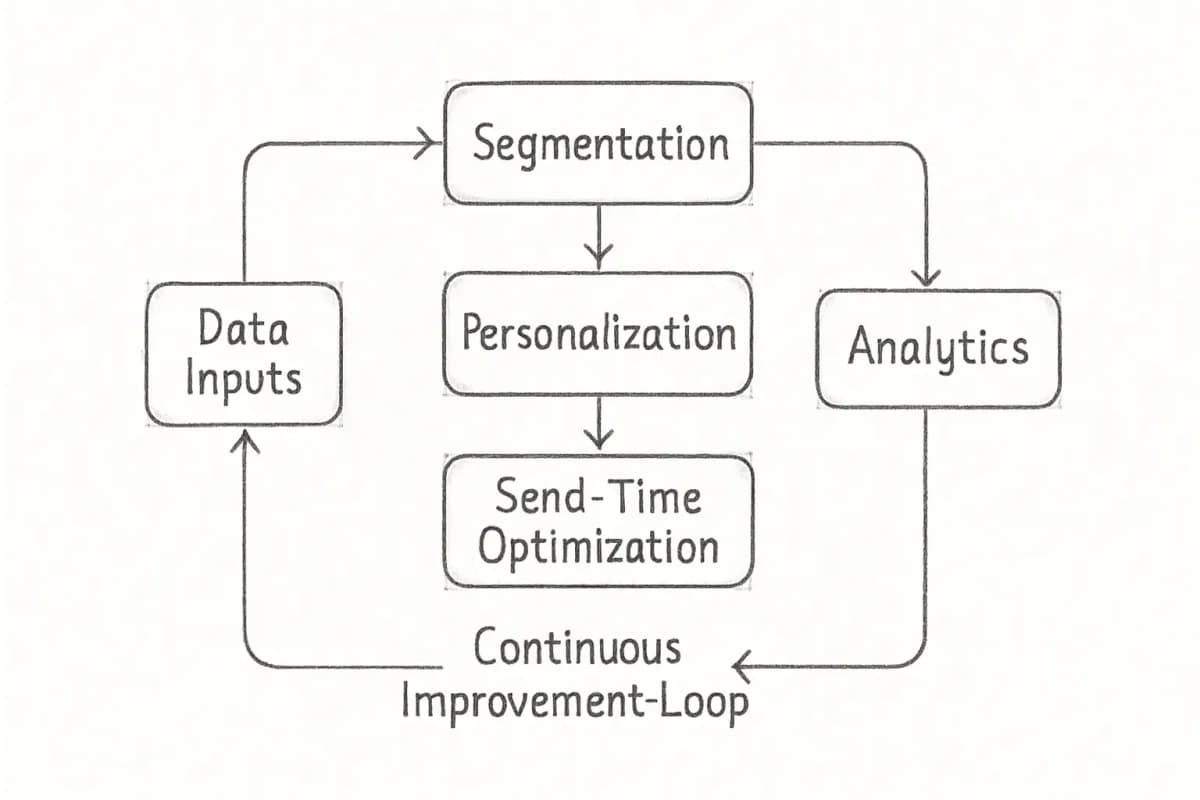
How to Implement an Email Marketing AI Agent
Getting started does not require a data science team or enterprise budget. Most modern platforms embed AI agent capabilities directly into their workflow builders.
Here is a practical implementation sequence:
- Define a specific goal. "Increase repeat purchases" or "reduce 60-day inactivity" is more useful than "improve email performance." The agent needs a measurable objective to optimize toward.
- Audit your data quality. Data quality is the limiting factor, not the AI itself. Models perform only as well as the data feeding them. Clean your lists, confirm your tracking is accurate, and ensure CRM data is current before activating an agent.
- Start with one high-value workflow. Start with a 3-email welcome series launching within two weeks, add abandoned cart recovery by week four, implement behavioral segmentation by month two, and deploy AI agents by month three. This phased approach demonstrates ROI before scaling complexity.
- Connect your CRM. Smooth performance relies on how well the agent is integrated with CRMs and marketing software. Native CRM integration gives the agent the behavioral and pipeline context it needs to make useful decisions.
- Set human review checkpoints. Despite AI agent capabilities, maintain human oversight on strategic decisions. Configure approval workflows for high-value segments, such as enterprise prospects or VIP customers, where AI recommendations require review before execution.
- Measure and expand. Track pipeline attribution, response rate lift versus manual baselines, and time saved on segmentation and testing. Scale only what the data supports.
For teams building their first AI-powered automation stack, the email marketing automation CRM setup guide walks through the technical integration steps in detail.
Platforms That Offer Email Marketing AI Agents
Several platforms now offer agent-level capabilities rather than simple automation:
- Klaviyo: helps users maximize AI integration to get more opens and clicks with Smart Send Time, automatically delivering emails at the best time of day for optimal engagement.
- Brevo: its AI agent, Aura, launched in May 2025, the first major result of a €50 million investment in AI innovation. Aura can add dynamic product recommendations, fine-tune audience segmentation, and optimize send times.
- ActiveCampaign: offers conditional content, predictive sending, and conversion probability scoring to better target and time messages.
- HubSpot: maximizes engagement with AI that predicts optimal timing and targeting.
- GetResponse: after answering a few simple questions, the platform can generate landing pages, autoresponder series, and newsletters, all aligned with campaign goals and branding.
The right platform depends on your list size, CRM ecosystem, and the specific workflows you want to automate first.
Risks and Limitations to Know Before You Deploy
An email marketing AI agent handles a large surface area of decisions. That autonomy creates genuine risks alongside the benefits.
Data privacy and compliance. AI platforms need access to sensitive customer information, which creates compliance issues. Under GDPR, you remain the data controller regardless of what the agent does. If you deploy an AI agent that reads email, categorizes messages, or sends outreach on your behalf, you are the data controller. The agent is a processor acting on your instructions. That distinction matters because the controller bears primary responsibility for lawful processing.
EU AI Act requirements. High-risk AI system requirements take effect in August 2026, including mandatory risk assessments, transparency obligations, and human oversight requirements. Email agents used for profiling or automated decision-making are most likely to be affected.
Over-automation risk. Communication can come across as robotic if it is not well managed. Brand voice, strategic judgment, and the ability to recognize when a campaign is tone-deaf in a particular moment still require human attention.
Data quality dependency. If your subscriber data is incomplete, outdated, or poorly structured, the agent's decisions will reflect that. Garbage in, garbage out applies directly here.
AI will not replace email marketers, but it will assist them. AI can enhance productivity by automating repetitive tasks, analyzing data, and providing insights to improve campaign performance. However, human creativity, strategic thinking, and emotional intelligence remain essential for crafting compelling messages and building customer relationships.
For teams exploring how AI fits into a broader personalization strategy, AI email marketing personalization techniques covers the approach in more depth.
Frequently Asked Questions
What is an email marketing AI agent?
An AI agent for email marketing is an intelligent, autonomous system that can plan, write, execute, and optimize entire email campaigns with minimal human involvement. Unlike traditional automation tools that rely on rigid "if-then" rules, AI agents use reasoning, learning, and adaptive decision-making to achieve specific marketing goals. The practical difference is that you give the system an objective rather than a set of instructions, and it determines how to reach that objective.
How is an AI agent different from standard email automation?
Standard automation executes predefined rules. An AI agent interprets goals, analyzes real-time data, and makes decisions autonomously. Traditional tools assist marketers, while autonomous agents make and execute decisions on their own, adapting as conditions change. The performance gap reflects this: automated emails generate 320% more revenue than manual campaigns despite representing just 2% of send volume.
Will an AI agent replace my email marketing team?
No. AI agents still need to be monitored to secure brand consistency and correct responses. The optimal outcomes are achieved when AI agents are utilized as helpers, not replacements. They should work to enhance human effort, but not replace it completely. The shift is from campaign execution to campaign direction: the agent handles analysis and deployment while your team focuses on strategy, creative direction, and brand judgment.
What should I set up before deploying an email marketing AI agent?
Three things matter most: clean subscriber data, a defined campaign objective, and CRM integration. Ensure clean and structured data since AI relies on accurate, up-to-date subscriber data. Clean your lists regularly and segment based on behavior, interests, or purchase history. Start with one workflow, measure results, and expand from there once you have confirmed the agent is making sound decisions.
Is an email marketing AI agent suitable for small businesses?
Small businesses can benefit from AI as much as enterprise-level brands, using AI to personalize email campaigns and target audiences based on intent signals. Most platforms now offer AI features on accessible pricing tiers. The key is starting with a single high-value workflow, such as a welcome series or abandoned cart recovery, before expanding the agent's scope.