
Email marketing remains the highest-ROI digital channel available to small businesses, yet most owners are leaving serious money on the table by running campaigns without a clear strategy. For every $1 spent on email marketing, the average return is $36, according to data from Litmus. That means a $200 monthly spend on email tools can realistically return $7,200, without relying on ad spend or algorithm-driven reach.
Constant Contact's Small Business Now report reveals that in 2024, 53% of small business owners in the U.S., U.K., Canada, and Australia used email marketing as the most frequent strategy for finding new and retaining repeat customers. But using email and using it well are two different things. According to research conducted in 2024, 73% of SMBs surveyed lacked confidence in their marketing strategies.
This guide gives you concrete, proven email marketing tips for small business owners who want to build a channel that actually drives revenue.
Key Takeaways
- Email marketing delivers an average return of $36 for every $1 spent, a 3,600% ROI, making it the most cost-efficient digital marketing channel.
- Automated emails generate 320% more revenue than non-automated emails.
- 50% of people will delete an email if it is not optimized for mobile.
- Personalized emails achieve a 29% open rate and a 41% click-through rate.
- For 64% of small businesses, email is a great tool for staying competitive with larger businesses, even on a smaller budget.
1. Build an Email List You Actually Own
Your email list is the only marketing asset you own outright. Social media followings are subject to platform algorithm changes overnight. When someone subscribes to your email list, you own that relationship. No algorithm can limit your reach or charge you to contact your own audience.
The most effective way to grow a quality list is through a lead magnet: a free, high-value resource offered in exchange for an email address. A lead magnet is a free resource or incentive that immediately solves a small but significant problem, establishing your brand as a helpful authority from the very first interaction.
Effective lead magnet formats for small businesses include:
- Short checklists or templates (instantly usable, low-friction)
- Discount codes or exclusive offers
- Free guides, mini-courses, or webinars
- Quizzes with personalized results
Statista found that 48% of consumers are happy to give their email address in exchange for a discount. If you sell products, a first-order discount is one of the fastest list-building tools available.
One rule is non-negotiable: never buy an email list. Most people on purchased email lists are not interested in what you are selling, and paid lists typically end up in spam folders or generate immediate unsubscribes. Beyond the wasted spend, bought lists damage your sender reputation and hurt deliverability for your entire program.
2. Send a Strong Welcome Email Immediately
The moment someone subscribes is when your brand has their full attention. Do not waste it with a generic confirmation message.
Welcome emails achieve an average open rate of 83.63% and a click-through rate of 16.60%, with a click-to-open rate of 19.85%. No other email type performs at this level consistently. A well-crafted welcome sequence is the highest-leverage thing a small business can build in email.
A solid welcome email does three things:
- Confirms what the subscriber signed up for and when they can expect to hear from you
- Delivers the promised lead magnet or discount immediately
- Gives them one clear next step, whether that is visiting a page, reading a post, or browsing your products
3. Segment Your List to Send More Relevant Emails
One of the most common email marketing tips for small business owners is to "send more emails." That is often the wrong advice. Sending the same message to everyone on your list is the fastest way to earn unsubscribes.
List segmentation is the practice of dividing your subscribers into groups based on shared characteristics, then sending targeted messages to each group. By sending targeted messages to each group based on demographics, purchase history, or behaviors, businesses can increase open rates and conversions, leading to better ROI.
Common segmentation criteria for small businesses:
- Purchase history (customers vs. non-buyers)
- Geographic location (for local offers or events)
- Sign-up source (lead magnet type, landing page)
- Engagement level (active openers vs. inactive subscribers)
- Product category interest
The revenue impact of segmentation is significant. To understand how to structure this effectively, our guide on email list segmentation strategies covers the frameworks that work best across different business types.
4. Write Subject Lines That Get Opened
Your subject line determines whether your email gets read or ignored. The subject line is one of the most important elements of your email. If it is not compelling or relevant to the recipient's needs, they may delete the message without opening it.
A few principles that reliably improve open rates:
- Keep it short. Subject lines under 50 characters tend to display cleanly on mobile.
- Be specific. "Your August invoice is ready" outperforms "Important update from [Business Name]."
- Use the recipient's name or reference their behavior where relevant. Personalized emails achieve an open rate of 29%.
- Avoid spam trigger words like "free," "guaranteed," or excessive punctuation. These hurt deliverability before the email even reaches an inbox.
- Questions in subject lines can increase opens by up to 50%, and numbers can increase them by 17%.
A/B testing subject lines is the most reliable way to understand what resonates with your specific audience. Test one variable at a time (length, tone, personalization, question vs. statement) and let results guide future decisions.
For a data-backed breakdown of what works, our post on email subject line best practices covers the techniques that consistently move the needle.
5. Use Automation to Nurture Leads Without Extra Work
Email automation is where small businesses gain a genuine advantage without hiring additional staff. Automated emails are triggered by specific subscriber actions or time intervals, which means they reach people at exactly the right moment.
Email automation is a must-have for businesses because it not only saves time, but makes you more money. Automated emails generate 320% more revenue than non-automated emails.
Essential automation sequences for small businesses:
- Welcome series: Introduced above. A three-to-five email sequence that onboards new subscribers.
- Abandoned cart emails: For ecommerce businesses, sending three abandoned cart emails results in 69% more orders than just one email.
- Post-purchase follow-up: Request a review, offer a complementary product, or share tips for using their purchase.
- Re-engagement campaigns: Target subscribers who have not opened your emails in 90 or more days before removing them from your list.
- Birthday or anniversary triggers: Simple but effective for retail and service businesses.
Companies using marketing automation to nurture prospects see a 451% increase in qualified leads, and those nurtured leads make purchases 47% larger than non-nurtured counterparts.
Most small business email platforms, including Mailchimp, Klaviyo, ActiveCampaign, and Brevo, include basic automation functionality even at lower price tiers.
6. Personalize Beyond the First Name
Using [First Name] in a subject line is the baseline, not the ceiling. True personalization matches the content of your email to what a subscriber has done, bought, or expressed interest in.
Personalized emails achieve a 29% open rate and a 41% click-through rate. Compare that to generic batch-and-blast campaigns and the difference is substantial.
Practical personalization tactics for small businesses:
- Reference a recent purchase and suggest a complementary product
- Recommend content based on what they clicked in a previous email
- Adjust send timing based on when individual subscribers typically engage
- Tailor promotions based on geographic location or past browsing behavior
Personalized calls-to-action (CTAs) convert 202% better than generic ones. Swapping a generic "Shop Now" button for "Continue Shopping for [Product Category]" based on the subscriber's last visit takes minutes to set up and can meaningfully lift conversion rates.
7. Optimize for Mobile First
More than half of all email opens happen on mobile devices. Designing for desktop and hoping it works on a phone is a reliable way to lose readers.
50% of people will delete an email if it is not optimized for mobile. That is half your list potentially gone before they read a single word.
What mobile optimization actually means in practice:
- Single-column layouts that stack cleanly on small screens
- Minimum font size of 16px for body text
- Buttons at least 44px tall so they are easy to tap
- Images that scale down without breaking the layout
- Subject lines and preview text written for a narrow display
- Emails that are mobile-optimized lead to 15% more conversions.
Test every campaign on at least two mobile email clients before sending. Most email service providers include preview tools that show how your email renders across devices and email clients.
8. Track the Right Metrics and Act on Them
Sending emails without reviewing performance data is the equivalent of running paid ads without checking conversions. The data tells you exactly where your program is working and where it is not.
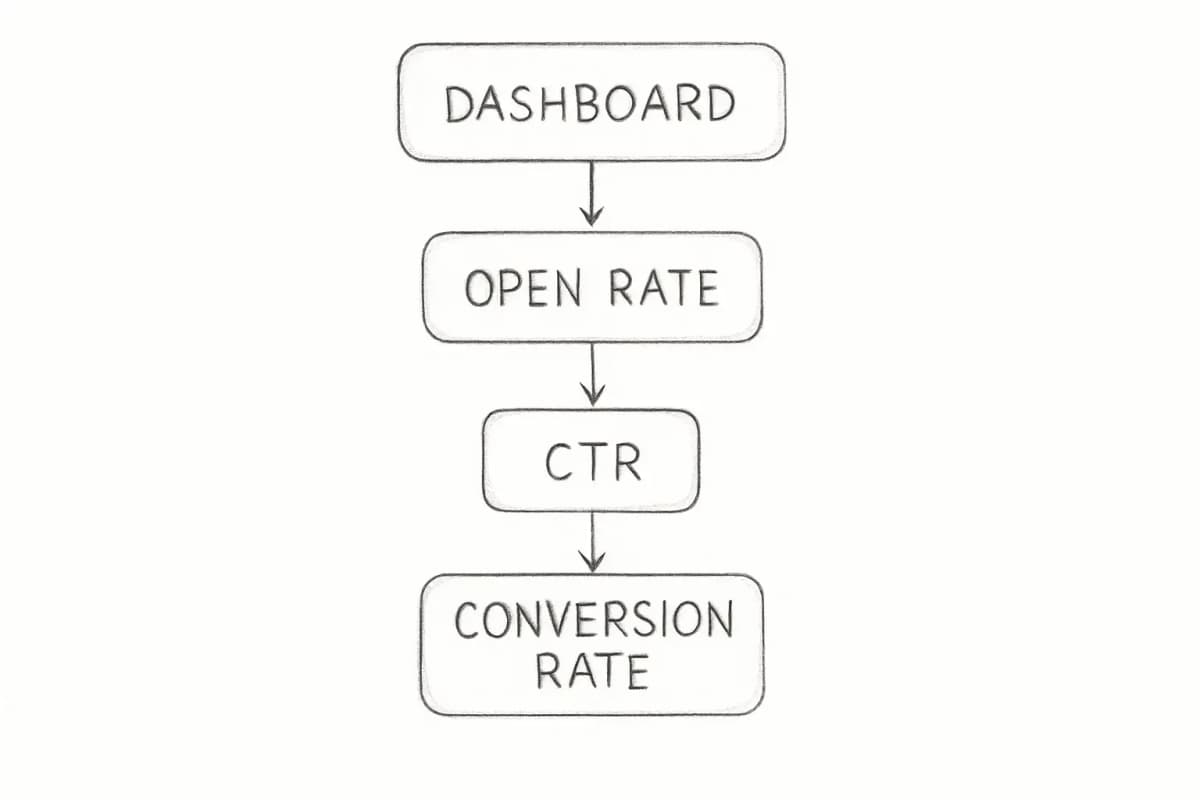
Email marketers now prioritize click-through rates, click-to-open rates, and conversion metrics over open rates when evaluating campaign performance. This shift matters because Apple's Mail Privacy Protection inflates open rate data, making it an unreliable standalone metric.
The metrics worth tracking for small business email programs:
| Metric | What it tells you |
|---|---|
| Click-through rate (CTR) | Whether your content and CTA are compelling |
| Click-to-open rate (CTOR) | How well your email content performs once opened |
| Conversion rate | Whether email activity leads to actual business outcomes |
| Unsubscribe rate | Whether your content matches subscriber expectations |
| Bounce rate | Whether your list quality and deliverability are healthy |
Keep your bounce rate under 2% to maintain sender reputation. An unsubscribe rate under 0.5% is healthy. Higher rates suggest a content-audience mismatch.
For a complete breakdown of how to set up and interpret your email data, see our post on email marketing analytics best practices.
9. Maintain a Clean List to Protect Deliverability
A large list is not automatically a valuable list. Inactive subscribers who never open your emails harm your sender reputation, which affects whether your emails reach the inbox at all.
A good email deliverability rate matters because if your emails do not reach inboxes, they cannot do their job. Even the best emails will not make an impact if they are stuck in spam or blocked.
List hygiene practices that protect deliverability:
- Remove hard bounces immediately after they occur
- Run a re-engagement campaign for subscribers inactive for 90 or more days
- Remove subscribers who do not re-engage after your reactivation sequence
- Never use purchased or scraped lists
- Comply with regulations such as the CAN-SPAM Act in the U.S. and GDPR in the European Union. Failure to comply can result in severe penalties, damage brand reputation, and lead to email deliverability issues.
A smaller, engaged list consistently outperforms a large, unresponsive one on every metric that matters.
Frequently Asked Questions
How can email marketing help my small business grow?
Email marketing offers small businesses cost-effective customer acquisition, relationship building capabilities, and scalable growth potential with minimal upfront investment. Unlike paid advertising, email does not stop working the moment you pause your budget. A well-built list and automation sequence continue to generate revenue month after month.
How often should a small business send marketing emails?
There is no universal answer, but consistency matters more than frequency. Most small businesses see strong results sending one to four emails per month. The key is that every email should provide clear value to the recipient. It is always better to have a smaller list that engages with your content than a larger one that never opens your emails. Start with a cadence you can sustain, then test whether increasing or decreasing frequency improves engagement.
What is a good email open rate for a small business?
The average email open rate across all industries is 21.33% as of the beginning of 2024. However, open rates have been skewed upward by Apple's Mail Privacy Protection feature, which auto-registers emails sent to Apple Mail users as opened. A more reliable performance indicator is your click-to-open rate (CTOR), which measures what percentage of people who opened your email actually clicked something. A rule of thumb is to target a CTOR of 10 to 15%.
Do I need expensive software to start email marketing for my small business?
No. Many platforms offer free plans for small lists, giving small businesses a low barrier to entry. Mailchimp, Brevo, and MailerLite all offer free tiers that include basic automation and segmentation. As your list grows and your strategy matures, upgrading to a paid plan typically pays for itself quickly given the channel's average ROI. The tool matters less than the strategy behind it.
Email marketing for small businesses works when it is built on a foundation of owned relationships, relevant content, and consistent measurement. The businesses that treat email as a strategic asset rather than a broadcast tool are the ones that see compounding returns over time. Start with one strong automation sequence, keep your list clean, and let the data guide every decision from there.