A strong event email marketing strategy is the difference between a half-empty room and a sold-out event. Whether you are running a corporate conference, a product launch, a webinar series, or a client-facing workshop, email remains the most direct and highest-converting channel for driving registrations, building pre-event excitement, and sustaining attendee relationships long after the last session ends.
Surveys show that 94% of event teams believe pre-event email marketing is the most important type of content. That number is not surprising when you consider the broader picture: for every $1 spent on email marketing, $36 is made in return, according to data from Litmus. For event agencies and growth teams managing tight budgets, those economics are hard to ignore.
This guide covers every phase of an event email marketing strategy, from list segmentation and send timing to post-event sequences that convert warm attendees into long-term customers.
Key Takeaways
- Email is the top event promotion channel. 45% of marketers say it outperforms every other medium for driving registrations.
- Automation drives disproportionate returns. Automated emails drive 37% of all email-generated sales, despite making up only 2% of email volume.
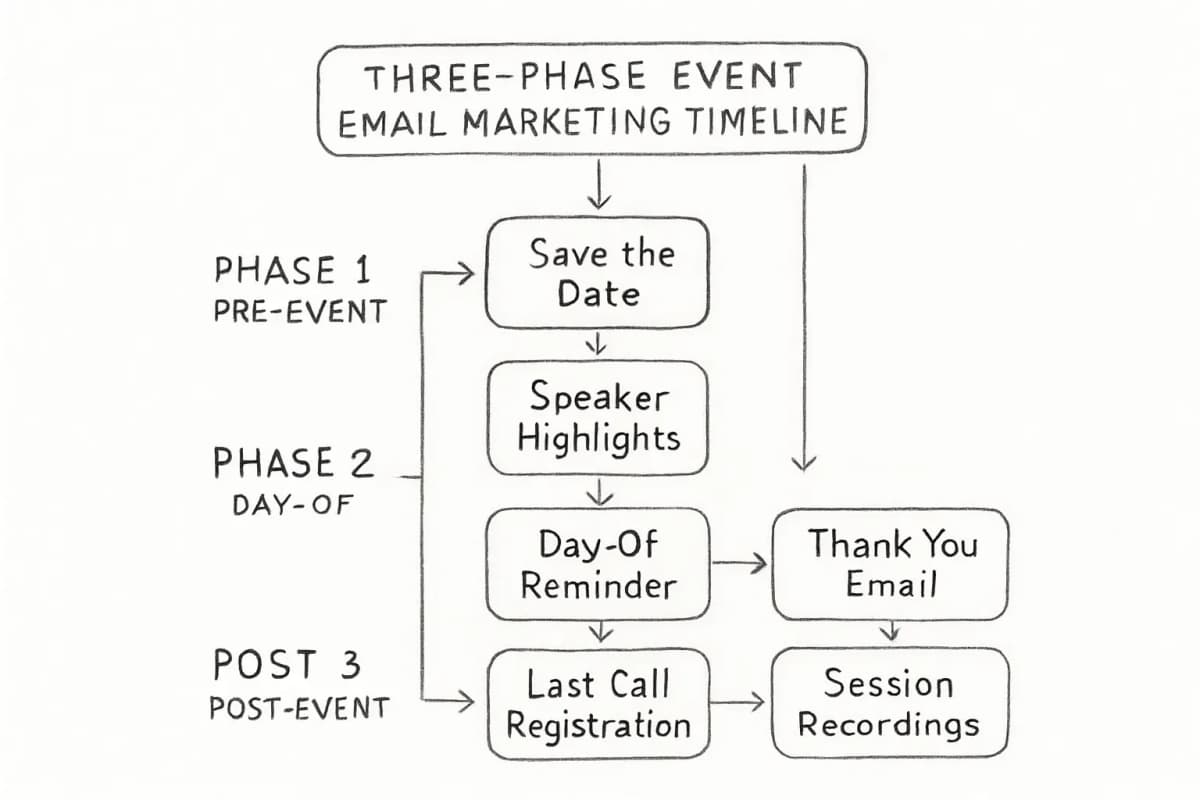
- Three-phase sequencing is essential. A complete event email marketing strategy covers pre-event, day-of, and post-event communications, each with a distinct goal.
- Segmentation is not optional. Sending the same message to your entire list costs you registrations and increases unsubscribe rates.
- Post-event follow-up is where loyalty is built. The emails you send after an event determine whether attendees come back next time.
Why Email Outperforms Every Other Event Promotion Channel
Bizzabo reports that 45% of marketers believe email marketing is the most effective channel for event promotion. Social media reaches a broader audience, but the inbox gives you something social platforms cannot: a direct, uninterrupted line to a person who has already opted in to hear from you.
Unlike social media, where ever-changing algorithms dictate reach, email is an owned channel, and you can keep your list up to date by cleaning it regularly. For event agencies managing multiple client campaigns simultaneously, that control over delivery and timing is a significant operational advantage.
Email is one of the most popular channels to promote events because it is personalized, affordable, and has a high return on investment. When you pair that with the ability to automate sequences tied to registration behavior, ticket purchase dates, and attendee segments, the channel becomes even more powerful.
Phase 1: Pre-Event Emails That Build Registrations
The launch email is the first in your event marketing sequence. It introduces your event and includes essential information about the date, location, and prices. With this email, you aim to inform your audience and get them excited about participating.
But one email is never enough. A well-timed email sequence builds anticipation, drives registrations, and keeps attendees engaged throughout the event journey. Start with a save-the-date email well in advance of your event to get on people's radar. As the event approaches, increase your email frequency with targeted messages highlighting key speakers, sessions, and networking opportunities.
A structured pre-event send schedule typically looks like this:
- Save the Date (6 to 8 weeks out): Stake your claim on calendars before competing events do.
- Event Announcement (4 to 6 weeks out): Full details, agenda highlights, and a clear registration CTA.
- Speaker or Session Spotlight (3 weeks out): Build credibility by showcasing who and what attendees will experience.
- Early Bird or Price Increase Alert (2 weeks out): Create urgency tied to a real deadline.
- Last Chance Reminder (3 to 5 days out): For contacts who opened but did not register.
- Day Before Reminder (24 hours out): Practical logistics, access links, and what to bring.
Use the important dates of your event promotion as email triggers. These can build the fear of missing out and drive more signups as the event approaches, but they also act as reminders.
Phase 2: Day-Of and During-Event Emails
Most event teams neglect the inbox once the event begins. That is a missed opportunity. Your event email marketing strategy extends beyond just filling the seats. Pre-event emails generate anticipation and registrations, while on-the-day emails remind attendees where to go or how to log in.
For in-person events, a morning-of email covering parking, check-in details, and the day's agenda reduces support requests and improves the attendee experience. For virtual events, this email includes access links, tech requirements, and session start times.
During the event, agenda updates, live session reminders, venue changes, and networking tips are all relevant touchpoints. For multi-day events or conferences, short recap emails sent each evening keep remote attendees and late registrants informed and engaged.
Phase 3: Post-Event Emails That Drive Long-Term ROI
This is where most event email marketing strategies fall short, and where the biggest returns are actually available.
Post-event emails are an excellent opportunity to continue the conversation or pitch your offerings to warm leads. Attendees have just spent time engaging with your brand. Their attention and trust are at their peak. That window does not stay open long.
Sending thank-you emails, post-event surveys, and follow-up content helps maintain connections with attendees, speakers, and sponsors who attended the event and those who could not be there.
A high-performing post-event sequence includes:
- Thank-you email (within 24 hours): Acknowledge their attendance, share one key takeaway, and include a replay link or resource download.
- Survey email (Day 2 to 3): Keep it short. Three to five questions. Feedback data improves your next event and signals to attendees that their opinion matters.
- Content follow-up (Day 5 to 7): Share session recordings, speaker slides, or a curated recap blog post.
- Offer or next step (Day 10 to 14): During the event, you established authority and trust with your audience. Attendees who know your value proposition are more likely to purchase from you. Following the event, you can send an email to pitch your products or services.
- Re-engagement for the next event (30 days out): Past attendees are your highest-converting audience for future events. Treat them accordingly.
Post-event follow-ups serve as an opportunity to thank attendees, request feedback via surveys, and share event highlights or recordings. These steps foster goodwill and encourage attendees to return next time, turning one-off attendees into a loyal community.
Segmentation: The Core of Any Effective Event Email Marketing Strategy
Sending the same email to everyone on your list guarantees average results at best. Effective event email marketing depends on getting the right message to the right person at the right time.
Effective event email marketing relies on segmentation. Rather than treating your audience as one homogenous list, break them into groups: past attendees, first-timers, VIP prospects, industry professionals, students, or early-bird seekers. By doing so, you can craft messages that speak directly to each group's unique motivations. For instance, your past attendees might appreciate special discounts for coming back, while newcomers could benefit from a more detailed event overview.
Key segments to build before your next event campaign:
- Previous attendees: Higher intent, warrant VIP messaging and loyalty perks.
- Non-attending registrants: People who signed up but did not show. They are warm leads; follow up with the replay and a lower-friction next step.
- No-shows from past outreach: Contacts who never opened. Consider a re-engagement email before adding them to your main sequence.
- Sponsor or partner contacts: Different relationship, different value proposition, different email.
An email marketing platform allows you to segment your audience and tailor messages based on preferences, registration status, and past engagement. Personalized subject lines, dynamic content, and targeted messaging, such as VIP invitations or special discounts, make recipients feel valued and more likely to attend.
For a deeper look at how segmentation improves every email metric, read our article on email list segmentation strategies that boost ROI by 760%.
Personalization and Automation: Making Scale Feel Personal
Automated emails generate 320% more revenue than non-automated emails. For event agencies running multiple campaigns simultaneously, automation is not a convenience; it is a strategic necessity.
When registration happens, you can automate a sequence with emails on specific dates to nurture your audience before the event. Every behavior-based trigger, such as clicking a speaker link, viewing a session page, or abandoning a registration form, is an opportunity to send a more relevant message automatically.
Integrating email marketing with your customer relationship management (CRM) system allows you to track attendee behavior, segment audiences more effectively, and nurture leads for future events. By syncing event registration data with your CRM, you can personalize follow-ups based on attendee interests, engagement levels, or past participation. This integration also enables automated workflows, such as triggering emails for no-shows or offering exclusive content to high-engagement attendees, ensuring more meaningful interactions.
Personalization in event email marketing goes well beyond a first-name merge tag. Effective personalization goes beyond just using a recipient's name. Understand their needs, challenges, and goals, and provide them with relevant, valuable content that enhances their event experience.
Measuring What Matters: Event Email Analytics
You cannot build an effective event email marketing strategy without keeping track of the most critical email metrics.
For event campaigns, the core metrics to track across every send are:
- Open rate: A directional signal on subject line and sender reputation quality.
- Click-through rate (CTR): In 2024, the average marketing email click-through rate was 2.62%. Use this as your baseline and aim to beat it with targeted segments.
- Click-to-open rate (CTOR): The truest measure of whether your email content is resonating with people who actually open.
- Registration conversion rate: The number of people who clicked through to your registration page and completed signup.
- Unsubscribe rate: A spike here during event outreach usually signals over-sending or poor audience-message fit.
Event email marketing is a continuous cycle of improvement. Use analytics tools to track open rates, click-through rates, and conversions. Identify what works: was it the subject line mentioning a free downloadable guide or the email highlighting a particular speaker?
A/B testing subject lines on every send is a minimum standard. Continuously experiment with different subject lines, content, designs, and calls-to-action to identify what resonates best with your audience and refine your email strategy.
Deliverability: Getting Your Event Emails to the Inbox
A flawless event email sequence means nothing if it lands in spam. Nearly 1 in 6 marketing emails never reach the inbox because of poor deliverability.
For event campaigns, deliverability risks increase because you are often sending to large lists in compressed timeframes. The practices that protect your sender reputation include:
- Clean your list before every campaign: Remove hard bounces, inactive subscribers, and invalid addresses.
- Authenticate your sending domain: SPF, DKIM, and DMARC records are non-negotiable. Ensure you choose a reputable email service provider (ESP) that supports authentication protocols like DKIM, SPF, and DMARC.
- Warm up volume gradually: If you are sending to a significantly larger list than usual for your event, ramp up volume over several days.
- Avoid spam trigger language: Avoid overly promotional language that could trigger spam filters, and comply with data privacy laws.
- Comply with regulations: GDPR and CAN-SPAM require clear unsubscribe options and honest sender identification. Build compliance into your templates, not as an afterthought.
Frequently Asked Questions
How many emails should I send before an event?
There is no single correct number, but most high-performing event campaigns send between five and eight pre-event emails spread across six to eight weeks. Sending too few emails may result in low awareness and engagement, while sending too many can lead to email fatigue and increased unsubscribe rates. Generally, a series of emails leading up to the event works best, with frequency increasing as the event date approaches. The key is that each email should carry a distinct message and clear purpose, not repeat the same announcement.
What is a good open rate for event emails?
Benchmarks vary by industry and list quality. As of 2025, the average email open rate across industries is 42.35%. Well-segmented event invitation emails to warm audiences often outperform that average. Focus more on click-through rate and registration conversion rate as the true measures of event email performance, since open rate data has been affected by Apple Mail Privacy Protection.
Should I email people who registered but did not attend?
Yes, and promptly. Non-attending registrants are among your warmest prospects for future events. Send them a replay link, a curated recap, or a "we missed you" message within 48 hours. The post-event sequence is a great time to ask for reviews via email, and to increase ticket sales or attendance for your upcoming events. Treat this segment differently from general attendees, as they have already shown purchase intent.
How does segmentation improve event email performance?
A successful segmentation approach will help you boost your click-through rates and event registrations. All you need is to understand your buyer personas in depth to deliver the best content version to them. When you message past attendees about loyalty perks, first-timers about what to expect, and VIP prospects about exclusive access, each group responds to content that feels written specifically for them because it is.