
Email marketing consistently delivers one of the highest returns of any digital channel, and the numbers back that up. For every $1 spent on email marketing, $36 is made in return, according to data from Litmus, equaling a 3,600% ROI. But knowing those numbers and knowing which types of campaigns generate them are two different things. This post breaks down real examples of email marketing that drive results, with the data to show why each one works.
Key Takeaways
- Automated emails generate 320% more revenue than non-automated emails.
- Welcome emails achieve an average open rate of 83.63% and a click-through rate of 16.60%, according to GetResponse benchmarks.
- Three-email cart abandonment sequences generated $24.9 million compared to $3.8 million for single-email sequences, in Klaviyo analysis.
- Segmenting email lists can lead to up to a 760% increase in email revenue.
- Automated win-back sequences achieve 10.34% conversion rates, meaning nearly one in ten lapsed customers returns to purchase when properly targeted.
Why Examples of Email Marketing Matter
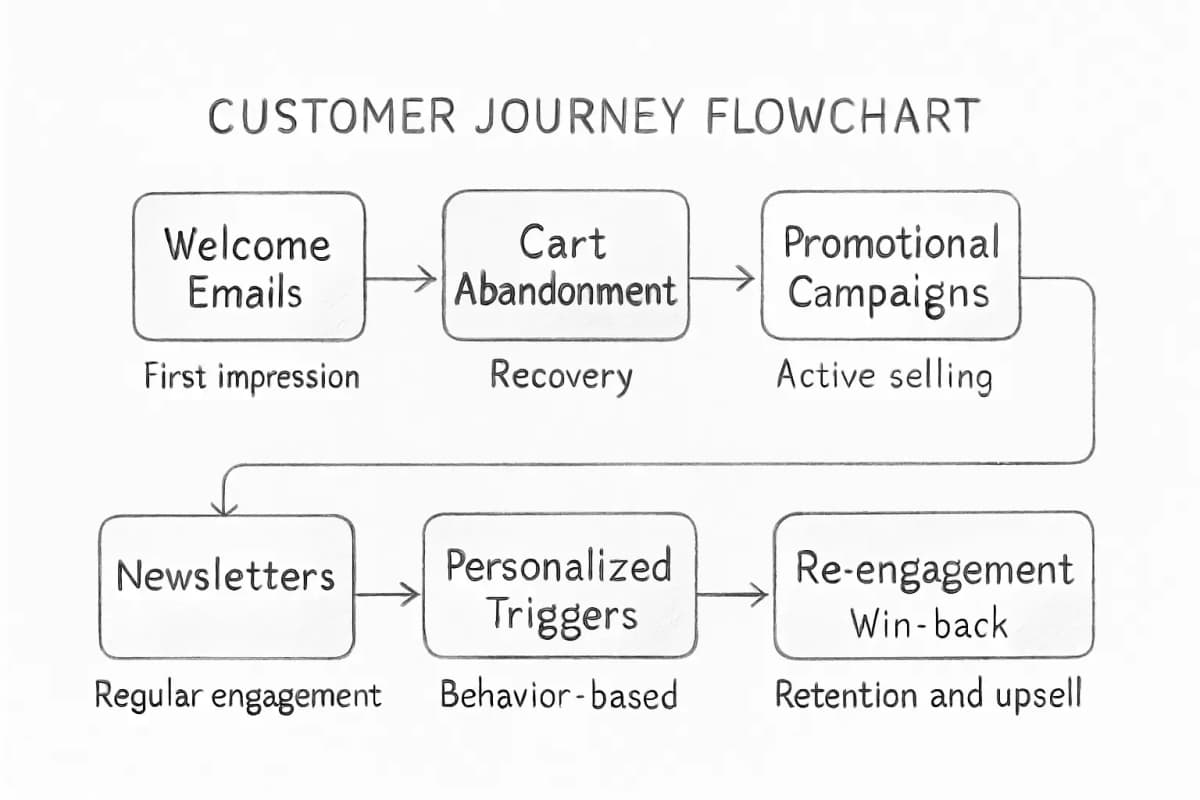
Most marketers already know email works. What they struggle with is choosing the right campaign type for the right moment. There are at least a dozen distinct examples of email marketing, each serving a different stage of the customer journey. A welcome email has a completely different job than a flash sale or a re-engagement sequence. Mixing up the format, or applying the wrong one at the wrong time, is one of the most common reasons campaigns underperform.
59% of consumers say marketing emails influence their purchase decisions, with over 50% saying they purchase from an email at least once a month. That influence depends on sending the right email at the right moment. The examples below are organized by purpose, so you can match them to your current goal.
1. Welcome Email Sequences
The welcome email is the single most important email you will send. Welcome emails are your most important campaigns because they set the tone for your entire relationship and have the highest engagement rates of any email type.
According to GetResponse benchmarks, welcome emails achieve an average open rate of 83.63% and a click-through rate of 16.60%, with a click-to-open rate of 19.85%, making it clear that these emails resonate strongly with new subscribers.
A strong welcome email marketing example typically includes:
- A clear brand introduction
- A preview of what subscribers will receive
- A direct CTA (a discount code, a free resource, or a next step)
- A personal, human tone
According to Omnisend, a series of three welcome emails can generate 90% more orders than a single welcome email. That alone makes the case for building a sequence rather than sending a single message.
2. Abandoned Cart Emails
Cart abandonment is not a niche problem. According to Baymard Institute (2026), the average online cart abandonment rate is 70.19%, based on a meta-analysis of multiple studies. That means roughly seven in ten people who express clear purchase intent leave without buying.
A well-constructed cart abandonment email directly addresses that gap.
Email remains the most effective recovery channel, with abandoned cart emails achieving 44.76% open rates and 10.7% conversion rates.
The structure that consistently works best is a three-email sequence:
- Email 1 (within 1 hour): A simple, friendly reminder. No discount yet.
- Email 2 (24 hours later): Add social proof, reviews, or address common objections.
- Email 3 (48 to 72 hours later): Introduce a limited incentive, such as free shipping or a small discount.
Sending a discount in the first email teaches buyers to abandon carts to receive discounts, which erodes margins across all cart completions. Reserve the incentive for the final message.
Studies show that sending the first recovery email within one hour of cart abandonment leads to the best results, and delaying beyond four hours can reduce recovery rates by nearly 50%.
3. Promotional and Seasonal Email Campaigns
Promotional emails are the workhorses of most email marketing campaign ideas. Done well, they drive measurable revenue. Done poorly, they train subscribers to ignore you.
Flash sales create urgency through limited-time offers, typically lasting 24 to 48 hours and featuring significant discounts or exclusive deals. The key is specificity: a subject line with an actual deadline outperforms a vague "sale going on now" message every time. For strong subject line guidance, check our post on email subject line best practices that boost open rates.
Seasonal campaigns tap into calendar moments that naturally increase purchase intent. A survey found that 68% of shoppers pay more attention to brand emails during the holidays, with certain occasions boosting website visits by up to 20%.
Effective promotional email marketing examples share a few traits:
- A single, clear offer
- Urgency that is authentic (a real deadline, real limited stock)
- A visual hierarchy that puts the CTA above the fold
- Mobile-first design
50% of people will delete an email if it is not optimized for mobile, so promotional emails that look great on desktop but break on mobile are burning potential revenue.
4. Email Newsletters
Newsletters are one of the most common examples of email marketing, and also one of the most misused. Many brands treat the newsletter as an obligation rather than an asset. The brands that treat it as a relationship-building channel see very different results.
71% of B2B marketers use an email newsletter as part of their content marketing strategy, according to a 2025 report from the Content Marketing Institute.
A newsletter works when it:
- Delivers something genuinely useful (insight, curation, tips)
- Maintains a consistent send schedule
- Connects back to relevant content, products, or resources
- Has a recognizable, human sender name
According to a GetResponse study, email newsletters had a 40.08% open rate in 2024, which is solid when you consider that newsletters are competing against dozens of other messages in a busy inbox. The brands that consistently beat that benchmark treat their newsletter like a publication, not a broadcast.
For ecommerce businesses, newsletters work especially well when tied to behavior. See our ecommerce email marketing tips for strategies that connect newsletter content to purchase behavior.
5. Personalized and Behavioral Trigger Emails
Personalization is the variable that separates average email programs from high-performing ones. This is not just about adding a first name to the subject line.
According to Klaviyo's industry benchmarks, the top 10% of emails convert 5x more subscribers and drive 9x more revenue per recipient. That gap comes from targeting, relevance, and timing, not from better creative or bigger discounts.
AI-driven personalization boosts revenue by 41% and CTR by 13.44%.
Behavioral trigger emails fire based on specific actions a subscriber takes (or does not take):
- Browsing a product category without purchasing
- Downloading a resource
- Reaching a loyalty milestone
- Going 30 days without opening an email
Personalized email subject lines can increase email open rates by 26%, according to Campaign Monitor. But the impact compounds when personalization goes beyond the subject line and into the actual content, product recommendations, and send timing.
6. Re-Engagement and Win-Back Campaigns
Every email list contains inactive subscribers. A substantial portion of most email databases, 30 to 40%, consists of completely disengaged subscribers. Leaving those contacts untouched is a deliverability risk and a missed revenue opportunity.
Re-engagement campaigns give inactive subscribers a reason to come back before you remove them from your list.
Research shows that running regular re-engagement campaigns can improve open rates from 14% to 45%, with 71% of marketers agreeing that re-engagement efforts are effective in reigniting inactive subscribers, according to Campaign Monitor.
Win-back campaigns go one step further, specifically targeting subscribers who have not purchased in an extended period.
The conversion rate for well-executed automated win-back sequences reaches 10.34%, and case study data demonstrates that successfully reactivated subscribers provide a 7:1 return in terms of conversions and purchases.
A well-structured win-back email marketing example typically has two to three emails, uses behavioral segmentation (such as RFM analysis to identify who is worth pursuing), and deploys an incentive only in the final message. 45% of recipients who receive a re-engagement email go on to read subsequent emails, which means a successful campaign does not just recover one transaction, it restores an ongoing relationship.
7. Post-Purchase and Lifecycle Emails
Post-purchase emails are among the most overlooked email marketing campaign ideas, and among the highest-performing. An email dispatched post-purchase can be a strong tool for building loyalty and encouraging repeat transactions. Statistics confirm that open rates for post-purchase emails are 40 to 50% higher than those for cold marketing campaigns.
Common post-purchase email examples include:
- Order and shipping confirmations (transactional, but also an upsell opportunity)
- Review request emails (sent 3 to 5 days after delivery)
- Product education emails (how to get the most from a purchase)
- Replenishment reminders for consumable products
- Cross-sell recommendations based on the purchased item
Cross-sell follow-up emails recommend products from the same category or complementary additions to a recent purchase. 64% of sales specialists say follow-up emails are the best way to drive upsell and cross-sell offers.
The post-purchase window is when trust is at its highest. An email sent then, even without a discount, converts at rates far above a cold promotional send.
How to Measure What Is Actually Working
Knowing the campaign types is half the challenge. Tracking which ones drive results for your specific audience completes it.
Measuring performance reveals what works and what needs improvement. The best approach is to focus on metrics that connect to business goals rather than vanity numbers.
The metrics that matter most per campaign type:
- Welcome sequence: Open rate, click rate, subscriber-to-customer conversion within 30 days
- Abandoned cart: Recovery rate (percentage of carts recovered), revenue per recipient
- Newsletter: Click rate, list growth, unsubscribe rate
- Win-back: Re-engagement rate, deliverability impact on the broader list
- Post-purchase: Repeat purchase rate, review completion rate
According to Omnisend's 2026 ecommerce marketing statistics report, automated emails accounted for just 2% of email sends, but drove 30% of revenue, earning 16 times more per send than scheduled campaigns.
That single statistic justifies investing in automation before volume. One well-timed, behavior-triggered message consistently outperforms five batch-and-blast sends. For a deeper dive into tracking and optimizing your campaigns, see our post on email marketing analytics best practices.
Frequently Asked Questions
What are the most effective types of email marketing campaigns?
The campaigns with the strongest measured results are welcome sequences, abandoned cart emails, and behavior-triggered automations. According to Omnisend, automated emails reach 38% average open rates and generate $2.87 per email compared to $0.18 for standard campaigns. The gap comes from timing and relevance, not from creative quality alone.
How many emails should be in an abandoned cart sequence?
Three is the research-backed standard. Send the first at 30 to 60 minutes after abandonment, the second at 24 hours, and the third at 48 to 72 hours. This three-email sequence is the industry standard backed by data from Klaviyo and SaleCycle. Reserve any discount incentive for the third email to avoid training buyers to abandon carts intentionally.
What makes a good email marketing example to learn from?
Look for campaigns that have a single, clear objective and a measurable outcome. The best email marketing examples combine behavioral targeting with relevant content and a specific CTA. The difference between top-performing and average campaigns largely comes down to batch-and-blast tactics versus highly segmented campaigns designed to be ultra-relevant for a specific audience.
How important is list segmentation for email marketing results?
It is one of the highest-leverage activities in email marketing. Marketers using advanced segmentation see a 760% increase in email revenue. Even basic segmentation by purchase history, engagement level, or acquisition source produces significantly better results than sending the same message to an entire list. Our guide on email list segmentation strategies covers the most impactful approaches.