
Discover how AI boosts email marketing with smarter segmentation, personalization, and send-time optimization. Learn practical tactics to increase ROI.
AI is no longer a peripheral feature in email marketing. It is the primary driver separating high-performing campaigns from average ones. 63% of marketers now use AI tools in their email marketing efforts, and the results back the investment: AI-powered email personalization has led to a 41% increase in revenue and a 13% boost in click-through rates. If you are asking how AI can be used to improve email marketing, the short answer is: across every stage of the campaign lifecycle, from content creation and segmentation to timing, deliverability, and analytics.
This guide breaks down exactly where AI creates measurable gains and how you can apply it to your own email program.
Key Takeaways
70% of marketers predict that up to half of their email operations will be AI-driven by 2026.
Automated emails generate 320% more revenue than non-automated emails.
Businesses using AI-powered send time optimization see an average 26% lift in open rates and a 41% improvement in click-through rates.
Emails with AI-generated subject lines see an open rate increase of 5% to 10%.
AI can help with segmentation by automatically identifying granular customer segments based on complex data patterns, allowing marketers to target specific groups with highly relevant messages.
What AI Actually Does in Email Marketing
Before diving into specific use cases, it helps to understand what AI is doing underneath the surface. AI analyzes customer data, behavior, and preferences to automatically tailor email content, subject lines, send times, and product recommendations to individual recipients.
This is fundamentally different from rule-based automation, where you set fixed triggers and sequences. AI learns from engagement patterns, adapts in real time, and makes decisions at a scale no human team can match.
Core AI capabilities in email marketing include natural language generation for subject lines and body copy, predictive analytics that forecast engagement likelihood and identify at-risk subscribers, automated workflows that adapt based on real-time subscriber behavior, and dynamic segmentation that updates audience groups automatically without manual list maintenance.
The practical result: in 2023, 62% of marketing teams needed two or more weeks to produce a single email. By 2025, only 6% do.
AI is no longer a peripheral feature in email marketing. It is the primary driver separating high-performing campaigns from average ones. 63% of marketers now use AI tools in their email marketing efforts, and the results back the investment: AI-powered email personalization has led to a 41% increase in revenue and a 13% boost in click-through rates. If you are asking how AI can be used to improve email marketing, the short answer is: across every stage of the campaign lifecycle, from content creation and segmentation to timing, deliverability, and analytics.
This guide breaks down exactly where AI creates measurable gains and how you can apply it to your own email program.
Key Takeaways
70% of marketers predict that up to half of their email operations will be AI-driven by 2026.
Automated emails generate 320% more revenue than non-automated emails.
Businesses using AI-powered send time optimization see an average 26% lift in open rates and a 41% improvement in click-through rates.
Emails with AI-generated subject lines see an open rate increase of 5% to 10%.
AI can help with segmentation by automatically identifying granular customer segments based on complex data patterns, allowing marketers to target specific groups with highly relevant messages.
What AI Actually Does in Email Marketing
Before diving into specific use cases, it helps to understand what AI is doing underneath the surface. AI analyzes customer data, behavior, and preferences to automatically tailor email content, subject lines, send times, and product recommendations to individual recipients.
This is fundamentally different from rule-based automation, where you set fixed triggers and sequences. AI learns from engagement patterns, adapts in real time, and makes decisions at a scale no human team can match.
Core AI capabilities in email marketing include natural language generation for subject lines and body copy, predictive analytics that forecast engagement likelihood and identify at-risk subscribers, automated workflows that adapt based on real-time subscriber behavior, and dynamic segmentation that updates audience groups automatically without manual list maintenance.
The practical result: in 2023, 62% of marketing teams needed two or more weeks to produce a single email. By 2025, only 6% do.
AI-Powered Personalization at Scale
Personalization has always been a core email marketing principle, but doing it at scale manually is not realistic. AI removes that constraint.
Through advanced algorithms, AI can analyze vast amounts of data, such as customer behavior, preferences, and purchase history, to create highly personalized email content. That personalization extends beyond inserting a first name into a subject line. It means dynamically adjusting entire content blocks, product recommendations, and offers based on each subscriber's individual profile.
Content personalization is the most commonly used strategy in AI-powered email marketing campaigns, adopted by 50% of surveyed marketers. And the outcomes are concrete: implementation of AI-powered personalization generates a 41% revenue increase alongside a 13.44% higher click-through rate.
Consumers increasingly expect personalized experiences, and nearly 80% will only engage with emails tailored to their previous interactions with the brand. AI makes meeting that expectation feasible without needing a dedicated team to manually build hundreds of email variants.
For a deeper look at putting personalization into practice, see our guide on email personalization techniques that boost conversions 47%.
Smarter Segmentation
Segmentation is one of the highest-ROI activities in email marketing, and AI makes it more precise and dynamic than traditional list-based approaches.
Segmented email campaigns generate 30% more opens and 50% more click-throughs, and 78% of marketers say segmentation is their most effective tactic.
Traditional segmentation relies on static criteria: geography, purchase date, plan type. AI-driven segmentation goes further. AI-driven segmentation creates audience groups based on behavior, identifies patterns that show shared interests or purchase intent, and updates these groups as subscriber behavior changes.
This dynamic approach means your segments stay accurate even as subscriber behavior shifts. A customer who bought once six months ago and has recently started browsing your site again will move into a re-engagement segment automatically, without a marketer needing to set up a separate rule.
To explore segmentation strategy in more depth, our article on email list segmentation strategies that boost ROI by 760% covers the frameworks that work best for different audience types.
Subject Line Optimization and A/B Testing
The subject line is the single most influential variable in email marketing performance. Research shows that 47% of email recipients decide to open an email based solely on the subject line, while 69% report email as spam based on the subject line alone.
AI approaches subject line testing fundamentally differently from traditional A/B methods. Instead of testing complete subject lines as black boxes, AI decomposes each subject line into its constituent elements, including tone, word choice, length, structure, personalization, and urgency level, and tests across multiple variants simultaneously to identify which specific elements drive opens.
AI can test multiple subject lines simultaneously and identify which one resonates best with your audience, then use this knowledge to send the winning subject line to most of your subscribers, increasing the likelihood of your emails being opened.
AI-Powered Personalization at Scale
Personalization has always been a core email marketing principle, but doing it at scale manually is not realistic. AI removes that constraint.
Through advanced algorithms, AI can analyze vast amounts of data, such as customer behavior, preferences, and purchase history, to create highly personalized email content. That personalization extends beyond inserting a first name into a subject line. It means dynamically adjusting entire content blocks, product recommendations, and offers based on each subscriber's individual profile.
Content personalization is the most commonly used strategy in AI-powered email marketing campaigns, adopted by 50% of surveyed marketers. And the outcomes are concrete: implementation of AI-powered personalization generates a 41% revenue increase alongside a 13.44% higher click-through rate.
Consumers increasingly expect personalized experiences, and nearly 80% will only engage with emails tailored to their previous interactions with the brand. AI makes meeting that expectation feasible without needing a dedicated team to manually build hundreds of email variants.
For a deeper look at putting personalization into practice, see our guide on email personalization techniques that boost conversions 47%.
Smarter Segmentation
Segmentation is one of the highest-ROI activities in email marketing, and AI makes it more precise and dynamic than traditional list-based approaches.
Segmented email campaigns generate 30% more opens and 50% more click-throughs, and 78% of marketers say segmentation is their most effective tactic.
Traditional segmentation relies on static criteria: geography, purchase date, plan type. AI-driven segmentation goes further. AI-driven segmentation creates audience groups based on behavior, identifies patterns that show shared interests or purchase intent, and updates these groups as subscriber behavior changes.
This dynamic approach means your segments stay accurate even as subscriber behavior shifts. A customer who bought once six months ago and has recently started browsing your site again will move into a re-engagement segment automatically, without a marketer needing to set up a separate rule.
To explore segmentation strategy in more depth, our article on email list segmentation strategies that boost ROI by 760% covers the frameworks that work best for different audience types.
Subject Line Optimization and A/B Testing
The subject line is the single most influential variable in email marketing performance. Research shows that 47% of email recipients decide to open an email based solely on the subject line, while 69% report email as spam based on the subject line alone.
AI approaches subject line testing fundamentally differently from traditional A/B methods. Instead of testing complete subject lines as black boxes, AI decomposes each subject line into its constituent elements, including tone, word choice, length, structure, personalization, and urgency level, and tests across multiple variants simultaneously to identify which specific elements drive opens.
AI can test multiple subject lines simultaneously and identify which one resonates best with your audience, then use this knowledge to send the winning subject line to most of your subscribers, increasing the likelihood of your emails being opened.
The compounding effect is significant. If you test subject lines on every campaign and improve open rates by 2-3% per test, within 6 months your baseline open rate will be 12-18% higher than where you started.
For specific subject line frameworks that work, see our article on email subject line best practices that boost open rates by 27%.
Send Time Optimization
When you send an email matters almost as much as what is in it. AI-powered send time optimization (STO) eliminates the guesswork.
Send time optimization uses machine learning to predict when each individual subscriber is most likely to open and engage with an email. Rather than sending to your entire list at 10 AM on Tuesday, the AI staggers delivery so each subscriber receives the email during their personal engagement window.
The impact is substantial: businesses using STO see an average 26% lift in open rates and a 41% improvement in click-through rates.
STO algorithms analyze each subscriber's historical behavior, including when they open emails, their time zone, whether they engage more on mobile or desktop, and their typical engagement patterns across days of the week. The model builds an individual profile for each subscriber and predicts their optimal send window with increasing accuracy as more data accumulates.
Real-world deployments confirm the impact. Puma used AI-powered STO to deliver emails based on individual timing preferences and saw a 5-10% lift in open rates. Most major email platforms including Klaviyo, Mailchimp, and HubSpot now include STO features in standard plans.
AI-Powered Email Automation
Automation has always been a core email marketing lever. AI makes automation sequences more responsive and more effective.
Despite representing just 2% of email volume, automated campaigns generate 37% of all email sales. This efficiency demonstrates the superior conversion power of triggered, behavior-based messaging.
Businesses using AI-powered automation sequences are seeing open rates above 40%, click-through rates of 6-8%, and revenue-per-email figures three to five times higher than manual campaigns.
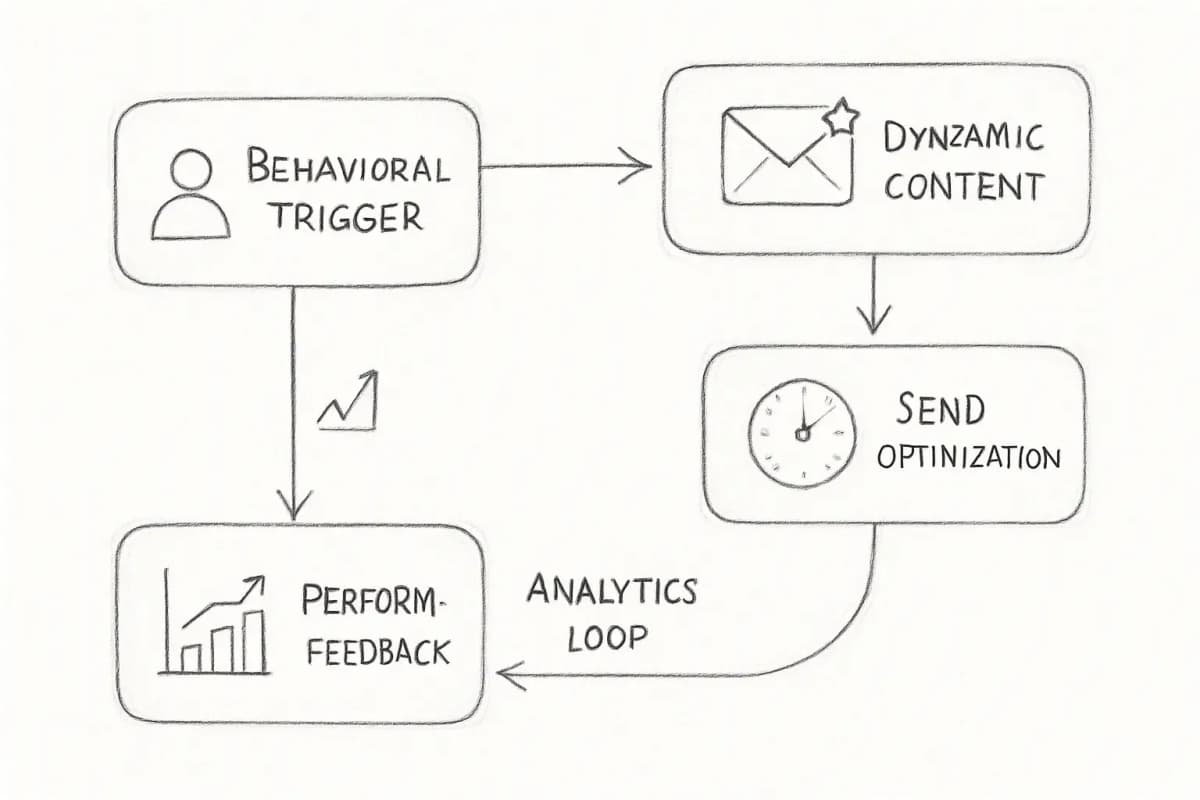
AI automation goes beyond static drip sequences. AI can handle A/B testing by automatically creating different email versions, testing them, and analyzing results to determine the best-performing content. It also automates list segmentation, dynamically grouping recipients based on behavior or preferences to deliver more relevant messages, and optimizes send times by analyzing when recipients are most likely to engage.
The compounding effect is significant. If you test subject lines on every campaign and improve open rates by 2-3% per test, within 6 months your baseline open rate will be 12-18% higher than where you started.
For specific subject line frameworks that work, see our article on email subject line best practices that boost open rates by 27%.
Send Time Optimization
When you send an email matters almost as much as what is in it. AI-powered send time optimization (STO) eliminates the guesswork.
Send time optimization uses machine learning to predict when each individual subscriber is most likely to open and engage with an email. Rather than sending to your entire list at 10 AM on Tuesday, the AI staggers delivery so each subscriber receives the email during their personal engagement window.
The impact is substantial: businesses using STO see an average 26% lift in open rates and a 41% improvement in click-through rates.
STO algorithms analyze each subscriber's historical behavior, including when they open emails, their time zone, whether they engage more on mobile or desktop, and their typical engagement patterns across days of the week. The model builds an individual profile for each subscriber and predicts their optimal send window with increasing accuracy as more data accumulates.
Real-world deployments confirm the impact. Puma used AI-powered STO to deliver emails based on individual timing preferences and saw a 5-10% lift in open rates. Most major email platforms including Klaviyo, Mailchimp, and HubSpot now include STO features in standard plans.
AI-Powered Email Automation
Automation has always been a core email marketing lever. AI makes automation sequences more responsive and more effective.
Despite representing just 2% of email volume, automated campaigns generate 37% of all email sales. This efficiency demonstrates the superior conversion power of triggered, behavior-based messaging.
Businesses using AI-powered automation sequences are seeing open rates above 40%, click-through rates of 6-8%, and revenue-per-email figures three to five times higher than manual campaigns.
AI automation goes beyond static drip sequences. AI can handle A/B testing by automatically creating different email versions, testing them, and analyzing results to determine the best-performing content. It also automates list segmentation, dynamically grouping recipients based on behavior or preferences to deliver more relevant messages, and optimizes send times by analyzing when recipients are most likely to engage.
The practical benefit for teams: these automated processes save time and improve campaign performance, allowing marketers to focus on strategy and creativity.
Deliverability: AI on Both Sides of the Inbox
Deliverability is where many marketers underestimate AI's role. It is not just a tool you use. It is also a system that inbox providers use to evaluate your emails before they reach your subscribers.
Approximately one in six marketing emails never reaches the recipient's inbox, with average deliverability rates hovering around 83% across major email service providers.
AI spam filters use machine learning models to detect patterns across millions of emails. Instead of relying on keywords alone, they analyze tone, link trustworthiness, historical engagement, complaint rates, and sender behavior to identify unwanted or risky messages.
On the sender side, AI tools help you stay on the right side of these filters. AI evaluates an email's structure before sending it, including subject line patterns, link density, promotional tone, and rendering stability. By flagging content patterns that correlate with lower engagement or higher complaints, AI helps teams adjust messaging before performance declines.
Sender reputation reflects authentication alignment, complaint rates, bounce rates, and sending consistency. AI tracks these signals continuously and surfaces early shifts, such as rising complaints within a specific segment, allowing marketers to adjust targeting or cadence before filtering tightens.
Gmail's RETVec system reads text as visual patterns rather than individual characters, making it resistant to character-substitution tricks. According to Google, RETVec improved Gmail's spam detection by 38% while reducing false positives by 19.4%.
The takeaway: AI helps you earn inbox placement by ensuring your content, reputation, and engagement signals align with what providers reward.
AI for Content Creation and Analytics
In 2025, 49% of marketers use generative AI for static copy creation, and the number of marketers using AI-powered image generation has increased by 340% in the last year.
Generative AI helps teams produce email copy faster, generate more subject line variations for testing, and draft personalized content blocks for different audience segments. The most effective use is not replacing writers but giving them a faster starting point and more variants to test.
On the analytics side, AI analyzes email marketing data by using algorithms to sift through large datasets and identify patterns in user behavior, engagement metrics, and campaign performance. It tracks how recipients interact with emails, such as opens, clicks, and conversions, and uses this data to predict future behaviors.
Predictive analytics platforms forecast campaign results before emails are sent. They estimate open rates and conversion probabilities based on content and audience characteristics, allowing marketers to adjust strategies before sending. That shift from reactive to predictive is where AI creates its biggest analytical advantage.
For a structured approach to interpreting email data, see our guide to email marketing analytics best practices.
Where AI Reaches Its Limits
AI is not a replacement for strategy, creative judgment, or audience understanding.
The practical benefit for teams: these automated processes save time and improve campaign performance, allowing marketers to focus on strategy and creativity.
Deliverability: AI on Both Sides of the Inbox
Deliverability is where many marketers underestimate AI's role. It is not just a tool you use. It is also a system that inbox providers use to evaluate your emails before they reach your subscribers.
Approximately one in six marketing emails never reaches the recipient's inbox, with average deliverability rates hovering around 83% across major email service providers.
AI spam filters use machine learning models to detect patterns across millions of emails. Instead of relying on keywords alone, they analyze tone, link trustworthiness, historical engagement, complaint rates, and sender behavior to identify unwanted or risky messages.
On the sender side, AI tools help you stay on the right side of these filters. AI evaluates an email's structure before sending it, including subject line patterns, link density, promotional tone, and rendering stability. By flagging content patterns that correlate with lower engagement or higher complaints, AI helps teams adjust messaging before performance declines.
Sender reputation reflects authentication alignment, complaint rates, bounce rates, and sending consistency. AI tracks these signals continuously and surfaces early shifts, such as rising complaints within a specific segment, allowing marketers to adjust targeting or cadence before filtering tightens.
Gmail's RETVec system reads text as visual patterns rather than individual characters, making it resistant to character-substitution tricks. According to Google, RETVec improved Gmail's spam detection by 38% while reducing false positives by 19.4%.
The takeaway: AI helps you earn inbox placement by ensuring your content, reputation, and engagement signals align with what providers reward.
AI for Content Creation and Analytics
In 2025, 49% of marketers use generative AI for static copy creation, and the number of marketers using AI-powered image generation has increased by 340% in the last year.
Generative AI helps teams produce email copy faster, generate more subject line variations for testing, and draft personalized content blocks for different audience segments. The most effective use is not replacing writers but giving them a faster starting point and more variants to test.
On the analytics side, AI analyzes email marketing data by using algorithms to sift through large datasets and identify patterns in user behavior, engagement metrics, and campaign performance. It tracks how recipients interact with emails, such as opens, clicks, and conversions, and uses this data to predict future behaviors.
Predictive analytics platforms forecast campaign results before emails are sent. They estimate open rates and conversion probabilities based on content and audience characteristics, allowing marketers to adjust strategies before sending. That shift from reactive to predictive is where AI creates its biggest analytical advantage.
For a structured approach to interpreting email data, see our guide to email marketing analytics best practices.
Where AI Reaches Its Limits
AI is not a replacement for strategy, creative judgment, or audience understanding.
More than 70% of marketers have encountered an AI-related incident including hallucinations, bias, or off-brand content. Generative AI can produce subject lines that perform well in testing but feel misaligned with your brand voice, or copy that is technically accurate but tonally wrong for a sensitive campaign.
AI is not appropriate for highly sensitive content such as complaints, refunds, and legal notices, or legal and regulatory statements requiring precise language.
AI does not override failed authentication, neutralize purchased list damage, or compensate for sustained spam complaint rates above provider thresholds. Authentication, consent, and frequency discipline remain foundational.
The practical approach: use AI for data-intensive tasks, volume-heavy decisions like send time and segmentation, and content drafting. Keep human oversight on brand voice, sensitive communications, and strategic direction.
Frequently Asked Questions
How can AI be used to improve email marketing results?
AI email marketing uses artificial intelligence to optimize email campaigns, automating tasks like segmentation, personalization, send times, and content creation to improve engagement and conversion rates. The highest-impact applications are AI-powered segmentation, send time optimization, subject line testing, and behavioral automation sequences.
Does AI actually improve open rates and click-through rates?
Yes, the data is consistent. AI-driven campaigns can increase email open rates by up to 41% in certain industries. Using AI for email personalization has led to a 13.44% increase in click-through rates for marketers. Results vary by list size, data quality, and how comprehensively AI is applied across the campaign.
Will AI replace email marketers?
No. The brands seeing the strongest email marketing results moved beyond traditional tactics to create sophisticated, data-driven programs. Successful marketing teams invest strategically in both technology and talent, recognizing email is a high-performing business driver when executed thoughtfully. AI handles the data-intensive work. Marketers handle strategy, brand voice, and creative judgment.
How do I start using AI in my email marketing without overhauling everything?
Start with features already built into your email service provider: send time optimization, subject line scoring, and AI-assisted segmentation. Features like send-time optimization, predictive content selection, and behavioral scoring that were once enterprise-only are now available on mid-market platforms starting at $29/month. Run a controlled test with a segment of your list, measure the lift against a control group, and scale what works.

No comments yet. Be the first!
More than 70% of marketers have encountered an AI-related incident including hallucinations, bias, or off-brand content. Generative AI can produce subject lines that perform well in testing but feel misaligned with your brand voice, or copy that is technically accurate but tonally wrong for a sensitive campaign.
AI is not appropriate for highly sensitive content such as complaints, refunds, and legal notices, or legal and regulatory statements requiring precise language.
AI does not override failed authentication, neutralize purchased list damage, or compensate for sustained spam complaint rates above provider thresholds. Authentication, consent, and frequency discipline remain foundational.
The practical approach: use AI for data-intensive tasks, volume-heavy decisions like send time and segmentation, and content drafting. Keep human oversight on brand voice, sensitive communications, and strategic direction.
Frequently Asked Questions
How can AI be used to improve email marketing results?
AI email marketing uses artificial intelligence to optimize email campaigns, automating tasks like segmentation, personalization, send times, and content creation to improve engagement and conversion rates. The highest-impact applications are AI-powered segmentation, send time optimization, subject line testing, and behavioral automation sequences.
Does AI actually improve open rates and click-through rates?
Yes, the data is consistent. AI-driven campaigns can increase email open rates by up to 41% in certain industries. Using AI for email personalization has led to a 13.44% increase in click-through rates for marketers. Results vary by list size, data quality, and how comprehensively AI is applied across the campaign.
Will AI replace email marketers?
No. The brands seeing the strongest email marketing results moved beyond traditional tactics to create sophisticated, data-driven programs. Successful marketing teams invest strategically in both technology and talent, recognizing email is a high-performing business driver when executed thoughtfully. AI handles the data-intensive work. Marketers handle strategy, brand voice, and creative judgment.
How do I start using AI in my email marketing without overhauling everything?
Start with features already built into your email service provider: send time optimization, subject line scoring, and AI-assisted segmentation. Features like send-time optimization, predictive content selection, and behavioral scoring that were once enterprise-only are now available on mid-market platforms starting at $29/month. Run a controlled test with a segment of your list, measure the lift against a control group, and scale what works.