
Building a quality email marketing list is one of the highest-ROI activities a business can invest in. Email marketing campaigns deliver an average ROI of 36 times what you spend, but that return depends entirely on the quality and intent of the people on your list. A purchased list of cold contacts will not get you there. A properly built opt-in list will.
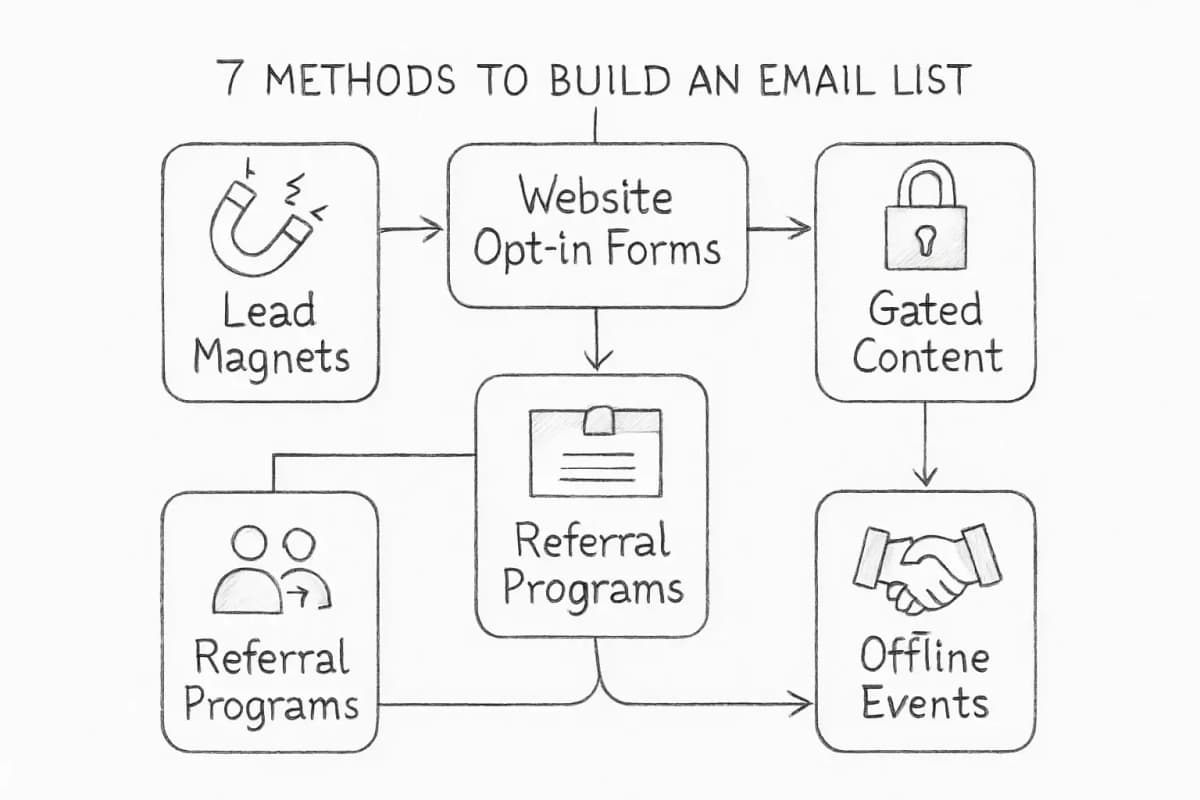
This guide covers seven proven methods for how to get an email marketing list, along with the data, tools, and tactics you need to make each method work.
Key Takeaways
- An opt-in list is a collection of contacts who have explicitly stated their consent to receive communications from your business. This is the only list worth building.
- Lead magnets can push email conversion rates from roughly 1.95% to 6.5% when you replace generic newsletter forms with value-driven exchanges.
- Average email list growth came in at 4% in 2024, and with 9% of subscribers unsubscribing and 7% bouncing annually, that is roughly 16% annual list loss before any growth effort.
- A high-quality opt-in list may be smaller, but it is far more effective at driving meaningful engagement, improving open and click rates, and ultimately converting subscribers into loyal customers.
- Every method below produces subscribers who actually want your emails, which protects your sender reputation and deliverability.
Why List Quality Beats List Size
Before jumping into tactics, it is worth understanding what makes a list valuable. Opt-in email marketing sends emails to people who have willingly signed up for your list. It is different from outbound emails because people sign up to hear from a business instead of getting unsolicited messages.
Opt-in email marketing helps your business build trust, increase engagement, and improve email deliverability. It also reduces spam complaints and strengthens brand credibility while aligning with ethical marketing practices.
87% of marketing leaders say email marketing is critical to the success of their company. That result depends on an engaged list, not just a large one.
1. Create a Lead Magnet That Solves a Specific Problem
A lead magnet is a free resource you offer in exchange for an email address. It is the most reliable way to accelerate list growth because it gives visitors an immediate reason to subscribe.
Email form popups without lead magnets converted 3.83% on mobile and 1.84% of visitors on desktop. Adding a lead magnet increased the average conversion rate to 7.73% on mobile and 4.7% on desktop, a 101.82% and 155.43% difference, respectively.
Effective lead magnet formats include:
- Checklists, templates, and swipe files
- Short ebooks or guide PDFs
- Mini email courses (5 to 7 days)
- Free tools, calculators, or quizzes
- Webinars or on-demand video training
Ebooks are the most popular lead magnet, with 27.7% of marketers using them. But format matters less than relevance. These valuable free resources should offer specific solutions to audience problems. The best lead magnets do not just attract any subscribers, they attract the right subscribers who are primed to engage with your offerings.
What makes a lead magnet convert: Specificity. A "Complete Marketing Guide" competes with everything else online. "10 Email Subject Line Templates for SaaS Onboarding Sequences" speaks directly to a defined audience and a defined problem.
2. Place Opt-In Forms Strategically Across Your Website
The placement of your signup forms determines how many visitors you actually capture. Most businesses put one form in the footer and stop there. That is not enough.
Place opt-in forms where visitors are most engaged, such as within blog content or using exit-intent popups when they are about to leave.
High-converting placements include:
- Within blog posts: Mid-content forms catch readers while they are actively engaged.
- Exit-intent popups: Exit-intent popups track a user's behavior on your website and trigger when they are about to leave. Using them is a great way to earn more quality email subscribers.
- Dedicated landing pages: Best for paid ads, gated content, or promotions where the goal is pure email capture.
- Homepage above the fold: Hard to miss, especially for first-time visitors.
Keep the form itself simple. Try to keep the signup process as simple as possible. All you really need is the email address, so do not make list members create an account or provide information you do not need.
Timing is crucial for popups. A delay of 6 to 10 seconds yields the best conversion rates, while immediate displays tend to underperform.
3. Use Gated Content to Attract High-Intent Subscribers
Gated content is a resource placed behind a form, accessible only after a visitor provides their email address. Unlike a generic newsletter signup, it attracts people with a specific interest and a clear intent to engage.
While gated content is not necessarily the best way to increase awareness, it is an excellent way to find high-quality leads, build a targeted audience, and establish authority in your industry, all of which contribute to higher conversion rates and increased revenue.
Gated content is online content hidden behind a data capture form, exclusive only to users who enter their information, typically a name and email address.
Common gated content formats that work well for list building:
- Industry research reports and benchmarks
- Whitepapers and original data studies
- Templates, toolkits, and frameworks
- Webinar replays and on-demand courses
Research from Unbounce shows the median landing page conversion rate sits at 6.6% across industries. High-value gated offers can convert up to 11% of visitors, compared to just 2% for standard landing pages.
After someone downloads your gated content, do not go silent. Set up a follow-up and lead nurturing strategy. Set up a personalized drip email series to build relationships with prospects and move them closer to conversion. Send thank-you emails, educational resources, and product demos to further engage with your leads.
For a detailed guide on nurturing new subscribers from the first touchpoint, see our article on welcome email sequence best practices.
4. Add Opt-In Opportunities to Social Media Channels
Social media does not replace email, but it is an effective funnel into your list. The key is treating social as a discovery channel and email as the owned channel where real relationships develop.
Social media profiles offer space to direct users to an email signup form. On Instagram, the link in bio can lead to a landing page with a signup form. On Twitter, the website field in the profile can serve this purpose. On Facebook, the call-to-action button can be set to "Sign Up."
Tactics that consistently produce results:
- Share lead magnet content in organic posts with a direct link to your landing page.
- Run paid lead generation campaigns on Facebook or LinkedIn that drive clicks to a dedicated signup page.
- Use Instagram Stories with a link sticker pointing to a free resource.
- Share short, interesting snippets of your newsletters on your social handles to entice people to sign up.
Paid social ads can be created specifically to gather email subscribers. These ads typically use lead generation objectives or link clicks to drive traffic to a signup page. Successful list-building ads include a concise offer, a visual that matches the message, and a form or button that leads to a landing page. The landing page should focus only on the signup, with minimal distractions.
5. Build a Referral Program for Your Email List
Word-of-mouth is one of the most cost-efficient ways to grow an email list because referred subscribers come pre-qualified by someone who already trusts your content.
Referral marketing is a great way to grow a healthy email list. By leveraging the trust your current subscribers and customers have in your company, you can attract new subscribers. These are people you can also convert into loyal customers.
A referral program for list growth works in two basic formats:
- Forward-to-a-friend links inside your regular emails, making it easy for satisfied subscribers to share.
- Incentivized referral programs that reward subscribers for successful signups. When a subscriber reaches a certain number of referrals, they receive a reward, for example early access after three referrals and a gift after ten.
Referral success depends on making sharing easy with one-click buttons, providing a clear benefit for both the referrer and the new subscriber, and acknowledging successful referrals promptly.
The Morning Brew newsletter built much of its growth through a structured referral tier system, offering merchandise, books, and exclusive access at different referral milestones. The model is replicable for businesses of any size.
6. Capture Emails at Offline and Live Events
If your business has any in-person presence, whether through events, trade shows, retail, or client meetings, offline touchpoints are often overlooked list-building opportunities.
Effective offline capture methods:
- Event sign-in sheets with email fields (ensure you note the consent to receive marketing)
- QR codes on business cards, packaging, or signage that link directly to a signup page
- Checkout prompts at physical retail locations
- Webinar and conference registrations that feed directly into your email platform
When collecting emails offline, double opt-in confirmation via email is the safest route. For double opt-ins, users must confirm their subscription via a link in an email in order to join your list. These lists tend to be smaller, but their engagement and quality is typically higher.
GDPR requires explicit consent for email marketing to EU residents. Pre-checked boxes do not count. Subscribers must actively choose to receive your emails. You must document when and how people opted in, and store this consent data securely.
7. Partner With Other Businesses or Newsletters
Co-marketing partnerships are a fast-track method to reach pre-qualified audiences that match your customer profile. When another business or creator recommends you to their list, trust transfers.
Formats that work:
- Newsletter sponsorships or swaps: Two non-competing newsletters agree to mention each other to their respective audiences.
- Co-branded lead magnets: Two complementary businesses create a joint resource. Both promote it to their audiences and both collect the signups.
- Guest content: Write for publications, blogs, or podcasts where your target audience already pays attention. Include a clear call to action linking to a lead magnet.
- Joint webinars: Host a live event with a partner brand. Both companies promote to their lists, and registrations are shared.
The mechanics are straightforward: find businesses that serve a similar audience but do not compete directly, agree on the format and how subscribers are split, and promote to both audiences. Partnerships like these can add hundreds or thousands of subscribers in a single campaign.
Once your list is growing, the next step is making sure every segment receives the right message at the right time. Read our guide on email list segmentation strategies that boost ROI by 760% for a full breakdown of how to structure a segmented program.
How to Maintain List Health as You Grow
Growing a list is only half the work. A list that grows but never gets cleaned will drag down your deliverability and skew your metrics.
Only 35% of marketers regularly delete unengaged subscribers. In practice, retaining inactive contacts inflates list size numbers while quietly dragging down open rates and deliverability scores.
Steps to keep your list performing:
- Set up a double opt-in to confirm subscriber intent and filter out typos and bots.
- Send a welcome sequence immediately to establish engagement from day one.
- Segment new subscribers based on the lead magnet or entry point they used.
- Run re-engagement campaigns every 6 months for inactive subscribers.
- Remove hard bounces and repeat non-openers quarterly.
Review and clean your email list every three to six months to maintain solid deliverability rates and accurate engagement metrics.
You can use tools like NeverBounce, ZeroBounce, or Kickbox to verify addresses before importing them, and your ESP's built-in suppression tools to manage ongoing churn.
For a deeper look at tracking what's working across your list-building efforts, check out our email marketing analytics best practices guide.
Frequently Asked Questions
What is the fastest way to build an email marketing list from scratch?
The fastest way to get started is combining a high-value lead magnet with a dedicated landing page, then driving traffic to that page via organic social or a small paid campaign. While average email opt-in rates languish at 1.95%, strategic implementation of lead magnets can elevate conversion rates to 6.5% among top performers. Set up your confirmation email and welcome sequence before you launch so every new subscriber is nurtured from the moment they join.
Should I buy an email list to grow faster?
No. If you want to build an email list, make it an opt-in email list. You should never pay for email addresses. Purchased lists damage your sender reputation, violate most ESPs' terms of service, and often run afoul of GDPR and CAN-SPAM regulations. The contacts did not ask to hear from you, so engagement and deliverability will suffer immediately.
What is the difference between single and double opt-in for list building?
Single opt-in adds a subscriber automatically to your list. This method is quick and easy, leading to a higher subscriber conversion rate, but it can result in a lower-quality list that may include incorrect email addresses or people who accidentally subscribed. Double opt-in sends a confirmation email asking the subscriber to verify their subscription. This method ensures a more engaged, accurate, and legitimate email list. For most businesses prioritizing deliverability, double opt-in is worth the slightly lower initial signup rate.
How many opt-in forms should I have on my website?
There is no fixed rule, but most high-performing sites have forms in multiple locations: within blog posts, on the homepage, on a dedicated landing page, and as an exit-intent popup. Placing opt-in forms in multiple locations helps you learn which customers want different things, which can lead to good segmentation opportunities. Start with two or three placements, track which converts best, and expand from there.
How do I keep my email list healthy after building it?
Clean it regularly. Consider carefully designed email collection methods and ensure that your lists include only engaged users. Avoiding too many unengaged contacts improves deliverability and engagement. Send a re-engagement campaign to anyone who has not opened in 90 days, and remove contacts who remain inactive after that. A smaller, engaged list outperforms a large, unresponsive one every time.