
HomeBlogAdvanced Email StrategyMachine Learning for Email Marketing: Boost ROI
Advanced Email Strategy

Machine Learning for Email Marketing: Boost ROI

Machine learning improves email ROI through smarter segmentation, send time optimization, and predictive analytics. Learn how to implement ML strategies.

J

James Chen

July 15, 2026

10 min read
HomeBlogAdvanced Email StrategyMachine Learning for Email Marketing: Boost ROI
Advanced Email Strategy

Machine Learning for Email Marketing: Boost ROI

Machine learning improves email ROI through smarter segmentation, send time optimization, and predictive analytics. Learn how to implement ML strategies.

J

James Chen

July 15, 2026

10 min read
Share:
Share:
#Machine Learning#Email Automation#Predictive Analytics#Email Personalization
Illustration for machine learning for email marketing

Stay in the loop

Get the latest posts delivered straight to your inbox. No spam, unsubscribe anytime.

Machine learning for email marketing is no longer a tool reserved for enterprise teams with data science departments. In 2025 and 2026, it has become the primary lever separating campaigns that generate consistent revenue from those that plateau on static templates and gut-feel scheduling. If you want to know what it actually does, how it works in practice, and where to start, this guide covers all of it.

Key Takeaways

  • Brands using AI-driven personalization report up to 42% higher revenue, with click-through rates exceeding 13%.
  • AI-generated subject lines outperform human-written alternatives by 26%, and the advantage compounds further when combined with dynamic send-time optimization.
  • Automated emails generate 320% more revenue than manual campaigns despite representing just 2% of send volume.
  • Brands using AI-driven segments saw revenue per recipient increase by 18 to 45% compared to traditional demographic segmentation, according to Klaviyo's 2025 State of Email report.
  • Nearly two-thirds of marketers now use AI tools for email campaigns, with 87% of AI adopters specifically applying it to email marketing.

What Machine Learning Actually Does in Email Marketing

Machine learning for email marketing is not a single feature. It is a layer of intelligence applied across the entire campaign lifecycle.

Machine learning detects patterns from large datasets and improves its recommendations over time without explicit programming. Natural language processing enables computers to interpret and generate human language, which marketers use to optimize subject line wording and copy based on tone, context, and audience preferences. Predictive analytics uses historical and current data to forecast which content and send times are most likely to deliver responses for specific subscriber segments.

AI in email marketing uses machine learning algorithms to personalize content, optimize send times, and segment audiences. While predictive AI provides insights based on historical data, generative AI can use this information to create new, relevant content tailored to specific user needs at speed and scale. They work together to automate, optimize, and personalize the email marketing process.

The practical result is that campaigns adapt in real time rather than running on a fixed template and schedule determined weeks in advance.

Stay in the loop

Get the latest posts delivered straight to your inbox. No spam, unsubscribe anytime.

Machine learning for email marketing is no longer a tool reserved for enterprise teams with data science departments. In 2025 and 2026, it has become the primary lever separating campaigns that generate consistent revenue from those that plateau on static templates and gut-feel scheduling. If you want to know what it actually does, how it works in practice, and where to start, this guide covers all of it.

Key Takeaways

  • Brands using AI-driven personalization report up to 42% higher revenue, with click-through rates exceeding 13%.
  • AI-generated subject lines outperform human-written alternatives by 26%, and the advantage compounds further when combined with dynamic send-time optimization.
  • Automated emails generate 320% more revenue than manual campaigns despite representing just 2% of send volume.
  • Brands using AI-driven segments saw revenue per recipient increase by 18 to 45% compared to traditional demographic segmentation, according to Klaviyo's 2025 State of Email report.
  • Nearly two-thirds of marketers now use AI tools for email campaigns, with 87% of AI adopters specifically applying it to email marketing.

What Machine Learning Actually Does in Email Marketing

Machine learning for email marketing is not a single feature. It is a layer of intelligence applied across the entire campaign lifecycle.

Machine learning detects patterns from large datasets and improves its recommendations over time without explicit programming. Natural language processing enables computers to interpret and generate human language, which marketers use to optimize subject line wording and copy based on tone, context, and audience preferences. Predictive analytics uses historical and current data to forecast which content and send times are most likely to deliver responses for specific subscriber segments.

AI in email marketing uses machine learning algorithms to personalize content, optimize send times, and segment audiences. While predictive AI provides insights based on historical data, generative AI can use this information to create new, relevant content tailored to specific user needs at speed and scale. They work together to automate, optimize, and personalize the email marketing process.

The practical result is that campaigns adapt in real time rather than running on a fixed template and schedule determined weeks in advance.


Send-Time Optimization: Delivering at the Right Moment

Most email teams send to their entire list at one fixed time, usually based on a best-practice article or industry benchmark. That approach treats every subscriber the same, which means most of them get the email at the wrong time.

Machine learning models that predict when each subscriber is most likely to open and engage can boost open rates by 26% and click-through rates by 41% compared to fixed-schedule sends.

By analyzing when individual users have historically opened and engaged with emails, the system determines the optimal delivery time for each person on the list. The result is a staggered send that arrives at each subscriber's personal peak-engagement window rather than a mass blast at an arbitrary time.

The commercial impact is measurable. Puma used AI-powered send-time optimization to deliver emails based on individual timing preferences and saw a 5 to 10% lift in open rates. At list scale, even a 5% open rate lift translates to thousands of additional engagements per campaign.


Predictive Segmentation: Moving Beyond Static Buckets

Traditional segmentation puts subscribers into fixed groups based on demographics or a single behavioral trigger. The problem is that these segments go stale fast, and they still send the same message to everyone in the group.

AI-driven segmentation is dynamic. Models continuously score each subscriber on behavioral signals, including conversion likelihood, predicted lifetime value, purchase frequency, content preference, and churn probability, and update those scores as new data comes in.

The output is segments like "high probability to purchase a specific product category within 14 days" or "at-risk subscribers showing declining engagement across three consecutive campaigns." One documented case showed 28% higher conversions compared to legacy segment performance, with high-propensity customers identified by the model being five times more likely to buy than the rest of the list.

This connects directly to the revenue upside of smarter list management. If you want the broader strategic foundation here, email list segmentation strategies that boost ROI by 760% covers how to build the segmentation layer that machine learning then optimizes on top of.


Subject Line and Content Optimization

The subject line is the first decision point for whether your email gets opened. Machine learning changes how that decision is influenced.

Machine learning models trained on your historical email data generate subject lines that consistently outperform manually written alternatives. The key is training on your audience's specific response patterns, not generic best practices.

Studies show AI-powered subject line tools can increase conversion rates by around 15 to 30%, while personalized subject lines can lift open rates by 41%.

Beyond the subject line, modern email platforms use machine learning to dynamically select subject lines, images, product recommendations, and entire content blocks based on each subscriber's predicted preferences and behavior patterns. The result is an email that feels individually crafted even when generated at scale.


Send-Time Optimization: Delivering at the Right Moment

Most email teams send to their entire list at one fixed time, usually based on a best-practice article or industry benchmark. That approach treats every subscriber the same, which means most of them get the email at the wrong time.

Machine learning models that predict when each subscriber is most likely to open and engage can boost open rates by 26% and click-through rates by 41% compared to fixed-schedule sends.

By analyzing when individual users have historically opened and engaged with emails, the system determines the optimal delivery time for each person on the list. The result is a staggered send that arrives at each subscriber's personal peak-engagement window rather than a mass blast at an arbitrary time.

The commercial impact is measurable. Puma used AI-powered send-time optimization to deliver emails based on individual timing preferences and saw a 5 to 10% lift in open rates. At list scale, even a 5% open rate lift translates to thousands of additional engagements per campaign.


Predictive Segmentation: Moving Beyond Static Buckets

Traditional segmentation puts subscribers into fixed groups based on demographics or a single behavioral trigger. The problem is that these segments go stale fast, and they still send the same message to everyone in the group.

AI-driven segmentation is dynamic. Models continuously score each subscriber on behavioral signals, including conversion likelihood, predicted lifetime value, purchase frequency, content preference, and churn probability, and update those scores as new data comes in.

The output is segments like "high probability to purchase a specific product category within 14 days" or "at-risk subscribers showing declining engagement across three consecutive campaigns." One documented case showed 28% higher conversions compared to legacy segment performance, with high-propensity customers identified by the model being five times more likely to buy than the rest of the list.

This connects directly to the revenue upside of smarter list management. If you want the broader strategic foundation here, email list segmentation strategies that boost ROI by 760% covers how to build the segmentation layer that machine learning then optimizes on top of.


Subject Line and Content Optimization

The subject line is the first decision point for whether your email gets opened. Machine learning changes how that decision is influenced.

Machine learning models trained on your historical email data generate subject lines that consistently outperform manually written alternatives. The key is training on your audience's specific response patterns, not generic best practices.

Studies show AI-powered subject line tools can increase conversion rates by around 15 to 30%, while personalized subject lines can lift open rates by 41%.

Beyond the subject line, modern email platforms use machine learning to dynamically select subject lines, images, product recommendations, and entire content blocks based on each subscriber's predicted preferences and behavior patterns. The result is an email that feels individually crafted even when generated at scale.

Behavior-based personalization using purchase history data boosts CTR by up to 39%. That is a meaningful gain from something most platforms now include as a standard feature.

For a deeper look at writing subject lines that perform before you layer AI on top, see email subject line best practices that boost open rates by 27%.


Churn Prediction and Re-Engagement

Subscriber disengagement is expensive. Every inactive contact degrades your sender reputation, inflates your list costs, and reduces your effective reach. Machine learning catches the warning signs before a subscriber fully disengages.

AI churn prediction models monitor behavioral signals that correlate with subscriber disengagement: declining open rates, longer intervals between purchases, reduced website activity, and shorter session durations.

Predictive analytics can identify customers who are at risk of churning. By analyzing patterns in customer behavior, such as a decrease in engagement or purchase frequency, AI models can flag these customers and trigger re-engagement campaigns aimed at retaining them.

The commercial case for this is straightforward. In one documented case, users inactive for 14 or more days were flagged by churn models, and an educational sequence reduced churn by 22%. Retaining existing subscribers costs less than acquiring new ones, and machine learning makes retention proactive rather than reactive.


Automated Campaign Performance: The Revenue Case

Automated emails drove 37% of all ecommerce email revenue in 2024 despite representing just 2% of email volume. That ratio illustrates why machine learning for email marketing delivers outsized ROI: a small percentage of sends, optimized by behavioral triggers and predictive models, generates a disproportionate share of revenue.

Companies using AI-driven email strategies see up to 41% more revenue than those using traditional batch-and-blast sends. Predictive recommendations increase revenue per email by an average of 41%.

The email marketing technology and services market grows at 13.3% CAGR, expanding from $12.33 billion in 2024 toward $17.9 billion by 2027. This growth reflects increasing sophistication of email platforms incorporating AI, advanced automation, predictive analytics, and cross-channel orchestration.

Teams using these capabilities are also shipping faster. 76% of marketing teams now produce and send a marketing email within 3 days. In 2024, 62% of teams took two weeks or more for a single email. The time saved on production goes back into strategy, testing, and list quality work.

Behavior-based personalization using purchase history data boosts CTR by up to 39%. That is a meaningful gain from something most platforms now include as a standard feature.

For a deeper look at writing subject lines that perform before you layer AI on top, see email subject line best practices that boost open rates by 27%.


Churn Prediction and Re-Engagement

Subscriber disengagement is expensive. Every inactive contact degrades your sender reputation, inflates your list costs, and reduces your effective reach. Machine learning catches the warning signs before a subscriber fully disengages.

AI churn prediction models monitor behavioral signals that correlate with subscriber disengagement: declining open rates, longer intervals between purchases, reduced website activity, and shorter session durations.

Predictive analytics can identify customers who are at risk of churning. By analyzing patterns in customer behavior, such as a decrease in engagement or purchase frequency, AI models can flag these customers and trigger re-engagement campaigns aimed at retaining them.

The commercial case for this is straightforward. In one documented case, users inactive for 14 or more days were flagged by churn models, and an educational sequence reduced churn by 22%. Retaining existing subscribers costs less than acquiring new ones, and machine learning makes retention proactive rather than reactive.


Automated Campaign Performance: The Revenue Case

Automated emails drove 37% of all ecommerce email revenue in 2024 despite representing just 2% of email volume. That ratio illustrates why machine learning for email marketing delivers outsized ROI: a small percentage of sends, optimized by behavioral triggers and predictive models, generates a disproportionate share of revenue.

Companies using AI-driven email strategies see up to 41% more revenue than those using traditional batch-and-blast sends. Predictive recommendations increase revenue per email by an average of 41%.

The email marketing technology and services market grows at 13.3% CAGR, expanding from $12.33 billion in 2024 toward $17.9 billion by 2027. This growth reflects increasing sophistication of email platforms incorporating AI, advanced automation, predictive analytics, and cross-channel orchestration.

Teams using these capabilities are also shipping faster. 76% of marketing teams now produce and send a marketing email within 3 days. In 2024, 62% of teams took two weeks or more for a single email. The time saved on production goes back into strategy, testing, and list quality work.

For a practical look at how AI fits into a broader campaign workflow, how to leverage AI in your email marketing provides a solid implementation framework. Flowchart showing machine learning email marketing workflow with four connected stages: data input box on the left receiving customer data, arrow flowing right to predictive modeling box showing algorithm processing, arrow to send-time optimization box showing calendar and clock icons, arrow to performance feedback loop box, then curved arrow returning to data input to close the cycle. Use professional blue and gray color scheme with icons for each stage.
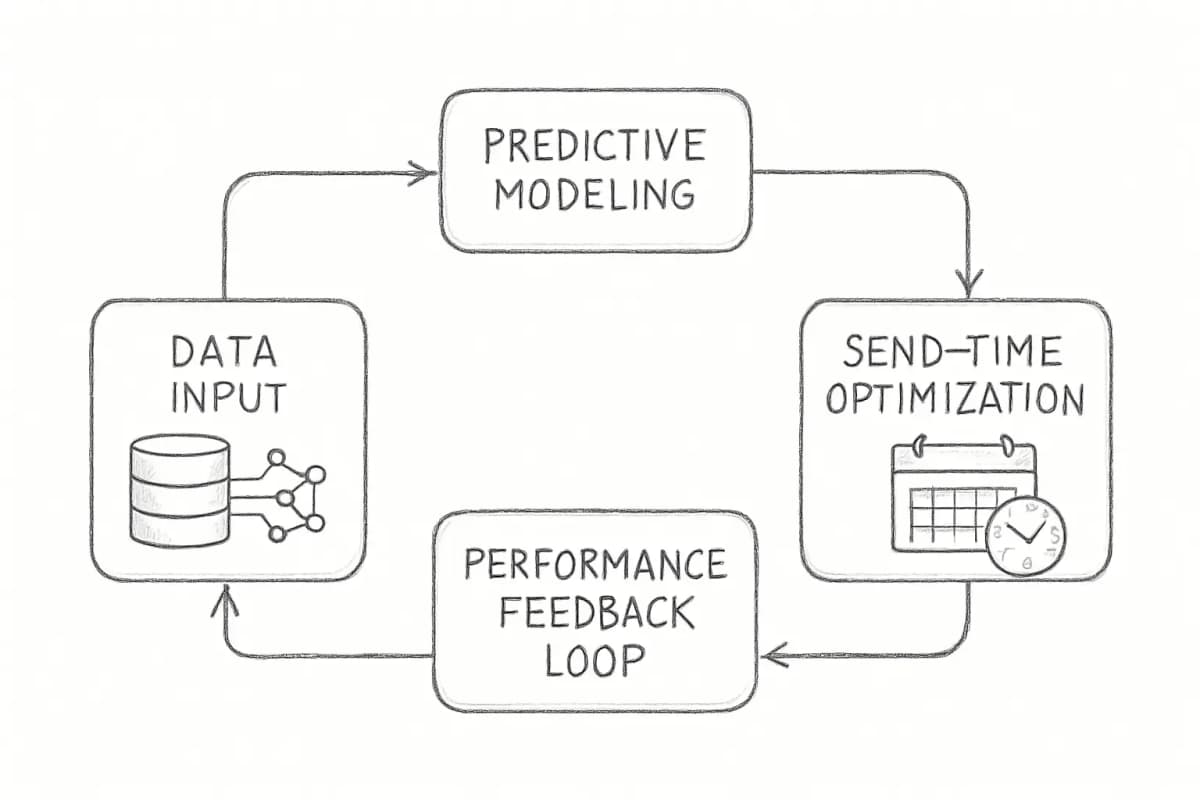
For a practical look at how AI fits into a broader campaign workflow, how to leverage AI in your email marketing provides a solid implementation framework. Flowchart showing machine learning email marketing workflow with four connected stages: data input box on the left receiving customer data, arrow flowing right to predictive modeling box showing algorithm processing, arrow to send-time optimization box showing calendar and clock icons, arrow to performance feedback loop box, then curved arrow returning to data input to close the cycle. Use professional blue and gray color scheme with icons for each stage.


How to Get Started with Machine Learning for Email Marketing

You do not need a custom-built model or a data science team to start using machine learning in your email program. Most mid-tier platforms already include these capabilities.

Here is a practical starting sequence:


How to Get Started with Machine Learning for Email Marketing

You do not need a custom-built model or a data science team to start using machine learning in your email program. Most mid-tier platforms already include these capabilities.

Here is a practical starting sequence:

  1. Audit your current data quality. Machine learning is only as good as the behavioral data feeding it. Clean your list, confirm your tracking is firing correctly, and make sure purchase history, browse behavior, and email engagement are all being captured.
  2. Enable send-time optimization first. It is the lowest-friction entry point, requires no content changes, and produces measurable open rate lifts within a few campaigns. Most platforms including Klaviyo, Mailchimp, and HubSpot include it natively.
  3. Move to behavioral segmentation. Replace static demographic segments with dynamic segments scored on purchase frequency, predicted lifetime value, and engagement trend. Segmented email campaigns generate 760% more revenue than non-segmented broadcasts, and the most effective segmentation combines behavioral data with AI-predicted intent scores.
  4. Layer in AI subject line testing. Run your AI-generated subject lines against manually written controls using a proper holdout group. Measure revenue per delivered email, not just open rate.
  5. Set up churn prediction triggers. Define your disengagement threshold (typically 60 to 90 days of inactivity), connect it to an automated re-engagement sequence, and let the model flag at-risk subscribers before they go cold.
  6. Track the right metrics. With Apple Mail Privacy Protection affecting 50% of email recipients, open rates are increasingly unreliable. Revenue per recipient, click-through rate, and conversion rate per send are the metrics that actually correlate with business outcomes.
  1. Audit your current data quality. Machine learning is only as good as the behavioral data feeding it. Clean your list, confirm your tracking is firing correctly, and make sure purchase history, browse behavior, and email engagement are all being captured.
  2. Enable send-time optimization first. It is the lowest-friction entry point, requires no content changes, and produces measurable open rate lifts within a few campaigns. Most platforms including Klaviyo, Mailchimp, and HubSpot include it natively.
  3. Move to behavioral segmentation. Replace static demographic segments with dynamic segments scored on purchase frequency, predicted lifetime value, and engagement trend. Segmented email campaigns generate 760% more revenue than non-segmented broadcasts, and the most effective segmentation combines behavioral data with AI-predicted intent scores.
  4. Layer in AI subject line testing. Run your AI-generated subject lines against manually written controls using a proper holdout group. Measure revenue per delivered email, not just open rate.
  5. Set up churn prediction triggers. Define your disengagement threshold (typically 60 to 90 days of inactivity), connect it to an automated re-engagement sequence, and let the model flag at-risk subscribers before they go cold.
  6. Track the right metrics. With Apple Mail Privacy Protection affecting 50% of email recipients, open rates are increasingly unreliable. Revenue per recipient, click-through rate, and conversion rate per send are the metrics that actually correlate with business outcomes.

For teams building out their automation infrastructure alongside this, email marketing automation CRM setup guide covers how to connect your CRM data to your email platform so the machine learning models have the behavioral signals they need.


Frequently Asked Questions

What is machine learning for email marketing?

AI in email marketing refers to technologies such as machine learning, natural language processing, and predictive analytics that analyze customer data to tailor subject lines, content, and send timing. In practice, it means email platforms use historical behavioral data to make automated decisions about what to send, when to send it, and to whom, without requiring manual input for each decision.

Does machine learning replace email marketers?

AI does not replace marketers. Instead, it works alongside them, handling data analysis and optimization so marketers can focus on creative strategy, messaging, and building customer relationships. The strategic layer, brand voice, offer design, and customer understanding still require human judgment.

Which email metrics should I track when using AI tools?

Focus on revenue per delivered email, click-through rate, conversion rate, and subscriber lifetime value. Open rates are useful for spotting anomalies like a deliverability issue, but less reliable as a success metric. The real measure of performance is what happens next: clicks, conversions, replies, and revenue are all better metrics of success.

How long does it take to see results from machine learning in email campaigns?

Results vary depending on list size and data quality, but in many mature programs, teams see incremental improvements such as open rate lifts from personalization and send-time optimization within a few campaigns rather than overnight. Larger, more engaged lists give models more signal to work with and typically produce faster results. A controlled rollout with a proper holdout group gives you the cleanest read on what the ML layer is actually contributing.


For teams building out their automation infrastructure alongside this, email marketing automation CRM setup guide covers how to connect your CRM data to your email platform so the machine learning models have the behavioral signals they need.


Frequently Asked Questions

What is machine learning for email marketing?

AI in email marketing refers to technologies such as machine learning, natural language processing, and predictive analytics that analyze customer data to tailor subject lines, content, and send timing. In practice, it means email platforms use historical behavioral data to make automated decisions about what to send, when to send it, and to whom, without requiring manual input for each decision.

Does machine learning replace email marketers?

AI does not replace marketers. Instead, it works alongside them, handling data analysis and optimization so marketers can focus on creative strategy, messaging, and building customer relationships. The strategic layer, brand voice, offer design, and customer understanding still require human judgment.

Which email metrics should I track when using AI tools?

Focus on revenue per delivered email, click-through rate, conversion rate, and subscriber lifetime value. Open rates are useful for spotting anomalies like a deliverability issue, but less reliable as a success metric. The real measure of performance is what happens next: clicks, conversions, replies, and revenue are all better metrics of success.

How long does it take to see results from machine learning in email campaigns?

Results vary depending on list size and data quality, but in many mature programs, teams see incremental improvements such as open rate lifts from personalization and send-time optimization within a few campaigns rather than overnight. Larger, more engaged lists give models more signal to work with and typically produce faster results. A controlled rollout with a proper holdout group gives you the cleanest read on what the ML layer is actually contributing.

No comments yet. Be the first!

Leave a comment

Comments are reviewed before publishing.

No comments yet. Be the first!

Leave a comment

Comments are reviewed before publishing.