
Email
Email

A modern blog built with Payload CMS, Next.js, and shadcn/ui.

RSS FeedSitemap

Explore

  • Blog
  • News
  • Statistics
  • Authors

Categories

  • Automation
  • Email Marketing Tools & Platforms
  • Email Marketing Training
  • Email Marketing Benchmarks
  • Email Automation & AI
  • Email Marketing Operations & Growth
  • Email Marketing Tools & Reviews
  • Email Marketing Technology

Latest articles

  • Best AI Email Marketing Platforms in 2024Jul 21, 2026
  • Best AI Tools for Email Marketing in 2024Jul 21, 2026
  • Top AI Email Marketing Platforms to ConsiderJul 21, 2026
  • Top Email Marketing Automation Platforms 2024Jul 21, 2026

Popular topics

  • #SMB Marketing Data
  • #Small Business Email Marketing
  • #SaaS Tools
  • #financial services benchmarks
  • #fund manager email
  • #Omnisend
  • #Platform Reviews
  • #Wealth Management
  • #skill development
  • #email marketing courses
  • #outsourced email teams
  • #email team scaling
  • #email outsourcing
  • #offshore email marketing
  • #cybersecurity
  • #Postscript

Stay in the loop

Join 2,000+ readers. Unsubscribe anytime.

Subscribe
Email

© 2026 Email. All rights reserved.

SitemapRSS
HomeBlogEmail Marketing Tools & PlatformsTop Email Marketing Automation Platforms 2024
Email Marketing Tools & Platforms

Top Email Marketing Automation Platforms 2024

Compare the best email automation platforms for 2024. See features, pricing, and real use cases to find the right fit for your business.

R

Rachel Torres

July 21, 2026

13 min read
Share:
#Email Automation#Marketing Tools#Platform Reviews#Email Strategy
Illustration for top email marketing automation platforms 2024

Stay in the loop

Get the latest posts delivered straight to your inbox. No spam, unsubscribe anytime.

Choosing the wrong email marketing automation platform costs you more than money. It costs you subscriber engagement, deliverability credibility, and the compounding gains that come from automation done right. This guide cuts through the noise and gives you a clear, data-backed breakdown of the top email marketing automation platforms in 2024, organized by what they actually do well and which business type they serve best.

Key Takeaways

  • Automated emails generate 320% more revenue than non-automated emails, and email delivers an average return of $36 for every $1 spent.
  • Despite representing only 2% of email volume, automated messages generated 37% of all email-attributed sales in 2024.
  • Automated emails average a 70.5% higher open rate and 152% higher click-through rate than standard broadcast messages.
  • Platform choice directly affects ROI: features that look identical on a checklist can deliver radically different results in practice.
  • The best platform depends on your business model: ecommerce, B2B, SaaS, and small businesses each have a clear front-runner.

Why Automation Is No Longer Optional

Approximately 76% of businesses now utilize some form of marketing automation as part of their strategy, reflecting widespread adoption across sectors. The holdouts are increasingly at a competitive disadvantage.

Email marketing automation platforms help businesses send targeted, personalized emails at scale by automating workflows, segmenting audiences, and integrating with CRM and ecommerce tools. But there is a meaningful difference between platforms that offer basic drip sequences and those that orchestrate multi-step behavioral journeys across email, SMS, and web.

Two platforms can both claim "automation" while delivering wildly different experiences: one might offer simple drip sequences, while another orchestrates multi-step behavioral journeys across email, SMS, and web.

The sections below break down each major platform by what it actually delivers, not what the marketing copy promises.


How to Evaluate an Email Automation Platform

Before choosing a platform, evaluate it against criteria that reflect your real working environment, not a generic feature checklist.

Key evaluation criteria include: ease of use, feature depth (automation capabilities, segmentation options, template quality, and A/B testing), deliverability performance, pricing transparency, integration ecosystem, and customer support quality.

Today's marketing teams specifically need platforms that offer predictive analytics, journey-based targeting, drag-and-drop builders, behavioral triggers, unified customer data for segmentation, AI-powered content features, strong deliverability, and transparent pricing.

Also understand how each platform bills. Brevo prices on email send volume rather than contact count, ActiveCampaign and HubSpot pricing vary materially by feature tier, and Mailchimp bills for unsubscribed contacts since its 2024 change. These structural differences affect your long-term cost significantly.


Top Email Marketing Automation Platforms in 2024

1. ActiveCampaign: Best for Automation Depth

ActiveCampaign consistently tops independent benchmarks for automation flexibility. It is the best email marketing software for anyone serious about automation. Its visual workflow builder remains the most capable in the industry, and with Active Intelligence, their AI feature that learns from your campaigns, it has become genuinely difficult to justify choosing anything else if automation matters to your business.

ActiveCampaign's highlights include advanced automation capabilities and CRM integration. Combined with lead scoring, these make it a top choice for marketers focused on nurturing customer relationships through personalized, data-driven campaigns. The platform is generally well-suited for enterprise businesses with complex sales funnels or multi-step customer journeys.

Unlike other platforms, ActiveCampaign lets you A/B test full automation sequences, not just individual emails.

Pricing: ActiveCampaign uses tiered pricing based on both contact count and plan level. The Starter plan at 1,000 contacts is $15/month, but most B2B teams need the Plus plan at $49/month for CRM and lead scoring.

Best for: B2B companies, SaaS teams, and agencies needing deep behavioral automation and built-in CRM.

Watch out for: There is a learning curve to ActiveCampaign, particularly if you integrate email automation and CRM functionalities.


2. Klaviyo: Best for Ecommerce

Klaviyo has become a go-to automation platform for online stores, particularly those on platforms like Shopify. Its differentiation is built on the depth of ecommerce-native data it ingests and acts on.

Klaviyo's flow builder creates automated email and SMS sequences triggered by customer behavior: abandoned cart, browse abandonment, post-purchase follow-up, welcome series, win-back, price drop alerts, and back-in-stock notifications. Flows support conditional splits based on 300+ customer attributes including purchase history, browsing behavior, email engagement, and predicted customer lifetime value.

Performance benchmarks from Klaviyo's Q4 2024 data show welcome series achieving 45 to 50% open rates and 8 to 12% conversion rates, with abandoned cart flows reaching 35 to 40% open rates and 15 to 20% conversion rates.

Klaviyo crossed $1 billion in revenue in 2024 with 167,000 customers and 34% year-over-year growth.

Best for: Ecommerce brands on Shopify, WooCommerce, or BigCommerce that need behavioral automation tied directly to revenue attribution.

Watch out for: Klaviyo's active profile counts include unsubscribed and bounced contacts. A list of 25,000 with 7,000 unsubscribed still bills at the 25,000 tier unless suppressed contacts are deleted manually.

For a deeper look at ecommerce-specific strategies, see our guide on ecommerce email marketing tips and strategies for higher ROI.


3. HubSpot: Best for CRM-First Teams

For most scaling teams, particularly B2B, SaaS, and services, HubSpot's Marketing Hub can be the most complete option. The automation depth, native CRM, AI tools, and a usable free tier make it the lowest-risk starting point for teams that expect to grow into more sophisticated programs.

The tradeoff is cost. HubSpot's Professional tier, where meaningful automation actually lives, starts at $890/month, a stark contrast to ActiveCampaign's comparable Plus tier at $49/month.

The built-in CRM aligns marketing and sales. Automated lead scoring and deal creation eliminate the need for separate CRM software for most teams.

Best for: Mid-market and enterprise B2B teams where sales and marketing alignment is the primary objective and budget supports the Professional tier.

Watch out for: HubSpot contacts receiving marketing emails count as "marketing contacts" toward billing. Contacts originally imported as CRM records become marketing contacts the moment they receive a campaign.


4. Brevo: Best Value for Budget-Conscious Senders

Brevo is an email and SMS marketing platform that charges by sending volume instead of contacts: every plan allows unlimited contacts, and the free plan sends up to 300 emails per day. Its strengths are affordable volume pricing with built-in SMS, CRM, and automation.

The Standard tier at $65/month for 20,000 emails gives you full marketing automation, A/B testing, and heatmaps, which is competitive against ActiveCampaign and Mailchimp at similar volumes.

Unlike most email marketing services that price primarily by the number of contacts, Brevo charges based on the number of emails you send per month. This structure rewards businesses with large lists that email infrequently.

Best for: Small and mid-sized businesses that want email, SMS, and a basic CRM in one platform without a large upfront commitment.

Watch out for: Common complaints include uneven support and costs that climb as sending volume grows.


5. Mailchimp: Best for Beginners and Small Lists

Mailchimp built its reputation on being approachable, and that's still true. The interface is clean, the drag-and-drop builder is intuitive, and with over 300 integrations, it connects to nearly every tool a small business already uses.

However, Mailchimp's automation capabilities have a ceiling. Mailchimp's Marketing Automation Flows handle basic sequences like welcome series and abandoned cart reminders. But teams needing sophisticated conditional branching, goal tracking, or multi-step behavioral workflows will find the platform restrictive compared to ActiveCampaign or Klaviyo.

Pricing: Mailchimp paid plans start at $26.50/month for 1,000 contacts and pricing scales significantly based on list size.

Watch out for: Mailchimp charges for unsubscribed and inactive contacts unless you manually archive them, which can inflate your bill 10 to 20% over what you would expect.

Best for: Entrepreneurs, bloggers, and small businesses sending straightforward campaigns to lists under 10,000 contacts.


6. MailerLite: Best Clean Option for Growing Teams

MailerLite is something of a fan favorite in the world of email marketing, offering a clean, modern, and user-friendly platform at an affordable price, especially compared to bigger-name alternatives.

MailerLite's latest version includes a streamlined design interface with improved usability, enhanced automation capabilities such as multi-trigger workflows, and pricing tiers tailored to different user needs.

Paid plans start at $12 per month. The free plan includes automation, landing pages, and signup forms, making it genuinely useful rather than a stripped-down teaser.

Best for: Small businesses that want a generous free plan with real automation functionality built in.

Watch out for: MailerLite lacks some advanced features found in other tools, such as detailed automation reports, lead scoring, and built-in CRM functionalities.


7. GetResponse: Best for Funnel Builders

GetResponse is a strong choice if you want to grow your revenue streams. Its funnel builder is aimed at converting new contacts into customers quickly, and it works well for selling subscriptions, tickets, or digital products.

Paid plans start at $19 per month, with unlimited emails and 1,000 contacts. The platform bridges email marketing with landing pages and sales funnels in a single interface, which reduces the need for third-party tools.

Best for: Creators, coaches, and small ecommerce operators who want email automation and funnel building in one platform without stitching together multiple tools.


Matching Platforms to Business Type

Business TypeRecommended PlatformKey Reason
Ecommerce (Shopify/WooCommerce)KlaviyoRevenue attribution and behavioral flows
B2B / SaaSActiveCampaign or HubSpotCRM integration and lead scoring
Small business / budgetMailerLite or BrevoGenerous free tiers, clean UX
Beginner / first platformMailchimpEase of use, broad integrations
Funnel-based businessesGetResponseBuilt-in funnel and landing page tools

What to Set Up First After Choosing a Platform

Picking a platform is only step one. What you automate first determines how quickly you see results. Prioritize these sequences before anything else:

  1. Welcome sequence. This is the highest-engagement window in any subscriber relationship. See our guide on welcome email sequence best practices for proven structures.
  2. Behavioral triggers. Abandoned cart, browse abandonment, and post-purchase flows drive disproportionate revenue. Email automations deliver 30 times more revenue per recipient than one-off promotional campaigns. The average return per recipient for campaigns is $0.11, while automated flows earn $1.94 per recipient.
  3. Segmentation. The quality of your automation is limited by the quality of your segmentation. Before layering on complex workflows, make sure your lists are cleanly divided by behavior, purchase history, and engagement level. For a deep dive, read our piece on email list segmentation strategies.
  4. Deliverability setup. Authenticate your domain with SPF, DKIM, and DMARC before your first send. Roughly 7% of emails now land in spam, directly reducing ROI.
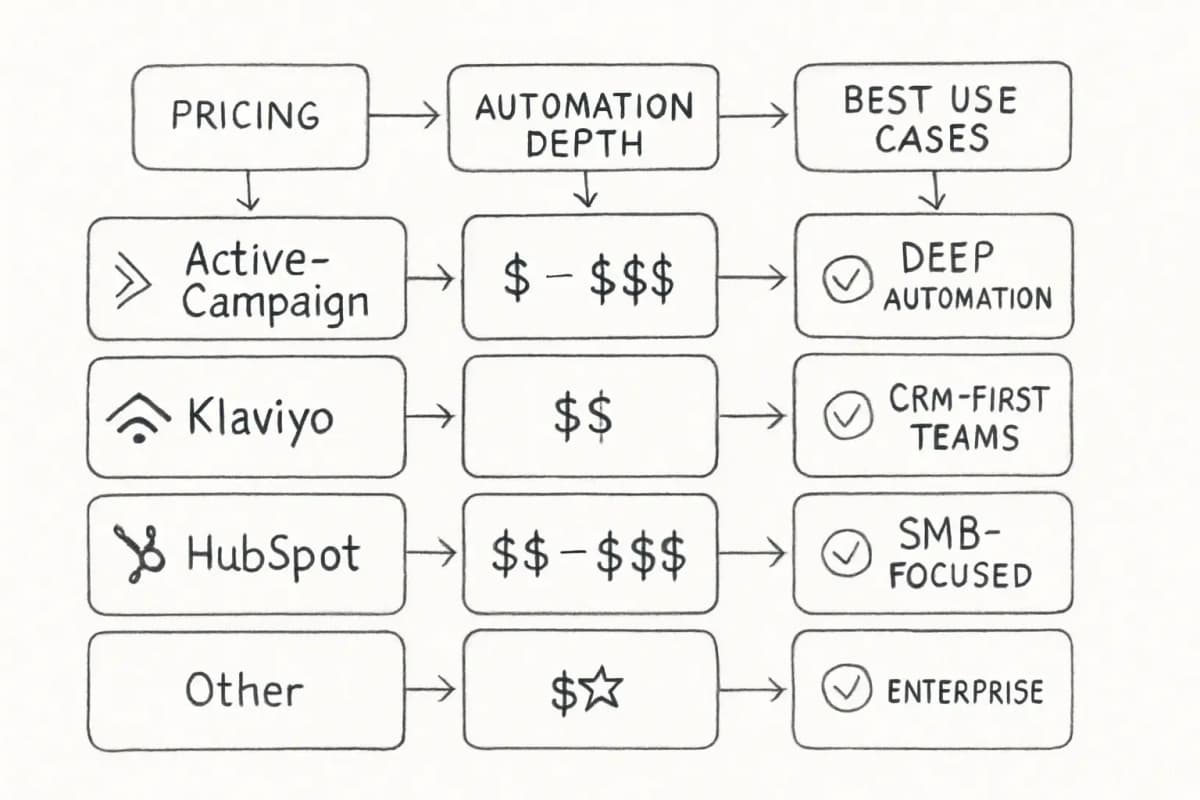
Comparison table showing top email automation platforms (ActiveCampaign, Klaviyo, HubSpot, and others) with three columns: pricing tiers, automation depth/capabilities, and best-fit use cases. Use a clean table format with platform logos on the left, pricing ranges in the middle column, automation feature descriptions in the center-right, and use case badges (ecommerce, CRM-first, SMB-focused, enterprise) on the right. Include visual indicators (checkmarks, stars) to show strength areas for each platform.


Frequently Asked Questions

What is the best email marketing automation platform in 2024?

There is no single best platform because the right choice depends on your business model. ActiveCampaign is best for deep automation, Klaviyo for ecommerce, and HubSpot for CRM-first teams. MailerLite and Brevo are strong options for small businesses on a budget.

How much does email marketing automation software cost?

Pricing varies widely. MailerLite's paid plans start at $12 per month. ActiveCampaign's Plus plan starts at $49/month for 1,000 contacts. HubSpot's Professional tier, where meaningful automation lives, starts at $890/month. Always verify pricing directly on the vendor's site, as tiers and features change regularly.

Do small businesses really need email automation?

Yes, and the ROI data makes this clear. Small businesses see a 25% increase in marketing ROI when they start using automation. Even simple sequences like welcome emails and abandoned cart flows generate returns that justify the investment at almost any list size.

What features should I prioritize when choosing an email automation platform?

Key features to prioritize include automation triggered by subscriber actions or behaviors, audience segmentation to divide your list based on specific criteria, A/B testing to determine what works best, and integrations that connect your email platform with your CRM or ecommerce stack. Beyond features, evaluate deliverability track record and pricing transparency at your actual expected contact count, not entry-level tiers.

How do I know if my email automation setup is working?

Track open rates, click-through rates, and conversion rates per automation flow, not just campaign averages. Automated flows should consistently outperform broadcast sends. The average open rate for automated emails is 35.64%, with a click-through rate of 2.02%. If your flows are underperforming those benchmarks, revisit your segmentation and trigger logic before changing the platform itself.


No comments yet. Be the first!

Leave a comment

Comments are reviewed before publishing.

More from

Related posts

Illustration for what is the best ai email marketing platform?
Email Marketing Tools & PlatformsJul 21, 2026 13 min

Best AI Email Marketing Platforms in 2024

Compare top AI email marketing platforms by features, pricing, and deliverability. Find the right solution for your business goals and ROI.

JJames Chen
Illustration for email marketing automation platform comparison
Email Marketing Tools & PlatformsJul 20, 2026 11 min

Email Marketing Automation Platforms: 2024 Comparison

Compare top email marketing automation platforms side-by-side. Find pricing, features, and which tool fits your business needs and budget.

JJames Chen
HomeBlogEmail Marketing Tools & PlatformsTop Email Marketing Automation Platforms 2024
Email Marketing Tools & Platforms

Top Email Marketing Automation Platforms 2024

Compare the best email automation platforms for 2024. See features, pricing, and real use cases to find the right fit for your business.

R

Rachel Torres

July 21, 2026

13 min read
Share:
#Email Automation#Marketing Tools#Platform Reviews#Email Strategy
Illustration for top email marketing automation platforms 2024

Stay in the loop

Get the latest posts delivered straight to your inbox. No spam, unsubscribe anytime.

Choosing the wrong email marketing automation platform costs you more than money. It costs you subscriber engagement, deliverability credibility, and the compounding gains that come from automation done right. This guide cuts through the noise and gives you a clear, data-backed breakdown of the top email marketing automation platforms in 2024, organized by what they actually do well and which business type they serve best.

Key Takeaways

  • Automated emails generate 320% more revenue than non-automated emails, and email delivers an average return of $36 for every $1 spent.
  • Despite representing only 2% of email volume, automated messages generated 37% of all email-attributed sales in 2024.
  • Automated emails average a 70.5% higher open rate and 152% higher click-through rate than standard broadcast messages.
  • Platform choice directly affects ROI: features that look identical on a checklist can deliver radically different results in practice.
  • The best platform depends on your business model: ecommerce, B2B, SaaS, and small businesses each have a clear front-runner.

Why Automation Is No Longer Optional

Approximately 76% of businesses now utilize some form of marketing automation as part of their strategy, reflecting widespread adoption across sectors. The holdouts are increasingly at a competitive disadvantage.

Email marketing automation platforms help businesses send targeted, personalized emails at scale by automating workflows, segmenting audiences, and integrating with CRM and ecommerce tools. But there is a meaningful difference between platforms that offer basic drip sequences and those that orchestrate multi-step behavioral journeys across email, SMS, and web.

Two platforms can both claim "automation" while delivering wildly different experiences: one might offer simple drip sequences, while another orchestrates multi-step behavioral journeys across email, SMS, and web.

The sections below break down each major platform by what it actually delivers, not what the marketing copy promises.


How to Evaluate an Email Automation Platform

Before choosing a platform, evaluate it against criteria that reflect your real working environment, not a generic feature checklist.

Key evaluation criteria include: ease of use, feature depth (automation capabilities, segmentation options, template quality, and A/B testing), deliverability performance, pricing transparency, integration ecosystem, and customer support quality.

Today's marketing teams specifically need platforms that offer predictive analytics, journey-based targeting, drag-and-drop builders, behavioral triggers, unified customer data for segmentation, AI-powered content features, strong deliverability, and transparent pricing.

Also understand how each platform bills. Brevo prices on email send volume rather than contact count, ActiveCampaign and HubSpot pricing vary materially by feature tier, and Mailchimp bills for unsubscribed contacts since its 2024 change. These structural differences affect your long-term cost significantly.


Top Email Marketing Automation Platforms in 2024

1. ActiveCampaign: Best for Automation Depth

ActiveCampaign consistently tops independent benchmarks for automation flexibility. It is the best email marketing software for anyone serious about automation. Its visual workflow builder remains the most capable in the industry, and with Active Intelligence, their AI feature that learns from your campaigns, it has become genuinely difficult to justify choosing anything else if automation matters to your business.

ActiveCampaign's highlights include advanced automation capabilities and CRM integration. Combined with lead scoring, these make it a top choice for marketers focused on nurturing customer relationships through personalized, data-driven campaigns. The platform is generally well-suited for enterprise businesses with complex sales funnels or multi-step customer journeys.

Unlike other platforms, ActiveCampaign lets you A/B test full automation sequences, not just individual emails.

Pricing: ActiveCampaign uses tiered pricing based on both contact count and plan level. The Starter plan at 1,000 contacts is $15/month, but most B2B teams need the Plus plan at $49/month for CRM and lead scoring.

Best for: B2B companies, SaaS teams, and agencies needing deep behavioral automation and built-in CRM.

Watch out for: There is a learning curve to ActiveCampaign, particularly if you integrate email automation and CRM functionalities.


2. Klaviyo: Best for Ecommerce

Klaviyo has become a go-to automation platform for online stores, particularly those on platforms like Shopify. Its differentiation is built on the depth of ecommerce-native data it ingests and acts on.

Klaviyo's flow builder creates automated email and SMS sequences triggered by customer behavior: abandoned cart, browse abandonment, post-purchase follow-up, welcome series, win-back, price drop alerts, and back-in-stock notifications. Flows support conditional splits based on 300+ customer attributes including purchase history, browsing behavior, email engagement, and predicted customer lifetime value.

Performance benchmarks from Klaviyo's Q4 2024 data show welcome series achieving 45 to 50% open rates and 8 to 12% conversion rates, with abandoned cart flows reaching 35 to 40% open rates and 15 to 20% conversion rates.

Klaviyo crossed $1 billion in revenue in 2024 with 167,000 customers and 34% year-over-year growth.

Best for: Ecommerce brands on Shopify, WooCommerce, or BigCommerce that need behavioral automation tied directly to revenue attribution.

Watch out for: Klaviyo's active profile counts include unsubscribed and bounced contacts. A list of 25,000 with 7,000 unsubscribed still bills at the 25,000 tier unless suppressed contacts are deleted manually.

For a deeper look at ecommerce-specific strategies, see our guide on ecommerce email marketing tips and strategies for higher ROI.


3. HubSpot: Best for CRM-First Teams

For most scaling teams, particularly B2B, SaaS, and services, HubSpot's Marketing Hub can be the most complete option. The automation depth, native CRM, AI tools, and a usable free tier make it the lowest-risk starting point for teams that expect to grow into more sophisticated programs.

The tradeoff is cost. HubSpot's Professional tier, where meaningful automation actually lives, starts at $890/month, a stark contrast to ActiveCampaign's comparable Plus tier at $49/month.

The built-in CRM aligns marketing and sales. Automated lead scoring and deal creation eliminate the need for separate CRM software for most teams.

Best for: Mid-market and enterprise B2B teams where sales and marketing alignment is the primary objective and budget supports the Professional tier.

Watch out for: HubSpot contacts receiving marketing emails count as "marketing contacts" toward billing. Contacts originally imported as CRM records become marketing contacts the moment they receive a campaign.


4. Brevo: Best Value for Budget-Conscious Senders

Brevo is an email and SMS marketing platform that charges by sending volume instead of contacts: every plan allows unlimited contacts, and the free plan sends up to 300 emails per day. Its strengths are affordable volume pricing with built-in SMS, CRM, and automation.

The Standard tier at $65/month for 20,000 emails gives you full marketing automation, A/B testing, and heatmaps, which is competitive against ActiveCampaign and Mailchimp at similar volumes.

Unlike most email marketing services that price primarily by the number of contacts, Brevo charges based on the number of emails you send per month. This structure rewards businesses with large lists that email infrequently.

Best for: Small and mid-sized businesses that want email, SMS, and a basic CRM in one platform without a large upfront commitment.

Watch out for: Common complaints include uneven support and costs that climb as sending volume grows.


5. Mailchimp: Best for Beginners and Small Lists

Mailchimp built its reputation on being approachable, and that's still true. The interface is clean, the drag-and-drop builder is intuitive, and with over 300 integrations, it connects to nearly every tool a small business already uses.

However, Mailchimp's automation capabilities have a ceiling. Mailchimp's Marketing Automation Flows handle basic sequences like welcome series and abandoned cart reminders. But teams needing sophisticated conditional branching, goal tracking, or multi-step behavioral workflows will find the platform restrictive compared to ActiveCampaign or Klaviyo.

Pricing: Mailchimp paid plans start at $26.50/month for 1,000 contacts and pricing scales significantly based on list size.

Watch out for: Mailchimp charges for unsubscribed and inactive contacts unless you manually archive them, which can inflate your bill 10 to 20% over what you would expect.

Best for: Entrepreneurs, bloggers, and small businesses sending straightforward campaigns to lists under 10,000 contacts.


6. MailerLite: Best Clean Option for Growing Teams

MailerLite is something of a fan favorite in the world of email marketing, offering a clean, modern, and user-friendly platform at an affordable price, especially compared to bigger-name alternatives.

MailerLite's latest version includes a streamlined design interface with improved usability, enhanced automation capabilities such as multi-trigger workflows, and pricing tiers tailored to different user needs.

Paid plans start at $12 per month. The free plan includes automation, landing pages, and signup forms, making it genuinely useful rather than a stripped-down teaser.

Best for: Small businesses that want a generous free plan with real automation functionality built in.

Watch out for: MailerLite lacks some advanced features found in other tools, such as detailed automation reports, lead scoring, and built-in CRM functionalities.


7. GetResponse: Best for Funnel Builders

GetResponse is a strong choice if you want to grow your revenue streams. Its funnel builder is aimed at converting new contacts into customers quickly, and it works well for selling subscriptions, tickets, or digital products.

Paid plans start at $19 per month, with unlimited emails and 1,000 contacts. The platform bridges email marketing with landing pages and sales funnels in a single interface, which reduces the need for third-party tools.

Best for: Creators, coaches, and small ecommerce operators who want email automation and funnel building in one platform without stitching together multiple tools.


Matching Platforms to Business Type

Business TypeRecommended PlatformKey Reason
Ecommerce (Shopify/WooCommerce)KlaviyoRevenue attribution and behavioral flows
B2B / SaaSActiveCampaign or HubSpotCRM integration and lead scoring
Small business / budgetMailerLite or BrevoGenerous free tiers, clean UX
Beginner / first platformMailchimpEase of use, broad integrations
Funnel-based businessesGetResponseBuilt-in funnel and landing page tools

What to Set Up First After Choosing a Platform

Picking a platform is only step one. What you automate first determines how quickly you see results. Prioritize these sequences before anything else:

  1. Welcome sequence. This is the highest-engagement window in any subscriber relationship. See our guide on welcome email sequence best practices for proven structures.
  2. Behavioral triggers. Abandoned cart, browse abandonment, and post-purchase flows drive disproportionate revenue. Email automations deliver 30 times more revenue per recipient than one-off promotional campaigns. The average return per recipient for campaigns is $0.11, while automated flows earn $1.94 per recipient.
  3. Segmentation. The quality of your automation is limited by the quality of your segmentation. Before layering on complex workflows, make sure your lists are cleanly divided by behavior, purchase history, and engagement level. For a deep dive, read our piece on email list segmentation strategies.
  4. Deliverability setup. Authenticate your domain with SPF, DKIM, and DMARC before your first send. Roughly 7% of emails now land in spam, directly reducing ROI.

Comparison table showing top email automation platforms (ActiveCampaign, Klaviyo, HubSpot, and others) with three columns: pricing tiers, automation depth/capabilities, and best-fit use cases. Use a clean table format with platform logos on the left, pricing ranges in the middle column, automation feature descriptions in the center-right, and use case badges (ecommerce, CRM-first, SMB-focused, enterprise) on the right. Include visual indicators (checkmarks, stars) to show strength areas for each platform.


Frequently Asked Questions

What is the best email marketing automation platform in 2024?

There is no single best platform because the right choice depends on your business model. ActiveCampaign is best for deep automation, Klaviyo for ecommerce, and HubSpot for CRM-first teams. MailerLite and Brevo are strong options for small businesses on a budget.

How much does email marketing automation software cost?

Pricing varies widely. MailerLite's paid plans start at $12 per month. ActiveCampaign's Plus plan starts at $49/month for 1,000 contacts. HubSpot's Professional tier, where meaningful automation lives, starts at $890/month. Always verify pricing directly on the vendor's site, as tiers and features change regularly.

Do small businesses really need email automation?

Yes, and the ROI data makes this clear. Small businesses see a 25% increase in marketing ROI when they start using automation. Even simple sequences like welcome emails and abandoned cart flows generate returns that justify the investment at almost any list size.

What features should I prioritize when choosing an email automation platform?

Key features to prioritize include automation triggered by subscriber actions or behaviors, audience segmentation to divide your list based on specific criteria, A/B testing to determine what works best, and integrations that connect your email platform with your CRM or ecommerce stack. Beyond features, evaluate deliverability track record and pricing transparency at your actual expected contact count, not entry-level tiers.

How do I know if my email automation setup is working?

Track open rates, click-through rates, and conversion rates per automation flow, not just campaign averages. Automated flows should consistently outperform broadcast sends. The average open rate for automated emails is 35.64%, with a click-through rate of 2.02%. If your flows are underperforming those benchmarks, revisit your segmentation and trigger logic before changing the platform itself.

No comments yet. Be the first!

Leave a comment

Comments are reviewed before publishing.

More from

Related posts

Illustration for what is the best ai email marketing platform?
Email Marketing Tools & PlatformsJul 21, 2026 13 min

Best AI Email Marketing Platforms in 2024

Compare top AI email marketing platforms by features, pricing, and deliverability. Find the right solution for your business goals and ROI.

JJames Chen
Illustration for email marketing automation platform comparison
Email Marketing Tools & PlatformsJul 20, 2026 11 min

Email Marketing Automation Platforms: 2024 Comparison

Compare top email marketing automation platforms side-by-side. Find pricing, features, and which tool fits your business needs and budget.

JJames Chen