
Choosing the right email marketing automation platform in 2025 is one of the most impactful decisions a marketer or business owner can make. Automated emails generate 320% more revenue than non-automated emails, and for every $1 spent on email marketing, the average return is $36. But returns like those only materialize when you pick a platform that matches your audience, your workflows, and your growth stage. This guide covers the top email marketing automation platforms 2025 has to offer, with honest comparisons of features, pricing, and who each tool serves best.
Key Takeaways
- Automated emails generate 320% more revenue than non-automated emails, making platform choice a direct revenue decision.
- ActiveCampaign delivers the most sophisticated workflows and customer journey mapping, while HubSpot provides a complete marketing ecosystem with CRM integration.
- Klaviyo is the gold standard for ecommerce stores, with Omnisend as a more affordable alternative.
- Brevo offers up to 100,000 contacts on its free plan and prices paid plans based on email volume rather than contact tiers, making it a strong value pick.
- No single platform wins everywhere. Match your tool to your business model, contact volume, and automation requirements before committing.
Why Automation Platform Choice Matters More Than Ever
Nearly 4.5 billion people use email worldwide in 2025, and this number is projected to reach over 4.8 billion by 2027. That audience scale means inboxes are more competitive, and batch-and-blast campaigns no longer cut through. Automation gives you the edge: behavior-triggered sequences, personalized flows, and lifecycle messaging that would be impossible to replicate manually.
Automated campaigns demonstrate 2,361% higher conversion rates than traditional campaigns. The right platform puts that kind of lift within reach. The wrong one buries it behind pricing walls, missing integrations, or workflows too rigid to reflect how your customers actually behave.
For a deeper look at what goes into a high-converting automation strategy, see our email marketing automation tips guide.
1. ActiveCampaign: Best for Advanced Automation
ActiveCampaign has gained popularity for its powerful email marketing and automation features and is particularly well-suited for small to medium-sized businesses looking to enhance customer relationships.
What sets it apart is the depth of its workflow engine. Its visual automation builder is best-in-class, with 135+ triggers, if/else branching, and split-testing of entire automation paths. ActiveCampaign has more than 1,000 integrations, including native integrations with Salesforce, Calendly, Webflow, Zendesk, DocuSign, and most major ecommerce platforms like Shopify, Magento, and WooCommerce.
The built-in CRM is a meaningful differentiator for teams that do not want to pay HubSpot prices. The built-in CRM aligns marketing and sales, and automated lead scoring and deal creation eliminate the need for separate CRM software for most teams.
Pricing: ActiveCampaign uses tiered pricing based on both contact count and plan level (Starter, Plus, Pro, Enterprise). The Starter plan at 1,000 contacts is $15/month, but most B2B teams need Plus ($49/month at 1,000 contacts) for CRM and lead scoring.
Best for: SMBs and B2B teams that need multi-step conditional workflows, lead scoring, and CRM alignment in a single platform.
2. Klaviyo: Best for Ecommerce
Klaviyo is the autonomous B2C CRM and AI marketing platform that unifies customer data and automates email, SMS, RCS, WhatsApp, and mobile push to drive personalized, revenue-generating campaigns.
Klaviyo's data model is built around ecommerce events, including purchase history, predictive lifetime value, churn risk, and next-purchase date, in ways that general-purpose platforms do not natively replicate. It offers 350+ professionally designed email templates and 80 pre-made flow templates for marketing automation.
Automated flows like abandoned cart or post-purchase messages generate up to 30x more revenue per recipient than broadcast campaigns, according to Klaviyo's latest email marketing benchmarks.
Over 165,000 paying customers use Klaviyo by mid-2025, concentrated largely in North America. User feedback consistently flags the pricing structure as the biggest hurdle for scaling brands, with costs jumping significantly as lists grow.
Pricing: Klaviyo's free plan includes up to 250 active profiles and 500 email sends per month. Email-only at 1,000 profiles starts at $30/month, scaling to $150/month at 10,000 contacts.
Best for: DTC brands on Shopify or WooCommerce that need deep behavioral segmentation and revenue attribution tied directly to purchase events.
To see how email automation fits into a full ecommerce strategy, check out our ecommerce email marketing tips.
3. HubSpot Marketing Hub: Best for Enterprise and CRM-First Teams
HubSpot is an all-in-one marketing automation platform built on a unified CRM, which means every email, workflow, and personalization rule is powered by a single, consistent customer record. Teams can build segmentation, triggers, and reporting directly from the CRM.
The enterprise plan includes all Marketing Hub Professional features plus customer journey analytics, multi-touch revenue attribution, Breeze social agent, email approvals, and lookalike lists.
The tradeoff is cost. HubSpot costs depend on marketing contacts, not just users. Professional starts at $800/month and Enterprise at $3,600/month. Professional and Enterprise also require onboarding fees ranging from $3,000 to $7,000.
If you only need email, HubSpot's pricing does not compete with pure ESPs. The value is in the integrated platform.
Pricing: Free CRM with limited email tools. Starter from $9/seat/month. Professional at $800/month. Enterprise at $3,600/month.
Best for: B2B and SaaS teams that need email, CRM, sales pipeline, and reporting under one roof without stitching together multiple vendors.
4. Brevo: Best Value All-in-One Platform
Brevo bundles email marketing, SMS, WhatsApp, marketing automation, and transactional SMTP into one platform, with a free plan that is actually usable for low-volume senders.
The pricing model is what makes Brevo stand out from the crowd. Brevo offers up to 100,000 contacts on the free plan, far more than most competitors, and paid plans are priced based on email volume rather than contact tiers. That distinction matters: as your list grows, you do not automatically pay more just for storing contacts.
Predictive sending AI optimizes the send time for individual recipients, and Brevo claims a 99% delivery rate with its dedicated deliverability infrastructure.
EmailTooltester awarded Brevo its Best Email Marketing Tool For Value For Money badge in 2023, 2024, and 2025, and its Best Email Marketing Tool badge for 2026.
Pricing: The free plan includes 300 daily email sends and storage for up to 100,000 contacts, completely free forever. The Starter plan starts at $9/month with no daily sending limit.
Best for: Growing businesses, agencies, and teams that send to large contact lists but want email-volume-based pricing rather than contact-based pricing.
5. Klaviyo Alternative: Omnisend for Ecommerce on a Budget
Omnisend is built for ecommerce automation that integrates email, SMS, and web push notifications to enhance customer journeys and track revenue effectively. It is consistently positioned as the more affordable option versus Klaviyo for store owners who want deep ecommerce functionality without the premium price tag.
Omnisend is built specifically for ecommerce with deep Shopify and WooCommerce integration, product recommendations, and shopping behavior triggers. Omnisend customers achieved a $79 ROI for every $1 spent in 2025 across email, SMS, and web push.
Omnisend's free plan includes 12,000 emails/month to 500 subscribers. Paid plans start at $16/month.
Best for: Small to mid-sized online stores that want ecommerce-native automation without Klaviyo's cost trajectory.
6. MailerLite: Best for Simplicity and Budget Senders
MailerLite is a versatile tool that simplifies email marketing by allowing users to design emails, automate campaigns, and track performance with ease. It is perfect for small to medium-sized businesses, bloggers, ecommerce shops, and freelancers who want a straightforward platform without unnecessary complexity.
MailerLite's core features include a drag-and-drop email editor, landing page and form builder, automation workflows triggered by actions like signups or purchases, and third-party integrations with platforms like Shopify, WooCommerce, WordPress, and Facebook.
MailerLite excels in providing generous email send limits and website-building capabilities, making it ideal for newsletter creators and service providers with simpler marketing needs.
Pricing: MailerLite's free plan is one of the most heavily stacked in the category, sending 2,500 emails a month to 250 subscribers. The Comfort paid plan starts at $12/month for 500 subscribers.
Best for: Solopreneurs, bloggers, newsletters, and small businesses that prioritize ease of use and low cost over advanced automation depth.
How to Choose the Right Platform
The platforms above cover different problems at different price points. Use this framework to narrow your choice:
- Ecommerce store: Start with Klaviyo if budget allows. Omnisend is the next best option at a lower cost per contact.
- B2B or SaaS business: ActiveCampaign for automation-heavy teams. HubSpot if your team needs a unified CRM from day one.
- Volume-based sending with a large contact list: Brevo's volume pricing model will save you money compared to contact-tier platforms.
- Newsletter, creator, or small service business: MailerLite gives you the cleanest experience at the lowest entry cost.
- Enterprise teams with multi-channel attribution needs: HubSpot Marketing Hub Enterprise or ActiveCampaign Pro.
No platform wins everywhere. Every category leader has a weak flank, and the right choice depends on company stage, channel priority, and whether your data lives inside the platform or in a separate CDP.
Before finalizing any decision, map your segmentation strategy first. How you segment your list will determine which platform's data model actually supports your campaigns. Our guide to email list segmentation strategies is a good starting point. 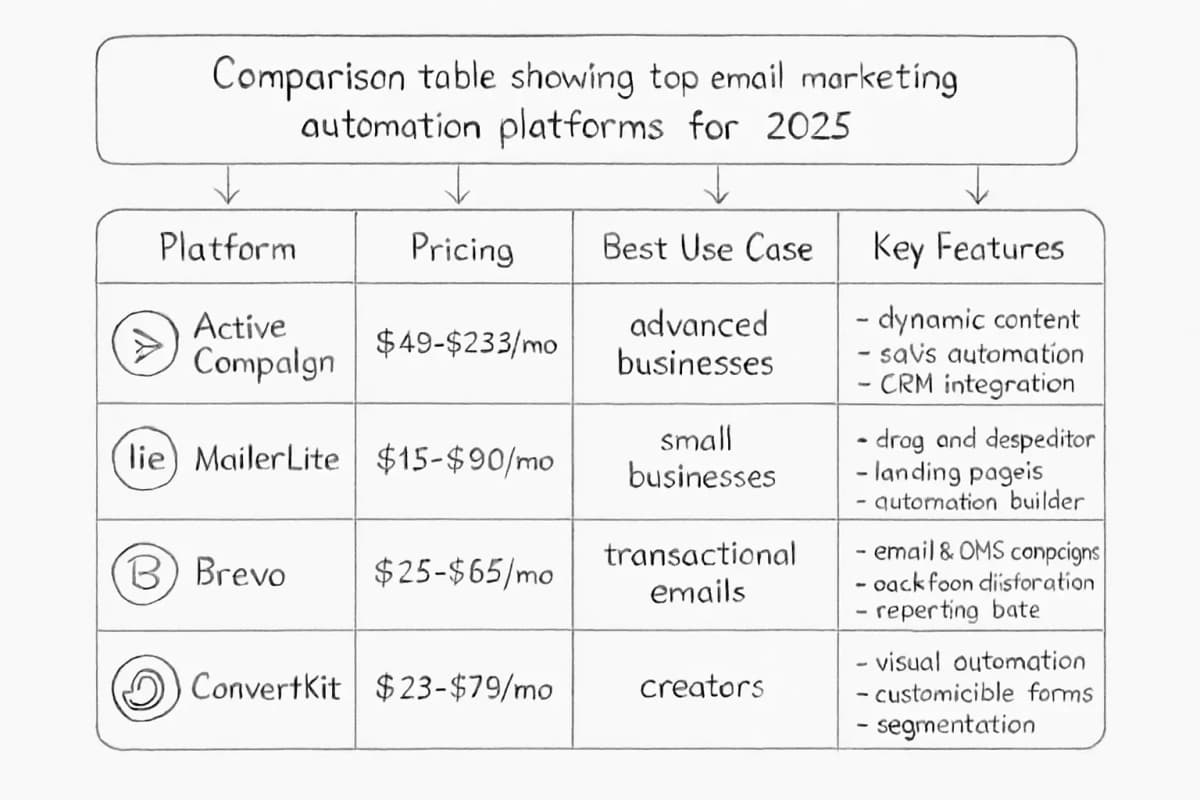
Frequently Asked Questions
What is the best email marketing automation platform for small businesses in 2025?
ActiveCampaign is the best value for automation-heavy SMBs. For businesses that primarily want affordability and simplicity, MailerLite is the stronger fit. Brevo is the most affordable entry point for teams with large contact lists who want volume-based pricing rather than paying per subscriber.
Is HubSpot worth the cost for email marketing?
If you only need email, HubSpot's pricing does not compete with pure ESPs. The value is in the integrated platform. If your team needs CRM, marketing automation, landing pages, and reporting in one place, then the total cost of ownership is competitive once you factor in what you would spend stitching those tools together separately.
Which platform has the best automation for ecommerce?
In a direct comparison for ecommerce, Klaviyo is the stronger platform for stores with large product catalogs and high transaction volumes. Klaviyo's data model is built around ecommerce events, including purchase history, predictive lifetime value, churn risk, and next-purchase date. For stores that need similar capabilities at a lower price point, Omnisend is the recommended alternative.
Do automated emails really outperform standard campaigns?
Yes, and the gap is significant. Automated campaigns demonstrate 2,361% higher conversion rates than traditional campaigns. Looking at specific automation types, back-in-stock emails delivered the highest conversion rate at 6.46%, while birthday messages produced an average order value more than 4x higher than the average. The reason is simple: automated emails are triggered by behavior, so they reach the right person at the exact moment they are most likely to act.