
Most digital marketing agencies already know email converts. The problem is that the wrong template, or a good template used without strategy, wastes every advantage email provides. A well-built digital marketing services email template does more than fill an inbox. It positions your agency, communicates real value to the right person, and moves a prospect or client toward a clear next step.
Email marketing campaigns produce an average ROI of 36 times over spend, meaning businesses earn $36 for every dollar invested. But that return assumes your emails are structured to land, get read, and drive action. For digital marketing service providers, that requires a different kind of template than a standard promotional newsletter.
This guide breaks down the components of effective email templates for digital marketing services, covering prospecting, client nurturing, reporting, and follow-up. Each section includes what to write, why it works, and what the data says.
Key Takeaways
- Email delivers an average 36x ROI, making it the highest-return digital channel available to most marketing teams.
- Personalization in email messages improves open rates by 29% and click-through rates by 41%.
- Automated email sequences deliver 30 times more revenue per recipient than one-off promotional campaigns; the average return per recipient for campaigns is $0.11, while automated flows earn $1.94 per recipient.
- Most effective cold emails fall between 50 and 125 words. Short emails are easier to read and reduce friction for replies, especially on mobile devices.
- Patterns that work well for agency cold outreach include leading with a specific observation rather than a pitch, keeping the CTA to a single yes/no question, and avoiding case study mentions in the first email.
Why Digital Marketing Agencies Need Dedicated Email Templates
A business email template is a pre-written, pre-designed, and pre-formatted email that you can adjust and send to your target audience. For digital marketing agencies, that definition matters more than it sounds.
Generic cold outreach fails consistently. Generic cold email outreach gets a 0.5% reply rate. That number improves substantially when templates are built for a specific context, service, and audience.
59% of B2B marketers rate email as their most effective channel for prospecting. But effectiveness is not automatic. It depends on how the template is built, whether it speaks to a real pain point, and whether it makes it easy for the recipient to respond.
A digital marketing services email template serves several distinct purposes across the client lifecycle:
- Prospecting: Introduce your agency to a cold contact without triggering the "mass email" reaction.
- Proposal follow-up: Keep momentum after a discovery call without being pushy.
- Client onboarding: Set expectations clearly before work begins.
- Monthly reporting: Communicate results in a format that builds confidence.
- Upsell and renewal: Expand scope based on demonstrated performance.
Each of these requires a different structure, tone, and CTA. A single template used for all of them will perform poorly across all of them.
The Anatomy of a High-Performing Digital Marketing Email Template
Before covering specific use cases, it helps to understand the structural components that apply across almost every type of marketing services email.
An effective structure uses: a brief credibility line (client or case metric), a personalized insight, a specific proposed action, and a simple CTA.
Here is what each component should accomplish:
1. Subject line
Your subject line is the first thing recipients see, so it needs to grab their attention. Use action-oriented language, personalization, or curiosity to entice them to open your email.
For digital marketing services specifically, subject lines that reference a specific metric or competitor observation outperform vague benefit statements. "Your paid search spend may be underperforming" works better than "We can help your business grow."
Check out email subject line best practices that boost open rates for a deeper breakdown of what moves the needle on open rates across different campaign types.
2. Opening line
The first line is the most important line in the email. It should show that the message was written for them, not pulled from a bulk list.
For agency outreach, this means referencing something specific: a traffic drop you noticed, a campaign you spotted, a content gap, or a recent company announcement.
3. Value proposition
After the introduction, present a compelling value proposition that highlights how your digital marketing services can address the recipient's pain points or help them achieve their goals. Keep it to one or two sentences. The goal is relevance, not comprehensiveness.
4. Social proof or credibility signal
One sentence referencing a relevant result. Not a full case study. Something like "We helped a similar SaaS company reduce cost-per-lead by 34% in 60 days" is enough.
5. Call to action
Keep the CTA to a single yes/no question. "Would it be worth a 15-minute call this week?" converts better than "Let me know if you'd like to schedule a demo or consultation at your convenience."
Cold Outreach Email Templates for Digital Marketing Services
Cold email remains one of the most cost-effective lead generation tools for agencies when done with precision.
A well-crafted cold email, personalized with the recipient's job title, brief context for your outreach, and references to a mutual connection, can set you apart and accelerate deal closures.
Email personalization does not mean spending 30 minutes per prospect. It means including one specific, researched detail that proves you actually looked at their business.
Here are three template frameworks for different digital marketing service types:
SEO Outreach Template
Use this when targeting a prospect whose organic rankings have clear gaps or recent drops.
Subject: Spotted a keyword gap on [Company]'s blog
Hi [First Name],
I was looking at [Company]'s content strategy and noticed you're not ranking for [keyword cluster] despite producing relevant content. A client in your space was in the same position, and we moved them from page 3 to position 2 for their core terms in 90 days.
Worth a 15-minute call to share what we found?
[Your Name]
PPC Audit Template
Write PPC emails that open with cost-per-acquisition or wasted spend insights to capture interest quickly. Lead with a data point such as "Your search campaigns average $X CPC; we cut that by 30% for clients in your niche."
Subject: Your current bid strategy may be burning budget
Hi [First Name],
I noticed [Company] is running broad match campaigns in [category]. Without tighter match types, you're likely paying for irrelevant clicks. We typically cut cost-per-lead by 30% to 40% in the first 60 days by restructuring ad groups.
Can I send a quick 3-minute Loom showing what I found?
[Your Name]
Social Media Management Template
Design social media outreach emails to demonstrate audience alignment and content cadence that drives engagement. Begin with a tangible example: "Your Instagram gets X average likes while competitor Y gets 3x with a similar following — content format is the difference." That pinpoints a tactical gap.
Client Nurturing and Reporting Email Templates
Once a client is onboarded, the email relationship shifts from acquisition to retention and expansion. The templates here need to communicate results clearly, reinforce trust, and create opportunities for upsell conversations without coming across as a sales push.
Monthly Reporting Template
A strong reporting email does three things: summarizes key metrics at a glance, connects performance to the client's business goals, and closes with a forward-looking recommendation.
Structure:
- Performance summary (3 to 5 key metrics vs. prior period)
- What drove the results (brief analysis, not a paragraph of jargon)
- What we're testing next (shows proactive thinking)
- One question or recommendation (opens a conversation)
Keep the body under 200 words. Attach the full report or link to a dashboard.
For a broader view of what metrics should anchor these reports, the email marketing analytics best practices guide covers measurement frameworks that connect campaign performance to revenue.
Follow-Up After Proposal Template
For high-ticket digital marketing outreach, a sequence of 4 to 6 targeted emails is optimal for maximizing conversion rates without triggering spam reports. Deploy this sequence over a 15 to 20 business day window.
The core rule is non-negotiable: every subsequent email must offer new value or introduce a fresh angle. You are not reminding them; you are providing a new reason to engage.
Avoid passive follow-ups. Messages like "Just checking in" or "Did you see my last email?" are conversion killers.
Instead, add context. Share a relevant stat, link to a case study, or mention a change in the prospect's competitive landscape that makes your service more relevant today than it was last week.
Segmentation and Personalization Inside the Template
Even a well-written digital marketing services email template will underperform if sent to the wrong segment. Segmentation is the foundation on which personalization works.
51% of marketers believe that segmenting is one of the most effective email marketing strategies. Email marketing campaigns that are most effective include segmentation (78%), message personalization (72%), and email automation (71%).
For digital marketing agencies, relevant segmentation dimensions include:
- Industry vertical (e-commerce, SaaS, professional services, etc.)
- Company size (startup vs. enterprise requires a completely different value pitch)
- Service interest (SEO, paid media, content, social, full-service)
- Funnel stage (cold prospect vs. warm lead vs. active client vs. lapsed client)
- Decision-maker role (CMO vs. growth manager vs. founder)
When building buyer personas, note role-specific goals such as scaling ROAS or reducing CAC, common objections like limited budget or past agency failures, and typical buying signals like recent funding or traffic spikes. Keep each persona to one page so cold email copy stays focused and actionable.
For a complete segmentation framework, the email list segmentation strategies that boost ROI by 760% guide is worth studying before you build your agency's outreach sequences.
Mobile Optimization and Design for Agency Emails
With over half of all emails opened on mobile devices, it is essential to prioritize mobile-first design. A responsive email ensures your message looks great on screens of all sizes.
For digital marketing services emails specifically, heavy HTML templates often work against you. Especially in cold outreach, a plain-text-looking email tends to feel more personal and less like a mass blast.
Design guidelines for service-based email templates:
- Use single-column layouts, larger fonts (16px+), and tappable buttons (at least 44px height).
- Avoid overloading emails with too many CTAs. Stick to one primary CTA supported by secondary links if necessary.
- Aim for a 60/40 ratio of text to images. Increasing the image ratio can slow down load time, which causes recipients to stop reading.
- Use white space deliberately. It improves readability and draws the eye to the CTA.
For reporting and onboarding emails where design matters more, branded HTML templates add professionalism. For prospecting, plain text with light formatting almost always outperforms a polished newsletter format.
Automation: Scaling Your Digital Marketing Services Templates
Manual sending does not scale. The agencies generating consistent pipeline from email build automated sequences that trigger based on behavior, not calendar dates.
Despite representing only 2% of email volume, automated messages generated 37% of all email-attributed sales in 2024.
Automation sequences to build for a digital marketing agency:
- Cold outreach sequence (4 to 6 emails, 15 to 20 business days)
- Lead magnet follow-up (triggered when someone downloads an audit or guide)
- Proposal sent sequence (3 emails over 10 days)
- Client onboarding sequence (first 30 days after contract signing)
- Quarterly upsell or review sequence (for active accounts)
- Re-engagement sequence (for lapsed leads or inactive clients)
The best email marketing platforms embrace AI to automate and personalize email campaigns. Use AI for predictive analytics, behavior-based triggers, A/B testing automation, and even content generation to ensure every email is relevant, contextual, and sent at the right time.
For teams building a more complete email strategy around these sequences, the email marketing strategy template provides a structured planning framework.
A/B Testing Your Digital Marketing Services Email Templates
No template is finished at launch. Every element is a hypothesis until tested.
Brands that regularly A/B test their emails achieve 83% higher ROI than those that never test. Companies that never test report average ROI of 2,300%, while those that often test achieve 4,200%.
Elements worth testing in digital marketing service email templates:
- Subject line format (question vs. statement, short vs. long, personalized vs. generic)
- Opening hook (observation-based vs. compliment-based vs. data-based)
- CTA phrasing (calendar link vs. yes/no question vs. direct ask)
- Email length (50 words vs. 100 words vs. 150 words)
- Sender name (personal name vs. company name vs. "Name from Company")
- Send time (Tuesday morning vs. Thursday afternoon for B2B)
Test every part of your email, from subject lines to your calls to action (CTAs). Treat each test as a learning opportunity, not just a performance tweak. 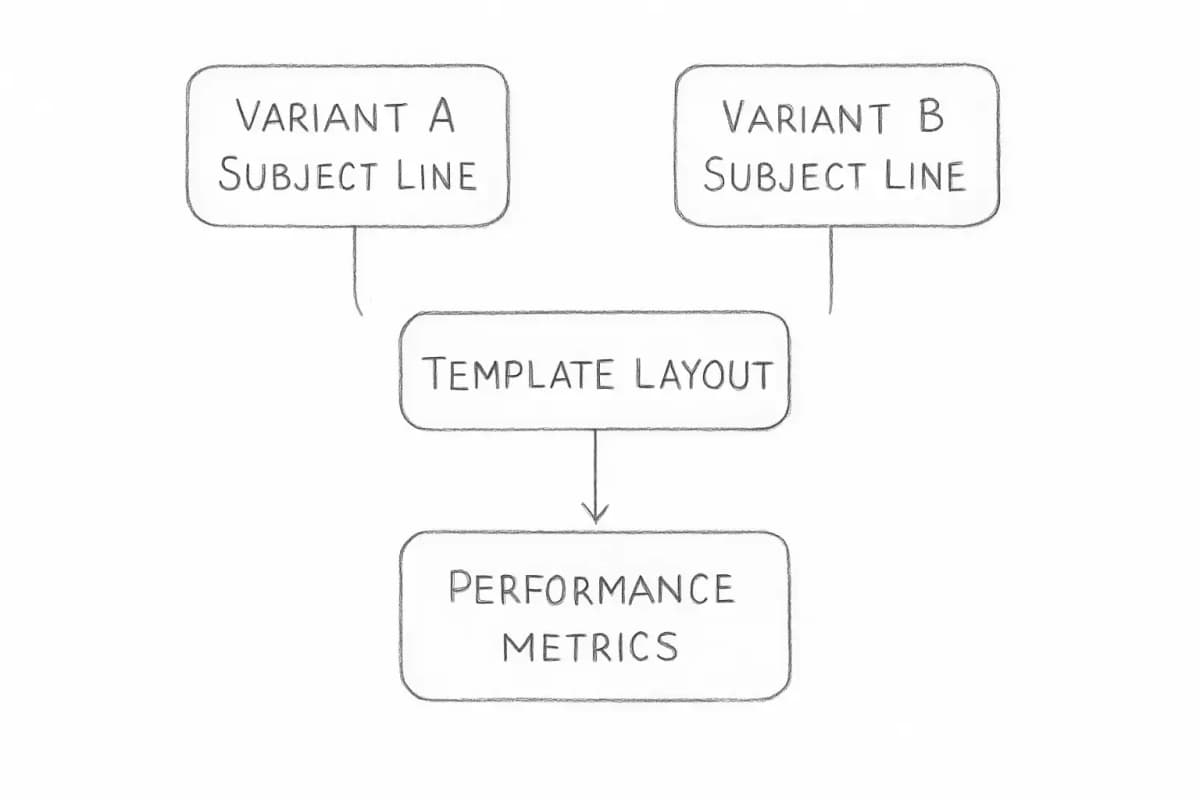
Deliverability: Making Sure Your Templates Actually Reach the Inbox
A well-written template that goes to spam is worthless. Deliverability is not a technical footnote. It is a core part of template performance.
The average email deliverability rate sits at 85% in 2024, heavily influenced by authentication protocols like DMARC, SPF, and DKIM. Brands that implement proper authentication see deliverability rates above 90%, while those without proper setup struggle with inbox placement.
Key deliverability steps for digital marketing agencies sending outreach at volume:
- Authenticate all sending domains with SPF, DKIM, and DMARC records
- Gmail and Yahoo's 2024 requirements for bulk senders make authentication mandatory rather than optional.
- Warm up new sending domains before ramping volume
- Keep spam complaint rates below 0.1%
- Include a clear, working unsubscribe link in every email
- Avoid spam trigger words in subject lines ("free," "urgent," "guaranteed")
- Send from a subdomain to protect your primary domain's reputation
Deliverability testing increases returns by 39% by ensuring emails avoid spam folders and reach intended destinations.
Frequently Asked Questions
What should a digital marketing services email template include?
Every effective digital marketing services email template needs five elements: a subject line that creates relevance or curiosity, a personalized opening line that shows real research, a concise value proposition tied to a specific pain point, one piece of social proof or credibility, and a single clear CTA. Keep your message brief and focused, avoiding unnecessary jargon or lengthy explanations. Templates that try to cover everything in one email consistently underperform templates that do one thing well.
How long should a digital marketing agency cold email be?
Most effective cold emails are between 50 and 125 words. Short emails are easier to read and reduce friction for replies, especially on mobile devices. For follow-up emails in a sequence, slightly longer messages can work if they introduce genuinely new value, such as a case study link or a competitive insight specific to the prospect.
How many follow-up emails should a digital marketing agency send?
Most replies come after 2 to 4 follow-up emails. Spacing them out and adding context in each follow-up improves response rates without annoying the recipient. For higher-ticket services, a sequence of 4 to 6 emails over 3 to 4 weeks is a reasonable range. The key is that each email adds something new rather than simply repeating the original ask.
How do I personalize a digital marketing services email at scale?
Personalization does not mean spending 30 minutes per prospect. It means including one specific, researched detail that proves you actually looked at their business. That one specific detail becomes your opening line. It does more work than five paragraphs of pitch copy. Tools that pull in dynamic fields from your CRM, such as company name, recent funding, traffic data, or campaign observations, let you add that specificity without rebuilding each email from scratch.