
Most of the data I need is now gathered. I have comprehensive information on email deliverability best practices, authentication requirements, list hygiene, spam rates, benchmarks, and segmentation. I'll now write the article.
According to Unspam's 2025 Email Deliverability Report, 36% of emails land in spam folders, with another 4% getting blocked or going missing, meaning roughly 40% of emails never reach the inbox regardless of how good the content is. If your campaigns are built on strong creative and compelling offers, that number should concern you. Email marketing deliverability best practices are not a technical afterthought. They are the foundation on which your entire channel ROI rests.
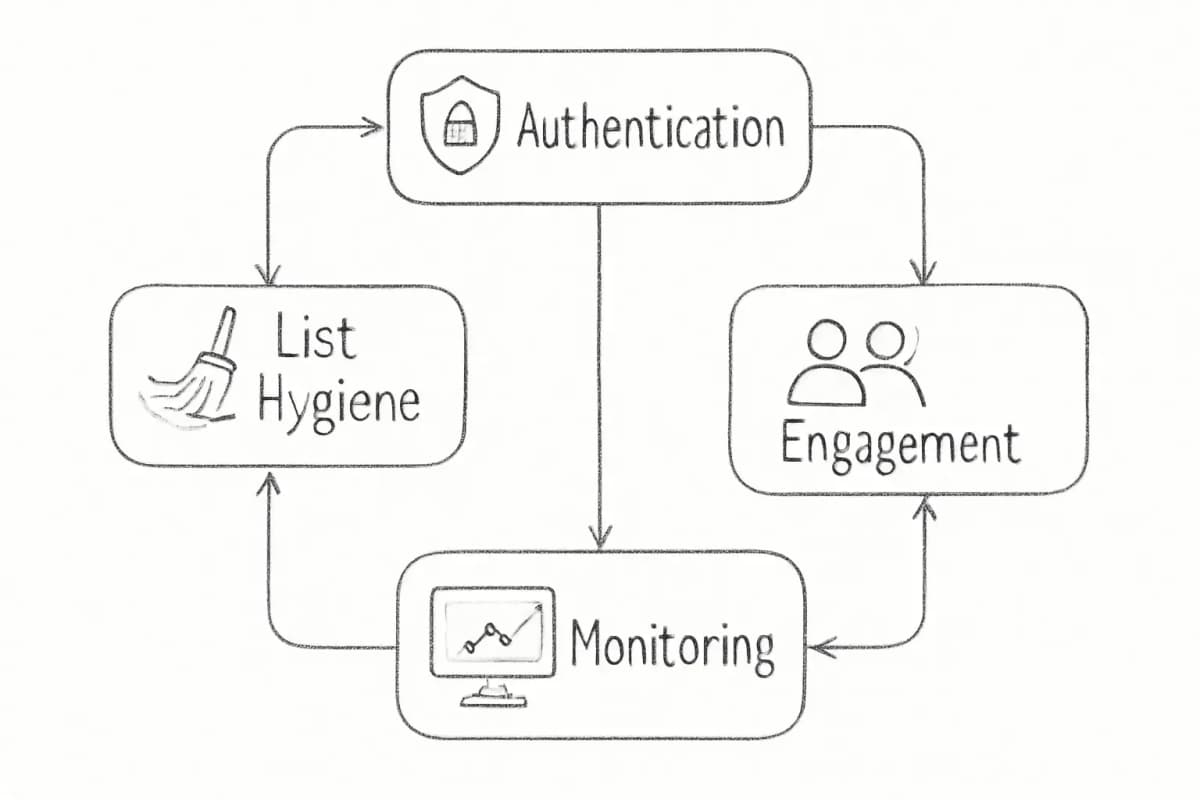
This guide covers the practices that matter most in 2025 and beyond: authentication, list hygiene, engagement signals, content, and monitoring. Every section is directly actionable.
Key Takeaways
- According to Validity's 2025 benchmark, only 83.5% of emails worldwide reach the inbox, meaning roughly one in six emails your business sends never gets seen.
- Fully authenticated senders are 2.7x more likely to reach inboxes than their unauthenticated counterparts.
- Gmail and Yahoo enforce a maximum spam rate of 0.3%, with Gmail recommending brands stay below 0.10%.
- According to the DMA's Email Benchmarking Report 2024, brands with double opt-in policies see inbox placement rates up to 10% higher than those relying on single opt-ins.
- Marketers using advanced segmentation see a 760% increase in revenue, and higher engagement signals directly improve your inbox placement with mailbox providers.
1. Understand What Deliverability Actually Measures
Before fixing deliverability, you need to understand what you are measuring.
Email delivery simply tells you whether a receiving server accepted your message. Email deliverability goes further: it tells you whether that message actually reached the recipient's inbox or just ended up in spam.
Your ESP dashboard probably shows delivery rate, not email deliverability. A 98% delivery rate sounds great until you realize it says nothing about where those emails ended up. You might be celebrating strong "delivery" while a quarter of your list never sees your campaigns.
Excellent email deliverability is 95% or higher. The average rate is around 83% to 85% globally, which means most senders have real room to improve. Targeting 90% or above for marketing emails is a reasonable and achievable goal with the right practices in place.
Three broad categories affect email deliverability: technical (authentication setup, IP reputation, domain reputation), behavioral (list quality, engagement rates, complaint rates), and content (spam triggers, HTML structure). Inbox providers weigh all three when deciding where your emails land.
2. Set Up Email Authentication Correctly
Authentication is no longer optional. Bulk senders can no longer skip authentication. Since early 2024, Gmail and Yahoo require SPF, DKIM, and DMARC for any sender delivering at scale.
Here is what each protocol does:
SPF(Sender Policy Framework): Think of SPF as your email's official ID card. It prevents spammers from sending emails using your domain name (a practice called "spoofing"). Without it, ISPs like Gmail and Outlook can't confirm an email truly came from you, making it much more likely to land in spam.DKIM(DomainKeys Identified Mail): Adds a cryptographic signature to your emails so receiving servers can verify the message was not altered in transit.DMARC(Domain-based Message Authentication, Reporting and Conformance): DMARC is the piece of the email authentication puzzle that has the most power to stop phishing schemes like email brand spoofing.
According to Sinch Mailgun's State of Email Deliverability in 2025 report, two thirds of senders are now using both SPF and DKIM authentication methods, and more than half of respondents have now adopted DMARC, 11% more than in 2023.
If you have DMARC in place but are using a p=none policy, that is only a starting point. Using a p=none DMARC policy? It's a step in the right direction, but you'll need to switch to a policy of Reject or Quarantine to get the full benefit of DMARC.
In May 2025, Microsoft rolled out significant deliverability changes, including stricter authentication requirements and new recommended practices for senders, following on the heels of Google and Yahoo updating their own sender guidelines in late 2023 and 2024. The direction across all major mailbox providers is clear: full authentication is table stakes.
3. Keep Your Email List Clean
No amount of good authentication can compensate for a list full of invalid, inactive, or disengaged addresses. List hygiene is one of the highest-leverage practices you can implement.
A bloated list filled with hard bounces, spam traps, and disengaged subscribers actively damages your sender reputation. Every campaign sent to such a list results in negative signals, such as high bounce rates and low open rates, which tells ISPs that your content is unwanted.
Practical hygiene actions to run consistently:
- Remove hard bounces immediately. Hard bounces (invalid emails) must be removed immediately. Soft bounces (like full inboxes) should be monitored and purged if they continue over multiple campaigns.
- Flag inactive subscribers. Subscribers who haven't interacted with your emails in 3 to 6 months should be flagged for follow-up to address disengagement before it affects your overall performance.
- Never buy lists. Purchased lists are often filled with outdated, invalid, or spam trap emails, damaging your deliverability and risking domain blacklisting. Instead, focus on organic list-building strategies: gated content, lead magnets, and optimized landing pages.
- Watch for spam traps. Spam traps are email addresses used by ISPs and anti-spam organizations to identify senders with poor list hygiene. Sending to a spam trap can severely damage your sender reputation, leading to blocklisting and drastically reduced deliverability.
According to Litmus, email marketers should evaluate and clean their lists at least every 90 days, emphasizing that "it's much better to have a smaller, highly engaged email list than a larger one full of random email addresses for deliverability."
For a deeper look at building a high-quality list from the ground up, see our guide on email list segmentation strategies that boost ROI by 760%.
4. Use Double Opt-In to Build a Higher-Quality Subscriber Base
How you collect email addresses has a direct effect on your deliverability from day one.
Double opt-in prevents invalid and risky addresses from entering your list in the first place by requiring subscribers to confirm their email before being added. This verification step filters out misspelled addresses, disposable accounts, and bot sign-ups at the point of collection. Combined with regular list cleaning, it significantly reduces bounce rates and protects sender reputation.
The data backs this up. For organizations that adopt double opt-in and other best practices, deliverability rates often exceed 97%, a big step up compared to the global average deliverability rate of 83% to 85% in 2025.
Double opt-in helps confirm subscribers actually want your emails, reducing the risk of fake sign-ups, typos, and spam traps. Combine this with secure, bot-resistant forms to build a cleaner, more engaged list from day one.
A well-crafted welcome sequence reinforces early engagement and signals positive behavior to mailbox providers. Our guide on welcome email sequence best practices covers how to structure that first impression.
5. Manage Sending Volume and Warm Up Properly
Sending too much too fast is one of the most common ways senders damage a new domain or IP reputation.
Use consistent sending patterns. Avoid sudden spikes in email volume that might trigger ISP suspicion. Mailbox providers treat erratic sending behavior as a red flag, especially from newer domains.
One-off sends to your full list or sudden volume spikes can lead to blocks and complaints. Ramp up gradually and segment based on recent engagement.
The consequences of high-volume sending without proper controls are severe. Email deliverability shows an inverse relationship with sending volume. Organizations sending 1M+ emails monthly face inbox placement below 28%, meaning more than 7 in 10 emails are filtered or rejected.
The solution is not to send fewer emails, but to send to the right people. Engagement-based segmentation lets you maintain volume for your most active subscribers while reducing pressure on unengaged segments. This protects domain reputation while preserving reach.
6. Respect Engagement Signals and Segment Accordingly
Mailbox providers use subscriber behavior to judge your sender reputation. Opens, clicks, replies, and even how quickly a recipient deletes your email all feed into inbox placement decisions.
Mailbox providers evaluate the sender's IP reputation and domain reputation, which you can think of as a credit score. Sending messages people engage with will increase your reputation score, and sending messages that people mark as spam will decrease your score.
According to eMarketer, 39% of marketers who segment their lists see higher open rates, while 28% report fewer opt-outs. High engagement, like frequent opens and genuine clicks, signals to ISPs that your emails are worth delivering, helping you avoid the spam folder.
Segmentation and personalization are directly tied to deliverability outcomes. Behavior-based emails generate roughly 3x higher engagement than scheduled campaigns, as they are triggered by specific user actions. Emails with personalized content generate up to 6x higher transaction rates compared to non-personalized campaigns.
For subscribers who have gone quiet, run a structured re-engagement campaign before removing them. If they do not respond, remove them. Proactively remove chronic non-responders or disinterested recipients. If a segment of your list hasn't engaged in a year or more, you should consider removing them, even if they never bothered to unsubscribe.
You can learn more about implementing this effectively in our detailed article on email personalization techniques that boost conversions.
7. Implement One-Click Unsubscribe and Honor Requests Promptly
Making it hard to unsubscribe does not keep subscribers. It produces spam complaints, which are far more damaging to your deliverability than a clean opt-out.
An important bulk email sender requirement involves making it easy for contacts to unsubscribe. Gmail and Yahoo now require one-click unsubscribe functionality, and senders must follow through with those requests.
One-click unsubscribe is also required using the list-unsubscribe header and RFC 8058, with opt-out requests processed within two days.
The performance data on this is clear. Gmail's one-click unsubscribe rule has changed how mailbox providers measure sender transparency. Data shows that senders including this header recorded complaint rates below 0.1%, while those without it faced higher spam feedback loops. Simplified opt-out mechanisms have become a measurable engagement factor.
Keep your spam complaint rate below 0.10% as a baseline. Once your spam complaint rate exceeds 0.1%, you're entering a "danger zone." If the complaint rate reaches 0.3%, you're in real trouble. That's when you're at risk of being blocklisted.
8. Monitor Your Sender Reputation and Inbox Placement Actively
You cannot improve what you do not measure. Most senders rely solely on delivery rate reported by their ESP, which tells you almost nothing about where your emails actually landed.
Tools like Google Postmaster Tools became essential for sender reputation monitoring, helping marketers maintain strong engagement and minimize complaints. Google Postmaster Tools is free and gives you direct visibility into how Gmail perceives your sending domain.
Key metrics to track consistently:
- Spam complaint rate (target: below 0.10%)
- Hard bounce rate (target: below 1%)
- Inbox placement rate (target: 90% or above)
- Domain reputation score in Google Postmaster Tools
- Blocklist status across major DNS blocklists
78.5% of respondents rated the importance of email deliverability between 8 and 10 in Sinch Mailgun's 2025 survey, yet nearly 88% of senders could not correctly define what the email delivery rate metric measures. Even though it was the second most common metric used to measure deliverability, it seems many senders don't realize what it means to have a good delivery rate.
Track the right numbers. Tie your deliverability monitoring to your broader email marketing analytics best practices so you have a complete picture of campaign performance, not just surface-level vanity metrics.
Frequently Asked Questions
What is a good email deliverability rate?
Excellent email deliverability is 95% or higher. The average email deliverability rate is around 83% to 85% globally, but this is true for marketing and bulk emails. Getting the average means a notable portion of your emails aren't reaching the primary inbox. For marketing campaigns specifically, aim for 90% inbox placement or above. Anything below 80% signals significant issues that need immediate attention.
What are SPF, DKIM, and DMARC, and are they required?
SPF, DKIM, and DMARC are email authentication protocols that verify your identity as a sender and protect your domain from spoofing. In 2024, Gmail and Yahoo announced stricter standards for bulk senders, enforcing SPF, DKIM, and at least some form of DMARC authentication. In May 2025, Microsoft also rolled out significant deliverability changes, including stricter authentication requirements. All three are now effectively required for any sender reaching Gmail, Yahoo, or Microsoft inboxes at scale.
How often should I clean my email list?
Clean your list quarterly for most sending programs. Clean before large sends and after imports. Fast-growing lists may need monthly cleaning. Beyond scheduled cleaning, remove hard bounces immediately after every campaign and flag subscribers who have not engaged within 3 to 6 months for a re-engagement sequence before suppressing them.
Does email content affect deliverability?
Yes, though authentication and list quality are stronger signals. Content factors that hurt deliverability include excessive use of spammy words, unbalanced image-to-text ratios, broken links, and missing plain-text versions. Inbox algorithms have become more adaptive, linking deliverability directly to authentication quality, user engagement, and message integrity. Relevant, well-structured content that recipients actually engage with sends positive signals to mailbox providers and builds domain reputation over time. Pairing strong content with compelling email subject line best practices helps drive the opens that reinforce your sender reputation.