
Choosing the wrong email marketing platform for your Shopify store costs more than money. It costs time spent on workarounds, data gaps that kill personalization, and missed automations that could have recovered lost revenue. Email marketing campaigns deliver an average ROI of $36 for every dollar spent, and for ecommerce specifically, some industries see up to $45 back per dollar, with retail and ecommerce leading those returns. The platform you run on shapes how much of that potential you actually capture.
So when it comes to Shopify email marketing vs Mailchimp, which one actually fits your store? The short answer: it depends on your list size, your automation needs, and how deeply you rely on Shopify data. This guide breaks down both platforms across pricing, features, automation, segmentation, and integration so you can make a clear, informed decision.
Key Takeaways
- Shopify Email is built directly into Shopify, requires zero third-party setup, and gives you 10,000 free emails per month with pay-as-you-go pricing beyond that.
- Mailchimp is a more capable standalone platform with advanced automation, A/B testing, and a broader template library, but it requires a third-party connector to work with Shopify.
- Mailchimp removed its native Shopify integration in 2019. Connecting the two now requires tools like ShopSync or Zapier, which add friction and can limit ecommerce-specific features.
- Shopify Email suits stores that want simplicity and tight native data sync. Mailchimp suits marketers who need multi-step automation, deep segmentation, or cross-platform campaigns.
- Mailchimp's free plan has been significantly reduced over time and no longer includes automation. Any serious campaign work requires a paid plan.
What Each Platform Actually Is
Shopify Email is Shopify's native email marketing tool, designed for merchants who want to create, send, and track emails directly from their Shopify dashboard, with no need for third-party integrations.
Mailchimp is a standalone email marketing platform suitable for various businesses, known for its advanced automation, A/B testing, and comprehensive analytics. It started as a pure email marketing service but has since expanded into a full marketing platform offering a broad range of services beyond emails.
These two tools are built for different contexts. Shopify Email is a native feature. Mailchimp is an independent product you connect to Shopify. That distinction matters more than most comparison guides acknowledge.
Pricing: What You Actually Pay
Shopify Email Pricing
All stores on Shopify's paid plans get 10,000 free emails to send at the beginning of every month. After that, charges apply. Additional emails cost $1 per 1,000 up to 300,000 emails, then $0.65 per 1,000 up to 750,000, and $0.55 per 1,000 beyond that.
Abandoned checkout automations are always free and do not count toward the monthly limit. That is a meaningful perk for stores that rely on cart recovery, which tends to be the highest-ROI automation in ecommerce.
Mailchimp Pricing
Mailchimp pricing ranges from $0 per month to over $350 per month, depending on your plan and contact count. The Free plan costs $0, Essentials starts at $13 per month, Standard starts at $20 per month, and Premium begins at $350 per month for 10,000 contacts.
The complexity, though, is in how quickly costs rise. Pricing increases dramatically as contact counts grow: 5,000 contacts costs $85 per month, 10,000 costs $145 per month, and 25,000 jumps to $355 per month.
There is also an important free plan caveat: the free plan went from 2,000 contacts in 2022, to 500 in 2023, to 250 in 2026, and automation was fully stripped from the free tier by mid-2025. For any Shopify store sending regular campaigns, Mailchimp's free tier is effectively unusable.
Bottom line on pricing: Shopify Email is cheaper at low send volumes and scales predictably. Mailchimp gets expensive fast once your list grows past a few thousand contacts.
Integration: The Fundamental Difference
This is the factor most comparison guides gloss over.
Effective as of March 21, 2019, the Mailchimp for Shopify integration was removed for new users from the Shopify marketplace. Both platforms released statements citing concerns over customer data and privacy.
Since Mailchimp discontinued its official Shopify app in 2019, integrations now use third-party connectors, Mailchimp's API, or CSV methods. The commonly recommended connectors include ShopSync, Zapier, and Make.com. Each adds setup complexity and can limit which ecommerce features sync correctly, including product feeds, revenue tracking, and behavioral triggers.
Shopify Email, by contrast, automatically syncs with your store's customer data and product catalog, simplifying email marketing for ecommerce. There is no separate account, no connector to maintain, and no risk of sync failures breaking your automations.
If native, real-time data sync matters to your workflow (and for most Shopify stores it does), Shopify Email has a structural advantage here.
Automation and Workflows
Shopify Email offers basic automation services that cater to the standard marketing needs of most ecommerce businesses. That includes pre-built flows for welcome emails, abandoned cart recovery, and post-purchase follow-ups. These pre-set automations are easy to activate with just a few clicks, which simplifies engaging customers at critical touchpoints.
Mailchimp goes further. You can create custom workflows based on user behavior, allowing emails to be tailored to specific actions, for example, if a customer opens an email you can trigger a follow-up offering a related product.
However, there are plan restrictions. As of June 2025, Mailchimp discontinued automation access for free plan users. Essentials plans restrict automation flows to a maximum of four steps. Only Standard and Premium plans support advanced multi-branch automations with unlimited steps, conditional logic, and sophisticated triggers.
For growing stores running ecommerce email marketing strategies that include multi-step nurture sequences, Mailchimp's Standard plan or above is the minimum viable option.
Segmentation
Mailchimp excels in audience segmentation, allowing marketers to create highly targeted campaigns based on user behavior, purchase history, and demographic data. Standard and Premium users have seen 2x more revenue on average for their connected ecommerce stores using predictive segmented emails versus non-predictive segmented emails.
Shopify Email offers segmentation too, but it works differently. Shopify Email offers strong segmentation options, especially for Shopify users. Since it pulls directly from Shopify's customer database, segments based on order history, product purchases, and store activity are accurate and updated in real time without any manual sync.
The trade-off: Mailchimp's segmentation is more customizable and logic-rich. Shopify Email's segmentation is simpler but more reliably accurate because the data never leaves the Shopify ecosystem.
For stores that want to run email list segmentation strategies that cut by purchase behavior, lifetime value, and product affinity, Mailchimp has the edge on depth. Shopify Email wins on data reliability.
Templates and Email Design
Mailchimp provides 279 basic templates, but only 7 are available on the free plan. Shopify Email has 46 branded templates. Shopify's templates automatically use your store's logo, colors, and fonts, with no setup required.
Mailchimp provides built-in A/B testing for email subject lines, content, and sending times, so you can test different email marketing strategies to optimize performance. Shopify Email does not offer native A/B testing, which is a real limitation for data-driven teams. Consistent testing is one of the clearest ways to improve open rates over time. See our guide on email subject line best practices to understand how much that gap matters.
Mailchimp takes design a step further with advanced content blocks such as videos, surveys, and product reviews, along with product recommendations based on cart, viewed items, or best sellers. Shopify Email's editor is cleaner and faster but less flexible.
Analytics and Reporting
With Mailchimp, businesses have access to detailed reports and insights into email performance, including open rates, click-through rates, and revenue attribution, allowing for continuous campaign optimization.
Shopify Email provides basic analytics to track campaign performance. You can monitor open rates, click-through rates, and conversions, helping you gauge the effectiveness of your email marketing efforts.
For stores that make decisions based on revenue attribution per campaign, Mailchimp's reporting is more granular. For stores that want to see which emails drove sales without leaving Shopify, Shopify Email's built-in reporting is sufficient and convenient.
Which Platform Is Right for Your Store?
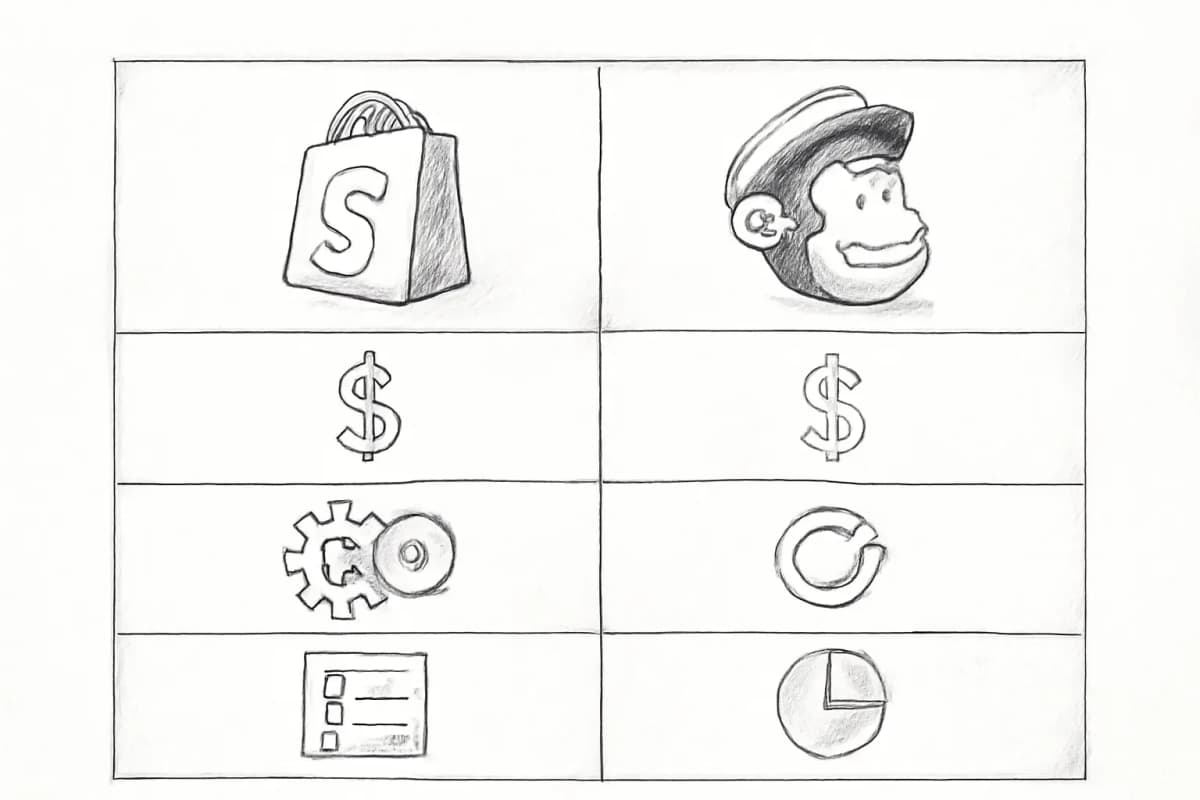
Choose Shopify Email if:
- You run a Shopify store and want zero integration overhead
- Your list is under 10,000 subscribers or your monthly send volume stays near 10,000 emails
- You need simple automations like abandoned cart and welcome sequences
- You want store branding applied to templates automatically
- Budget efficiency is the priority and you do not need A/B testing or complex segmentation
Choose Mailchimp if:
- You need advanced email marketing features such as detailed segmentation, automation, and A/B testing
- You plan to integrate email marketing with other marketing channels and tools beyond Shopify
- You are comfortable managing a third-party connector to sync Shopify data
- You need multi-step behavioral flows and advanced reporting
- Your business plans to expand and Mailchimp's scaling features like a larger contact base and intricate segmentation make it a priority
One important note: Mailchimp's classic automation builder was retired in mid-2025, with automated emails now requiring a paid plan. Factor that into your total cost calculation before deciding.
For a broader view of how email fits into your overall plan, see our email marketing strategy template and our guide to welcome email sequence best practices for flow ideas you can apply on either platform.
Frequently Asked Questions
Does Mailchimp still integrate with Shopify?
Since Mailchimp discontinued its official Shopify app in 2019, integrations use third-party connectors, Mailchimp's API, or CSV methods. You can connect the two platforms using tools like ShopSync or Zapier, but these workarounds add setup complexity and may not support all ecommerce features such as real-time revenue tracking and behavioral triggers.
Is Shopify Email free?
All stores on Shopify's paid plans get 10,000 free emails to send at the beginning of every month. Beyond that, you pay $1 per 1,000 additional emails up to 300,000, with volume discounts after that. There is no standalone free tier; you need an active Shopify plan.
Can I use Mailchimp for abandoned cart emails on Shopify?
Yes, but only through a third-party connector. Without a direct integration with Shopify, Mailchimp lacks some crucial ecommerce features, including revenue tracking, product feeds for abandoned cart and browse abandonment flows, and the ability to embed products. Shopify Email handles abandoned cart emails natively and, notably, does not count those automations against your monthly email quota.
Which platform has better deliverability for Shopify stores?
Some ecommerce brands report higher bounce rates on Mailchimp than on competitors, with higher spam folder rates as well. Shopify Email sends from Shopify's infrastructure, which is optimized for ecommerce transactional and marketing email. For stores staying within the Shopify ecosystem, deliverability through Shopify Email tends to be more consistent. For either platform, maintaining a clean, engaged list is the primary driver of inbox placement.