
Creators Return to Newsletters as Algorithm Dependency Fades in 2026
Free newsletter platforms like Substack and Beehiiv are gaining traction as creators escape social media algorithms. Email now offers owned audiences and faster monetization paths.
A growing number of digital creators are walking away from social media as their primary distribution channel, and the data from 2025 and early 2026 shows exactly why. As reported by 24H Live, free newsletter platforms are gaining serious traction among creators who no longer want their reach controlled by platforms they do not own. The shift is happening at scale, and it carries real implications for business owners and marketing teams building long-term audience strategies.
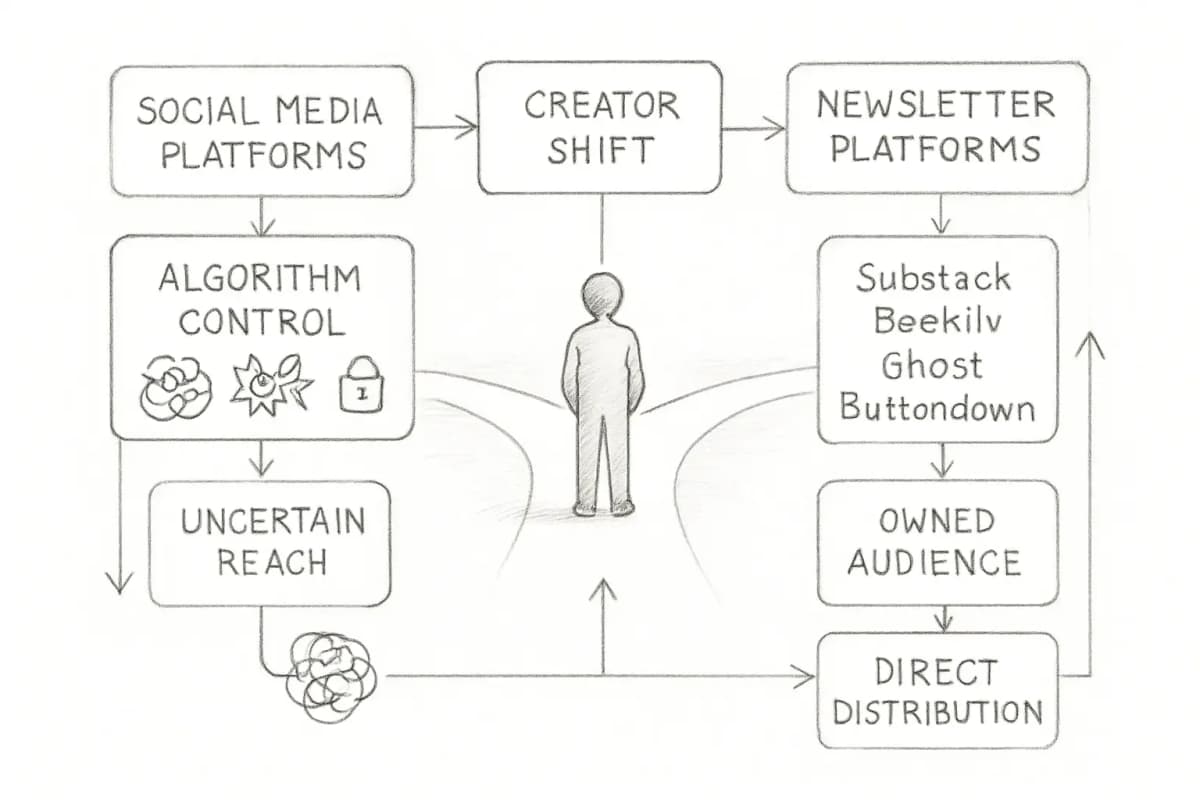
Algorithm Fatigue Is Pushing Creators Toward Owned Channels
The core problem is not engagement, it is access. Instagram's organic reach dropped 12% year over year from 2024 to 2025, while LinkedIn's organic reach declined by 34% over the same period. The arithmetic is stark: a brand with 10,000 Instagram followers can expect roughly 350 of them to see any given organic post, while a brand with 10,000 email subscribers can expect nearly all of them to receive the email, with open rates typically between 20% and 40%.
LTK CEO Amber Venz Box put it plainly: "I think that 2025 was the year where the algorithm completely took over, so followings stopped mattering entirely."
This is not just a creator problem. For business owners and growth teams, it means that audience size on social platforms is increasingly a vanity metric. A list of 5,000 email subscribers consistently outperforms a social following ten times that size in terms of reliably reaching people who have actually opted in.
Newsletter Platforms Are Benefiting Directly
Substack and Beehiiv have become the primary destinations for creators making this shift, and both platforms reported strong growth heading into 2026.
With over 35 million active subscriptions and 3 million paid, Substack proved that a single writer could build a brand as powerful as a publication. Substack has raised $100 million in a funding round that valued the company at $1.1 billion.
Beehiiv is scaling even faster on the infrastructure side. Beehiiv grew its number of individual newsletters and sites by over 60% in 2025 to reach 140,000, while its revenue nearly doubled to $28 million. Q1 2026 was the best quarter in Beehiiv's history, with the platform adding $4.5M ARR and crossing 50,000 active users.
Creators Return to Newsletters as Algorithm Dependency Fades in 2026
Free newsletter platforms like Substack and Beehiiv are gaining traction as creators escape social media algorithms. Email now offers owned audiences and faster monetization paths.
A growing number of digital creators are walking away from social media as their primary distribution channel, and the data from 2025 and early 2026 shows exactly why. As reported by 24H Live, free newsletter platforms are gaining serious traction among creators who no longer want their reach controlled by platforms they do not own. The shift is happening at scale, and it carries real implications for business owners and marketing teams building long-term audience strategies.
Algorithm Fatigue Is Pushing Creators Toward Owned Channels
The core problem is not engagement, it is access. Instagram's organic reach dropped 12% year over year from 2024 to 2025, while LinkedIn's organic reach declined by 34% over the same period. The arithmetic is stark: a brand with 10,000 Instagram followers can expect roughly 350 of them to see any given organic post, while a brand with 10,000 email subscribers can expect nearly all of them to receive the email, with open rates typically between 20% and 40%.
LTK CEO Amber Venz Box put it plainly: "I think that 2025 was the year where the algorithm completely took over, so followings stopped mattering entirely."
This is not just a creator problem. For business owners and growth teams, it means that audience size on social platforms is increasingly a vanity metric. A list of 5,000 email subscribers consistently outperforms a social following ten times that size in terms of reliably reaching people who have actually opted in.
Newsletter Platforms Are Benefiting Directly
Substack and Beehiiv have become the primary destinations for creators making this shift, and both platforms reported strong growth heading into 2026.
With over 35 million active subscriptions and 3 million paid, Substack proved that a single writer could build a brand as powerful as a publication. Substack has raised $100 million in a funding round that valued the company at $1.1 billion.
Beehiiv is scaling even faster on the infrastructure side. Beehiiv grew its number of individual newsletters and sites by over 60% in 2025 to reach 140,000, while its revenue nearly doubled to $28 million. Q1 2026 was the best quarter in Beehiiv's history, with the platform adding $4.5M ARR and crossing 50,000 active users.
The monetization numbers reinforce the trend. Paid subscriptions on Beehiiv generated $19M in 2025 versus $8M in 2024, a 138% jump, driven by niche creators delivering specialized expertise. For newsletters launched in 2025, the median time to a first dollar dropped to 66 days.
Ownership Is the Strategic Differentiator
The reason creators are moving toward newsletters is not purely about reach. It is about owning the asset.
As search visibility becomes increasingly unpredictable, with some publishers reporting a loss of upwards of 80% of their search traffic, and social channels continue to fracture into smaller algorithm-controlled pockets, brands are rediscovering that email is the one channel they truly own. In 2026, that ownership becomes a strategic advantage.
Beehiiv CEO Tyler Denk frames it as a question of ownership: Beehiiv is "unopinionated" on how creators grow, monetize, and engage with their audience, which he believes stands in direct contrast to platforms like Patreon and Substack. He has argued publicly that Substack does not offer creators a truly "owned audience" but instead converts their audience into platform users.
The financial case for platform choice matters too. Substack's perpetual 10% fee compounds quickly, meaning $100,000 in annual subscriptions results in losing $10,000 every year to platform fees. Beehiiv, Ghost, and Buttondown do not take a revenue cut beyond standard payment processing fees, which changes the unit economics for creators at scale.
What This Means for Business Owners and Marketing Teams
The creator newsletter trend is a signal, not just a story. While every social platform wrestles with algorithm volatility, shifting content policies, and AI-curated feeds, email continues doing what it has always done: reliably reaching opt-in audiences through creator-owned distribution.
For marketers and growth teams, the practical takeaway is straightforward. Platform algorithm changes, policy shifts, or bans can eliminate your reach overnight. Email is the only marketing channel you fully own.
Customer acquisition costs are up about 67% since 2021, making owned-channel strategies increasingly cost-efficient compared to paid social. And data across tools shows creators with diversified revenue earning roughly 3x more than those sticking to a single channel or model.
LinkedIn is also factoring into this shift. The platform's native newsletter feature gives B2B creators a way to build a subscriber base inside a professional network, before migrating those readers to a fully owned list over time. It is a practical bridge between borrowed reach and owned distribution.
The Broader Picture
If 2025 was the year newsletters proved their staying power, 2026 is shaping up to be the year they become the center of the content economy. That is not hyperbole from a newsletter platform, it is a conclusion supported by platform growth numbers, creator migration patterns, and the declining economics of organic social reach.
For business owners watching this trend, the question is not whether to build an email list. It is how quickly to prioritize it. A direct relationship with subscribers, one that no algorithm update can disrupt, is the most resilient distribution asset a business can hold.

The monetization numbers reinforce the trend. Paid subscriptions on Beehiiv generated $19M in 2025 versus $8M in 2024, a 138% jump, driven by niche creators delivering specialized expertise. For newsletters launched in 2025, the median time to a first dollar dropped to 66 days.
Ownership Is the Strategic Differentiator
The reason creators are moving toward newsletters is not purely about reach. It is about owning the asset.
As search visibility becomes increasingly unpredictable, with some publishers reporting a loss of upwards of 80% of their search traffic, and social channels continue to fracture into smaller algorithm-controlled pockets, brands are rediscovering that email is the one channel they truly own. In 2026, that ownership becomes a strategic advantage.
Beehiiv CEO Tyler Denk frames it as a question of ownership: Beehiiv is "unopinionated" on how creators grow, monetize, and engage with their audience, which he believes stands in direct contrast to platforms like Patreon and Substack. He has argued publicly that Substack does not offer creators a truly "owned audience" but instead converts their audience into platform users.
The financial case for platform choice matters too. Substack's perpetual 10% fee compounds quickly, meaning $100,000 in annual subscriptions results in losing $10,000 every year to platform fees. Beehiiv, Ghost, and Buttondown do not take a revenue cut beyond standard payment processing fees, which changes the unit economics for creators at scale.
What This Means for Business Owners and Marketing Teams
The creator newsletter trend is a signal, not just a story. While every social platform wrestles with algorithm volatility, shifting content policies, and AI-curated feeds, email continues doing what it has always done: reliably reaching opt-in audiences through creator-owned distribution.
For marketers and growth teams, the practical takeaway is straightforward. Platform algorithm changes, policy shifts, or bans can eliminate your reach overnight. Email is the only marketing channel you fully own.
Customer acquisition costs are up about 67% since 2021, making owned-channel strategies increasingly cost-efficient compared to paid social. And data across tools shows creators with diversified revenue earning roughly 3x more than those sticking to a single channel or model.
LinkedIn is also factoring into this shift. The platform's native newsletter feature gives B2B creators a way to build a subscriber base inside a professional network, before migrating those readers to a fully owned list over time. It is a practical bridge between borrowed reach and owned distribution.
The Broader Picture
If 2025 was the year newsletters proved their staying power, 2026 is shaping up to be the year they become the center of the content economy. That is not hyperbole from a newsletter platform, it is a conclusion supported by platform growth numbers, creator migration patterns, and the declining economics of organic social reach.
For business owners watching this trend, the question is not whether to build an email list. It is how quickly to prioritize it. A direct relationship with subscribers, one that no algorithm update can disrupt, is the most resilient distribution asset a business can hold.