
Email
Email

A modern blog built with Payload CMS, Next.js, and shadcn/ui.

RSS FeedSitemap

Explore

  • Blog
  • News
  • Statistics
  • Authors

Categories

  • Hiring & Team Building
  • Email Campaign Strategy
  • Email Design & Templates
  • Email Compliance & Legal
  • Email Deliverability & Best Practices
  • Career Development
  • Email Strategy for Finance & Professional Services
  • Email Marketing Metrics

Latest articles

  • How to Hire an Email Marketing SpecialistJul 22, 2026
  • Email Marketing Campaigns Template: Ready-to-UseJul 22, 2026
  • Canva Email Marketing Templates: Design Fast, Convert MoreJul 22, 2026
  • Email Marketing Templates for FranchisesJul 22, 2026

Popular topics

  • #Lead Follow-Up
  • #iCloud Email
  • #Marketing Management
  • #Product Launch
  • #Electrician Marketing
  • #statistics
  • #Budget-Friendly
  • #Free Resources
  • #Miami businesses
  • #AI Writing Tools
  • #Automation Tools
  • #Spam Rate Statistics
  • #SMB Marketing Data
  • #Small Business Email Marketing
  • #SaaS Tools
  • #financial services benchmarks

Stay in the loop

Join 2,000+ readers. Unsubscribe anytime.

Subscribe
Email

© 2026 Email. All rights reserved.

SitemapRSS
HomeBlogEmail Marketing Strategy7 Easy Steps to Successful Email Marketing
Email Marketing Strategy

7 Easy Steps to Successful Email Marketing

Master email marketing in 7 simple steps. Learn list building, segmentation, copywriting, and analytics to boost ROI and engagement today.

M

Marcus Webb

July 22, 2026

13 min read
Share:
#Email Marketing Basics#Marketing Strategy#email campaigns#Deliverability
Illustration for 7 easy steps to successful email marketing

Stay in the loop

Get the latest posts delivered straight to your inbox. No spam, unsubscribe anytime.

Email marketing delivers an average return of $36 to $42 for every $1 spent, making it the highest ROI channel in digital marketing. If your campaigns are not hitting those numbers, the problem is almost never the channel itself. It is the strategy behind the sends. The 7 easy steps to successful email marketing below give you a clear, practical framework for building campaigns that reach the inbox, earn clicks, and convert subscribers into paying customers.

Key Takeaways

  • Email marketing delivers an average return of $36 for every dollar spent.
  • Segmented campaigns generate 14.31% better open rates and 101% more clicks than non-segmented ones.
  • Personalized emails have a 29% higher open rate, a 41% higher click-through rate, and personalized subject lines are 26% more likely to be opened.
  • Automated emails generate 320% more revenue than non-automated emails.
  • Deliverability depends on authentication, sender reputation, list quality, and compliance with rules enforced by Gmail, Yahoo, and Microsoft.

Step 1: Set Clear Goals Before You Send Anything

The most common reason email programs underperform is that campaigns get launched without a defined objective. Before writing a single line of copy, decide what success looks like for each campaign: a new subscriber conversion, a product purchase, a webinar registration, or a renewal.

Each goal dictates a different structure. A nurture sequence looks nothing like a flash sale email. A re-engagement flow has different success metrics than a product announcement.

Use specific, measurable targets:

  • Open rate goal: Compare to your industry baseline
  • Click-through rate (CTR) goal: Shoot for above 3.5% for strong campaigns
  • Conversion goal: Define the exact action you want subscribers to take

Good email metrics vary by industry, but 2024 to 2025 benchmarks show a click-through rate of 2 to 3% is typical, while above 3.5% is excellent. According to Validity's 2025 Email Deliverability Benchmark Report, the global average inbox placement rate sits at 84 to 85%, with top performers achieving 90% or higher.

Once your goals are set, every decision downstream from copy to send time should serve them. Check your progress with our email marketing analytics best practices.


Step 2: Build and Maintain a Quality Email List

A large list is not the same as a good list. A list of 5,000 engaged subscribers will outperform a list of 50,000 unresponsive ones every time. Roughly 7% of emails now land in spam, directly reducing ROI. A bloated, unclean list accelerates that problem.

How to grow your list the right way

  • Use double opt-in to confirm subscriber intent and reduce spam traps
  • Offer a genuine lead magnet (a resource, checklist, or discount) that earns the signup
  • Place sign-up forms in high-traffic locations: your homepage, blog posts, checkout flow, and social bios

How to keep it clean

  • Remove hard bounces immediately after each send
  • Run re-engagement campaigns for subscribers who have not opened in 90 to 180 days
  • Suppress chronic non-openers rather than continuing to mail them

According to GlockApps' deliverability data from January 2024, 1 in 4 emails sent to Yahoo, AOL, Hotmail, and Outlook users failed to reach the inbox. Poor list hygiene is one of the primary causes. If you need help building your list faster, see our guide to lead gathering tools for email lists.


Step 3: Segment Your List for Relevance

Sending the same message to every subscriber is one of the fastest ways to drive unsubscribes and suppress engagement. Segmentation fixes this by making each email feel like it was written specifically for the reader.

Segmented campaigns generate a 760% revenue increase compared to broadcast campaigns. They also achieve 14.31% higher open rates and 100.95% higher click rates.

Start with these core segments

  1. New subscribers (first 30 days): Onboard them with a welcome sequence
  2. Active buyers (purchased in the last 90 days): Focus on upsell, cross-sell, and loyalty
  3. Engaged non-buyers (opened but not purchased): Send proof and objection-handling content
  4. Lapsed subscribers (no opens in 90+ days): Re-engagement or suppression

78% of marketers say segmentation is the most effective way to improve performance. You do not need 20 segments to start. If you are just getting started with email list segmentation, begin with three to five segments maximum. A solid starting set includes prospects versus customers, engaged versus unengaged subscribers, and contacts by industry or company size.

For a deeper look at segmentation tactics, read our article on email list segmentation strategies that boost ROI by 760%.


Step 4: Write Emails That Get Opened and Clicked

Content is where most email programs stall. Weak subject lines kill open rates. Vague body copy kills clicks. The fix is treating each email as a single, focused conversation rather than a broadcast.

Subject lines

Businesses that master A/B testing their subject lines see up to 49% higher open rates compared to those who do not test at all.

What to test first:

  • Length (short vs. medium)
  • Personalization (first name or behavior-based reference)
  • Specificity (a concrete result or number vs. a vague benefit)
  • Tone (curiosity vs. direct statement)

Behavioral personalization, based on actions, outperforms demographic personalization, based on name or location, by 31%.

Body copy and CTAs

  • Lead with the most important point in the first two lines
  • Use one clear call to action per email
  • Keep paragraphs to two or three lines for mobile readability
  • Write like a person, not a press release

88% of users check their email multiple times a day, with 39% checking it three to five times daily. Mobile is where most of those opens happen. In 2025, 55% of email opens occurred on mobile devices. Design and copy that do not adapt to mobile leave more than half your audience with a poor experience.

For more proven subject line techniques, read our guide on email subject line best practices that boost open rates by 27%.


Step 5: Personalize Beyond the First Name

Basic personalization, inserting [First Name] into a subject line, is table stakes. The programs generating serious revenue use behavioral and contextual personalization that treats each subscriber as an individual with specific interests and history.

Personalized emails have a 29% higher open rate and a 41% higher click-through rate compared to non-personalized emails. Personalized subject lines are 26% more likely to be opened.

Personalized calls-to-action result in 202% better conversion rates than default or standard calls to action.

Effective personalization tactics

  • Purchase history: Recommend related products based on what someone already bought
  • Browse behavior: Trigger emails based on pages or products a subscriber viewed
  • Engagement level: Send more content to active openers, reduce frequency for lapsed ones
  • Lifecycle stage: Match the message to where someone is in the buying journey

62% of business leaders see personalization as a driving force in increasing customer retention, and emails with personalized elements can boost conversion rates by up to 60%.


Step 6: Use Automation to Scale Without Sacrificing Relevance

Automation is the lever that separates high-performing email programs from average ones. It lets you send the right message at exactly the right moment without manual work for every send.

Automated emails generate 16 times more revenue per send than manual campaigns, producing $2.87 per send compared to $0.18 for manual campaigns.

Automated emails drove 37% of all ecommerce email revenue in 2024 despite representing just 2% of email volume.

Core automation flows every program should have

  1. Welcome sequence: Introduce your brand, set expectations, deliver your lead magnet. Welcome emails achieve an 83.6% open rate in ecommerce, the highest of any automated email type.
  2. Abandoned cart: Recover lost revenue from shoppers who did not complete a purchase. Abandoned cart emails achieve an average CTR of 23.33%, the single highest-performing email type by click engagement.
  3. Post-purchase: Build loyalty, reduce buyer's remorse, and create repeat buyers
  4. Re-engagement: Win back lapsed subscribers before removing them from your active list
  5. Browse abandonment: Reach visitors who viewed products but did not add them to their cart

Brevo's 2026 data shows that automation emails achieve a 30.63% open rate versus 20.73% for standard campaigns. Behavioral triggers, including welcome emails, post-purchase follow-ups, and re-engagement sequences, reach subscribers at the right moment, which is why they consistently outperform batch-and-blast sends.


Step 7: Protect Deliverability and Track the Right Metrics

You can write the best email in the world and it still will not generate ROI if it lands in the spam folder. Deliverability is not a technical afterthought. It is a core part of email marketing strategy.

Authentication: the non-negotiable baseline

Use all three protocols: SPF, DKIM, and DMARC for strong authentication and a good sender reputation. Gmail and Yahoo began enforcing bulk sender requirements in February 2024. Any sender dispatching 5,000 or more messages per day to personal accounts must have SPF, DKIM, and DMARC configured, implement one-click unsubscribe, and keep spam complaint rates below 0.3%.

Metrics that actually matter

Not all email metrics carry equal weight. With Apple Mail Privacy Protection inflating open rates, bot-driven phantom engagement has made open rates unreliable, pushing high-performing teams toward revenue per email, list churn, and lifetime value as the metrics that matter.

Track these instead:

  • Click-through rate: The strongest engagement signal you can reliably measure
  • Revenue per email: Directly ties your program to business outcomes
  • List growth rate: Measures whether your acquisition is outpacing churn
  • Spam complaint rate: Keep this below 0.1% to protect inbox placement. The industry standard for complaint rate is below 0.1%, with many experts recommending rates of 0.02% or lower.
  • Unsubscribe rate: A useful signal that content relevance or frequency needs adjusting
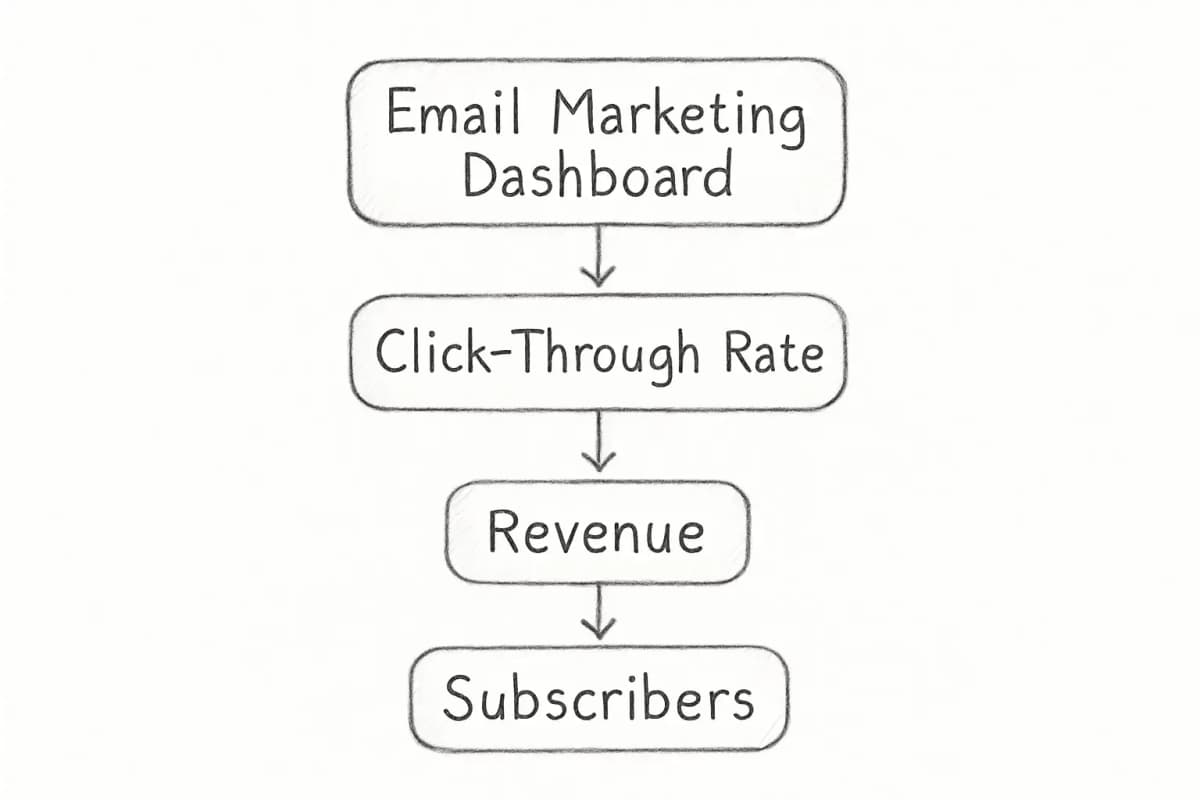
A dashboard showing email marketing key performance metrics including click-through rate, revenue pe

The top 8% of email programs, those hitting 45:1 or higher ROI, most commonly send newsletters and onboarding emails rather than promotional blasts. That is a strong signal: relationship-building content, not volume, drives the best returns.


Putting It All Together

The 7 easy steps to successful email marketing are not complicated in isolation. The challenge is executing them together, consistently. Start with one gap. If your list is dirty, clean it first. If you have no automation, build a welcome sequence this week. If your segments do not exist yet, create three simple ones and measure the lift.

52% of consumers made a purchase directly from an email they received, making email the most effective channel for driving sales. That opportunity is available to every business willing to treat email as a discipline rather than an afterthought.


Frequently Asked Questions

How long does it take to see results from email marketing?

Basic results, such as improved open and click rates, often appear within the first two to four campaigns after implementing segmentation or subject line testing. Revenue impact from automation flows typically becomes measurable within 30 to 60 days of activation, depending on your list size and send frequency.

What is a good open rate for email marketing in 2025?

The average email open rate in 2025 was 43.46%, a slight increase on 2024's average of 42.35%. However, these figures are influenced by Apple Mail Privacy Protection. Click-through rate is a more reliable benchmark for actual engagement.

How often should I send emails to my list?

There is no universal answer. Frequency should match subscriber expectations set at sign-up, your content volume, and engagement data. A general starting point is one to two emails per week, adjusting based on unsubscribe rates and revenue per send. Sending more is only valuable if the content justifies it.

What is the most important factor in email deliverability?

Think of your sender reputation as a credit score for your email program. Internet service providers like Gmail, Yahoo, and Outlook assign this score based on your historical sending behavior. A high reputation score signals that you are a trustworthy sender, granting your emails a direct path to the inbox. Authentication (SPF, DKIM, DMARC), list hygiene, and low spam complaint rates are the primary inputs that build and protect that score.


No comments yet. Be the first!

Leave a comment

Comments are reviewed before publishing.

More from

Related posts

Illustration for how to use a crm for email marketing
Email Marketing StrategyJul 22, 2026 15 min

How to Use a CRM for Email Marketing

Learn to sync your CRM with email marketing for better targeting, automation, and ROI. Step-by-step guide for marketing teams.

RRachel Torres
Illustration for email marketing tips for small budget
Email Marketing StrategyJul 22, 2026 14 min

Email Marketing Tips for Small Budget

Master email marketing on a shoestring budget. Discover free tools, segmentation tactics, and ROI strategies that actually work for startups and solopreneurs.

PPriya Kapoor
Illustration for continuous retraining in ai for email marketing
Email Marketing StrategyJul 21, 2026 11 min

Continuous Retraining in AI for Email Marketing

Learn why AI models need constant retraining to stay effective in email marketing. Discover best practices to maintain deliverability and ROI.

SSarah Mitchell
HomeBlogEmail Marketing Strategy7 Easy Steps to Successful Email Marketing
Email Marketing Strategy

7 Easy Steps to Successful Email Marketing

Master email marketing in 7 simple steps. Learn list building, segmentation, copywriting, and analytics to boost ROI and engagement today.

M

Marcus Webb

July 22, 2026

13 min read
Share:
#Email Marketing Basics#Marketing Strategy#email campaigns#Deliverability
Illustration for 7 easy steps to successful email marketing

Stay in the loop

Get the latest posts delivered straight to your inbox. No spam, unsubscribe anytime.

Email marketing delivers an average return of $36 to $42 for every $1 spent, making it the highest ROI channel in digital marketing. If your campaigns are not hitting those numbers, the problem is almost never the channel itself. It is the strategy behind the sends. The 7 easy steps to successful email marketing below give you a clear, practical framework for building campaigns that reach the inbox, earn clicks, and convert subscribers into paying customers.

Key Takeaways

  • Email marketing delivers an average return of $36 for every dollar spent.
  • Segmented campaigns generate 14.31% better open rates and 101% more clicks than non-segmented ones.
  • Personalized emails have a 29% higher open rate, a 41% higher click-through rate, and personalized subject lines are 26% more likely to be opened.
  • Automated emails generate 320% more revenue than non-automated emails.
  • Deliverability depends on authentication, sender reputation, list quality, and compliance with rules enforced by Gmail, Yahoo, and Microsoft.

Step 1: Set Clear Goals Before You Send Anything

The most common reason email programs underperform is that campaigns get launched without a defined objective. Before writing a single line of copy, decide what success looks like for each campaign: a new subscriber conversion, a product purchase, a webinar registration, or a renewal.

Each goal dictates a different structure. A nurture sequence looks nothing like a flash sale email. A re-engagement flow has different success metrics than a product announcement.

Use specific, measurable targets:

  • Open rate goal: Compare to your industry baseline
  • Click-through rate (CTR) goal: Shoot for above 3.5% for strong campaigns
  • Conversion goal: Define the exact action you want subscribers to take

Good email metrics vary by industry, but 2024 to 2025 benchmarks show a click-through rate of 2 to 3% is typical, while above 3.5% is excellent. According to Validity's 2025 Email Deliverability Benchmark Report, the global average inbox placement rate sits at 84 to 85%, with top performers achieving 90% or higher.

Once your goals are set, every decision downstream from copy to send time should serve them. Check your progress with our email marketing analytics best practices.


Step 2: Build and Maintain a Quality Email List

A large list is not the same as a good list. A list of 5,000 engaged subscribers will outperform a list of 50,000 unresponsive ones every time. Roughly 7% of emails now land in spam, directly reducing ROI. A bloated, unclean list accelerates that problem.

How to grow your list the right way

  • Use double opt-in to confirm subscriber intent and reduce spam traps
  • Offer a genuine lead magnet (a resource, checklist, or discount) that earns the signup
  • Place sign-up forms in high-traffic locations: your homepage, blog posts, checkout flow, and social bios

How to keep it clean

  • Remove hard bounces immediately after each send
  • Run re-engagement campaigns for subscribers who have not opened in 90 to 180 days
  • Suppress chronic non-openers rather than continuing to mail them

According to GlockApps' deliverability data from January 2024, 1 in 4 emails sent to Yahoo, AOL, Hotmail, and Outlook users failed to reach the inbox. Poor list hygiene is one of the primary causes. If you need help building your list faster, see our guide to lead gathering tools for email lists.


Step 3: Segment Your List for Relevance

Sending the same message to every subscriber is one of the fastest ways to drive unsubscribes and suppress engagement. Segmentation fixes this by making each email feel like it was written specifically for the reader.

Segmented campaigns generate a 760% revenue increase compared to broadcast campaigns. They also achieve 14.31% higher open rates and 100.95% higher click rates.

Start with these core segments

  1. New subscribers (first 30 days): Onboard them with a welcome sequence
  2. Active buyers (purchased in the last 90 days): Focus on upsell, cross-sell, and loyalty
  3. Engaged non-buyers (opened but not purchased): Send proof and objection-handling content
  4. Lapsed subscribers (no opens in 90+ days): Re-engagement or suppression

78% of marketers say segmentation is the most effective way to improve performance. You do not need 20 segments to start. If you are just getting started with email list segmentation, begin with three to five segments maximum. A solid starting set includes prospects versus customers, engaged versus unengaged subscribers, and contacts by industry or company size.

For a deeper look at segmentation tactics, read our article on email list segmentation strategies that boost ROI by 760%.


Step 4: Write Emails That Get Opened and Clicked

Content is where most email programs stall. Weak subject lines kill open rates. Vague body copy kills clicks. The fix is treating each email as a single, focused conversation rather than a broadcast.

Subject lines

Businesses that master A/B testing their subject lines see up to 49% higher open rates compared to those who do not test at all.

What to test first:

  • Length (short vs. medium)
  • Personalization (first name or behavior-based reference)
  • Specificity (a concrete result or number vs. a vague benefit)
  • Tone (curiosity vs. direct statement)

Behavioral personalization, based on actions, outperforms demographic personalization, based on name or location, by 31%.

Body copy and CTAs

  • Lead with the most important point in the first two lines
  • Use one clear call to action per email
  • Keep paragraphs to two or three lines for mobile readability
  • Write like a person, not a press release

88% of users check their email multiple times a day, with 39% checking it three to five times daily. Mobile is where most of those opens happen. In 2025, 55% of email opens occurred on mobile devices. Design and copy that do not adapt to mobile leave more than half your audience with a poor experience.

For more proven subject line techniques, read our guide on email subject line best practices that boost open rates by 27%.


Step 5: Personalize Beyond the First Name

Basic personalization, inserting [First Name] into a subject line, is table stakes. The programs generating serious revenue use behavioral and contextual personalization that treats each subscriber as an individual with specific interests and history.

Personalized emails have a 29% higher open rate and a 41% higher click-through rate compared to non-personalized emails. Personalized subject lines are 26% more likely to be opened.

Personalized calls-to-action result in 202% better conversion rates than default or standard calls to action.

Effective personalization tactics

  • Purchase history: Recommend related products based on what someone already bought
  • Browse behavior: Trigger emails based on pages or products a subscriber viewed
  • Engagement level: Send more content to active openers, reduce frequency for lapsed ones
  • Lifecycle stage: Match the message to where someone is in the buying journey

62% of business leaders see personalization as a driving force in increasing customer retention, and emails with personalized elements can boost conversion rates by up to 60%.


Step 6: Use Automation to Scale Without Sacrificing Relevance

Automation is the lever that separates high-performing email programs from average ones. It lets you send the right message at exactly the right moment without manual work for every send.

Automated emails generate 16 times more revenue per send than manual campaigns, producing $2.87 per send compared to $0.18 for manual campaigns.

Automated emails drove 37% of all ecommerce email revenue in 2024 despite representing just 2% of email volume.

Core automation flows every program should have

  1. Welcome sequence: Introduce your brand, set expectations, deliver your lead magnet. Welcome emails achieve an 83.6% open rate in ecommerce, the highest of any automated email type.
  2. Abandoned cart: Recover lost revenue from shoppers who did not complete a purchase. Abandoned cart emails achieve an average CTR of 23.33%, the single highest-performing email type by click engagement.
  3. Post-purchase: Build loyalty, reduce buyer's remorse, and create repeat buyers
  4. Re-engagement: Win back lapsed subscribers before removing them from your active list
  5. Browse abandonment: Reach visitors who viewed products but did not add them to their cart

Brevo's 2026 data shows that automation emails achieve a 30.63% open rate versus 20.73% for standard campaigns. Behavioral triggers, including welcome emails, post-purchase follow-ups, and re-engagement sequences, reach subscribers at the right moment, which is why they consistently outperform batch-and-blast sends.


Step 7: Protect Deliverability and Track the Right Metrics

You can write the best email in the world and it still will not generate ROI if it lands in the spam folder. Deliverability is not a technical afterthought. It is a core part of email marketing strategy.

Authentication: the non-negotiable baseline

Use all three protocols: SPF, DKIM, and DMARC for strong authentication and a good sender reputation. Gmail and Yahoo began enforcing bulk sender requirements in February 2024. Any sender dispatching 5,000 or more messages per day to personal accounts must have SPF, DKIM, and DMARC configured, implement one-click unsubscribe, and keep spam complaint rates below 0.3%.

Metrics that actually matter

Not all email metrics carry equal weight. With Apple Mail Privacy Protection inflating open rates, bot-driven phantom engagement has made open rates unreliable, pushing high-performing teams toward revenue per email, list churn, and lifetime value as the metrics that matter.

Track these instead:

  • Click-through rate: The strongest engagement signal you can reliably measure
  • Revenue per email: Directly ties your program to business outcomes
  • List growth rate: Measures whether your acquisition is outpacing churn
  • Spam complaint rate: Keep this below 0.1% to protect inbox placement. The industry standard for complaint rate is below 0.1%, with many experts recommending rates of 0.02% or lower.
  • Unsubscribe rate: A useful signal that content relevance or frequency needs adjusting

A dashboard showing email marketing key performance metrics including click-through rate, revenue pe

The top 8% of email programs, those hitting 45:1 or higher ROI, most commonly send newsletters and onboarding emails rather than promotional blasts. That is a strong signal: relationship-building content, not volume, drives the best returns.


Putting It All Together

The 7 easy steps to successful email marketing are not complicated in isolation. The challenge is executing them together, consistently. Start with one gap. If your list is dirty, clean it first. If you have no automation, build a welcome sequence this week. If your segments do not exist yet, create three simple ones and measure the lift.

52% of consumers made a purchase directly from an email they received, making email the most effective channel for driving sales. That opportunity is available to every business willing to treat email as a discipline rather than an afterthought.


Frequently Asked Questions

How long does it take to see results from email marketing?

Basic results, such as improved open and click rates, often appear within the first two to four campaigns after implementing segmentation or subject line testing. Revenue impact from automation flows typically becomes measurable within 30 to 60 days of activation, depending on your list size and send frequency.

What is a good open rate for email marketing in 2025?

The average email open rate in 2025 was 43.46%, a slight increase on 2024's average of 42.35%. However, these figures are influenced by Apple Mail Privacy Protection. Click-through rate is a more reliable benchmark for actual engagement.

How often should I send emails to my list?

There is no universal answer. Frequency should match subscriber expectations set at sign-up, your content volume, and engagement data. A general starting point is one to two emails per week, adjusting based on unsubscribe rates and revenue per send. Sending more is only valuable if the content justifies it.

What is the most important factor in email deliverability?

Think of your sender reputation as a credit score for your email program. Internet service providers like Gmail, Yahoo, and Outlook assign this score based on your historical sending behavior. A high reputation score signals that you are a trustworthy sender, granting your emails a direct path to the inbox. Authentication (SPF, DKIM, DMARC), list hygiene, and low spam complaint rates are the primary inputs that build and protect that score.

No comments yet. Be the first!

Leave a comment

Comments are reviewed before publishing.

More from

Related posts

Illustration for how to use a crm for email marketing
Email Marketing StrategyJul 22, 2026 15 min

How to Use a CRM for Email Marketing

Learn to sync your CRM with email marketing for better targeting, automation, and ROI. Step-by-step guide for marketing teams.

RRachel Torres
Illustration for email marketing tips for small budget
Email Marketing StrategyJul 22, 2026 14 min

Email Marketing Tips for Small Budget

Master email marketing on a shoestring budget. Discover free tools, segmentation tactics, and ROI strategies that actually work for startups and solopreneurs.

PPriya Kapoor
Illustration for continuous retraining in ai for email marketing
Email Marketing StrategyJul 21, 2026 11 min

Continuous Retraining in AI for Email Marketing

Learn why AI models need constant retraining to stay effective in email marketing. Discover best practices to maintain deliverability and ROI.

SSarah Mitchell